
Packaging Manufacturer Insurance
Who Pays When Your Packaging Triggers Someone Else’s Recall?

Index

Gordon B. Coyle
CEO, The Coyle Group
845-474-2924
How to get started
TL;DR. Executive Summary
The product inside was perfectly safe.
The cakes were fine, the cereal was fine, the puree was fine.
But the film faded, the liner gave off an odor, or a strand of plastic came loose inside a pouch, and now your customer is recalling their product and sending you the bill.
In my experience, that is the moment a packaging company learns what its policy actually says.
Very often the owner dropped the recall extension years ago because, as I’ve heard it put more than once, it “costs way too much,” and the general liability policy everyone assumed would respond carries exclusions written for exactly this situation.
That is why I wrote this guide. Packaging manufacturer insurance is not one policy.
It is a program built around how corrugated, carton, film, label, and container plants actually lose money, and the biggest losses usually land on someone else’s product.
If this sounds familiar
You make the box, the film, the label, or the container, and a customer’s contract or a recall scare just made you wonder whether your coverage was built for a packaging plant at all.
The Coyle Group is a commercial insurance agency that handles the complex, high-value risks other agencies don’t know how to structure, where the details in the policy are the difference between a paid claim and a denied one. We start with a confidential review of what you already carry, and the end of this guide explains exactly how that works.
What is packaging manufacturer insurance, and who needs it?
Packaging manufacturer insurance is a coordinated set of policies that protects a plant making containers, films, cartons, labels, or closures for other companies’ products. Here is the twist: your biggest exposure is usually not your own product. It is the brand’s product sitting inside yours, and what happens to it when your packaging fails.
That one fact changes everything about how we build the program.
A generic manufacturing package assumes you make a finished good and sell it.
You make a component that touches someone else’s finished good, so your loss shows up as their spoilage, their recall, and their lost sales.
Operations that need this kind of program include:
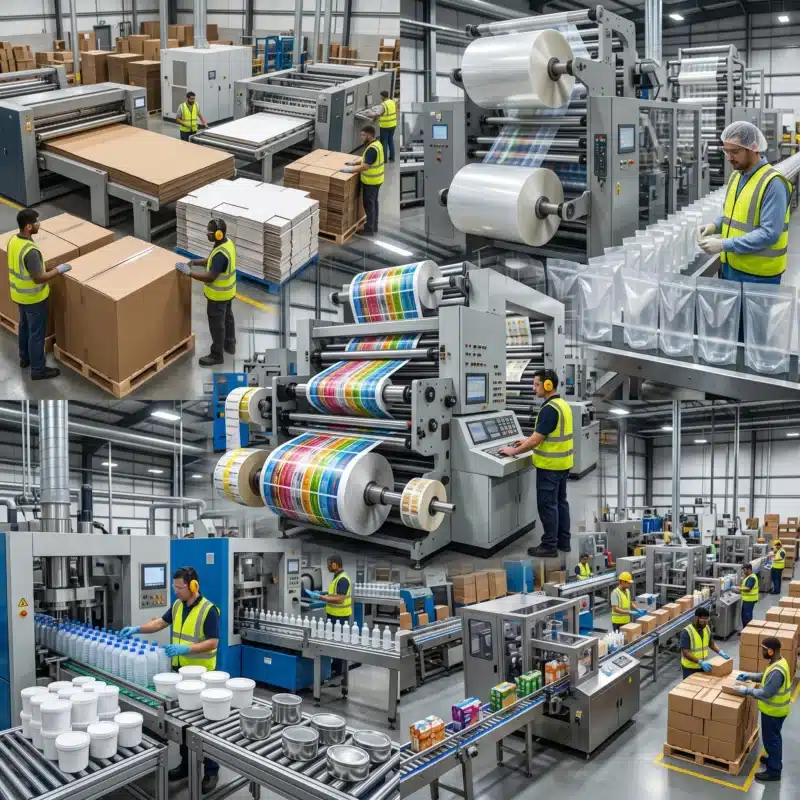
If your packaging failure leads to product damage, spoilage, or injury, you can be held responsible, and the brand’s lawyers will name you right alongside everyone else.
If you are still pre-revenue, a simpler starter package usually fits better for now.
The same goes if your packaging department runs inside a parent company’s plant and insurance program, or if you only resell packaging you buy from others; in those cases a lighter setup, such as product liability written for distributors, is often the better fit.
For everyone else, this is part of our broader manufacturing insurance work, and the pattern repeats often enough that I can usually tell you where the gap sits before I see the policy.
What actually goes wrong on a packaging line?
Most packaging losses fall into a handful of predictable scenarios, and each one should trigger a specific policy. The problem is that in a generic program, several of them trigger nothing at all, and owners only find that out when the claim lands.
Start with the cost of getting this wrong.
In 2010, Kellogg recalled about 28 million boxes of Corn Pops, Froot Loops, Apple Jacks, and Honey Smacks after liner material gave off an off odor.
That is the downside a packaging supplier carries: not just a lost invoice, but a recall measured in millions of boxes.
To make this practical, I use what we call the Packaging Loss Map. It matches each way a packaging plant actually loses money to the coverage that should pay, and to the gap we see most often.
Loss scenario |
What it looks like |
Coverage that should respond |
Common gap we see |
|---|---|---|---|
|
Seal failure or leak |
Pouches or cans fail, product spoils on shelves |
Products liability, third-party recall |
No recall coverage at all |
|
Material or ink migration |
Odor or chemicals move into food |
Products liability, third-party recall |
“Impaired property” exclusion |
|
Misprinted label |
Wrong allergen or ingredient statement |
Third-party recall, E&O style coverage |
Reprint and recall left uninsured |
|
Foreign material from packaging |
Plastic strands found inside finished product |
Products liability, third-party recall |
Brand voluntary recall not covered |
|
Press or corrugator fire |
Building, stock, and machinery lost |
Property, business interruption |
Indemnity period too short |
|
Line breakdown |
A motor or control failure stops the line |
Equipment breakdown, business interruption |
Mechanical failure excluded from property |
|
Customer property in your plant |
Plates, dies, board, or film damaged |
Inland marine or customer-property coverage |
Small sublimit on others’ property |
|
Release onsite or into drains |
Pollution liability |
Pollution excluded from GL |
|
|
Scheduling and label data locked |
Cyber, including business interruption |
No cyber, or IT-only cyber |
|
|
Worker caught in machinery |
Injury at a filler, sealer, or die-cutter |
Workers’ compensation |
Class codes that don’t match the work |
This is not a recent problem, either.
In July 2026, a fruit puree brand recalled pouches after its packaging supplier recalled a production run of defective pouches that could leave a strand of soft plastic in the product. The packaging, not the food, started the recall.
Two terms in that table come up again below. Inland marine is coverage for property that moves or sits outside your normal property policy, including customers’ goods in your care.
The indemnity period is how long business interruption coverage keeps paying after a covered loss.
Want to walk the Loss Map against your own policy? No pressure, just clarity.
Book a call and we will go through it with you line by line.
If your packaging causes a customer’s recall, does product liability pay?
Usually not for the recall itself, and that surprises almost every packaging owner I talk to. Product liability pays for bodily injury or property damage your product causes. The catch is that a recall of safe-but-unsellable product often involves neither, and that is exactly where the exclusions sit.
Your general liability policy includes products-completed operations coverage, with its own separate aggregate limit, for injury or damage that shows up after your packaging ships.
That matters, because packaging defects tend to surface late, once product reaches shelves.
But a standard policy also carries exclusions that hit packaging hard:
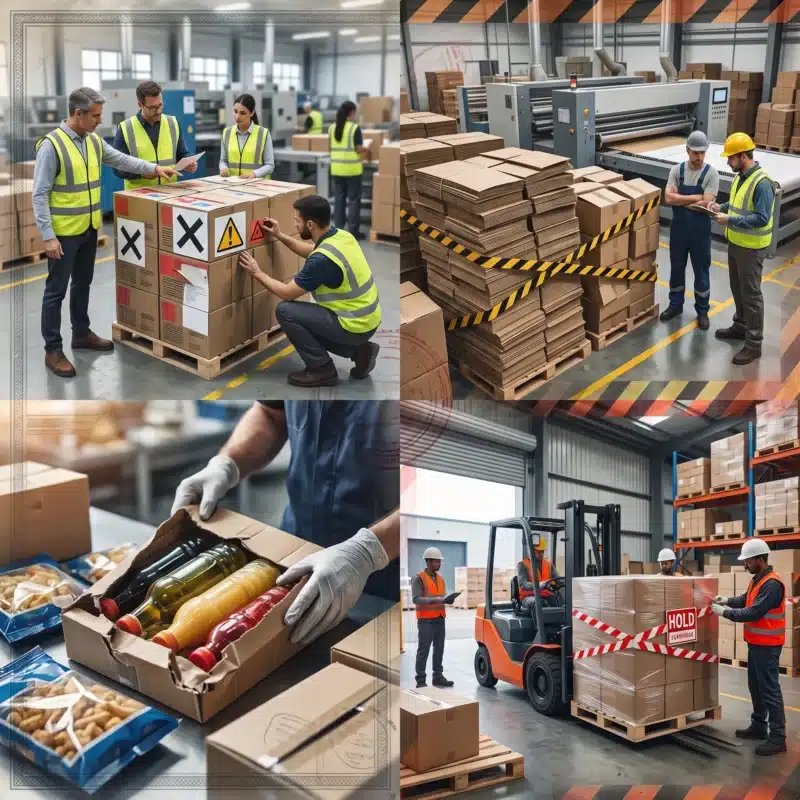
That is why you have to buy recall coverage on purpose.
And for a packaging maker, the version that matters most is third-party recall, sometimes called customer recall expense, which responds when the brand recalls its product because of your packaging.
However, many recall policies only cover your own product.
So ask specifically whether the policy covers a brand-initiated, voluntary recall, because most recalls start that way.
From what I’ve seen, the reprint bill is the other surprise. A standard program does not pay to make the packaging again after a misprint. That is a business risk you manage with proofs, signed approvals, and quality control, while insurance covers the downstream damage.
Real-world example
Here is a case I’ve heard about that shows the problem clearly. A soft packaging manufacturer supplied film for a pastry company’s mini cakes. After the cakes reached stores, the packaging had faded and changed color, even though the cakes themselves were perfectly safe to eat. The pastry company recalled anyway and went after the packaging manufacturer for the cost. The packaging maker’s product liability policy did not include a recall or withdrawal extension, because the owner had dropped it as too expensive. The likely result: the exclusions for “your product” and “recall of products, work or impaired property” left the claim with nowhere to go.
Packaging manufacturer insurance that treats recall as optional is the most common weak spot I find.
We print custom labels and a client sued over a design defect. What covers this?
Usually not general liability, because it only responds to bodily injury or property damage, and a label lawsuit is normally about your client’s financial loss. That kind of claim needs errors and omissions coverage, which manufacturers E&O is built for. If the client supplied the design, your contract and signed proof approvals become your strongest defense, so keep every sign-off on file.
Not sure whether your policy covers a brand’s recall? Contact us and we will read the recall and exclusion wording with you.
Which coverages does a packaging plant actually need?
A packaging plant needs liability, recall, property, equipment, and people coverage working as one program, not a pile of separate policies. And one detail inside your property program decides whether a fire costs you a few bad months or the business: how long your business interruption coverage actually lasts.
Here is the core packaging manufacturer insurance program I’d expect to see for an established plant:
Coverage |
What it pays for in a packaging plant |
Packaging detail to check |
|---|---|---|
|
General liability with products-completed ops |
Injury or damage your packaging causes after it ships |
Limits that match customer contracts |
|
Product recall (first and third party) |
Withdrawal, disposal, and the brand’s recall expenses |
Brand-initiated voluntary recalls included |
|
Commercial property |
Building, presses, board, resin, film, and finished stock |
Values updated for current replacement cost |
|
Lost income and continuing costs after a covered loss |
Indemnity period matched to equipment lead times |
|
|
Motor, electrical, and control failures on lines and presses |
Covers BI from breakdowns, not just repairs |
|
|
Income lost when a board, resin, or ink supplier goes down |
Named and unnamed suppliers |
|
|
Inland marine / customer property |
Plates, dies, cylinders, and customer materials in your care |
Limits sized to what’s actually onsite |
|
Ink, solvent, and adhesive releases |
Claims-made reporting rules |
|
|
Ransomware that halts scheduling, presses, or label data |
Production downtime, not just data breach |
|
|
Injuries at fillers, sealers, die-cutters, and forklifts |
Correct class codes and payroll |
|
|
Umbrella or excess |
Limits above GL, auto, and employer’s liability |
Enough to meet $5M to $10M contract demands |
Now the business interruption piece.
A typical small business package limits business income to about 12 months. When a key machine is custom-built or shipped from overseas, 12 months can run out before production does.
Check your number against your real lead times, not the default. The same logic applies to customer property. Many property forms give personal property of others only a small amount of coverage, while the printing plates, dies, and customer-supplied materials in your plant can be worth far more.
Does packaging manufacturer insurance cover equipment breakdown costs?
Only if you add equipment breakdown coverage. A standard commercial property policy excludes internal mechanical and electrical failure, so a burned-out motor or a failed control board on a press, laminator, or corrugator is usually not covered on its own. Equipment breakdown pays to repair or replace the machine, and the better forms also cover the business income you lose while the line is down.
A few policy-structure details also decide whether the program holds up:
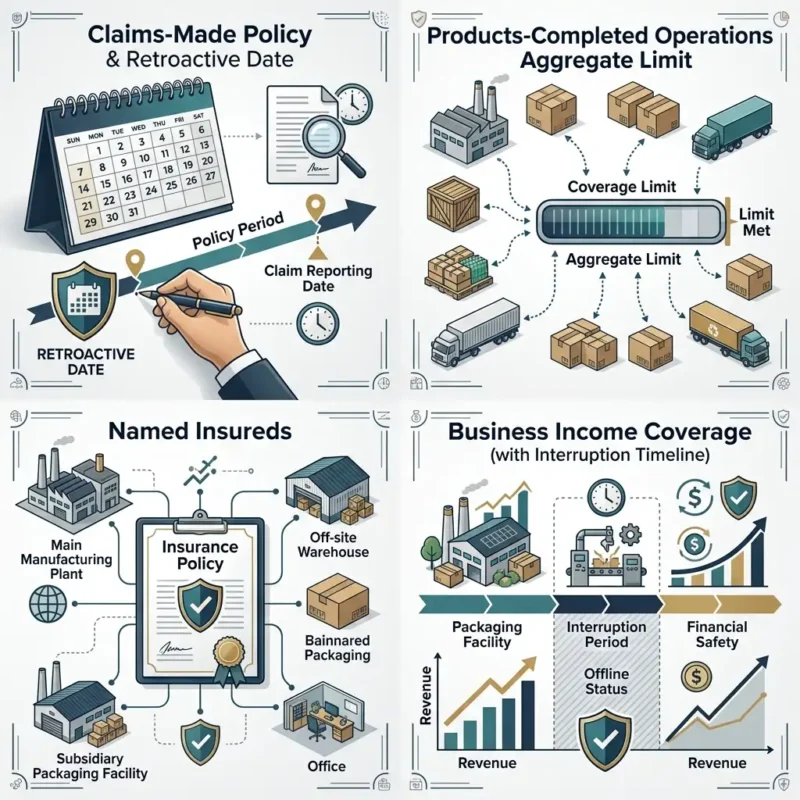
Not sure which of these you already carry? A second opinion on your business insurance can map your current program against this table without disrupting your broker.
Is a standard manufacturing package enough for a packaging company?
For most established packaging plants, no. A standard package can cover the building, the basic liability, and the payroll. It rarely addresses the losses that make packaging different, and those are the ones big enough to sink a year’s profit.
Here is how a generic package typically compares with a program built for packaging:
Issue |
Standard manufacturing package |
Packaging-built program |
|---|---|---|
|
Brand recall caused by your packaging |
Usually excluded |
Third-party recall coverage |
|
Unsellable but undamaged customer product |
“Impaired property” exclusion applies |
Addressed through recall and liability structure |
|
Customer plates, dies, and materials |
Small sublimit, if any |
Scheduled inland marine limit |
|
Business interruption after a fire |
Often 12 months |
Indemnity period based on lead times |
|
Machine breakdown |
May be excluded from property |
Equipment breakdown with BI |
|
Contract wording (AI, waiver, primary) |
Standard endorsements only |
Endorsements matched to each contract |
|
Liability limits |
Often $1M/$2M |
Umbrella sized to customer demands |
I’ll put it the way I often do with owners: Bottom line is that almost all insurance programs we review contain at least one fatal mistake.
Neither shows up on a quote comparison, because both look like savings until the day they matter.
What insurance do your customers’ contracts require?
Big brands usually require higher limits, recall coverage, and specific endorsements before they’ll sign a supply agreement. And here is what catches owners: the contract often asks you to promise more than your policy covers, which turns the gap into a risk you’ve agreed to carry yourself.
Requirements we see in packaging and co-packing agreements, and the ones your packaging manufacturer insurance has to satisfy, include:
That last point is the one I’d circle in red.
When you agree to indemnify a brand for losses your insurance won’t pay, you’ve signed up for uninsured risk.
Before you sign, run through this checklist:

Have a contract on your desk right now? Contact us and send it over before you sign.
How does your packaging type change your risk?
The material you run and the market you sell into change which coverage gets stressed hardest. A corrugated plant and a food-contact film converter can both call themselves packaging manufacturers, but their worst day looks completely different, and so should their insurance.
Packaging type |
Biggest exposure |
Coverage to emphasize |
|---|---|---|
|
Food and beverage contact |
Migration, seal failure, foreign material |
Third-party recall, higher product limits |
|
Pharma and medical packaging |
Sterility, tamper evidence, labeling accuracy |
Recall, higher limits, contract review |
|
Corrugated and paperboard |
Heavy fire load, large machinery |
Property, BI with long indemnity period |
|
Flexible film and plastics |
Migration, extrusion and lamination equipment |
Recall, equipment breakdown |
|
Labels and printing |
Misprints, allergen errors, customer plates |
Third-party recall, customer property |
|
Metal and glass containers |
Seal integrity, worker injury |
Products liability, workers’ comp |
A few notes that matter in practice:
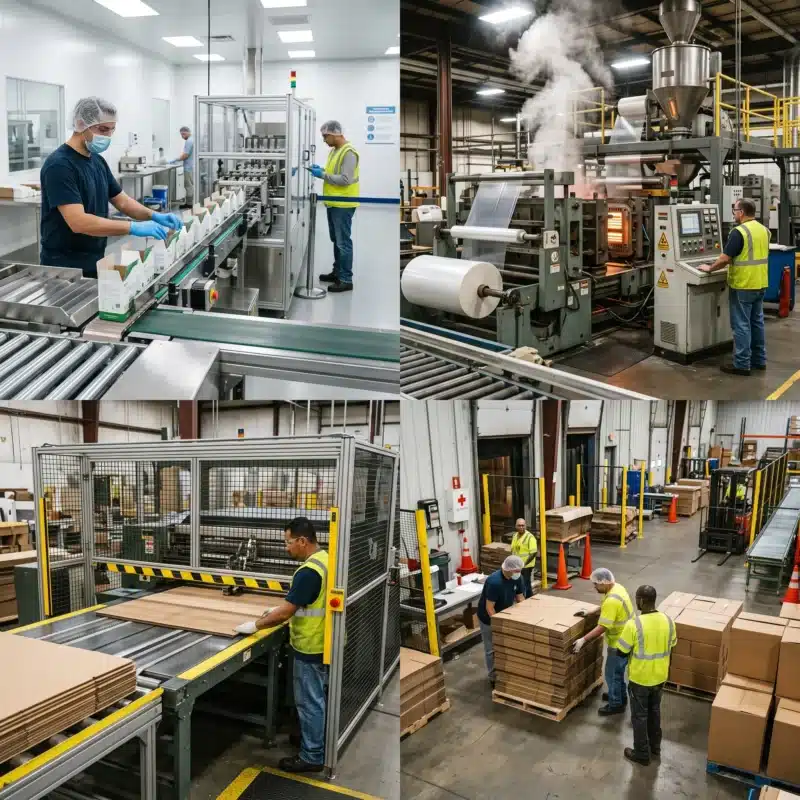
Want a second look at how your mix of materials and markets affects your program? Book a call and tell us what runs on your floor.
How much does packaging manufacturer insurance cost?
Most small packaging plants pay about $3,000 to $6,000 a year for a basic package, while mid-sized plants pay $10,000 to $25,000. Here is the catch: those figures describe a basic manufacturing package, and the coverages that matter most for packaging, like recall and higher limits, sit on top of them.
These ranges come from our analysis of manufacturing insurance costs:
Operation size |
Typical annual premium (basic package) |
|---|---|
|
Small plant (often under 20 employees) |
$3,000 to $6,000 |
|
Mid-sized operation |
$10,000 to $25,000 |
|
Large plant |
$50,000 or more |
|
General liability alone ($1M limit) |
$500 to $3,000+ |
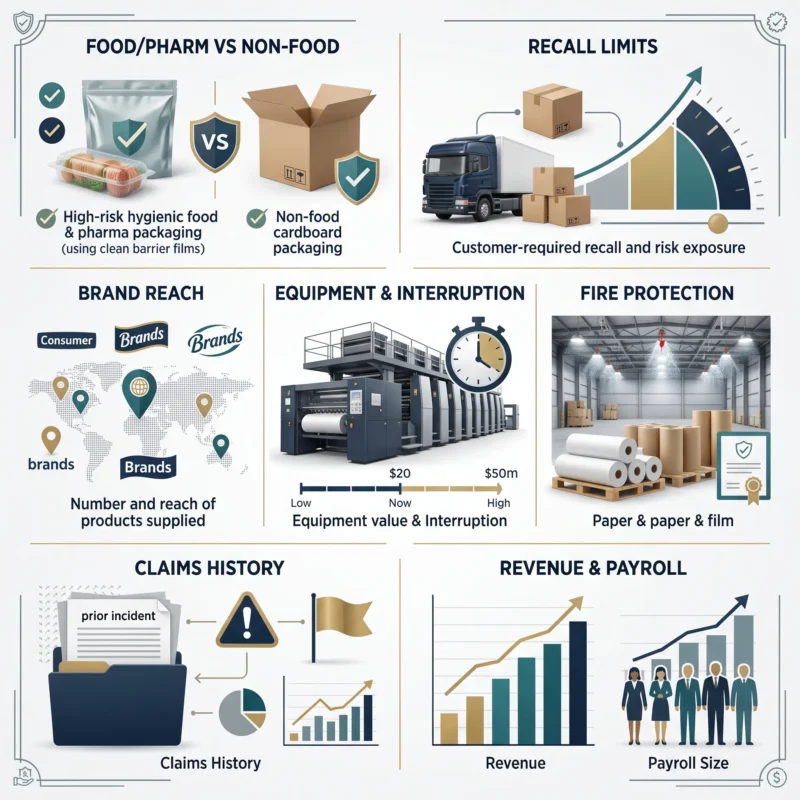
What moves the number for a packaging company:
From what I’ve seen, the cheapest quote usually wins by quietly dropping something: the recall extension, the customer-property limit, or a few months of business interruption. Compare coverage first, price second. Packaging manufacturer insurance that costs a little more but answers your Loss Map is cheaper than a policy that doesn’t pay.
How do you get the right program in place?
Start with a review of what you already carry, before anything goes to market. That sounds backwards to most owners, who think the answer is more quotes. In practice, sending your account to five brokers usually makes the result worse, not better.
When several brokers submit the same account, underwriters see duplicate submissions, and once one broker reaches a carrier, the others can’t use it.
Carriers also tend to deprioritize accounts they know every broker in town is shopping. As I like to put it, you don’t need five brokers shopping your insurance; you need one capable broker making sure the right insurers compete for your business.
Placement matters as much as the policy.
Recall gets bought for the plant’s own product only, with no third-party recall.
Nobody completes a business income worksheet against real press lead times.
And customer plates and dies never make it onto a schedule.
Recall in particular is a specialty market with a limited number of insurers, so knowing which ones write packaging suppliers, and how to present seal testing, proof approvals, and traceability to them, changes the terms you get. That is why we start with a Confidential Review.
It is private, it does not disrupt your current broker, and it works two ways:
To make that review fast, gather what we call the Coyle Packaging Line Coverage Check:
Ready for a confidential review? Book a call.
It starts with a 15-minute conversation, not an application.
What should you know before you buy?
Before you buy packaging manufacturer insurance, know that the right program is built around your customers’ products, not just your plant. One more point ties it together: every item below is something a quote comparison won’t show you, so use this list to check any proposal, including your current one.
The questions below are the ones packaging owners ask most, from whether you need product liability at all to what a $1 million limit costs. One theme runs through nearly every answer: recall and contract terms matter more than the premium, so read these with your own policy and customer agreements in hand.
Questions about Packaging Manufacturer Insurance?
Get the Right Coverage for Your packaging manufacturer insurance
Most brokers start with a quote. We start with your business. Before anything goes to market, we look at how your plant actually loses money: the brand recall your packaging could trigger, the customer plates and dies on your floor, the press that would take months to replace. Then we make sure your insurance is built to protect against those risks, not just priced to win.
The Coyle Group is an independent commercial insurance brokerage, and business insurance is all we do. We’ve been at it since 1929 and keep 95% of our clients year after year. We work with packaging companies across the US, reading the exclusions, endorsements, and customer contracts most people never get to.
It starts with a Confidential Review. It’s a short conversation, not an application, and it doesn’t disrupt your current broker. If you have coverage today, we tell you whether it’s built right. If you’re buying new, we build the underwriting picture first and then bring the right insurers to the table, so they compete for your business and you don’t have to.

This article was written by the CEO of The Coyle Group, Gordon B. Coyle, CPCU, ARM, AMIM, PWCA, who has over 40 years of experience working with business owners of all sizes and industries across the US, solving their insurance challenges.
Here’s how to take the next step
Schedule Your Insurance Confidence Assessment
In our 30-minute call, you’ll discover:
Not ready for a call?
Get Free Access to Our Gated Video:
“How to Finally Feel Confident in Your Coverage. “
And discover the exact system we use to help business owners eliminate hidden coverage gaps, stop overpaying, and finally feel confident in their protection.
What Peace of Mind Looks Like
Trusted by business owners across the U.S.
The Coyle Group is 1st class! Gordon and his team are knowledgeable, responsive, and attentive to detail. Gordon is that rare breed of professional who genuinely cares for his clients and works hard to exceed their expectations. I highly recommend them.


The insurance brokerage service was truly tailored to my needs, nothing like those big brokers who steer you toward random policies that don’t fit your profile. Thank you to the team for your help.

I was working with another broker and having difficulty acquiring General Liability coverage. A colleague recommended The Coyle Group. They were able to get coverage bound in just a couple of business days and a policy issued in ten days, and with a solid carrier at a competitive premium. Truly impressive results, plus it was a pleasure working with them. I highly recommend the Coyle Group!

If any business is looking to work with an insurance brokerage firm that is not only excellent at what the firm does, but one that deeply values the needs of the clients, then The Coyle Group is the firm for you. Give them a call and see for yourself. I can assure that you will quickly agree.

Want to know more?
See related blogs

The Crowdstrike Debacle and Cyber Insurance
Third Party Employment Practices Liability Insurance. Protect Your Business

Are You Overpaying or Underinsured on Your Business Insurance?
