
Food Processing Insurance
Contamination, Product Recall, and Equipment Breakdown. Standard GL Excludes All Three

Index

Gordon B. Coyle
CEO, The Coyle Group
845-474-2924
How to get started
Food processing insurance is a specialty commercial program that protects food manufacturers, processors, and packagers from the unique risks standard business policies exclude: contamination, product recall, equipment breakdown, and product liability.
If you’ve tried to get insurance for your food processing operation and been told “we don’t cover that,” you’re not alone.
These are real quotes from real food business owners. And if you’ve managed to get quotes, you’ve probably been hit with premiums that are “significantly higher than anticipated” and brokers who seem more interested in selling than advising.
The problem isn’t your business. At The Coyle Group, we specialize in complex, high-value risks other agencies don’t know how to structure, and food processing is one of the most consistently mishandled classes in commercial insurance, especially for established and mid-market manufacturers whose operations have outgrown a standard package.
Most brokers shop your risk to the wrong carriers. Food processing requires underwriters who understand HACCP plans, product recall exposure, and contamination liability. If your current policy is a standard commercial package, there’s a near-certain chance you have coverage gaps that would leave you financially exposed when a claim hits.
The Coyle Group Works With Food Processors That Have Complex, High-Value Risks.
Food processing requires underwriters who understand HACCP plans, product recall exposure, and contamination liability. If your current policy is a standard commercial package, there’s a near-certain chance you have coverage gaps that would leave you financially exposed when a claim hits.
We work in the surplus lines and specialty markets where food processing risks actually belong, and we build programs around your real exposure, not a generic template.
What Is Food Processing Insurance and Who Needs It?
Food processing insurance is a specialty commercial insurance program for businesses that manufacture, process, or package food for sale. It covers the liability and property exposures that standard business policies exclude: contamination, product recall, and equipment breakdown. Standard GL policies were not designed for your risk, and that gap is where businesses fail.
The food processor ends up either uninsured, underinsured, or dramatically overpaying with a carrier who has no real expertise in the class.
The stakes are high enough that working with brokers who understand manufacturing insurance as a specialty, not as an afterthought on a standard commercial application, is the difference between a program that pays and one that doesn’t.
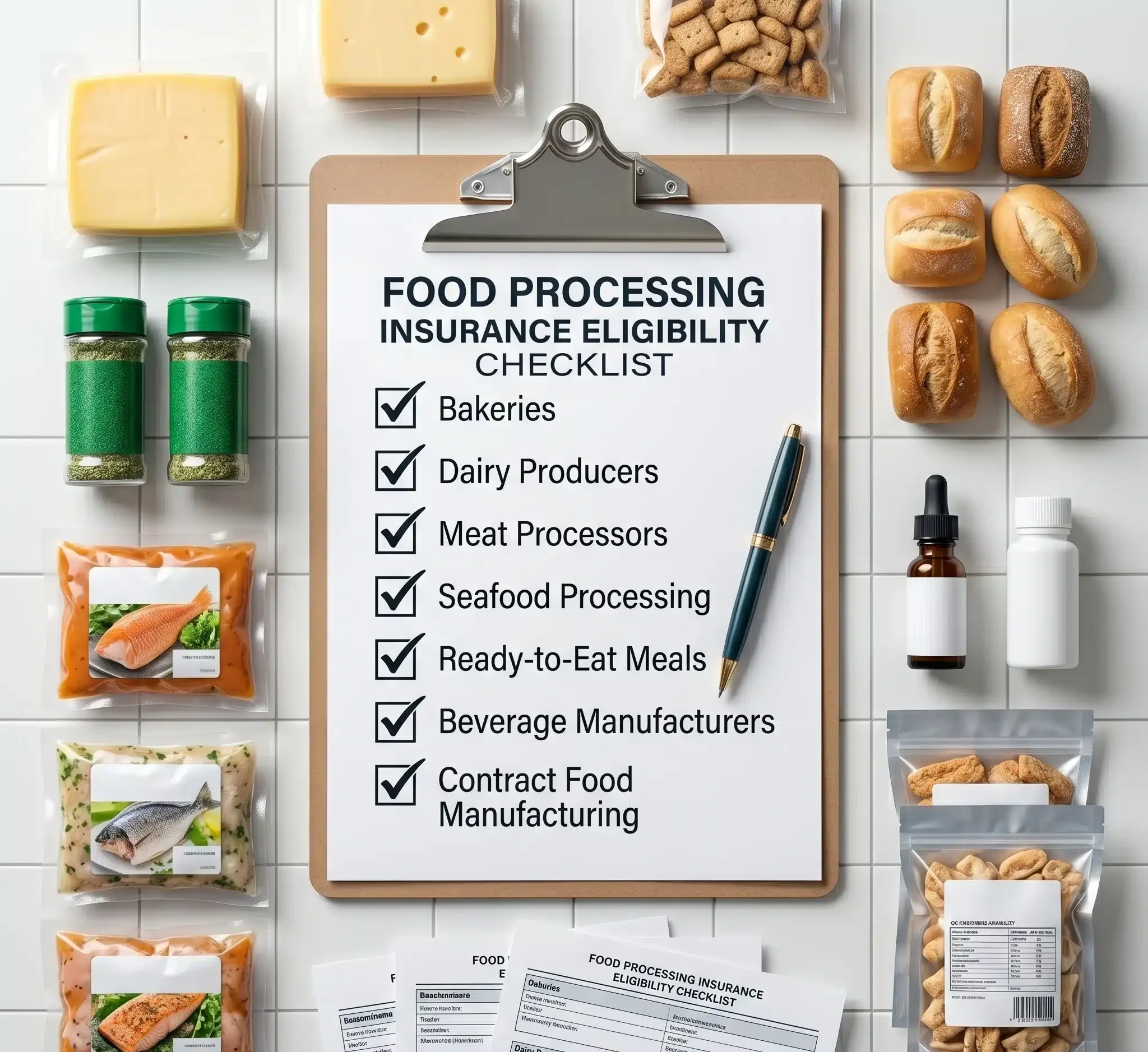
This includes:
Why Are Food Processors Rejected by Standard Carriers?
Food processing is considered a high-hazard class by most standard insurance carriers, and large household-name insurers often decline to write it entirely.
For food processing, the right carriers are underwriters who specialize in food and beverage, understand how to evaluate a HACCP plan, and know what a mock recall means operationally.
What standard carriers won’t tell you:
Starting a food business and struggling to get quoted?
If you’re a new food manufacturer, cottage food producer scaling up, or startup without operating history, the declinations you’re getting are not about your business quality: they’re about carrier appetite. Most standard markets don’t write startup food risks, full stop. We work with surplus lines carriers who do. What they need from you isn’t a track record. It’s a HACCP plan, an allergen control procedure, and a documented supplier qualification process. If you have those in place, we can get you quoted. Book a call, and we’ll get started.
Contact The Coyle Group to connect with the right specialty markets for your operation.
What Does a Food Processing Insurance Policy Actually Cover?
A complete food processing insurance program is not a single policy: it is a layered program built from multiple coverage lines. Each line covers a distinct exposure, and gaps between them are where claims get denied.
Here is what a properly structured program includes:
Coverage |
What It Protects Against |
Critical Notes |
|---|---|---|
|
Product Liability |
Consumer illness, injury, or death from your product |
Core coverage; $1M–$5M+ limits typical |
|
Product Recall / Withdrawal |
Physical recall costs, retailer fees, disposal, lost income |
NOT included in standard GL: must be separate |
|
Contamination Coverage |
Biological (pathogens), chemical (allergens), physical (metal, plastic) |
Includes business interruption triggered by contamination |
|
Spoilage |
Product loss from temperature/refrigeration failure, power outage, transit breakdown |
Critical for cold-chain operations; excluded from standard property policies |
|
Equipment Breakdown |
Machinery failure, electrical/mechanical breakdown |
Can halt production for weeks; pairs with equipment breakdown insurance |
|
General Liability |
Third-party bodily injury, property damage on premises |
Foundation coverage: insufficient on its own |
|
Workers’ Compensation |
Employee injuries: state-required |
25%+ of injuries happen in the first year of employment; workers’ compensation insurance is non-negotiable |
|
Business Interruption |
Lost income from production shutdown (disaster, contamination, equipment failure) |
Often undervalued relative to actual revenue at risk |
|
Cyber Insurance |
Ransomware, data breach, operational technology attacks |
Ransomware attacks on food companies up 13% in 2022; average cost $4.54M: cyber insurance for manufacturers is no longer optional |
The most commonly skipped coverage:
Product recall insurance. Business owners assume their product liability policy handles a recall. It doesn’t. Product liability covers claims from consumers who were already harmed. Recall insurance covers the cost of removing product from shelves before harm occurs, which is where the real financial exposure lives.
Does Food Processing Insurance Cover Spoilage and Temperature Failure?
Spoilage coverage protects against product loss caused by refrigeration or temperature control failure: including power outages, equipment breakdown, and temperature excursions during transit. For food processors with cold-chain product (dairy, frozen goods, packaged produce, ready-to-eat meats), this is a critical coverage line that standard property policies typically exclude, and one that pairs directly with your equipment breakdown insurance policy.
What spoilage coverage typically includes:
What spoilage coverage doesn’t include:
Loss from improper packing by the processor, or deliberate reduction of refrigeration. Underwriters review cold-chain documentation as part of underwriting: temperature logs, carrier agreements, and equipment maintenance records all factor into coverage terms and pricing.
For high-value, temperature-sensitive products, spoilage coverage limits should be sized to your maximum inventory value at any single location or in transit.
Businesses that distribute through third-party wholesalers and distributors face additional exposure at every handoff point in the cold chain: that exposure needs to be reflected in your limits, not discovered after a denial.
Our Food Facility Had a Contamination Incident: What Covers the Cleanup?
Cleanup after a contamination incident is covered by a contaminated products or recall policy, an equipment breakdown policy, or a pollution policy, depending on what caused it. Your property policy and GL usually pay nothing. The catch is that each policy responds only to its own cause, so the source of the contamination decides who pays.
From what I’ve seen, owners assume their property policy handles a plant cleanup. It almost never does. Standard property forms exclude bacteria and contamination, and GL carries a pollution exclusion that the Insurance Information Institute confirms leaves cleanup to a standalone policy.
Here is how the cause maps to the coverage:
What Happened |
Which Policy Should Respond |
What to Check |
|---|---|---|
|
Pathogen found in the plant (Listeria, Salmonella) |
Contaminated products / recall policy |
Whether sanitizing equipment and lost production are included, or only product costs |
|
Refrigeration or machinery failure that contaminated product |
Equipment breakdown |
The hazardous substance cleanup sublimit and spoilage extension |
|
Ammonia, chemical, or cleaning agent release |
Whether first-party cleanup of your own site is included |
|
|
Tampering or a threat against your product |
Contaminated products (malicious tampering and extortion) |
Whether the policy pays without a government recall |
The gap I see most often is the first row. Some contaminated products forms pay to clean and sanitize your lines after a covered event, and others pay only for the product itself. If you run an ammonia refrigeration system, a liability-only pollution form will not clean up your own site, which is why environmental remediation coverage matters for many plants.
What to do in the first 48 hours:
What Does a Product Recall Actually Cost a Food Processor?
A product recall is not a line item: it is a business-threatening event. The average cost of a food recall in the US exceeds $10 million when logistics, regulatory response, lost sales, retailer penalties, and brand damage are included. For a small or mid-sized processor, a single recall without dedicated product recall coverage is often the end of the business.
Here are the actual cost components a recall generates:
Real-World Scenario: The $340,000 Undeclared Allergen Recall
A mid-sized regional sauce manufacturer discovered an undeclared allergen in a batch of hot sauce after it had already shipped to three retail chains. The recall cost $340,000 in logistics, retailer penalties, and production shutdown, none of which was covered under their standard GL policy. Product recall insurance would have covered the full event for an annual premium of approximately $8,000. The business survived. Many don’t.
Book a call to make sure your recall exposure is properly covered.
How Do Product Recall Insurance Options Compare for Food Manufacturers?
Food manufacturers have four recall options: a sublimit inside a package policy, standalone recall expense coverage, contaminated products insurance, and third-party recall liability. They are not interchangeable. The option most owners already have is the weakest one, and they usually don’t find that out until they file.
In my experience, the most common setup I find on a food account is a recall sublimit of around $100,000 tucked inside a manufacturer’s package policy. It looks like coverage on paper. Against what a product recall actually costs, it barely covers the trucking.
Option |
What It Pays |
Where It Falls Short |
Best Fit |
|---|---|---|---|
|
Package policy recall sublimit |
Limited recall expenses, often around $100,000 |
Too small for a multi-retailer event; narrow triggers |
Not a stand-alone solution for any food processor |
|
Standalone recall expense |
Your own costs: retrieval, disposal, notification, replacement |
Usually no lost profits or brand rehab unless added |
Lower-hazard products with regional distribution |
|
Contaminated products insurance |
Recall costs plus lost gross profit, rehab, and crisis response; triggers for accidental contamination, malicious tampering, government recall, and extortion |
Higher premium; underwriting reviews your food safety program closely |
Most food processors, especially high-risk categories |
|
Third-party recall liability |
Your customer’s recall costs when your ingredient causes their recall |
Does not pay your own recall costs |
Ingredient suppliers and contract manufacturers |
The standard CGL policy excludes recall costs through what’s known as the sistership exclusion, so none of these gaps get filled by your general liability. For most processors, the right answer is contaminated products coverage, with third-party recall liability added if you sell ingredients into someone else’s product. Our product recall insurance page breaks down each form in more depth.
How Much Does Food Processing Insurance Cost?
Food processing insurance costs vary based on product class, annual revenue, safety programs, and claims history. A $10M-revenue food processor typically pays between $40,000 and $120,000 per year for a complete program including general liability, product liability ($5M limits), product recall ($1M–$5M), property, and workers’ compensation insurance.
Underwriters price food processing risks by product risk class:
Product Category |
Risk Level |
Recall Cost as % of Total Program |
|---|---|---|
|
Ready-to-eat meats |
High |
60-80% |
|
Dairy / infant formula |
High |
60-80% |
|
Packaged cut produce |
High |
50-70% |
|
Baked goods |
Medium |
30-50% |
|
Sauces, condiments |
Lower |
20-35% |
|
Snacks (long shelf life) |
Lower |
20-30% |
Costs vary by product class, inspection history, and the quality of your safety programs.
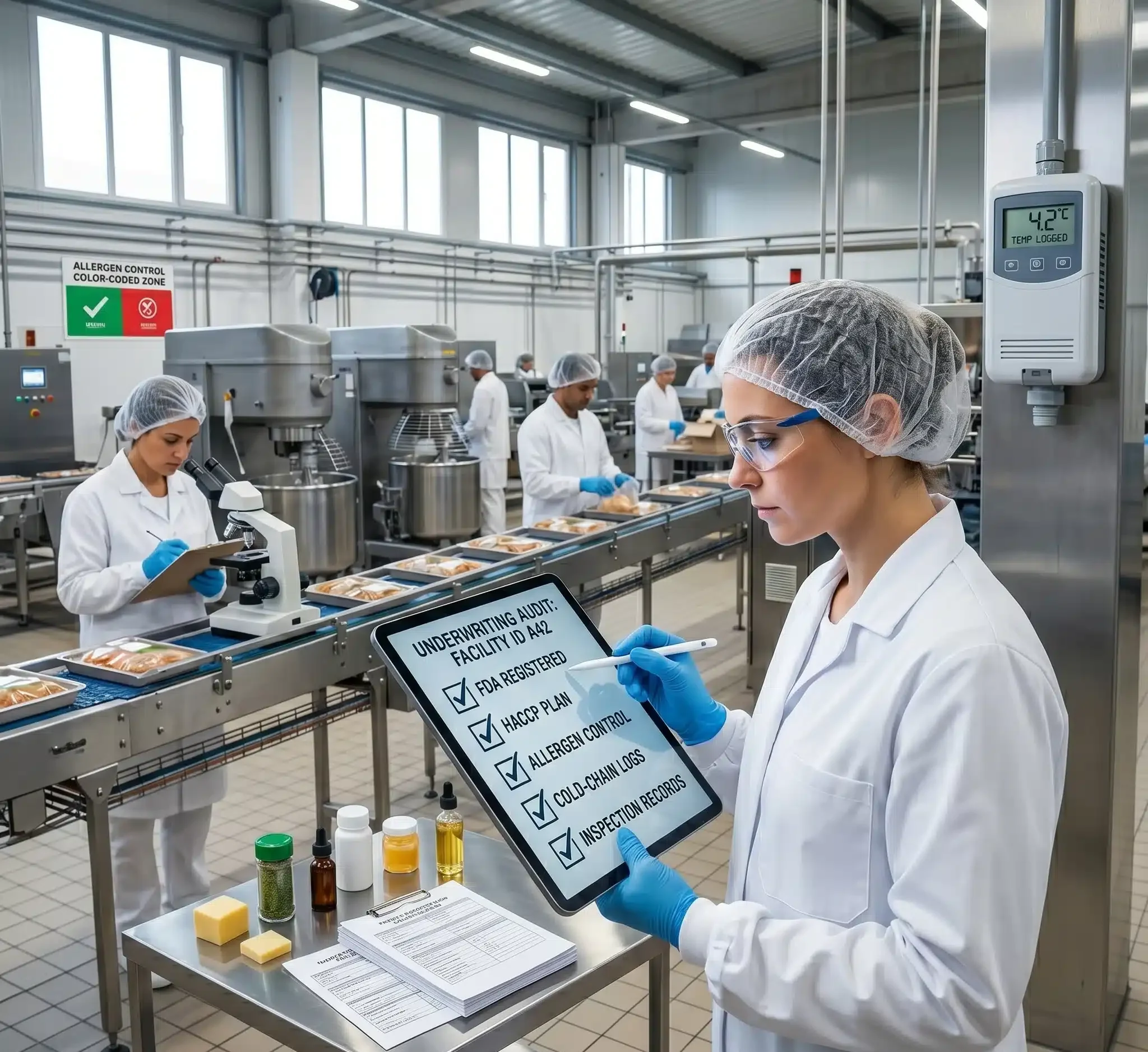
The factors underwriters weigh most heavily:
How Much Product Liability Coverage Does a Food Processor Need?
Product liability limits for food processors should be based on three factors: your distribution reach, your retail channel requirements, and your product risk class. Most business owners set limits too low: then discover the gap when they’re signing a new retail distribution agreement that contractually requires higher limits than their current policy carries.
Minimum recommended limits by distribution channel:
Channel |
Minimum Limit Recommended |
|---|---|
|
Direct-to-consumer / farmers market |
$1M per occurrence / $2M aggregate |
|
Regional retail (1-3 states) |
$2M per occurrence / $4M aggregate |
|
National retail / grocery chains |
$3M–$5M per occurrence / $5M–$10M aggregate |
|
Foodservice / institutional supply |
$3M–$5M per occurrence / $5M–$10M aggregate |
|
Contract manufacturing for branded clients |
$5M+ (check client contracts for requirements) |
Most retail distribution agreements contractually require minimum product liability limits, often $2M–$5M with the retailer named as an additional insured. If you’re signing distribution agreements, your product liability limit needs to match or exceed the contractual requirement before you ship.
What Is the Best Food Processing Liability Insurance for Mid-Market Manufacturers?
The best food processing liability insurance for a mid-market manufacturer is a coordinated program, not a single carrier’s policy. That means product liability, contaminated products, and umbrella coverage written to work together. Picking the carrier is the easy part. What separates a strong program from a weak one is how the pieces fit together.
A mid-market business generally earns between $10 million and $500 million a year. At that size, you have retail contracts, multiple facilities, and limits other companies dictate to you. Over 40 years, I’ve found that the policy a company bought at $5 million in revenue rarely fits at $50 million, and nobody updates it until a claim lands.
What a strong mid-market food liability program includes:
When we review programs at this size, nine out of ten have at least one fatal flaw. Usually it’s a limit that no longer matches a customer contract, or a recall policy that only responds to government-mandated recalls.
We Import Ingredients: What Cargo and Liability Coverage Do We Need?
If you import ingredients, you need marine cargo or stock throughput coverage for the goods in transit, plus product liability and recall coverage that accounts for your foreign supplier. The part most processors miss is legal. Under U.S. food safety rules, the liability for that ingredient lands on you, not the overseas supplier.
The FDA’s Foreign Supplier Verification Programs rule makes the U.S. owner or consignee responsible for verifying that imported food meets U.S. safety standards. In practice, if a contaminated ingredient reaches a consumer, the claim comes to you. Foreign suppliers are hard to sue in U.S. courts, and their insurance often excludes U.S. claims.
Exposure |
Coverage You Need |
What to Watch |
|---|---|---|
|
Ocean or air transit |
Marine cargo, written all-risk (Institute Cargo Clauses A) |
Freight forwarder coverage pays by weight or package, not by what your product is worth |
|
Transit plus warehouse storage |
Closes the gap between cargo and property coverage |
|
|
Temperature-sensitive ingredients |
Cargo with a refrigeration breakdown endorsement |
Named-perils forms often exclude spoilage |
|
Theft in transit |
Cargo theft coverage |
Does insurance cover stolen cargo depends on the form and the security conditions |
|
Contaminated or mislabeled ingredients |
Product liability plus contaminated products |
Foreign supplier’s COI is rarely collectible |
|
Supplier shutdown |
Name key suppliers on the policy |
From what I’ve seen, the processors who come through a bad shipment intact treat their supplier verification program and their insurance as one system. If importing is a large part of your operation, our food importer insurance guide goes deeper on cargo structure and importer-of-record liability.
Not sure your cargo limits match your shipment values? Contact us for a review.
What Do Underwriters Need From You Before They Quote?
Food processing is an underwritten risk: meaning the insurer evaluates your specific operation before agreeing to cover it and at what price. Unlike a standard BOP where a few data points generate a quote in minutes, food processing underwriting involves a genuine review of your operation.
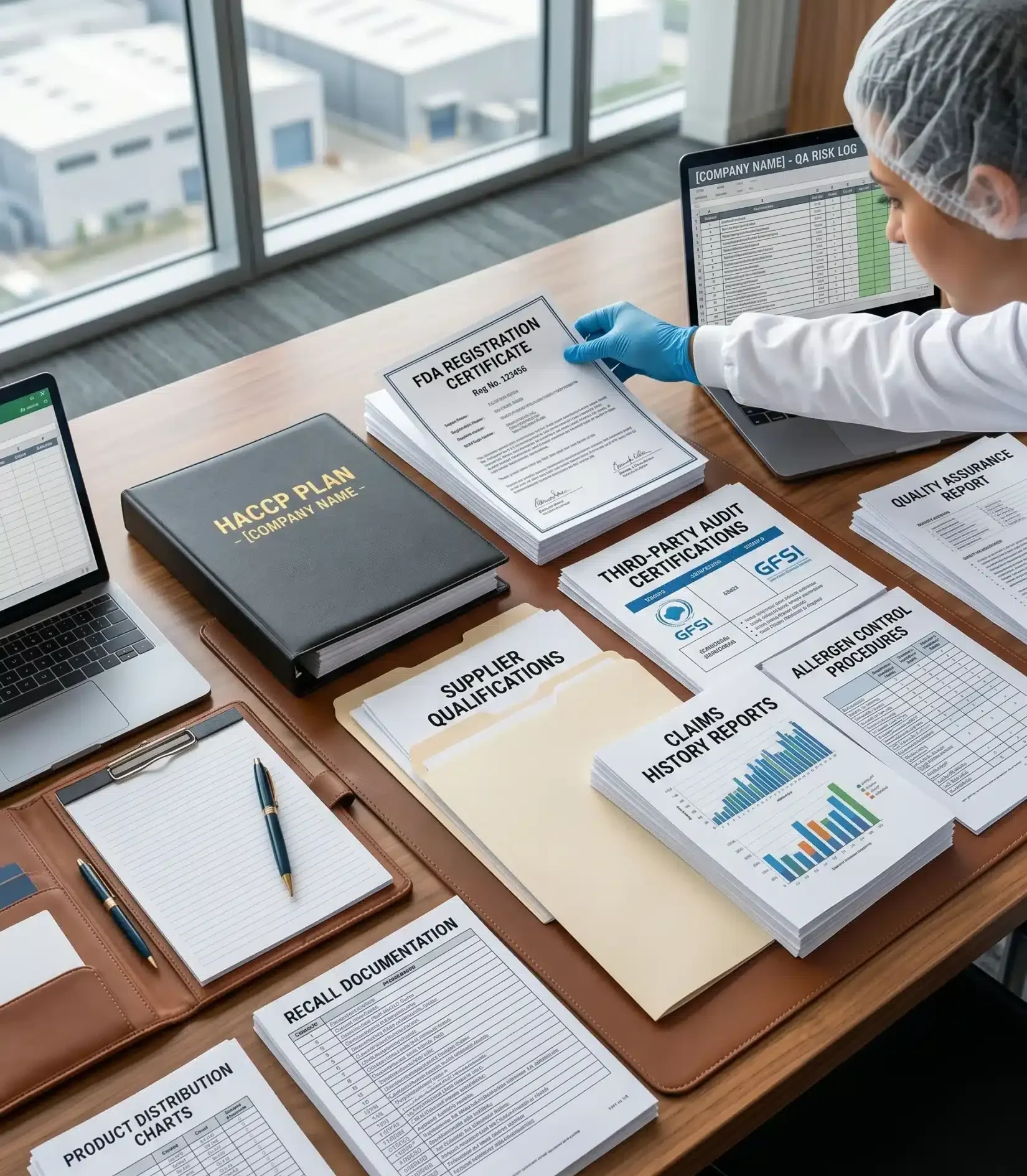
Preparing this package before you approach specialty carriers dramatically speeds the process and produces better terms:
If you’re unsure how your documentation stacks up, our process at The Coyle Group starts with a full review of what you have before we approach any market: that’s part of how we get our clients better terms than they’d find going direct.
What Is the Best Workers’ Compensation Insurance for Food Processing Facilities?
The best workers’ compensation program for a food processing facility has three things: correct class codes, a verified experience mod, and a broker who actively manages claims. Price matters less than you’d think. Two plants with the same payroll can pay very different premiums, and the difference usually comes down to details nobody checked.
Food processing plants carry injury risks most office-based businesses never see:
Here’s what I see most often. Industry experts estimate that 60% to 70% of experience mods contain errors, and most brokers never check. Office staff sometimes get coded at plant rates instead of the much lower clerical code (8810). And getting to your minimum mod can cut workers’ comp costs nearly in half.
Workers’ comp is something you rent, not buy. You pay back every claim dollar through future premiums. That’s why a strong safety program, a return-to-work plan, and prompt claim reporting matter as much as the carrier you pick. Our workers’ compensation insurance page explains how the mod is calculated.
How Can a Food Processor Lower Their Insurance Premium?
Food processing insurance is more expensive than most commercial classes, but costs are not fixed. Concrete actions move premiums meaningfully down. The principles are the same ones that apply to any well-structured commercial insurance program, but in food processing, the documentation requirements are more specific, and the premium impact of getting them right is larger.
Steps that directly reduce your cost:
One approach that consistently backfires:
Reducing limits to lower premiums. A $1M product recall insurance limit sounds reasonable until you calculate a real multi-retailer event. Underinsuring recall exposure is the most expensive short-term decision a food processor can make.
Book a call with The Coyle Group to review your current program and find savings.
What Questions Should I Ask Before Buying Food Processing Insurance?
The broker you work with matters as much as the carrier. Before binding any food processing insurance policy, ask these questions directly. They apply whether you’re buying for the first time or switching from a program that’s been under-performing, and they’re the same questions we’d ask ourselves before placing any risk. If your current broker can’t answer them clearly, that’s the answer. A full diagnostic review takes less than an hour and tells you exactly where you stand.
About the broker:
About the policy:
About the process:
How Does The Coyle Group Handle Food Processing Insurance Programs?
The Coyle Group builds food processing insurance programs in three steps: Discovery, Gap Review, and Right-Sizing. We start with how your plant actually runs, not with a quote. We don’t approach a single carrier until we understand where your real exposure sits. In my experience, that step alone is what most brokers skip.
That process is what sets a specialist apart from a broker who handles food as part of a general commercial book. If you already have a program and want to know where it stands, a second opinion on your business insurance is the fastest way to find out.
Book a call with The Coyle Group to start with a review of your current program.
The Coyle Second Opinion
9 out of 10 business insurance policies we review have a gap that would sink a claim
Yours might be one of them, and the only time you find out is when you file a claim and it gets denied. Send us your policy for an independent, confidential read: what’s covered, what’s missing, what you’re overpaying for. We never contact your broker or shop the market. Flat $2,500, refunded in full if you don’t get real value.



The team that reads your policy, line by line.
Questions about Food Processing Insurance?
Get the Right Coverage for Your Food Processing Operation
At The Coyle Group, we have spent over 95 years building insurance programs for manufacturers, importers, and product companies with complex liability exposure. Food processing insurance is one of the most consistently mishandled programs in commercial lines, and one of the most consequential to get wrong.
Our programs for food processors are structured around HACCP/FSMA compliance, product recall coverage as a primary line, and contamination coverage that actually responds at claim time. We work with manufacturers, importers, private-label food brands, and food producers across all product categories.
We access specialty markets that write food processing risks, and place programs built to respond at claim time. If your current policy has not been reviewed by someone who regularly places this class, that review is worth 30 minutes before your next retail expansion or product launch.

This page was written by Gordon B. Coyle, CPCU, ARM, AMIM, PWCA, CEO of The Coyle Group, who brings over 40 years of experience advising financial services firms, investment managers, and professional organizations across the United States.
Schedule Your Insurance Confidence Assessment
In our 30-minute call, you’ll discover:
Not ready for a call?
Get Free Access to Our Gated Video:
“How to Finally Feel Confident in Your Coverage. “
And discover the exact system we use to help business owners eliminate hidden coverage gaps, stop overpaying, and finally feel confident in their protection.
What Peace of Mind Looks Like
Trusted by business owners across the U.S.
The Coyle Group is 1st class! Gordon and his team are knowledgeable, responsive, and attentive to detail. Gordon is that rare breed of professional who genuinely cares for his clients and works hard to exceed their expectations. I highly recommend them.


The insurance brokerage service was truly tailored to my needs, nothing like those big brokers who steer you toward random policies that don’t fit your profile. Thank you to the team for your help.

I was working with another broker and having difficulty acquiring General Liability coverage. A colleague recommended The Coyle Group. They were able to get coverage bound in just a couple of business days and a policy issued in ten days, and with a solid carrier at a competitive premium. Truly impressive results, plus it was a pleasure working with them. I highly recommend the Coyle Group!

If any business is looking to work with an insurance brokerage firm that is not only excellent at what the firm does, but one that deeply values the needs of the clients, then The Coyle Group is the firm for you. Give them a call and see for yourself. I can assure that you will quickly agree.

Want to know more?
See related blogs

The Crowdstrike Debacle and Cyber Insurance
Third Party Employment Practices Liability Insurance. Protect Your Business

Are You Overpaying or Underinsured on Your Business Insurance?
