
Private Equity Insurance New York
7 Exposures Your Program Has to Answer

Index

Gordon B. Coyle
CEO, The Coyle Group
845-474-2924
How to get started
TL;DR. Executive Summary
Private equity insurance New York programs have to answer to New York law, not just to the fund’s Delaware documents.
Most New York sponsors I talk to don’t think they have an insurance problem.
They have a General Partnership Liability policy (GPL), a D&O tower and a broker who sends the renewal every year.
Or a deal closes, the diligence broker becomes broker of record, and nobody ever reads the old policies against New York law.
Your fund documents say Delaware, but your office, your people, your Limited Partner (LP) data and many of your portfolio companies sit in New York, and nobody has checked whether your program answers to New York regulators, courts and employment law.
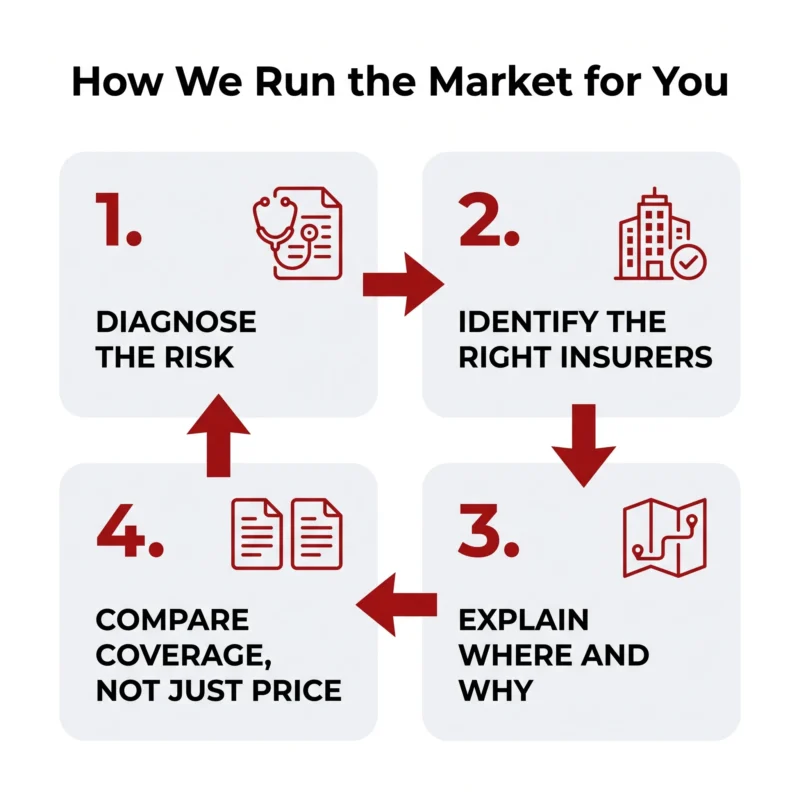
We manage the market for you: we review what you have, find the insurers that fit, and bring back options you can compare side by side. I spent a stretch reviewing the insurance behind about 90 of the country’s top private equity firms.
Book a call for a 15-minute conversation, not an application.
The Coyle Group is a commercial insurance agency that handles the complex, high-value risks other agencies don’t know how to structure, where the details in the policy are the difference between a paid claim and a denied one.
If you want the full program from the general partner (GP) to fund to portfolio, start with our guide to insurance for private equity firms and the wider financial services hub.
This page covers the New York layer on top of it.
Why Does a New York Private Equity Firm Need More Than a Standard PE Insurance Program?
Because Delaware documents don’t stop New York exposure. Your fund may be organized in Delaware, but New York law still governs your management company, your employees, your Limited Partner (LP) data and many of your portfolio companies.
I call this Delaware paper, New York exposure. The fund documents pick the court for partnership disputes.
They don’t pick the regulator, the employment law or the breach notice rules that apply to your Manhattan office or your portfolio company upstate.
That’s how a program can look strong at the fund level and still be thin on everything New York adds.
The New York Exposure Map
Here is how each exposure maps to the policy that has to respond:
New York exposure |
Who it hits |
Policy that has to respond |
What I check in the wording |
|---|---|---|---|
|
Martin Act and NY Attorney General |
GP, fund, individual partners |
Coverage for subpoenas and investigations, not just lawsuits |
|
|
SEC exams and enforcement |
Management company, partners |
GPL / D&O, E&O |
How “claim” is defined; individual coverage |
|
NYDFS Part 500 (only if DFS-licensed) |
Licensed affiliates |
Regulatory defense and incident response |
|
|
NYDFS control rules for insurer deals |
Sponsors investing in NY insurers |
GPL / D&O |
Whether regulatory proceedings tied to deals count as claims |
|
SHIELD Act |
Anyone holding NY residents’ private information |
Cyber |
Notification, regulatory defense, LP and employee data |
|
NYC Human Rights Law |
Management company, NYC portfolio companies |
Retaliation and discrimination claims under the city’s broader standard |
|
|
Workers’ comp, DBL and Paid Family Leave |
Management company with NY employees |
Statutory policies |
Every New York employee covered from day one |
What Doing Nothing Costs
Want to see your program against this table? Book a call and we’ll walk through it in 15 minutes.
Will Your GPL or D&O Pay for a New York Attorney General or SEC Investigation?
Sometimes, and the answer sits in two definitions: “claim” and “loss.” Many GPL and D&O forms pay defense costs once a formal investigation starts against an insured person. The expensive part often begins earlier, though, with an informal request or a subpoena to the firm, and that’s where I see New York sponsors get surprised.
What the Martin Act Lets the Attorney General Do
The Martin Act reaches securities dealings “within or from this state.”
It lets the Attorney General run its own investigations, subpoena witnesses and require the production of books and papers.
For a sponsor, that means fundraising decks, valuation practices, side letters and performance reporting can all end up in an AG inquiry.
Where the SEC Fits
The SEC adds a second front.
If your management company is one of the registered investment advisers the SEC examines, your policy has to treat exam fallout as more than paperwork.
Five Wording Checks for Regulatory Coverage
Here’s how I explain the split to clients: E&O covers what your firm does.
D&O covers how your firm is governed. A regulatory inquiry can touch both.
So check these points in the GPL behind your private equity insurance New York program:
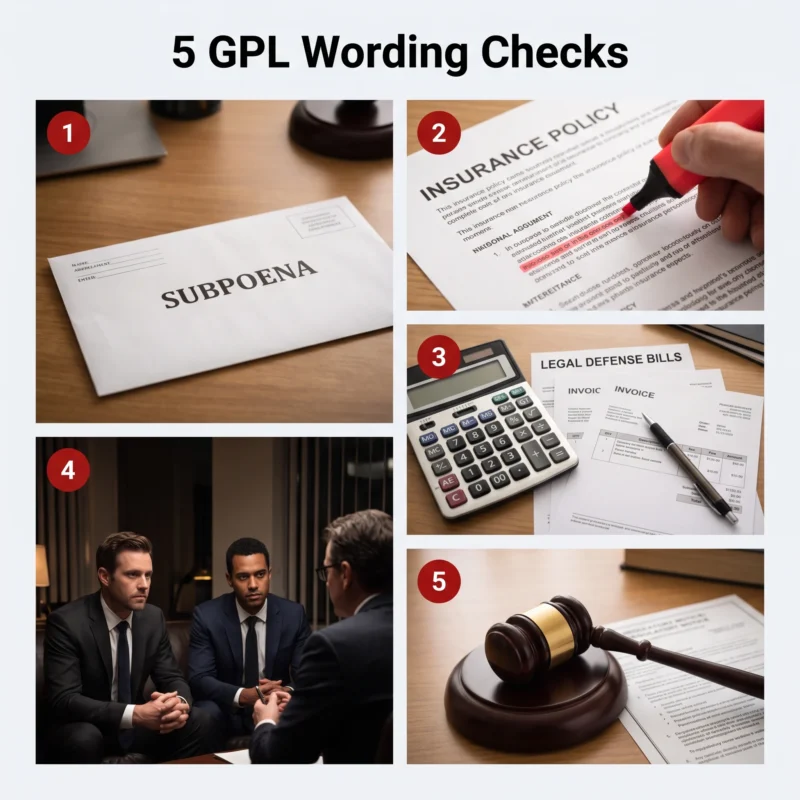
Gallagher’s 2026 GPL guide says regulatory investigations “have also been a significant source of claims” for asset managers.
That is why the definition of “claim” deserves a close read.
For more on adviser-level coverage, see our page on registered investment advisers.
Does the Fund’s Policy Protect Partners Who Sit on Portfolio Company Boards?
Usually, but only as a backstop. Outside directorship liability (ODL) in a GPL policy generally responds after the portfolio company’s own indemnification and D&O, so it’s only as good as that underlying program. And because ODL drives the most frequent GPL claims, that coordination matters far more than most sponsors assume.
Why Outside Directorship Liability (ODL) Is the Claim to Plan For
For buyout firms, those claims “tend to be more severe,” because majority control and multiple board seats pull sponsors into litigation earlier.
The Four Exclusions That Cause the Trouble
The fund’s policy can’t fix a portfolio D&O nobody read. These are the exclusions that cause the trouble:
Exclusion |
What it does |
Why it bites a PE sponsor |
|---|---|---|
|
Insured vs. insured |
Bars claims one insured brings against another |
The sponsor, its designees on the board and the company may all be insureds |
|
Major shareholder |
Bars claims by owners above a set stake |
A sponsor or co-investor almost always clears that threshold |
|
Bars wrongful acts before a set date |
Pre-closing conduct falls outside the new owner’s policy |
|
|
Investor claims |
Limits claims brought by fund investors |
An LP suit over a portfolio decision may not be covered at the GP level |
Have a partner on a portfolio board? Contact us and we’ll check how the GPL and the portfolio D&O fit together.
What Changes in Your Insurance When You Buy a New York Company?
Almost everything changes at closing, even when the policies look identical the day before. Change-in-control clauses can end coverage for new wrongful acts, claims-made policies need a tail, and the target’s old policies may hold value you’re about to lose. The order you handle these in decides whether the gaps close or open.
What I Find in Pre-Close Reviews
Here’s the sequence I follow:
The Five-Stage Deal Sequence
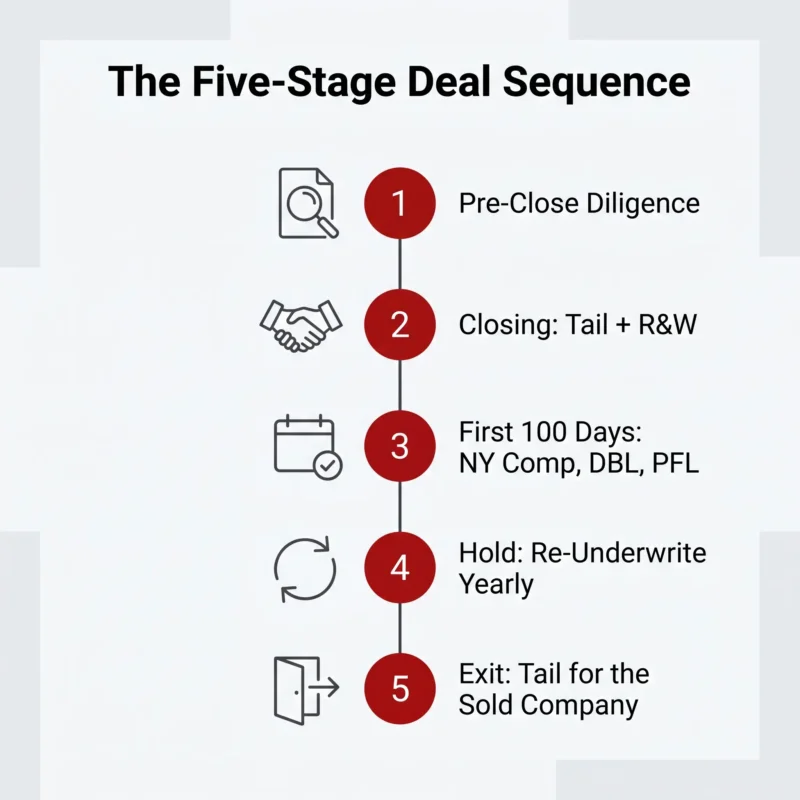
A Note on the Post-Closing Broker Change
One note on the post-closing broker change: in many deals, the broker that ran insurance diligence becomes broker of record after closing.
That can work fine. Just make sure someone reviews the target’s program on its merits before the account moves.
Should New York Portfolio Companies Share a Master Program or Keep Their Own Policies?
It depends on how alike the companies are. A master program brings consistency and buying power, but shared limits mean one bad loss at one company can drain protection for the rest. In practice, the right answer is often a hybrid, and the deciding factors are practical rather than theoretical.
Master, Stand-Alone or Hybrid
Here’s how the three approaches compare:
Approach |
Where it helps |
Where it hurts |
Usually fits |
|---|---|---|---|
|
Master program |
Consistent terms, one renewal date, more buying power |
Shared aggregate limits; one large loss affects every company |
Similar companies in one industry |
|
Stand-alone policies |
Limits sized to each risk; clean exit when you sell |
More renewals to manage; terms drift apart |
Mixed portfolios, very different risks |
|
Hybrid |
Master D&O, EPLI or cyber, separate property and casualty |
Takes active coordination |
Most growing portfolios |
Who pays matters as much as what’s covered. Your LPA decides which costs the fund can carry and which belong to the management company or the portfolio company, so allocate premium the way the documents allow.
Multi-state portfolios add another layer to private equity insurance New York planning.
We place coverage nationally, and Donna Richard, our Senior Account Manager, has spent 20 years in workers’ compensation and runs multi-state programs.
That matters when a New York holding company owns operations in New Jersey, Pennsylvania and Texas, each with its own rules.
What Cyber and Data Rules Does a New York Sponsor Have to Plan For?
Two rules matter most, and only one applies to everyone. New York’s SHIELD Act reaches any business holding New York residents’ private information, wherever that business sits. NYDFS Part 500 is narrower. It covers DFS-licensed or regulated entities only, and getting that answer wrong changes what your cyber policy needs to do.
SHIELD Act vs. Part 500 at a Glance
The two rules differ on who they reach and what your policy needs to do:
Rule |
Who it reaches |
What it requires |
What to confirm in your policy |
|---|---|---|---|
|
SHIELD Act |
Any business keeping private data on New York residents |
Reasonable safeguards and notice after a breach |
Notification costs, regulatory defense, LP and employee data |
|
NYDFS Part 500 |
Entities operating under, or required to hold, a DFS license |
A full cybersecurity program |
Regulatory defense and incident response tied to DFS |
The SHIELD Act requires reasonable administrative, technical and physical safeguards, plus notice to affected people after a breach.
For a sponsor, that data includes LP records, employee files and portfolio company customer data.
NYDFS Part 500 applies only if the firm or an affiliate holds a DFS license or registration.
A PE firm isn’t covered simply because it’s a New York financial business, so confirm the answer before you build the program around it.
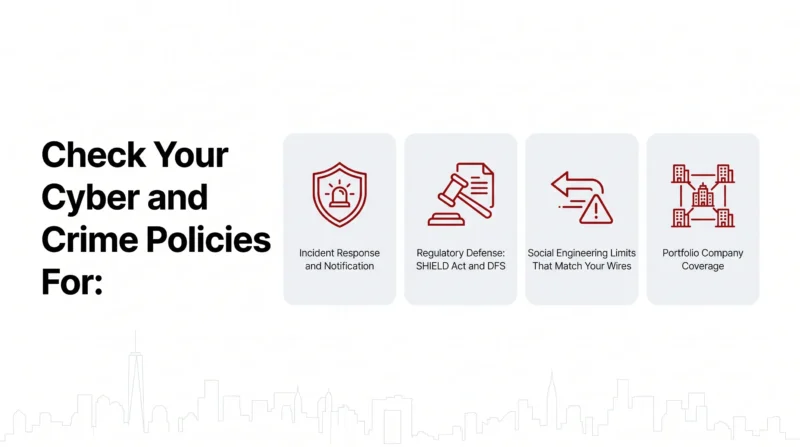
The Wire Risk in Capital Calls and Closings
The bigger day-to-day threat is money movement.
Capital calls, distributions and closings all involve large wires, which makes social engineering a live risk.
Check your cyber and crime policies for:
Not sure which rules apply to you? Book a call and we’ll sort it out in 15 minutes.
Which Policy Should Respond to Each New York Claim?
Each New York claim has a first policy that should answer it, and sometimes a backup. The trouble is that the backup only works if the first policy is written right, so a gap in one policy quietly becomes a gap in the whole program. Here’s how I map it for sponsors.
Read each row as a test of your current program:
If this happens |
First policy that should respond |
Backup |
Gap I check for first |
|---|---|---|---|
|
The NY Attorney General subpoenas the firm over fundraising materials |
GPL (D&O and E&O) |
None |
“Claim” doesn’t include subpoenas or informal requests |
|
An LP sues the GP over a portfolio decision |
GPL |
None |
Limits on claims brought by fund investors |
|
A portfolio company shareholder suit names a partner on its board |
Portfolio company D&O |
GPL outside directorship liability |
Insured vs. insured or major shareholder exclusion |
|
A Manhattan employee alleges retaliation |
Management company EPLI |
None |
EPLI never bought, or bought with a low limit |
|
Fake wire instructions redirect a capital call |
Crime, social engineering coverage |
Cyber, if it includes funds transfer fraud |
Social engineering sublimit below the wire size |
|
A breach exposes LP personal data |
Cyber |
None |
Notification and regulatory costs capped by a sublimit |
|
An office employee gets hurt at work |
New York workers’ compensation |
None |
Coverage missing for a New York employee |
If you can’t name the policy for a row, that row is your gap. The fix is usually a wording change or an added line, not a full rebuild, and most of these problems aren’t expensive to fix.
They come from carelessness, not cost.
Want us to run your program through this table? Contact us and we’ll fill it in with your actual policies.
How Does a Confidential Review of a New York PE Program Work?
It’s a private review of your policies before anything goes to market or any broker changes. We read the forms, exclusions, endorsements, limits, contracts and loss history across the GP, fund and portfolio, then tell you what’s right and what we’d change. Here’s the part sponsors don’t expect: it doesn’t disrupt your current broker.
We call it Review First, Market Later. If you have coverage now, we review the existing policies before deciding what to improve.
If you’re buying new coverage, we build the underwriting picture first.
Either way, the process runs the same:
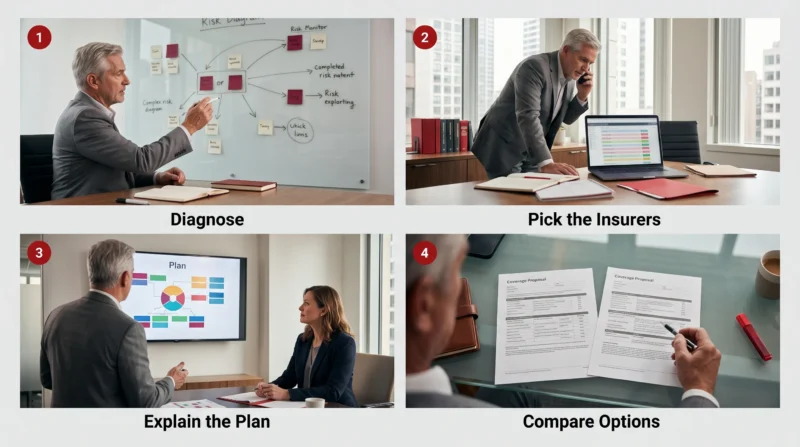
The workload benefit is real: fewer applications, fewer duplicate requests and one point of contact for the whole program.
Who Does the Review
The people reading your policies matter as much as the process.
I hold the CPCU and ARM designations, and Michael Vanderwerker, our Chief Integration Officer, has 35 years in D&O and 41 years in commercial insurance. Our senior people each bring 40 or more years to the table. One client put it this way in a published review: “Gordon has a process that is thorough, comprehensive and easy.
It allows companies to uncover risks they may not have been aware of.
Red Flags in a New York PE Insurance Program
Real-world example
A boutique M&A advisory firm came to us with a program that looked complete. Its “cyber” coverage was a $50,000, third-party-only endorsement on a business owners policy. Its E&O definition of “professional services” left out two of the firm’s core services, and it carried only $1 million of E&O with defense costs inside the limit, on deals worth tens to hundreds of millions.
We replaced the $280 endorsement with a $1,300-a-year standalone cyber policy, used a $200-a-year endorsement to fix the E&O definition, recommended higher E&O limits and added crime coverage. In total, we identified about $2 million in gaps. Read the full M&A advisory firm case study.
What Does Private Equity Insurance Cost in New York, and What Do Underwriters Look At?
There’s no honest flat number, because underwriters price each sponsor on its own facts. Fund size, strategy, board seats and claims history move the premium far more than the zip code does. The 2026 market adds a twist, though: claim-free firms are seeing mostly flat renewals, and flat pricing can hide wording problems.
The Five Underwriting Factors
These five factors decide eligibility and price for private equity insurance New York sponsors buy:
Factor |
Why underwriters care |
What to have ready |
|---|---|---|
|
Assets under management and strategy |
Bigger funds and riskier strategies mean bigger potential claims |
Fund sizes, vintages, strategy description |
|
Portfolio count and board seats |
ODL is the most frequent GPL claim |
List of companies, control positions, board seats |
|
Claims and investigation history |
Recent claims drive price and retentions |
Loss runs, LP disputes, regulatory inquiries |
|
Regulatory profile |
SEC registration and DFS licenses shape regulatory exposure |
Form ADV, any DFS licenses, NY insurer holdings |
|
Controls |
Cyber and wire controls drive cyber and crime terms |
MFA, wire verification procedures, compliance manual |
Where the Market Stands
Diagnosis comes before quotes.
Here’s where the market stands:
Market signal |
What it says |
Source |
|---|---|---|
|
GPL, claim-free firms |
Mostly flat premiums expected for 2026 |
|
|
GPL, firms with recent claims |
May face premium increases |
|
|
GPL retentions |
Bottoming out; carriers may raise them |
Gallagher 2026 GPL guide |
|
US D&O rates |
Down 3% in Q1 2026, up 1% in Q2 2026 |
|
|
US financial institutions rates |
Down 1% in Q2 2026 |
Marsh Global Insurance Market Index |
Limits and How We’re Paid
Limits deserve their own conversation, and our guide on how much D&O is enough walks through it.
On fees, we’re paid through carrier commissions and don’t charge upfront fees for standard placements. For M&A due diligence work, we may propose a fee and discuss it before any work begins.
Already have a broker? A second opinion on your business insurance doesn’t require you to switch.
How Do You Choose an Insurance Broker for a New York Private Equity Firm?
Choose the broker who reads your wording before quoting your price. For a New York sponsor, that means someone who can map GP, fund and portfolio coverage against New York law, run the market without flooding it, and stay involved when a claim lands. You can test all of that in one meeting.
Ask any broker who wants your private equity insurance New York program to show you how they would:
What About Getting Quotes From Several Brokers?
Once one broker submits to an insurer, that market is blocked for the others. Insurers that know an account is being shopped everywhere put less effort into it, and you end up answering the same questions three times. You get more real competition when one broker runs a disciplined process across the right markets.
Who This Isn’t Right For
We’re not the right fit if the plan is to put three brokers in a race.
We also won’t copy a weak program at the same price and present it as if everything is fine. Our sweet spot is established mid-market sponsors and portfolio companies, roughly $10 million to $500 million in revenue, with complex operations. If your risk is simple and small, a basic package may serve you well, and I’ll tell you so.
Ready for a straight answer? Book a 15-minute call, not an application.
Questions about Private Equity Insurance New York?
Build Private Equity Insurance Around Your New York Exposure
A sponsor’s program has to fit the way you actually operate: Delaware documents, a New York office and portfolio companies in several states. That’s the difference between being covered and being adequately covered. It shows up when the Attorney General sends a subpoena, when an investor sues over a decision made in a portfolio boardroom, and when a deal closes with the old policies still in place.
Our family has been in the insurance business since 1929, and we only do business insurance. We’re independent, not captive to any carrier. We start renewals 90 to 120 days out, re-underwrite every year and review contracts before you sign. You don’t need five brokers shopping your insurance. You need one capable broker making sure the right insurers compete for your business.
The first step costs nothing and doesn’t disrupt your current broker. We put your GPL, D&O and portfolio policies side by side against your New York exposures, then tell you what’s working, what’s missing and what I’d change.
Book a 15-minute call. If your program is solid, I’ll tell you that too.
This article was written by the CEO of The Coyle Group, Gordon B. Coyle, CPCU, ARM, AMIM, PWCA, who has over 40 years of experience working with business owners of all sizes and industries across the US, solving their insurance challenges.
Here’s how to take the next step
Schedule Your Insurance Confidence Assessment
In our 30-minute call, you’ll discover:
Not ready for a call?
Get Free Access to Our Gated Video:
“How to Finally Feel Confident in Your Coverage. “
And discover the exact system we use to help business owners eliminate hidden coverage gaps, stop overpaying, and finally feel confident in their protection.
What Peace of Mind Looks Like
Trusted by business owners across the U.S.
The Coyle Group is 1st class! Gordon and his team are knowledgeable, responsive, and attentive to detail. Gordon is that rare breed of professional who genuinely cares for his clients and works hard to exceed their expectations. I highly recommend them.

The insurance brokerage service was truly tailored to my needs, nothing like those big brokers who steer you toward random policies that don’t fit your profile. Thank you to the team for your help.

I was working with another broker and having difficulty acquiring General Liability coverage. A colleague recommended The Coyle Group. They were able to get coverage bound in just a couple of business days and a policy issued in ten days, and with a solid carrier at a competitive premium. Truly impressive results, plus it was a pleasure working with them. I highly recommend the Coyle Group!

If any business is looking to work with an insurance brokerage firm that is not only excellent at what the firm does, but one that deeply values the needs of the clients, then The Coyle Group is the firm for you. Give them a call and see for yourself. I can assure that you will quickly agree.

Want to know more?
See related blogs

The Crowdstrike Debacle and Cyber Insurance
Third Party Employment Practices Liability Insurance. Protect Your Business

Are You Overpaying or Underinsured on Your Business Insurance?
