
Why Is My Commercial Insurance Renewal So High
(When the Market Is Getting Cheaper)

Index

Gordon B. Coyle
CEO, The Coyle Group
845-474-2924
How to get started
TL;DR. Executive Summary
You had no claims, and it still went up.
The renewal showed up later than it should have, the premium jumped, and the only explanation in the cover email was “market conditions.”
Meanwhile, you keep reading that commercial insurance rates are finally coming down.
I’m Gordon Coyle, and I review renewals like yours every week.
The Coyle Group is a commercial insurance agency for business owners who’ve outgrown one-size-fits-all coverage and need a specialist who understands the nuances.
In my experience, a big increase in a softening market almost always traces back to one line, one bucket, or one decision you can identify.
This page shows you how to find it before you sign.
The short version
The average commercial account is getting flat or lower pricing, so “the market” rarely explains a big jump on its own. We break your renewal down line by line, find out whether the increase is rate, exposure, coverage, or lost credits, and check whether anyone actually tested your account with other carriers. Most owners get a clear answer in one conversation.
Book a call and send us your renewal.
Why is my commercial insurance renewal so high if rates are coming down?
Because the average is soft, but your account isn’t average. Market-wide pricing turned flat to negative in 2026, so a large increase usually points to something specific in your program: a hard-hit line, growth in your exposures, a coverage change, or lost credits. That raises a harder question, which is whether anyone explained which of those it was.
Here is what the market actually did this year:
That is a very different conversation than the one most owners had in the hard market of the last few years.
What doing nothing costs you
Which part of my renewal went up?
Usually one or two lines, not the whole program. When I lay last year’s renewal next to this year’s, the increase almost always concentrates in umbrella, commercial auto, or a property schedule that got revalued. The surprise for most owners is that other lines often went down at the same time, which hides where the real pressure sits.
Start by asking your broker for premium by line of coverage, last year versus this year. Then compare each line to what the market is doing.
Here are the most recent benchmarks I trust:
Line of coverage |
Ivans renewal rate change, Aug 2026 |
Broker survey premium change, Q2 2026 |
What it means for your renewal |
|---|---|---|---|
|
Umbrella |
+6.82% |
+5.3% |
Still rising everywhere; a jump here is common but should be explained |
|
+5.69% |
–6.3% |
Big accounts are getting decreases; an increase usually means revaluation or location risk |
|
|
+5.44% |
Not listed in release |
Small-account package; outgrowing it can hide problems |
|
|
+4.18% |
Not listed in release |
Moderating; large increases point to class, sales, or claims |
|
|
Commercial auto |
+3.58% |
+4.5% |
Still firm; fleet growth and driver records matter most |
|
Workers’ compensation |
–1.1% |
–3.2% |
Falling; an increase usually means payroll growth or your experience mod |
Sources: Ivans Index August 2026, which tracks the same policy year over year, and The Council of Insurance Agents & Brokers Q2 2026 P&C Market Survey.
In practice, the bigger and better-presented your account, the more likely you are to sit at the lower end of these ranges.
Not sure which line drove your number? Contact us with last year’s and this year’s renewal, and we’ll show you where the increase sits.
Why are umbrella and commercial auto driving so many mid-market increases?
Because those two lines are where carriers are still losing money, and they are passing that pressure to you. Umbrella premiums rose for the 35th straight quarter, and commercial auto isn’t far behind. The catch is that an umbrella increase often has nothing to do with your own claims, and that surprises owners with spotless records.
Here is what I see driving it:
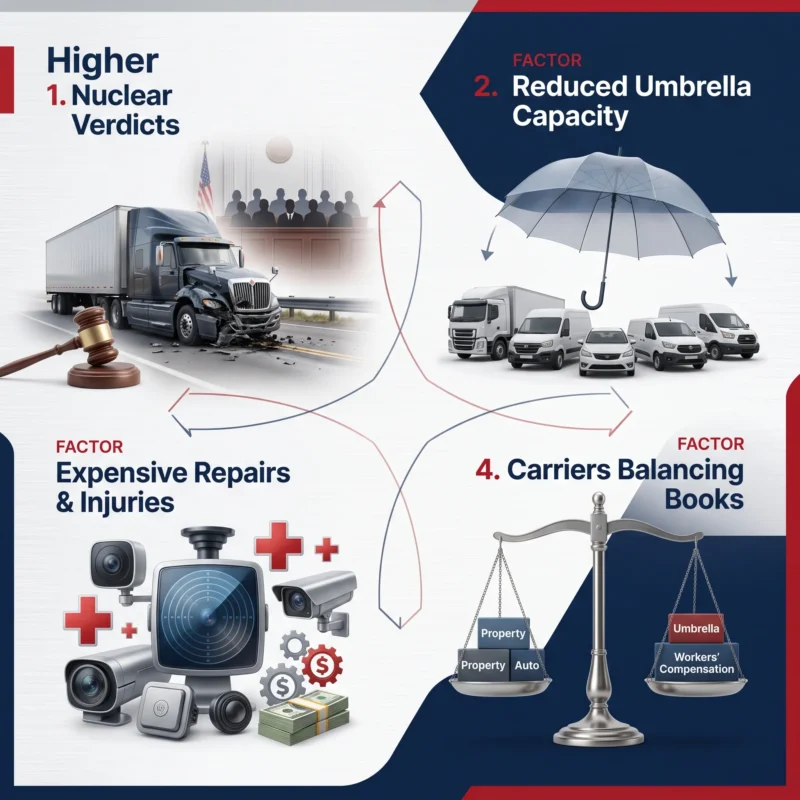
What “re-layering the tower” does to your price
This is the part most brokers never explain.
Your broker then has to stack additional layers from other markets to get you back to $5 million. Each layer carries its own minimum premium, and some may come from non-admitted carriers.
From what I’ve seen, that one decision can double or triple the cost of your liability tower without a single claim on your record.
If you’re weighing whether you need a true umbrella or an excess policy in that tower, my breakdown of commercial umbrella vs. excess liability walks through the difference.
For fleet-heavy businesses, it’s also worth understanding what moves commercial auto insurance premiums at renewal, because the auto line feeds everything above it.
What is the Four-Bucket Renewal Breakdown?
It’s the method I use to split any renewal increase into four causes: rate, exposure, coverage, and credits. Once you sort the dollars into these buckets, you know who controls each piece and what to push back on. The important nuance is that not every bucket is a bad sign, and some increases are exactly the right call.
Bucket |
What changed |
Who controls it |
What to ask your broker |
|---|---|---|---|
|
1. Rate |
The carrier’s price per unit of exposure |
Carrier and market |
“What was the pure rate change on each line?” |
|
2. Exposure |
Revenue, payroll, vehicles, locations, property values |
You (it reflects your business) |
“Which exposure numbers changed, and are they accurate?” |
|
3. Coverage and structure |
Limits, deductibles, endorsements added or quietly removed |
You and your broker |
“Did anything in the coverage change, in either direction?” |
|
4. Credits and underwriting |
Schedule credits removed, class code changes, loss history, experience mod, minimum premiums, carrier appetite |
Underwriter, influenced by your broker |
“Did we lose any credits, and why?” |
A few notes on each bucket:
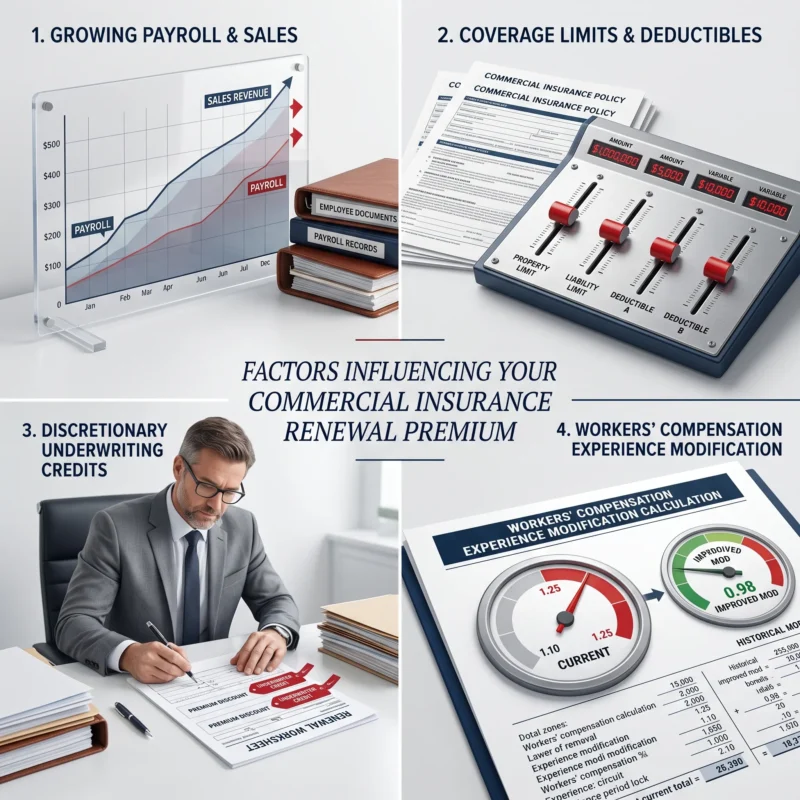
Real-world example from our files
We reviewed a Northeast food distributor doing more than $40 million in revenue. Its building was insured for about $3 million, while the true replacement cost was roughly $9 million to $10 million. Correcting that pushed the exposure bucket up sharply, as it should. But we also moved the deductible from $5,000 to $25,000, repositioned the account with the underwriter, and moved it off a small-business package policy. The result: insured values roughly tripled, while the premium rose to about 1.5 times what they had been paying.
That example is why I never judge a renewal by the total alone.
So if you’re asking why is my commercial insurance renewal so high, part of the answer may be that your values finally caught up with reality. A high number can be the right number, as long as every dollar ties to a bucket you understand.
Why did my premium go up when I had no claims?
Because clean claims only protect one of the four buckets. Your rate, exposures, coverage, and credits can all move even in a perfect year. Industry loss trends, revaluations, and carrier rebalancing all hit claim-free accounts. What matters next is whether your broker used your clean record as leverage, or just let it sit in the file.
In practice, here is what drives increases on claim-free accounts:
Use your loss runs as leverage
Your loss runs are the single best negotiating tool you have.
I recommend pulling five years of loss runs before every renewal, and in New York, carriers must provide them within 10 days of a request.
Then compare what the carrier paid in claims to what you paid in premium.
A gap like that is a story an underwriter needs to hear. A clean loss ratio, presented well, is how you earn credits back.
Have clean loss runs and still got hit? Book a call, and we’ll show you how to put that record to work at this renewal.
Was my account actually marketed?
Often, no. In my experience, many brokers only remarket an account when the renewal comes in more than 10% to 15% higher, and some never test it at all. The quiet risk is that “we looked at the market” can mean anything from five real submissions to one phone call. You’re entitled to know which.
Here is what I hear from owners who come to us after a bad renewal:
Questions to send your broker this week

A good broker answers these in writing without hesitation.
If you’d like a benchmark for what a thorough review looks like, here’s what your broker should review at renewal. Vague answers to specific questions tell you almost everything you need to know.
Should I accept, negotiate, remarket, or switch brokers?
It depends on what the Four-Bucket Breakdown shows and how much time you have. If the increase ties cleanly to exposure growth, accepting may be right. If credits vanished or the account was never marketed, you have leverage. The trap is choosing the most dramatic option without the data, because a rushed remarket can backfire.
Option |
When it makes sense |
Risks |
Time you need |
|---|---|---|---|
|
Accept the renewal |
Increase ties to real exposure growth or a coverage upgrade |
Leaving credits on the table |
Any |
|
Negotiate with your current carrier |
Clean loss runs, lost credits, strong risk controls you can document |
Carrier may hold firm without a credible alternative |
30 to 60 days |
|
Remarket the account |
Increase is mostly rate or credits, and the account was never tested |
Rushed or duplicated submissions make underwriters wary |
60 to 120 days |
|
Adjust structure |
You can absorb a higher deductible or retention |
Cutting limits creates dangerous gaps |
30 to 60 days |
|
Bring in a new broker |
Explanations are vague, renewals are always late, account has outgrown the broker |
Switching at the last minute without a plan |
90 to 120 days ideally |
A few cautions from what I’ve seen:
Want a confidential second opinion before you decide? Our second opinion review looks at your renewal without disrupting your current broker.
How do I lower my commercial insurance before I sign?
Fix the data, document your controls, and restructure where it makes sense. Those three moves lower more renewals than any amount of shopping. Here’s the part owners rarely hear: the lowest premium isn’t always the lowest cost, and chasing it can raise what you actually spend on risk.
Moves that consistently work for established businesses:
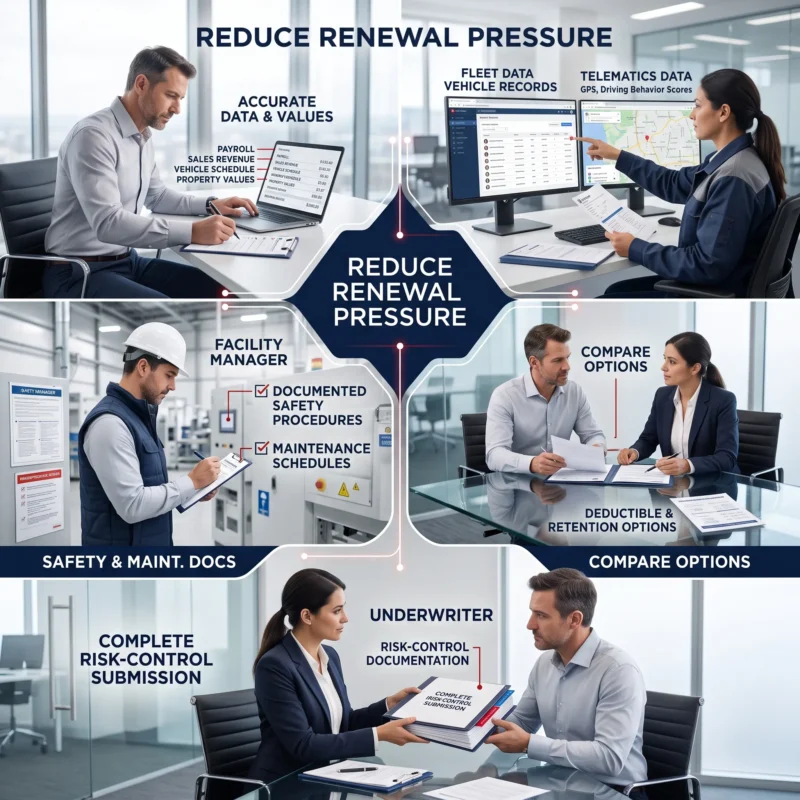
Think in total cost of risk
In my experience, a client who pays slightly more premium but has fewer claims, lower deductibles, and better terms usually spends far less overall.
Over 40 years I’ve found that protection comes before cost savings, and done right, the savings follow.
How do I keep next year’s renewal from being a surprise?
Start 120 days out and treat renewal as a process, not an event. Most renewal shocks happen because the work starts too late, so there’s no time to fix data, document controls, or test the market. The good news is that a simple timeline removes almost all of that risk for next year.
Days before renewal |
What should happen |
|---|---|
|
120 days |
Pull five years of loss runs; review exposures and business changes |
|
90 days |
Update property values, payroll, fleet, and locations; document risk controls |
|
60 days |
Broker builds and submits a complete underwriting package |
|
30 days |
Review quotes line by line with the Four-Bucket Breakdown; decide |
Beyond the timeline, a few habits help year-round:
For a step-by-step version, use our commercial insurance renewal checklist.
Want next year’s renewal handled on this timeline? Book a call, and we’ll map out your 120-day plan.
The bottom line
A high renewal in a soft market is a signal, not a sentence. Somewhere in your program, a line, a bucket, or a decision drove that number, and you can find it. The question that matters most is whether you find it before you sign, or after you’ve paid another year of premium you didn’t need to.
So when an owner asks me, why is my commercial insurance renewal so high, I answer with the same steps every time: break it down by line, sort it into the four buckets, check whether the account was really marketed, and then decide.
You’ll find more guidance like this in our insurance advice for business owners library.
Book a call or contact us, and we’ll look at your renewal with you, confidentially and without disrupting anything you have in place today.
Questions about Why Is My Commercial Insurance Renewal So High?
Get the Right Coverage for Your Business Insurance
A high renewal in a softening market usually means one of two things. Something in your program needs fixing, or nobody has done the work to prove your account deserves a better price.
I’ve spent over 40 years sitting on the business owner’s side of that table. We break your renewal down line by line, find exactly where the increase lives, and take your account to underwriters with a clear, well-documented story. You get a real answer and a real plan, not “market conditions.”
Here’s how to take the next step. Schedule Your Renewal Review Call

This article was written by the CEO of The Coyle Group, Gordon B. Coyle, CPCU, ARM, AMIM, PWCA, who has over 40 years of experience working with business owners of all sizes and industries across the US, solving their insurance challenges.
Here’s how to take the next step
Schedule Your Insurance Confidence Assessment
In our 30-minute call, you’ll discover:
Not ready for a call?
Get Free Access to Our Gated Video:
“How to Finally Feel Confident in Your Coverage. “
And discover the exact system we use to help business owners eliminate hidden coverage gaps, stop overpaying, and finally feel confident in their protection.
What Peace of Mind Looks Like
Trusted by business owners across the U.S.
The Coyle Group is 1st class! Gordon and his team are knowledgeable, responsive, and attentive to detail. Gordon is that rare breed of professional who genuinely cares for his clients and works hard to exceed their expectations. I highly recommend them.

The insurance brokerage service was truly tailored to my needs, nothing like those big brokers who steer you toward random policies that don’t fit your profile. Thank you to the team for your help.

I was working with another broker and having difficulty acquiring General Liability coverage. A colleague recommended The Coyle Group. They were able to get coverage bound in just a couple of business days and a policy issued in ten days, and with a solid carrier at a competitive premium. Truly impressive results, plus it was a pleasure working with them. I highly recommend the Coyle Group!

If any business is looking to work with an insurance brokerage firm that is not only excellent at what the firm does, but one that deeply values the needs of the clients, then The Coyle Group is the firm for you. Give them a call and see for yourself. I can assure that you will quickly agree.

Want to know more?
See related blogs

The Crowdstrike Debacle and Cyber Insurance
Third Party Employment Practices Liability Insurance. Protect Your Business

Are You Overpaying or Underinsured on Your Business Insurance?
