
Best Commercial Insurance Brokers in New York City
8 Tests to Run Before You Hire One
Best Commercial Insurance Brokers in NYC for a Second Opinion
Index

Gordon B. Coyle
CEO, The Coyle Group
845-474-2924
How to get started
TL;DR. Executive Summary
The right commercial insurance broker for a New York City (NYC) business is the one that fits your risk, not the biggest name or the most stars.
Most owners start looking for a new broker the week something goes wrong.
The renewal lands with one quote at four times last year’s price, a certificate never shows up and a job walks, or a claim gets denied over coverage nobody mentioned.
A star rating can’t tell you whether a broker will read your lease, place a hard New York risk and fight for your claim. We manage the market for you: we review what you have first, pick the insurers that actually fit and bring the options back for you to compare. 95% of our clients stay with us.
Book a 15-minute call before your next renewal, not after it.
The Coyle Group is a commercial insurance agency that handles the complex, high-value risks other agencies don’t know how to structure, where the details in the policy are the difference between a paid claim and a denied one.
This guide is part of our insurance advice for business owners, and it ranks no one.
It gives you the tests I’d use to pick a broker for my own company.
What Makes a Commercial Insurance Broker the Right One for a New York City Business?
Fit makes a broker right, not size or star ratings. The right NYC broker knows your industry, reaches the insurers that write New York risks, answers fast and reviews your coverage before quoting. Here’s the problem: most rankings measure none of that, and the cost of picking wrong shows up at claim time.
What Picking the Wrong Broker Costs
Most of those problems come from programs that are built wrong and a broker who never looked.
I’d rather you judge brokers on what they check than on what they charge.
I call the checklist below the NYC Broker Fit Test. It turns a vague “who’s good?” into eight questions with answers you can verify.
The NYC Broker Fit Test
Test |
What to ask |
What a good answer sounds like |
|---|---|---|
|
1. License |
“Are you licensed for property and casualty in New York?” |
A license you can look up today |
|
2. Industry fit |
“Which accounts like mine do you handle?” |
Names your three biggest exposures without prompting |
|
3. Market access |
“Which insurers, including E&S, would you approach?” |
Explains where and why before anything is submitted |
|
4. Coverage gaps |
“What would you check first in my policies?” |
Forms, exclusions, endorsements, limits and contracts |
|
5. Certificates |
“How fast do you issue a COI?” |
A named person and a turnaround time |
|
6. Renewals |
“When does renewal work start?” |
90 to 120 days out, with a written summary |
|
7. Claims |
“Who works with the adjuster?” |
A named person who pushes the claim forward |
|
8. Pay |
“How are you paid?” |
A plain answer on commissions and fees |
A broker who passes all eight is doing a real coverage review, not just a quote.
The carrier writes the policy, but the broker decides whether it actually protects you.
Which Type of NYC Broker Fits Your Business: Global, Regional, Local, Online or Boutique?
Match the broker type to your size and complexity. Global firms suit companies with in-house risk managers and international exposures, while boutique and local brokers suit owner-led and mid-market companies. The real question is where your account ranks inside the firm, because that decides who answers your calls.
Broker type |
Usually fits |
Strengths |
Watch for |
Where a mid-market account ranks |
|---|---|---|---|---|
|
Global brokerage |
Large corporations with a risk manager and international risk |
Deep analytics, global reach |
Mid-size accounts may get a junior team |
Small fish, big pond |
|
National or regional firm |
Mid-market and multi-state companies |
Broad markets, benefits capability |
Service varies by office and team |
Middle of the pack |
|
Local independent agency |
Storefronts, small contractors, simple risks |
Local knowledge, fast certificates |
Limited E&S or specialty access at some agencies |
Depends on the agency |
|
Online platform |
Very small, standard risks |
Speed, no meeting needed |
Hard to reach a person for certificates or claims |
An account number |
|
Boutique specialist |
Mid-market companies with complex operations and no risk manager |
Senior attention, deep policy review |
Smaller bench, so check team depth |
Big fish, small pond |
If you’re weighing a platform against a person, I’ve compared buying business insurance online vs. an agent in more detail.
Ownership changes matter too.
When a brokerage is acquired, the team on your account can change, so ask about broker consolidation.
Ask, too, how often account managers change. When owners ask me to name the best commercial insurance brokers in New York City, I tell them size matters less than this: who works your account on an ordinary Tuesday?
At a boutique like ours, the client is a big fish in a small pond.
That’s the kind of fact to ask any firm for, especially if you run one of the mid-market companies that get lost at large firms.
Not sure which type of broker you have now? Book a call and we’ll tell you honestly whether your current setup fits.
Which Brokers Specialize in Your Industry: Technology, Professional Services, Distributors and Private Companies?
The right specialist names your industry’s biggest exposures before you explain them. That’s the test, because almost every broker website lists every industry. What they say in the first meeting tells you more than what they list, and the table below shows what a specialist should raise first.
Industry |
What a specialist raises first |
Gap generalists often miss |
|---|---|---|
|
Technology Errors and Omissions (E&O) and cyber written to work together, plus contract liability |
“Cyber” that turns out to be a small endorsement |
|
|
The definition of “professional services” in the E&O policy |
A definition that leaves out services you actually sell |
|
|
Product liability for imported or private-label goods, stock in transit, vendor endorsements |
Distributor gaps like property values set years ago |
|
|
Privately held companies and founders |
Directors and Officers (D&O) coverage for the people and the company |
$1 million limits picked by default, not by decision |
|
Contractors |
Action-over claims, subcontractor workers’ comp, contract wording |
Subcontractors without their own coverage |
|
Restaurants and bars |
Liquor liability and property after a claim |
Restaurant insurance in New York that isn’t renewed after one loss |
We saw the professional services gap firsthand with a mergers and acquisitions (M&A) advisory firm.
About $2 million in gaps came out of one review.
How Founders Should Compare D&O Options
If you run a private company and you’re comparing D&O options, put four things side by side before you look at price:

A quick way to tell D&O from general liability is what I call the five-second test: did something happen, or was a decision challenged?
Financial firms carry extra layers here, which is why our financial services insurance work starts with the decision makers.
Why Is Commercial Insurance in New York City Harder to Place Than Almost Anywhere Else?
Strict labor laws, heavy contract demands and tight insurer appetite all meet in one city, so a broker needs more markets and more paperwork skill here. Owners feel it most after a single claim, when some standard insurers won’t renew at all, and the broker’s market access decides what happens next.
That last point is where excess and surplus (E&S) lines come in.
In my experience, the brokers who do well here can place business with both standard and E&S insurers, and they know which one your account belongs in before it goes out.
How Do You Check That a New York Broker Is Licensed and Qualified?
Look the broker up with the New York State Department of Financial Services (DFS) before your first meeting. A license proves the minimum, though, not skill. The second half of the check, credentials, complaints and market access, tells you whether the broker can handle your account.
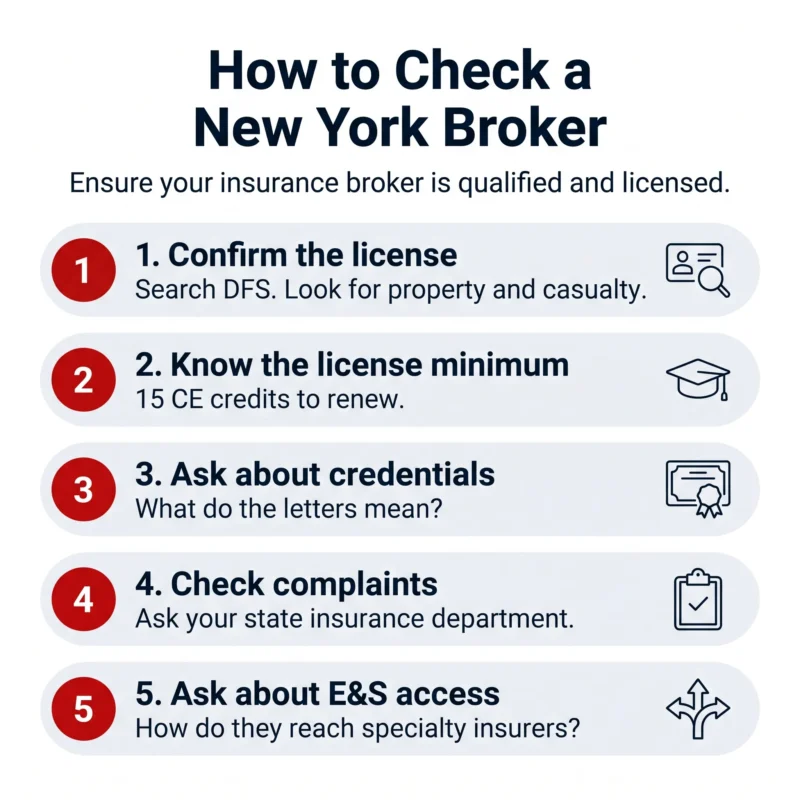
The NAIC makes a useful distinction too: a broker represents your business by searching the market for you.
That’s the job, so hold every candidate to it.
Comparing two broker proposals right now? Contact us and we’ll explain what each one does and doesn’t cover.
What Questions Should You Ask a Commercial Insurance Broker Before You Hire Them?
Ask questions that make a broker show their process, not their prices. The answers that matter come in specifics: names, timelines and what they’d change in your current policies. One question most owners skip, how the broker gets paid, explains a lot about the advice that follows.

A broker who answers these well is already doing what your insurance broker should be doing all year, not just at renewal.
On pay, here’s our answer.
Like most brokers, we’re paid through commissions from insurance carriers when policies are placed.
We don’t charge upfront fees for standard placements.
For specialized consulting, like complex risk assessments or merger due diligence, we may propose a fee, and we discuss it before any work begins.
Any broker should explain how insurance brokers get paid just as plainly.
What Are the Red Flags That You Hired the Wrong Broker?
The clearest red flag is a renewal with no conversation: a new price, no questions and no review of what changed. That’s paperwork, not risk management. The other warning signs are quieter, and they usually surface only when a claim, an audit or a contract exposes them.
If three or more of these sound familiar, read the signs it’s time to switch before your next renewal.
Real-world example: the dividend nobody claimed.
An importer came to us after getting two-week response times from its prior broker, who had also told them employers liability and Employment Practices Liability Insurance (EPLI) were the same thing. Their ocean cargo policy had a profit-sharing clause nobody had acted on, worth $10,000 to $12,000 for the current year. We took a broker of record appointment with the existing carrier at a lower commission for us, 15% instead of 25%, so the client kept the dividend.
Should You Send Your Account to Five Brokers to Find the Best One?
No. Comparing options is smart, but sending the same account to five brokers usually hurts you. Insurers see duplicate submissions, the first broker can block a market for everyone else, and a generalist may misclassify your risk. There’s a better way to get real competition, and it starts with one broker running the process.
Here’s what usually happens when an account goes out five times:
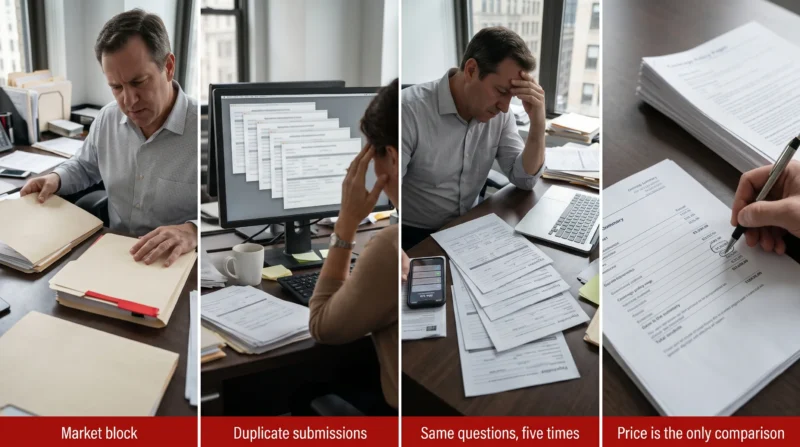
I tell owners this all the time: more brokers does not equal more leverage.
One capable broker who explains where they’re going and why, then brings the viable options back for you to compare, gets you more.
That’s why shopping business insurance across many brokers rarely works.
It’s also why we approach the market as a single, organized process.
Already have several brokers working on your renewal? Book a call and we’ll help you sort out what’s actually different between them.
What Do Underwriters Look At, and What Drives the Price of Commercial Insurance in NYC?
Underwriters price your operations, your losses and your paperwork, not just your address. In NYC, the same five factors decide both whether an insurer will quote and what you pay. The factor owners control most is the last one: how clearly the account gets presented.
Factor |
Why underwriters care |
What to have ready |
|---|---|---|
|
Class of business and class codes |
They set the base rate, and wrong codes inflate or understate the premium |
An accurate description of operations and payroll by class |
|
Loss history |
It predicts future claims, and one large loss can push you toward E&S |
Five years of loss runs, with explanations for large claims |
|
Contracts and leases |
Additional insured, waiver and limit demands change the exposure |
The insurance sections of your lease and key contracts |
|
Property and locations |
Building age, construction and values drive property pricing |
Current replacement cost values for every location |
|
How the submission is presented |
Complete, organized submissions get more underwriter attention |
One clean submission, sent once, by one broker |
I won’t put a price range on this page.
A single number for an NYC business misleads more than it helps, and our breakdown of what business insurance costs in New York shows how wide the ranges run.
If your number jumped, start with why your commercial insurance renewal is so high, then ask whether you’re overpaying or underinsured.
What Coverage Changes When Your Business Grows From $10M to $100M, and Will Your Broker Keep Up?
Almost every line changes as revenue grows from $10 million to $100 million: limits, entities, locations, employees and contracts all outgrow the original program. The risk isn’t growth itself. It’s a program that never caught up, because nobody re-underwrote the business along the way.
Growth trigger |
Coverage that changes |
Ask your broker |
|---|---|---|
|
New locations |
Property schedule, liability locations |
Is every new location listed with the right values? |
|
More employees |
Workers’ comp payroll and class codes, EPLI |
Does our EPLI limit match our headcount? |
|
Bigger contracts |
Higher liability and umbrella or excess limits, additional insured wording |
Can we meet this contract before we sign it? |
|
New products or markets |
Product liability, import exposure |
Does the policy cover a new product line? |
|
Investors or a board |
D&O for directors and the company |
Are new board members insureds? |
|
More data and systems |
Cyber insurance sized to records and revenue |
Is our cyber standalone or an endorsement? |
|
Acquisitions |
Named insureds, prior acts, entity schedules |
Is every entity a named insured? |
I call the most common version the new-location blind spot: a business opens a site faster than the property schedule changes.
It’s why we re-underwrite your business every year, and why how often you review your business insurance should follow your growth, not the calendar.
Growing faster than your program? Contact us and we’ll map what needs to change before your next renewal.
How Do You Switch to a Better Broker Without a Gap in Coverage?
Switch with a broker of record (BOR) letter or at renewal, and start 90 to 120 days before expiration. Your coverage doesn’t have to change on day one. What matters is timing and sequence, because a rushed switch is how owners end up with a gap.
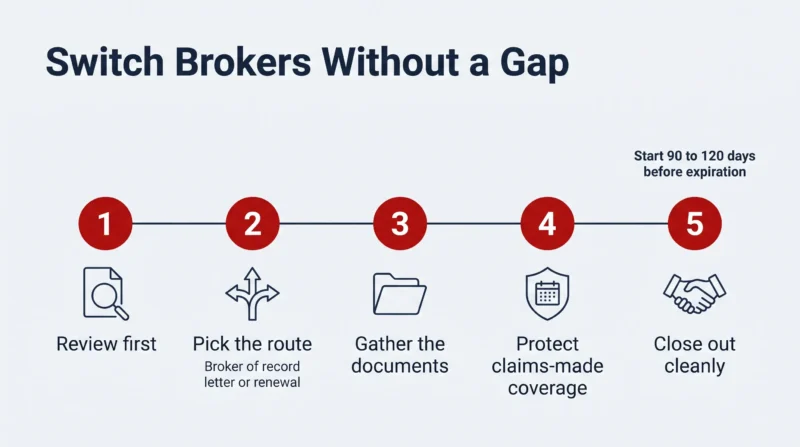
Switching is less work than most owners expect, and switching insurance agents rarely interrupts coverage when it’s timed right.
How Does The Coyle Group Approach a New York City Account?
We start with a Confidential Review, not a quote. We read what you have, tell you what’s working and what’s missing, and only then decide which insurers belong in the conversation. The first step costs nothing and doesn’t disrupt your current broker, which matters more than most owners realize.
The Coyle Process
We call the first step the Confidential Review.
Here’s how it works:
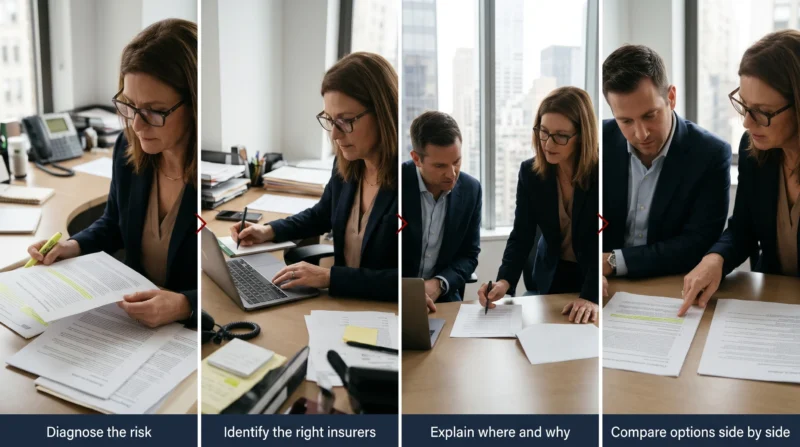
You fill out fewer applications, answer each question once and deal with one point of contact.
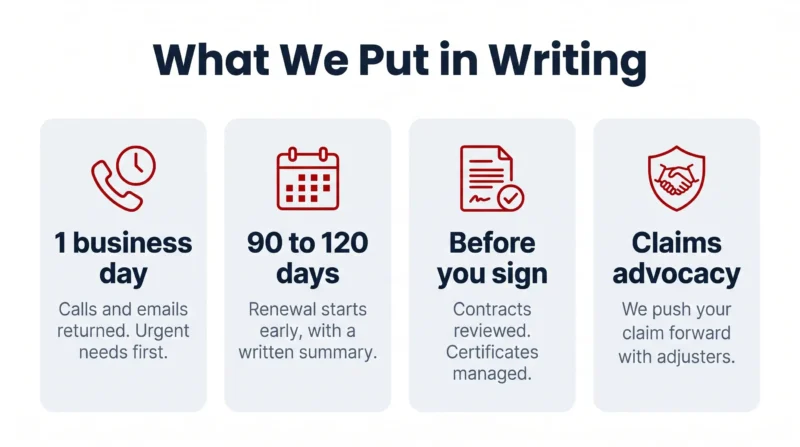
What We Put in Writing
We’re independent, not captive to any carrier, and we only do business insurance.
Our family has been in the insurance business since 1929, and we hold a 5.0 rating across 41+ Google reviews.
We’re not the right fit if you want someone to rubber-stamp what you already have at a lower price.
We won’t copy a deficient program and present it as if everything is fine.
A very small business with a simple, standard risk may be well served by a basic packaged policy, and I’ll say so.
And if the plan is to put three brokers in a race, we’re not your broker: we get hired to win, not to bid.
Ready for a clear answer? Book a 15-minute call, not an application.
Questions about Best Commercial Insurance Brokers In New York City?
Hire a New York City Broker Who Reviews First and Quotes Second
Picking from a list of the best commercial insurance brokers in New York City is a guess until someone has read your policies. That’s the difference between being covered and being adequately covered. It shows up when a landlord rejects a certificate, when an audit doubles a premium and when an insurer won’t renew after one claim.
Our family has been in the insurance business since 1929, and we only do business insurance. We’re independent, not captive to any carrier. We start renewals 90 to 120 days out, re-underwrite every year and return calls within one business day. You don’t need five brokers shopping your insurance. You need one capable broker making sure the right insurers compete for your business.
The first step costs nothing and doesn’t disrupt your current broker. We put your policies, contracts and loss history side by side, then tell you what’s working, what’s missing and what I’d change.
Book a 15-minute call. If your current broker is doing a good job, I’ll tell you that too.

This article was written by the CEO of The Coyle Group, Gordon B. Coyle, CPCU, ARM, AMIM, PWCA, who has over 40 years of experience working with business owners of all sizes and industries across the US, solving their insurance challenges.
Here’s how to take the next step
Schedule Your Insurance Confidence Assessment
In our 30-minute call, you’ll discover:
Not ready for a call?
Get Free Access to Our Gated Video:
“How to Finally Feel Confident in Your Coverage. “
And discover the exact system we use to help business owners eliminate hidden coverage gaps, stop overpaying, and finally feel confident in their protection.
What Peace of Mind Looks Like
Trusted by business owners across the U.S.
The Coyle Group is 1st class! Gordon and his team are knowledgeable, responsive, and attentive to detail. Gordon is that rare breed of professional who genuinely cares for his clients and works hard to exceed their expectations. I highly recommend them.

The insurance brokerage service was truly tailored to my needs, nothing like those big brokers who steer you toward random policies that don’t fit your profile. Thank you to the team for your help.

I was working with another broker and having difficulty acquiring General Liability coverage. A colleague recommended The Coyle Group. They were able to get coverage bound in just a couple of business days and a policy issued in ten days, and with a solid carrier at a competitive premium. Truly impressive results, plus it was a pleasure working with them. I highly recommend the Coyle Group!

If any business is looking to work with an insurance brokerage firm that is not only excellent at what the firm does, but one that deeply values the needs of the clients, then The Coyle Group is the firm for you. Give them a call and see for yourself. I can assure that you will quickly agree.

Want to know more?
See related blogs

The Crowdstrike Debacle and Cyber Insurance
Third Party Employment Practices Liability Insurance. Protect Your Business

Are You Overpaying or Underinsured on Your Business Insurance?
