
Insurance Company Not Renewing My Business Policy
What to Do Before the Deadline

Index

Gordon B. Coyle
CEO, The Coyle Group
845-474-2924
How to get started
TL;DR. Executive Summary
A non-renewal ends your policy at expiration, not today, so you are still covered until the date on the letter. The clock is already running, though. Most states give you 30 to 60 days of written notice, and a complex account needs 45 to 60 days just to be marketed properly. Get the reason in writing, find out whether the cause is your account, the carrier, or your broker, and never let coverage lapse.
Five years with the same carrier. Maybe one claim, maybe none.
Some owners tell me the notice even said the decision was “final and could not be changed.” If “my insurance company not renewing my business policy” is the exact thought running through your head right now, the frustration is fair.
The panic is not, because you have more options than the letter suggests.
That assumes your agent is the fix.
In my experience, a non-renewal is a deadline, and a test of your broker. Sometimes the broker is the solution.
Sometimes the broker is the reason you got the letter.
The Coyle Group is a commercial insurance agency for business owners who’ve outgrown one-size-fits-all coverage and need a specialist who understands the nuances.
I wrote this guide for established companies carrying real premium across several lines, and it is part of our insurance advice for business owners library.
You just got a non-renewal and you want to know if you can stay covered on the same terms.
Here is our approach: find out the real reason, decide whether it is fixable, and put a complete, well-told submission in front of the right underwriters before your deadline. We handle commercial insurance non-renewal situations regularly, and time is the one thing we cannot give back.
Book a non-renewal review the same day the letter arrives.
Can an insurance company refuse to renew your business policy?
Yes. An insurer can decline to renew a commercial policy at the end of its term if it gives you written notice within your state’s window. You are still covered until the expiration date. But the clock started the day that letter was mailed, and the notice usually went to your broker too.
That broker detail matters more than it looks, because someone on your side may have known before you did.
Here is what the answer really means for you:

A business insurance non-renewal is a business decision by the carrier.
Your job is to make sure the next decision, where your account goes, gets made by someone who started early enough.
How much notice does an insurance company have to give?
It depends on your state, but 30 to 60 days of written notice is common, and 45 days is a frequent baseline. The catch is that notice rules only tell you when the letter must arrive. They say nothing about how long it actually takes to replace a complex program, which is usually longer than owners expect.
Here is how the rules look in practice:
So check two dates right away: the date the notice was mailed and the date your policy expires.
If the notice looks late for your state, ask your broker to confirm your rights before anything else.
I got a non-renewal letter. What does it mean?
A commercial insurance non-renewal means your carrier will not offer you a new policy term, and your current coverage ends on the expiration date unless you replace it. That is all it means legally. What it means practically depends on three lines in the letter, and most owners skim past the one that matters most: the stated reason.
When a client forwards me a letter, I read it for:

Non-renewal vs. cancellation
Factor |
Non-renewal |
Mid-term cancellation |
|---|---|---|
|
When it happens |
At the end of the policy term |
During the active term |
|
Typical notice |
Often 30 to 60 days, set by state law |
Often around 10 days |
|
Common causes |
Loss history, appetite change, agency termination, underwriting guidelines |
Non-payment, misrepresentation, material change in risk |
|
Your coverage today |
Fully in force until expiration |
Ends on the cancellation date |
|
Future applications |
Must be disclosed, but explainable |
Harder to explain; closer scrutiny |
|
Limits on the carrier |
Notice and reason rules vary by state |
Many states restrict underwriting cancellations after the early part of the term |
Why would an insurance company refuse to renew a policy?
An insurance company refuses to renew for one of three reasons: something about your account changed, something about the carrier changed, or something about your broker’s relationship with the carrier changed. Most articles only cover the first two. The third one is the reason I wrote this page, and it changes who should be fixing the problem.
Underwriters use non-renewal when they believe an account is no longer acceptable at any price.
They often don’t simply raise your rate instead, because in most states rates and rules need regulatory approval, and a carrier worried about a whole class or region often finds it cleaner to exit than to reprice.
This is where I use what we call the Three-Question Non-Renewal Triage:
What’s behind a business insurance non-renewal
Cause |
Typical examples |
What the underwriter needs to see |
Realistic outcome |
|---|---|---|---|
|
Your account |
Claim frequency, big losses, open inspection items, unreported operational changes, lapsed licenses, roof condition flagged by third-party data |
Proof the issue is closed: invoices, photos, updated schedules, safety programs, a loss explanation |
Often reversible, or placeable elsewhere with a strong story |
|
The carrier |
Pulling out of your industry or state, cutting capacity, reinsurance costs, a change in how it underwrites |
Context that the decision was not about you, plus clean exposure data |
Rarely reversible; remarket early to carriers that want the class |
|
Your broker |
Terminated agency contract, a broker with only a few carriers, marketing started too late |
A new broker with access to the right markets |
Usually solved by moving the account |
A word on claims: frequency often worries underwriters more than severity. Three or four small claims in a term can read as a pattern, while you can usually explain one larger, well-managed loss.
Not sure which cause is yours? A second opinion on your business insurance takes one conversation and costs you nothing.
What if the letter says “terminated agency contract”?
It usually means your broker lost that carrier. The carrier ended its contract with your agency, so your agency can no longer place business there, and your policy is non-renewed as a result. In that case the problem was never your business. It was the agency’s relationship, and the fix is almost always moving the account.
In that situation, an insurance company not renewing my business policy is really an agency losing a carrier.
That is the moment to stop waiting on the same broker to solve it.
A terminated agency contract is the clearest version of a broker-caused non-renewal, but it is not the only one:

Signs your broker is the solution, or the reason
Your broker is the solution if… |
Your broker may be the reason if… |
|---|---|
|
They warned you months ago the carrier was pulling back |
You found out from the letter, and they found out from you |
|
They called the day the notice arrived with a plan |
Their plan is to resubmit the same application to the same carriers |
|
They can name the carriers they are approaching |
They say nobody will write you, without naming who they asked |
|
They started renewal conversations 90 to 120 days out |
First contact came 30 days before expiration |
If the right column looks familiar, compare it against what your broker should review at renewal, then read should I switch insurance brokers.
The carrier’s decision is out of your hands. Who handles the next one is yours to make.
Why can’t a mid-market account wait?
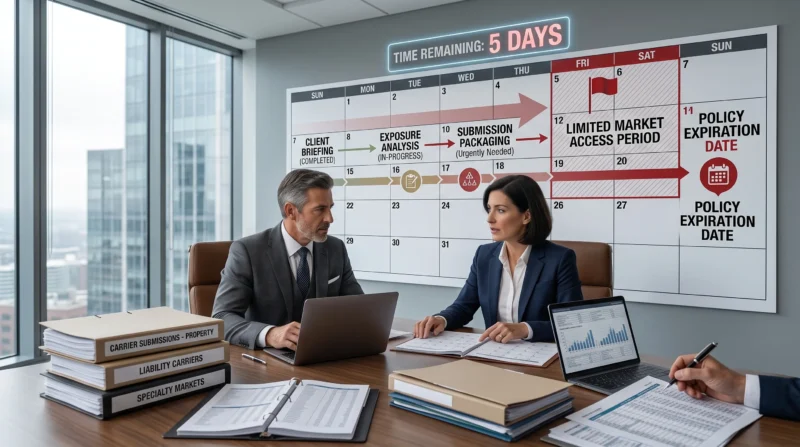
Because nobody can shop a complex account properly in 30 to 45 days. When several policies renew together, with fleets, multiple properties, or a large loss on the record, quality underwriting requires 45 to 60 days minimum. And the risk is bigger than a late quote, because one declined line can pull the rest of the program down with it.
From what I’ve seen, the damage spreads in a predictable order for a mid-market business:
This is also why prevention matters: a commercial insurance renewal checklist that starts 90 days out keeps most of these surprises off your desk.
Book a call if several of your policies renew within the same window.
What should you do this week?
This week, get your loss runs, confirm the exact expiration date, ask your broker which carriers they are approaching, and get a second set of eyes on the notice. The order matters, and the third step is the one that tells you the most about whether your broker can actually place the account.
What a new underwriter will ask for
Document |
Why it matters |
|---|---|
|
Five-year loss runs |
Proves your actual history, not the one the underwriter imagines |
|
Current declarations and schedules |
Shows what you need to match |
|
The non-renewal notice and stated reason |
They will ask; answering first builds trust |
|
Updated revenue, payroll, fleet, and property values |
Accurate pricing and fewer surprises at audit |
|
Loss explanation and corrective actions |
Turns a claim into a solved problem |
|
Contract insurance requirements |
Makes sure the replacement satisfies your customers and lenders |
Notice-to-expiration timeline
Window |
What must happen |
|---|---|
|
Days 1 to 7 |
Reason in writing, loss runs requested, target carriers named |
|
Weeks 2 to 4 |
Correct what can be corrected; submission built and sent |
|
Weeks 4 to 6 |
Quotes compared on terms, not just price |
|
Final 2 weeks |
Bind, confirm contract requirements, issue new certificates |
Can a non-renewal be reversed?
Sometimes, yes, and more often than owners expect when the cause is correctable. If the account fell out of line with an underwriting guideline and you fix it before the renewal date, carriers do rescind non-renewals. The catch is that reversals are won with evidence, not persuasion, and the request has to come from someone the underwriter trusts.
Here is how that works in practice:
Usually not. A carrier exiting your state or class will not reverse for one account, and a terminated agency contract will not reverse for your broker. Spend the time remarketing instead.
What are my options if the carrier won’t reconsider?
If reversal is off the table, you have four real paths, and the right one depends on the cause, your timeline, and your broker. The wrinkle is that the cheapest-looking option is not always the one that keeps your coverage intact, so compare them on terms before price.
Option |
Best when |
Speed |
Coverage breadth |
Watch-outs |
|---|---|---|---|---|
|
Stay with current carrier (reversal) |
Correctable issue, fixed in time |
Fast |
Same as today |
Only works with proof and a credible advocate |
|
Standard market through your current broker |
Carrier exit; broker has relationships for your class |
Moderate |
Usually comparable |
Resubmitting the same thin application gets the same answer |
|
Excess and surplus lines |
Hard-to-place classes or recent losses |
Moderate |
Can be narrower |
Review exclusions, deductibles, taxes and fees closely |
|
Move the account to a specialist broker |
Terminated agency contract, too few carriers, or a late start |
Depends on how early you move |
Often broader when the program is rebuilt |
Pick one broker; do not let several shop the same markets |
Surplus lines is a tool, not a verdict. It exists for risks the standard market won’t take right now, and many accounts move back once their story improves.
The one approach I warn against is what I call the shotgun approach: calling several brokers to shop your account at once.
Underwriters see the same risk from multiple sources, treat it as a waste of their time, and quietly close the file. As I often tell owners: frankly, you don’t know if a better alternative exists.
That is why the first submission needs to be the right one.
Our guide on how to switch insurance brokers walks through the mechanics.
How do you tell a new underwriter your story?
You tell it first, completely, and with evidence. The non-renewal will come up on the application either way, so the account that explains it up front wins trust that the account hiding it never gets. There is a second reason this matters, and it has nothing to do with manners.
Most applications ask directly whether you have been cancelled or non-renewed. Carriers can treat an omission as material misrepresentation, which hands the next carrier grounds to rescind or deny.
A strong submission includes:
Real-world example: medical supply distributors.
During COVID, carriers wrote coverage for almost any company with “medical” in its name, often on generic business owner’s policies. As claims came in and underwriters learned many were distributing surgical devices and diagnostics they never intended to cover, major carriers withdrew from the class entirely. By 2024, standard BOP coverage for medical supply distributors was virtually unavailable, and these accounts moved into life sciences underwriting, with different applications and criteria. The distributors who came through well secured certificates from suppliers naming them as additional insured, pulled five-year loss runs, and used a broker with life sciences underwriter relationships. The ones who struggled had generalist brokers submitting to carriers that no longer wrote the class, burning through their limited options.
That example captures the whole lesson.
The commercial insurance non-renewal was market-driven, yet the outcome depended on how the story was told and which broker told it.
Contact us if your class is going through something similar.
Will a non-renewal raise my premiums?
It can, but the cause matters more than the letter itself. A carrier-driven or agency-driven non-renewal often places at comparable pricing with a carrier that wants your class, while a risk-driven one usually means some correction. Yet the biggest rate risk is not the non-renewal at all; it is a lapse or a rushed, last-week placement.
Also look past the premium.
A rushed replacement is where those mistakes get locked in, and it is how a company ends up underinsured without realizing it.
Got a non-renewal notice? Send it to us
A non-renewal is a deadline, and a test of your broker. The owners who come through it well move in the first week, find out whether the cause is their account, the carrier, or the agency, and put an honest story in front of underwriters who want their class. The ones who struggle wait for someone else to notice the date.
Got a non-renewal notice?
Send it to us or book a non-renewal review, and we’ll tell you where your account can go and what your options are before the deadline.
We work best with established companies doing $100,000 or more in annual sales; if you are earlier than that, a direct online carrier may be the better fit for now.
Questions about Insurance Company Not Renewing My Business Policy?
Get Covered Again Before Your Non-Renewal Deadline
A non-renewal is a deadline, and a test of your broker. Most agencies will tell you not to panic and to wait while they look into it. Waiting is how complex accounts end up rushed into last-week placements, narrower coverage, or a gap in coverage. At The Coyle Group, we start the day your notice arrives. We find out whether the cause is your account, the carrier, or your agency’s relationship with that carrier, and we build the plan around the answer.
Over 40 years, I’ve built relationships with underwriters who know I don’t place bad business, and that trust is what gets a second look when it matters. We put one complete, well-told submission in front of the carriers that actually want your class. We don’t blast your account across the market. We explain the non-renewal up front, and we compare quotes on terms, not just price, so the replacement doesn’t quietly open new gaps.
Got a non-renewal notice? Send it to us and we’ll tell you where your account can go before the deadline. We work best with established companies doing $100,000 or more in annual sales.

This article was written by the CEO of The Coyle Group, Gordon B. Coyle, CPCU, ARM, AMIM, PWCA, who has over 40 years of experience working with business owners of all sizes and industries across the US, solving their insurance challenges.
Here’s how to take the next step
Schedule Your Insurance Confidence Assessment
In our 30-minute call, you’ll discover:
Not ready for a call?
Get Free Access to Our Gated Video:
“How to Finally Feel Confident in Your Coverage. “
And discover the exact system we use to help business owners eliminate hidden coverage gaps, stop overpaying, and finally feel confident in their protection.
What Peace of Mind Looks Like
Trusted by business owners across the U.S.
The Coyle Group is 1st class! Gordon and his team are knowledgeable, responsive, and attentive to detail. Gordon is that rare breed of professional who genuinely cares for his clients and works hard to exceed their expectations. I highly recommend them.


The insurance brokerage service was truly tailored to my needs, nothing like those big brokers who steer you toward random policies that don’t fit your profile. Thank you to the team for your help.

I was working with another broker and having difficulty acquiring General Liability coverage. A colleague recommended The Coyle Group. They were able to get coverage bound in just a couple of business days and a policy issued in ten days, and with a solid carrier at a competitive premium. Truly impressive results, plus it was a pleasure working with them. I highly recommend the Coyle Group!

If any business is looking to work with an insurance brokerage firm that is not only excellent at what the firm does, but one that deeply values the needs of the clients, then The Coyle Group is the firm for you. Give them a call and see for yourself. I can assure that you will quickly agree.

Want to know more?
See related blogs

The Crowdstrike Debacle and Cyber Insurance
Third Party Employment Practices Liability Insurance. Protect Your Business

Are You Overpaying or Underinsured on Your Business Insurance?
