
Pharmaceutical Distributor Insurance New Jersey
Why Your License File Won’t Pay a Claim

Index

Gordon B. Coyle
CEO, The Coyle Group
845-474-2924
How to get started
TL;DR. executive Summary
Pharmaceutical distributor insurance New Jersey programs have to satisfy the state license file, your customers’ contracts and the claims you’ll actually face, and those are three different standards.
Then the Department of Health application asks for certification of your general and product liability insurance, a hospital system sends a certificate request with limits you’ve never carried, and your 3PL tells you what plenty of owners discover too late: they “do not provide insurance for our products.” That moment is where pharmaceutical distributor insurance New Jersey buyers really start.
You can pass the New Jersey license review, post the bond and send a clean certificate, and still own a program that won’t pay when a refrigerated load runs warm, a drug you sold ends up in a lawsuit or a D&O claim touches an affiliate. We manage the market for you: we review what you have, find the insurers that fit pharmaceutical distribution and bring back options you can compare side by side. Our family has been in the insurance business since 1929.
Book a call for a 15-minute conversation, not an application.
The Coyle Group is a commercial insurance agency that handles the complex, high-value risks other agencies don’t know how to structure, where the details in the policy are the difference between a paid claim and a denied one.
For the full national coverage breakdown, start with our pharmaceutical distributor insurance guide and the wider wholesalers and distributors hub. This page covers the New Jersey layer on top of it.
What Does New Jersey Require Before You Can Distribute Prescription Drugs Into the State?
A New Jersey Department of Health license, for each location, renewed every year, even if your warehouse sits in Pennsylvania or Ohio. The application asks for your general and product liability insurance and a surety bond. Here’s the catch: passing that review proves you have paperwork on file, not that your program will pay a claim.
Under the state’s wholesale drug regulations, a distributor selling prescription drugs into New Jersey needs a license whether or not it’s located in New Jersey. Out-of-state applicants can register by reciprocity if their home-state license meets comparable standards, but they still have to name a New Jersey agent for service of process.
On the federal side, wholesale distributors and 3PLs must report their licensure to FDA every year to stay authorized trading partners under DSCSA.
The New Jersey License File at a Glance
Here’s what the state asks for, and which items are actually insurance:
Requirement |
What New Jersey asks for |
Is it insurance? |
Where owners trip |
|---|---|---|---|
|
NJ DOH license |
One license per location, renewed annually |
No |
Adding a second site without licensing it |
|
Liability insurance information |
Certification of general and product liability coverage |
Yes, but only proof it exists |
Assuming “on file” means “adequate” |
|
Surety bond or equivalent |
$100,000, or $25,000 if gross receipts are $10 million or less |
No |
Treating the bond as claim protection |
|
Designated representative |
Two years of verifiable managerial or compliance experience |
No |
Turnover in the role before renewal |
|
Out-of-state items |
Home-state license, FDA/DEA registrations, latest inspection, NJ agent |
No |
Missing the resident agent |
|
Controlled substances |
Disclosure on the application, plus state and DEA registration |
No |
Crime coverage that ignores CDS |
What Doing Nothing Costs
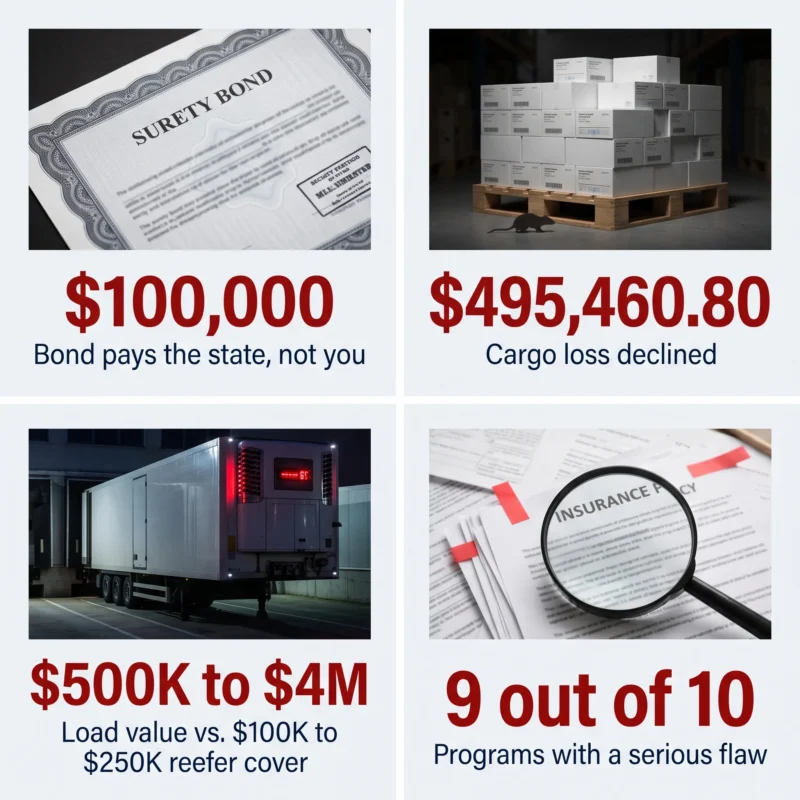
The license file only tells the state you have a policy, and that’s the trap in most pharmaceutical distributor insurance New Jersey programs. What happens when a loss lands is a different question, and the numbers get big fast:
Is the New Jersey $100,000 Bond the Same as Insurance?
No. The bond secures payment of administrative penalties and fees owed to the state, and it doesn’t pay a single customer claim. The nuance owners miss is that New Jersey lets insurance, a letter of credit or trust funds stand in for the bond, which makes the two easy to confuse on paper.
In plain terms, the bond protects New Jersey from you. Liability insurance protects you from the people who sue you.
You need both, and they never substitute for each other in a claim.
Question |
Surety bond |
Liability insurance |
|---|---|---|
|
Who does it protect? |
The State of New Jersey |
Your business |
|
What triggers payment? |
Unpaid penalties, fees or costs |
A covered claim or loss |
|
Who pays it back? |
You reimburse the surety |
Nobody, within the policy terms |
|
How much? |
$100,000, or $25,000 under $10 million in receipts |
Whatever limits you buy |
|
Per location? |
One bond can cover your separate locations |
Each location must be scheduled |
One bond can cover your separate locations, and the commissioner can waive it if you already hold a comparable bond in another state. That flexibility is useful, but it’s also why I ask every New Jersey client to show me the bond and the liability policies side by side.
More than once, an owner has told me the “insurance” on the license file was the bond.
Not sure what’s sitting in your license file? Book a call and we’ll sort the bond from the coverage in 15 minutes.
Why Does the License Minimum Fall Short of What New Jersey Customers Demand?
Because the state sets a floor, and your customers set the ceiling. New Jersey only asks whether you carry general and product liability. Manufacturers, hospital systems, GPOs and trading partners ask how much, on what form and with what wording. That gap is where most New Jersey certificates fail on the first pass.
I put it this way to clients: the license floor is not the contract ceiling. New Jersey’s due diligence rules require a New Jersey distributor buying from an unlicensed out-of-state wholesaler to obtain copies of that seller’s general and product liability coverage, so your certificate of insurance gets read by your trading partners, not just the state.
Standard |
Who sets it |
What it typically asks for |
Does it protect you? |
|---|---|---|---|
|
License floor |
NJ Department of Health |
Proof that GL and product liability exist |
Barely; it only proves a policy exists |
|
Contract ceiling |
Manufacturers, hospitals, GPOs, trading partners |
Specific limits, additional insured, primary/non-contributory, notice of cancellation |
Only if your policies actually match the wording |
|
Real protection |
Your losses |
Limits sized to inventory, product class and claims, plus the right endorsements |
Yes, when it’s built from your exposures |
When a schedule asks for coverage you don’t carry, the fix starts with the contract, not the certificate.
Our guide to customer contract insurance requirements walks through the clauses I read first, and product recall limits deserve their own line, because a general liability policy won’t pay to pull a lot back.
How Does New Jersey Product Liability Law Treat a Distributor That Didn’t Make the Drug?
It treats you as part of the chain, not a bystander. New Jersey folds most product injury claims into the New Jersey Products Liability Act, and plaintiffs routinely name wholesalers alongside manufacturers and pharmacies. The twist is that the less you control the product, the more your protection depends on contracts and endorsements, not on the law.
In the valsartan litigation consolidated in New Jersey federal court, wholesalers sat on the defendant list next to the manufacturers and pharmacies, and the court held that New Jersey personal-injury claims, except breach of express warranty, are subsumed by the Products Liability Act.
From what I’ve seen, that’s the moment a distributor learns the “middle-man” defense costs real money to raise.
Three things decide how exposed you are:
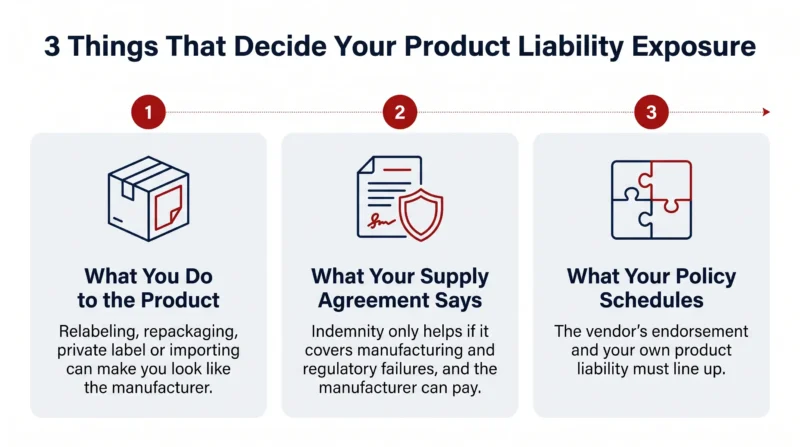
New Jersey’s consumer fraud and false claims statutes add state enforcement exposure for operators with New Jersey revenue, which belongs in the D&O conversation below.
Which Coverages Does a New Jersey Pharmaceutical Distributor Need?
The same core stack as any drug distributor: product liability, recall, stock throughput, cargo, crime, cyber, workers’ compensation and umbrella. What changes in New Jersey is where the risk concentrates: port-side inventory, a dense warehouse corridor, flood-prone docks, mandatory workers’ comp and customers with some of the heaviest contract demands in the country.
Here’s how each coverage in a pharmaceutical distributor insurance New Jersey program maps to the reason it matters:
Coverage |
The New Jersey reason it matters |
What I check |
|---|---|---|
|
Product liability |
Wholesalers get named in New Jersey product suits |
Vendor’s endorsement, aggregate limits, imported-product wording |
|
Product recall |
Corridor customers ask for dedicated recall limits |
Who pays recall expenses, third-party recall costs |
|
Owned stock moving from the Port of New York and New Jersey through the Exit 8A corridor |
Valuation at selling price, temperature endorsement, flood at the dock |
|
|
High-value loads on I-95 and the Turnpike |
Per-load limits, theft warranties, reefer conditions |
|
|
Crime and fidelity |
Diversion and employee theft of controlled or specialty drugs |
Limits far above the $25,000 I often see inside a package |
|
DSCSA data, trading-partner portals and wire payments |
Social engineering, business interruption |
|
|
Required for New Jersey employers |
Every warehouse and driver classified correctly |
|
|
Contract towers of $10 million or more |
Follow-form wording over product liability |
If you hold other companies’ drugs as a 3PL, warehouse legal liability leads, and your customers need their own stock coverage.
Facilities with a long industrial history also run into New Jersey’s environmental rules, so I check for pollution coverage on older sites.
Want to see your program against this table? Contact us and we’ll fill it in with your actual policies.
Will Your Policy Pay if a Refrigerated Shipment Goes Out of Range?
Only if your policy carries the right wording. Most standard cargo and property forms exclude spoilage, deterioration and delay, and an excursion often leaves the product looking perfect, which lets an insurer argue there was no physical damage at all. The bigger trap comes after the excursion: what you do with the product next.
Here are the denial reasons I see most, and how to get ahead of each one:
Denial reason |
How the insurer frames it |
How to close the gap |
|---|---|---|
|
Spoilage or deterioration exclusion |
“Loss or damage caused by spoilage, contamination, deterioration, freezing” |
Temperature-deviation or spoilage endorsement |
|
Delay |
Loss “arising from delay” is excluded, even if the product warmed |
Delay coverage or a carve-back for temperature loss |
|
No physical loss |
The vials are intact, so nothing was damaged |
Wording that treats a confirmed excursion as loss |
|
Missing temperature records |
No continuous logs, no set point, no pre-trip check |
Record-keeping you can actually meet |
|
Failure to salvage |
You destroyed product without testing it |
Pre-agreed salvage and destruction protocol |
|
Commodity sublimit |
Pharmaceuticals capped or excluded unless scheduled |
Pharmaceuticals scheduled at full value |
|
Carrier or contingent cargo cap |
The trucker’s reefer limit is far below the load |
Your own cargo or stock throughput at full value |
Real-world example: frozen vaccines and a salvage fight.
In American Home Assurance Co. v. Merck & Co., Merck, the New Jersey-headquartered drugmaker, read the temperature gauges on a delivered truck and “determined that the vaccines were unfit for use due to the possibility that they had frozen in transit.” The insurer disputed the loss, arguing among other things that Merck should have tried to salvage the product. Merck pointed to the FDA rule that drugs exposed to temperature extremes “shall not be salvaged and returned to the marketplace.” Even a company with Merck’s resources ended up in court over a frozen shipment.
Courts enforce delay wording too.
Theft is the other transit risk worth pricing out, and our guide on whether insurance covers stolen cargo explains the warranties that decide those claims.
What Can a New Jersey Supreme Court Ruling Teach a Distributor About D&O?
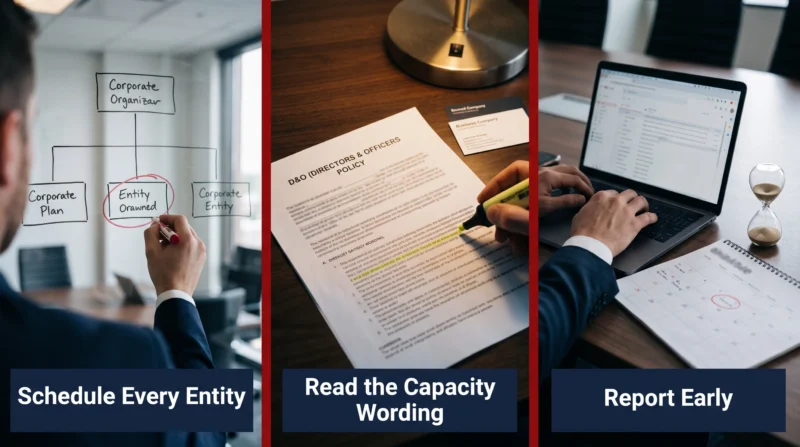
That the exclusions in your D&O policy mean exactly what they say. In Mist Pharmaceuticals v. Berkley Insurance, decided May 11, 2026, a divided New Jersey Supreme Court let the insurer refuse to fund a settlement under a capacity exclusion. The lesson for distributors runs deeper than one exclusion: it’s about how the policy lists your companies.
Berkley also alleged Mist’s “failure to comply with Berkley’s reporting requirements” hampered its investigation.
For a New Jersey distributor, three takeaways matter:
What Changes if You Handle Controlled Dangerous Substances in New Jersey?
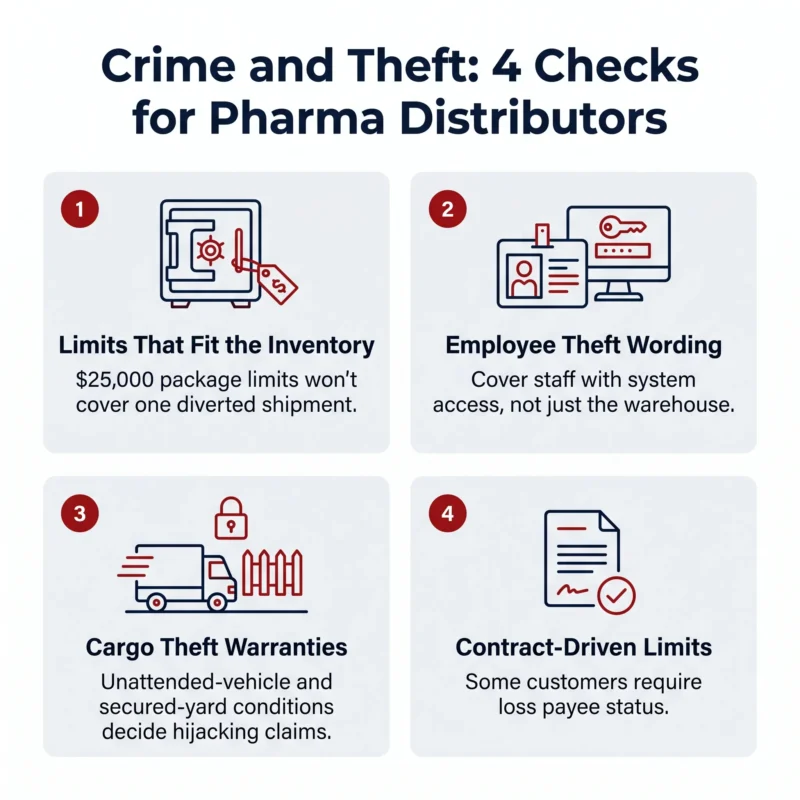
More registrations, more scrutiny and a bigger crime exposure. New Jersey’s application asks whether you handle controlled dangerous substances, and distributors that do must also register with the state and the DEA. The insurance side is where owners get surprised, because diversion and employee theft rarely fit the coverage they already have.
New Jersey’s rules say a distributor that deals in controlled dangerous substances must also register with the Department of Health and the DEA, and the DEA layers its own security rules on top. Every one of those controls shows up again in underwriting. Underwriters want to see access controls, cycle counts, vetted carriers, secured yards and continuous temperature monitoring before they’ll offer meaningful limits.
On the coverage side:
Handling CDS or specialty drugs? A second opinion on your business insurance doesn’t require you to switch brokers.
What Do Underwriters Look At, and What Does Pharmaceutical Distributor Insurance Cost in New Jersey?
Cost depends on five underwriting factors more than on the state: product class, inventory value, cold-chain share, customer-required limits and loss history. New Jersey adds pressure through corridor contract demands and port-side concentration. The part most owners skip is the diagnosis, and that’s what actually moves the price.
The Five Underwriting Factors
Here’s what underwriters weigh, and what to have ready before anyone quotes:
Factor |
Why underwriters care |
What to have ready |
|---|---|---|
|
Product class |
Rx, specialty, biologics and CDS carry very different severity |
Product list with share of sales by class |
|
Inventory value and locations |
Concentration at one dock or port terminal drives property and stock exposure |
Peak and average values by location, flood zone |
|
Cold-chain share |
Temperature losses are frequent and hard to adjust |
Share of refrigerated product, monitoring and SOPs |
|
Customer-required limits |
Contracts dictate products, recall and umbrella towers |
Every insurance schedule from your top customers |
|
Loss and regulatory history |
Past claims, recalls and inspection findings predict future ones |
Five years of loss runs and recent inspection reports |
Here’s how pricing ranges look for pharmaceutical distributor insurance New Jersey buyers, as of October 2026:
Program profile |
Annual premium range |
What moves it |
|---|---|---|
|
Distributor programs in general (our published range) |
$6,000 to $75,000+ |
Revenue, product mix, limits, claims |
|
Corridor-scale suppliers to big-pharma sponsors |
High six figures to low seven figures (published market commentary) |
$10 million+ products towers, recall, sponsor wording |
Lower premiums come from a stronger submission, better controls and the right markets, not from cutting limits your contracts require.
How Do I Review a New Jersey Distributor‘s Program Before It Goes to Market?
With a Confidential Review: a private look at your policies, bond, contracts and loss history before anyone approaches an insurer or you change brokers. We tell you what’s built correctly and what we’d change. Here’s the part owners don’t expect: it doesn’t disrupt your current broker, and the first conversation is 15 minutes.
I run it on every pharmaceutical distributor insurance New Jersey review, and the process runs the same every time:
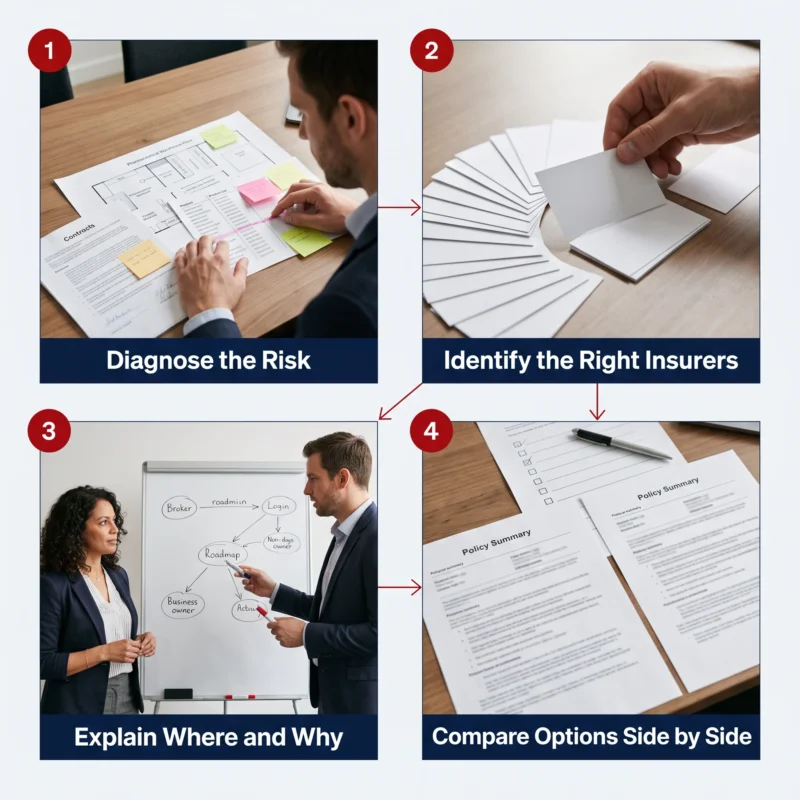
The workload benefit is real: fewer applications, fewer duplicate requests and one point of contact.
For a distributor example, see our food distributor case study.
Red Flags in a New Jersey Pharmaceutical Distributor Program
These patterns show up in our guide to wholesale distributor insurance gaps too.
What About Getting Quotes From Several Brokers?
Comparing options is smart.
Sending the same account to several brokers usually isn’t. Several brokers approach the same insurers, underwriters see duplicate submissions and the first broker to reach a market blocks the others. Generalists also tend to classify a drug distributor as a general wholesaler, which produces quotes for the wrong risk.
Who This Isn’t Right For
Ready for a clear answer? Book a 15-minute call, not an application.
Questions about Pharmaceutical Distributor Insurance New Jersey?
Build Pharmaceutical Distributor Insurance That Clears New Jersey and Pays Claims
A New Jersey program has to answer to three audiences: the state, your customers and the claims adjuster. That’s the difference between being covered and being adequately covered. It shows up when a hospital rejects your certificate, when a refrigerated load runs warm and when a product suit names you next to the manufacturer.
Our family has been in the insurance business since 1929, and we only do business insurance. We’re independent, not captive to any carrier. We review contracts before you sign, start renewals 90 to 120 days out and re-underwrite every year. You don’t need five brokers shopping your insurance. You need one capable broker making sure the right insurers compete for your business.
The first step costs nothing and doesn’t disrupt your current broker. We put your license file, customer schedules and policies side by side, then tell you what’s working, what’s missing and what I’d change.
Book a 15-minute call. If your program is solid, I’ll tell you that too.

This article was written by the CEO of The Coyle Group, Gordon B. Coyle, CPCU, ARM, AMIM, PWCA, who has over 40 years of experience working with business owners of all sizes and industries across the US, solving their insurance challenges.
Here’s how to take the next step
Schedule Your Insurance Confidence Assessment
In our 30-minute call, you’ll discover:
Not ready for a call?
Get Free Access to Our Gated Video:
“How to Finally Feel Confident in Your Coverage. “
And discover the exact system we use to help business owners eliminate hidden coverage gaps, stop overpaying, and finally feel confident in their protection.
What Peace of Mind Looks Like
Trusted by business owners across the U.S.
The Coyle Group is 1st class! Gordon and his team are knowledgeable, responsive, and attentive to detail. Gordon is that rare breed of professional who genuinely cares for his clients and works hard to exceed their expectations. I highly recommend them.

The insurance brokerage service was truly tailored to my needs, nothing like those big brokers who steer you toward random policies that don’t fit your profile. Thank you to the team for your help.

I was working with another broker and having difficulty acquiring General Liability coverage. A colleague recommended The Coyle Group. They were able to get coverage bound in just a couple of business days and a policy issued in ten days, and with a solid carrier at a competitive premium. Truly impressive results, plus it was a pleasure working with them. I highly recommend the Coyle Group!

If any business is looking to work with an insurance brokerage firm that is not only excellent at what the firm does, but one that deeply values the needs of the clients, then The Coyle Group is the firm for you. Give them a call and see for yourself. I can assure that you will quickly agree.

Want to know more?
See related blogs

The Crowdstrike Debacle and Cyber Insurance
Third Party Employment Practices Liability Insurance. Protect Your Business

Are You Overpaying or Underinsured on Your Business Insurance?
