
Multi-Unit Franchise Insurance
One Program or Separate Policies? How to Cover Every Unit Without a Gap

Index

Gordon B. Coyle
CEO, The Coyle Group
845-474-2924
How to get started
TL;DR. Executive Summary
Your first store was easy to insure.
That is the real job of multi-unit franchise insurance, and most groups don’t fix it until a claim forces the issue.
In plain terms, multi-unit franchise insurance is one coordinated program that covers every location a franchisee owns, built so each unit still meets its own franchise agreement and lease.
It replaces store-by-store policies with one schedule, one renewal date, and limits that protect each location separately.
The Coyle Group is a commercial insurance agency that handles the complex, high-value risks other agencies don’t know how to structure, where the details in the policy are the difference between a paid claim and a denied one.
You are tired of juggling it all. Each unit has its own policy, its own landlord, and its own list of franchisor requirements, and you only find out a store wasn’t covered after a claim. Our approach is to treat your units as one portfolio, with protection that still holds at every single location. In my experience, almost every program we review has at least one serious gap, and we find it before a claim does.
The next step is a short conversation. Book a call.
This guide is for established franchise groups with two or more units, real payroll, and a growth plan.
What Is Multi-Unit Franchise Insurance, and How Is It Different From Insuring One Store?
Multi-unit franchise insurance is one coordinated program that covers every location you own while still meeting each unit’s franchise and lease requirements. It is not just “more policies.” The catch is that insurance follows your legal entity, not your store names, and that single detail decides whether your units can share a program at all.
Franchising has moved toward groups like yours.
FRANdata also reports that 19.3% of franchisees now control 58.8% of all franchised locations.
Even so, I still see groups insured as if each store were a separate small business.
Here is what changes once you own more than one unit:
Getting this wrong is expensive.
I share a real example of exactly that further down.
Who May Not Need a Multi-Unit Program Yet?
A combined program is not right for everyone.
You may be better off with separate policies if:

Franchise groups face most of the same structure questions as any growing mid-market business, only with a franchisor’s rules layered on top.
Should You Put Every Location on One Master Program or Keep Separate Policies?
Most franchise groups with three or more units under common ownership should move to one master program. But “most” is not “all.” The smartest programs I build almost always leave one or two units out on purpose, and knowing which ones is where groups save money or lose it.
Here is how the three common structures compare:
Issue |
One master program |
Separate policies per location |
Franchisor-endorsed group program |
|---|---|---|---|
|
Renewal dates |
One date for every unit |
Staggered all year |
Set by the program |
|
Liability aggregate |
Shared, unless you add a per-location aggregate |
Each store has its own |
Varies by program |
|
Property limits |
One blanket limit can float between stores |
Each store limited to its own schedule |
Usually per location |
|
Adding a new unit |
Endorse it onto the program |
Shop and bind a new policy |
Enroll through the program |
|
Selling a unit |
Remove it by endorsement |
Cancel that policy |
Exit the program for that unit |
|
Certificates |
One carrier, consistent wording |
Different forms at every store |
Built to brand standards |
|
One bad store at renewal |
Affects the whole group |
Mostly stays with that store |
Affects your pricing in the pool |
|
Pricing leverage |
Strongest, carriers see your full size |
Weakest, every store looks small |
Uses the system’s buying power |
|
Mixing brands |
Possible, with careful underwriting |
Easy |
Usually one brand only |
|
Best for |
3+ units, same entity family, same risk |
1 to 2 units, or very different operations |
Owners who want simple compliance first |
To decide which units belong together in your multi-unit franchise insurance program, I use what I call The Three-Match Test.
A unit belongs on the master program only when it matches the rest of the group on all three:
When a unit fails any match, keep it on its own policy and review it again each year.
That usually covers a store with a liquor license, a turnaround location with heavy losses, or a unit you plan to sell soon. Bottom line is that almost all insurance programs we review contain at least one fatal mistake.
Book a call and we will run the Three-Match Test on your current locations.
Why Does a Per-Location Aggregate Matter So Much Once You Have Several Units?
A per-location aggregate matters because, without it, every store on your master program shares one annual limit. One location’s bad year can quietly use up the protection the other stores depend on. And here is the part most owners miss: your franchise agreement probably assumes each unit has its own limit already.
Your general liability policy has two key numbers.
If you want a deeper explanation, we cover general liability limits in detail.
Picture four stores on one program with a $2 million aggregate:
A per-location aggregate endorsement gives each scheduled location its own aggregate, so one unit cannot exhaust the program.
This is a core franchise issue, not a technical footnote.
Insurance guidance from the IFA Legal Symposium warns multi-unit owners to make sure per-unit insurance minimums are not being shared among locations.
Check the same structure on your liquor liability, and confirm how your umbrella responds. One umbrella over the program usually works, but only if its aggregate holds up per location. We explain how layers stack in umbrella vs excess liability.
What Does Your Franchisor Actually Require at Every Unit?
Your franchisor requires every unit to meet the insurance section of your franchise agreement independently, usually with set limits, additional insured status, and proof of coverage on demand. That sounds simple. The trouble is that each landlord adds its own demands on top, and the two lists rarely match.
The rules start before you sign.
The FTC’s Franchise Rule requires franchisors to give you a disclosure document, the FDD, and that is where insurance requirements are first spelled out.
Brands update them, and a new requirement often applies at your next renewal or your next unit.
At every location, expect to track:
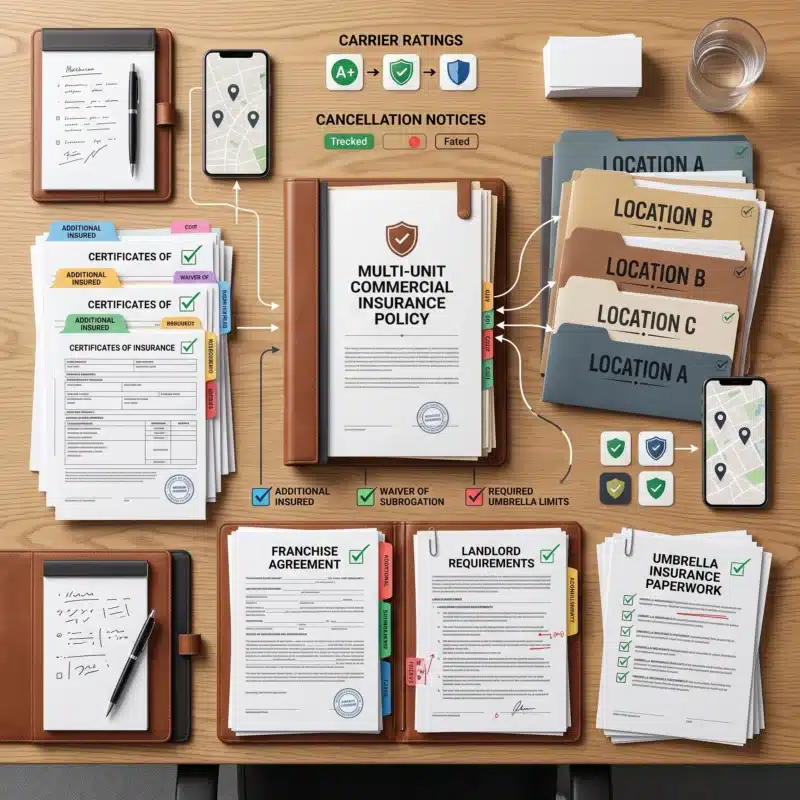
These clauses work just like other customer contract insurance requirements: what you signed sets the minimum your policy must deliver.
Many franchise agreements also let the franchisor buy coverage for you and send you the bill if your proof lapses.
What About the Franchisor’s Recommended Insurance Program?
Endorsed programs solve compliance fast, and some are excellent. But they are built around the brand’s minimums, not your full exposure.
How Do You Prove Compliance Without Drowning in Certificates?
A certificate of insurance only shows what coverage looked like the day it was printed.
With a well-built multi-unit franchise insurance program, one carrier issues every certificate with the same wording, which cuts most of the back-and-forth. Blanket additional insured endorsements that cover anyone you agree in writing to add save even more rework.
Contact us and we will compare your policies against your franchise agreement’s insurance section.
What Insurance Do Multi-Unit Franchise Owners Actually Need?
Multi-unit franchise owners need general liability, property, business interruption, workers’ comp, auto, an umbrella, EPLI, and cyber, plus liquor liability if you serve alcohol. The list looks like what a single store buys. What changes is how each coverage has to be built once your units share limits, people, and suppliers.
Coverage |
Why it matters at multi-unit scale |
Multi-unit watch-out |
|---|---|---|
|
General liability |
Every store has customers on site |
Add a per-location aggregate |
|
Commercial property |
Buildings, equipment, and inventory at each unit |
Blanket limits need an honest statement of values (your signed list of what each site is worth), or coinsurance (a penalty for understating values) can cut the claim |
|
Business interruption |
Lost income while a store is closed |
A shared commissary or key supplier can close stores that were never damaged |
|
Workers’ comp |
Your biggest headcount exposure |
Every state with employees must be listed |
|
Commercial auto and hired/non-owned auto |
Managers driving between stores, deliveries |
Employees using their own cars for errands |
|
Umbrella |
Sits above your primary limits |
Must satisfy the highest franchisor requirement |
|
EPLI |
More hires, more managers, more claims |
Third-party coverage and wage-and-hour limits |
|
Cyber |
Shared POS, payment data, loyalty apps |
Systems connected to the franchisor’s network |
|
Liquor liability |
Units that serve alcohol |
Same per-location aggregate question as GL |
|
Crime |
Cash handling at several sites |
Employee theft across locations |
Three of these deserve a closer look in any multi-unit franchise insurance review.
How Do Coverage Needs Change by Franchise Type?
The core stack stays the same, but the biggest exposure shifts with what your units actually do:
Franchise type |
Biggest exposures |
Coverage to check closely |
|---|---|---|
|
Quick-service and casual dining |
Slip-and-falls, foodborne illness, kitchen fires, alcohol |
Liquor liability, food contamination, shared commissary income |
|
Fitness and wellness |
Member injuries, equipment, 24/7 access |
General liability with member injury terms, equipment property |
|
Home services |
Vehicles, work inside customers’ homes, subcontractors |
Commercial auto, contractors’ tools, subcontractor certificates |
|
Retail |
Theft, inventory, customer injuries |
Crime, inventory values, seasonal stock |
|
Healthcare and med spa |
Treatment errors, patient data |
Professional liability, cyber |
|
Childcare and education |
Supervision claims, abuse allegations |
Abuse and molestation coverage, professional liability |
Which Policy Pays When Something Goes Wrong?
Here is how a well-built program responds to the claims I see most often in franchise groups:
What happens |
Policy that responds |
What can go wrong |
|---|---|---|
|
A customer slips at store three |
General liability |
The shared aggregate is already drained by another store |
|
An employee is burned in the kitchen |
Workers’ comp |
That state was never added to the policy |
|
A fire at the central kitchen closes four stores |
Business interruption with dependent property |
Only the damaged building was insured for lost income |
|
A manager crashes their own car running a bank deposit |
Hired and non-owned auto |
Nobody bought it, so the group pays directly |
|
Hackers steal card data through the shared POS |
Cyber |
Limits were sized for one store, not the whole group |
|
A fired employee sues for discrimination |
EPLI |
The policy only lists the original LLC |
What Won’t Multi-Unit Franchise Insurance Cover?
Multi-unit franchise insurance won’t cover anything your policies exclude, and every policy in the stack has exclusions. A master program makes management easier, but it does not widen coverage. The surprises usually come from assuming one policy picks up what another one leaves out.
Here are the gaps I explain to franchise groups most often:
None of these are reasons to avoid a program.
They are reasons to read every form against how your units actually operate.
Why Do Franchise General Liability Claims Get Denied?

Every one of these is preventable with a schedule review and the right endorsements before a claim happens.
How Do Workers’ Comp and Payroll Work When Your Units Cross State Lines?
Workers’ comp follows state law, not your franchise brand, so every state where you have employees must appear on your policy. Expanding into a new state changes the rules immediately. And one state’s quirk can break a multi-state program entirely if nobody plans for it.
Here is what I watch for when a group expands:
That last point surprises many owners. A sloppy safety culture at one unit doesn’t stay at that unit. It shows up in your premium at every location for three years.
Our workers’ compensation insurance guide explains how mods and audits work.
Book a call before you sign a lease in a new state, not after.
How Do You Add a New Location (or Sell One) Without a Gap?
You add a new location by endorsing it onto your existing program before it opens, with the franchisor’s wording in place from day one. Most policies include a short automatic extension for new locations. However, that extension is limited in time and dollars, and I would never let a store depend on it.
Here is the sequence I recommend for adding a unit to your multi-unit franchise insurance:
We cover this timing in more detail in does business insurance cover a new location.
Selling a unit works in reverse.
Remove the store from the schedule by endorsement on the closing date, and check your lease and franchise transfer terms for any certificate the buyer must provide.
Real example (the second location nobody added)
A growing manufacturer opened a second facility and kept its original property policy as it was. Nobody updated the schedule to include the new building. When a fire broke out at the new location, the carrier had no coverage in place for it, and the loss cost the company hundreds of thousands of dollars. The lesson for franchise groups is the same: a new unit is not covered just because the company is insured. It has to be on the policy before it opens.
Does One Location’s Claim Raise Premiums for All Your Units?
Yes. On a master program, carriers price your group’s combined loss history, so one problem store affects everyone’s renewal. That sounds like a downside. In practice, though, the same math rewards groups that run a tight safety program at every unit, and it gives you real leverage at renewal.
Carriers rate a multi-unit franchise insurance program on combined exposure and track record:
Cost driver |
What pushes premium up |
What brings it down |
|---|---|---|
|
Sales and payroll |
Fast growth with no updated exposure data |
Accurate, current figures at every renewal |
|
Property values |
Older buildings, no sprinklers, coastal sites |
Sprinklers, alarms, honest statements of values |
|
Locations and states |
Many states, weather-exposed regions |
Clustered markets, documented storm plans |
|
Alcohol sales |
A high share of revenue from liquor |
Server training and ID policies |
|
Loss history |
Frequent claims at one or more stores |
Clean history and fast incident reporting |
|
Policy structure |
Many small policies with minimum premiums and fees |
One program with consolidated fees |
|
Safety consistency |
Each store doing its own thing |
One safety and maintenance routine everywhere |
That last factor is the one you control. A group that runs the same training and inspection routine at every store gives underwriters confidence, and that usually shows up in the terms.
There is no honest single price, because a three-unit fitness group and a twenty-unit restaurant group look nothing alike to a carrier.
What I can promise is that consolidating usually removes duplicate policy fees and puts your full size in front of the market.
Contact us to have your group’s renewal marketed as one portfolio.
What Mistakes Do Multi-Unit Franchise Owners Make Most Often?
The most common mistake is listing a DBA instead of the legal entity that owns the store. It looks harmless on a certificate. Yet it is only the first of several small errors that compound as you add units, and most of them stay invisible until the day a claim is filed.
Here is my checklist of the mistakes I see most:
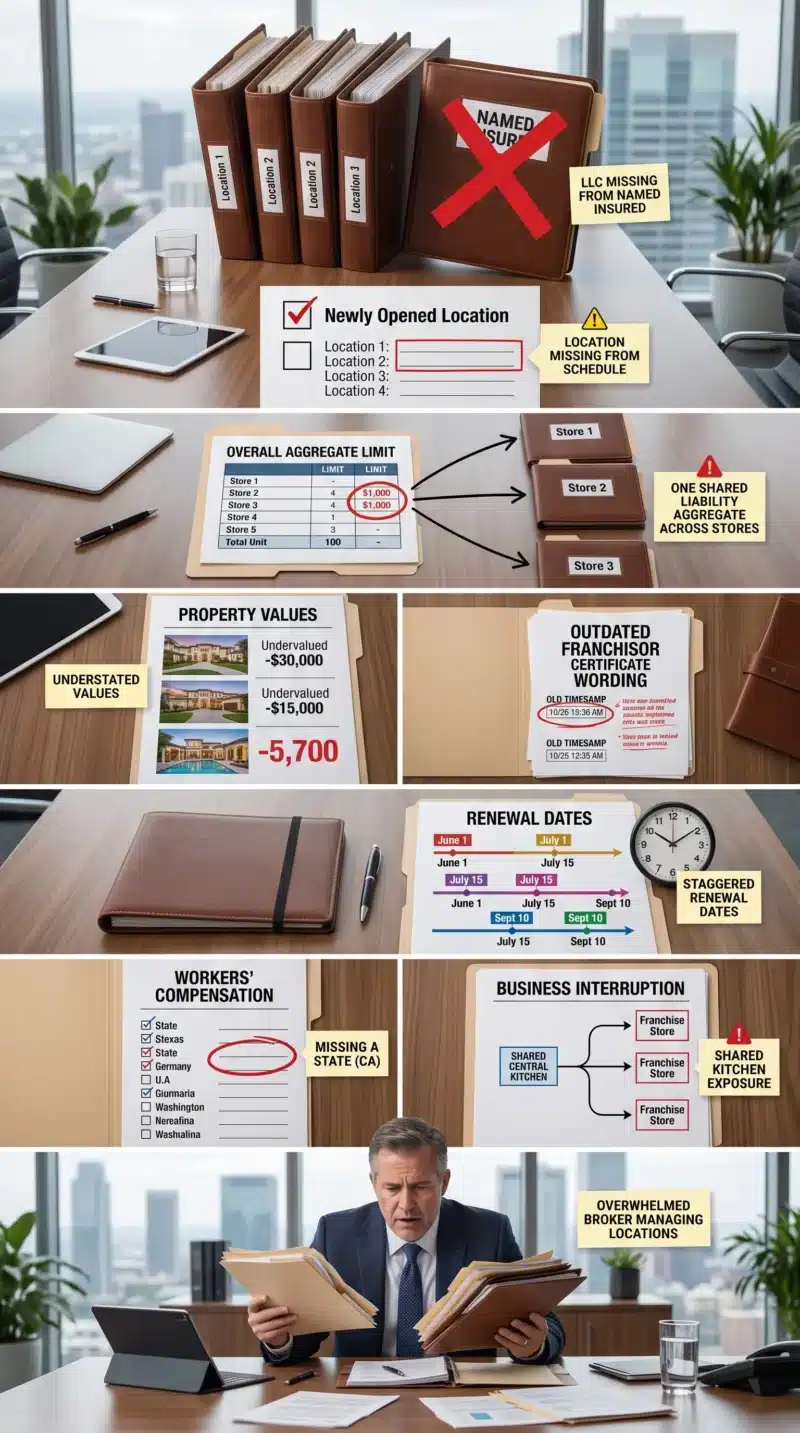
If you checked more than two, it is time for a full review.
Have You Outgrown the Broker Who Insured Your First Store?
If you own five franchises and your broker never reviews coverage gaps, you have probably outgrown them. That isn’t always a knock on the broker. It means your group now needs program thinking: someone who reads your franchise agreements, checks every schedule, and markets all your units as one account.
In my experience, a generalist broker misses the same things with franchise groups again and again:
How Do You Choose a Broker Who Specializes in Multi-Unit Franchises?
Plenty of agencies insure single franchise units. Far fewer specialize in multi-unit groups.
Look for a broker who:
Ask your current broker these questions about your multi-unit franchise insurance:
If the answers are vague, ask yourself should you switch insurance brokers. Frankly, you don’t know if a better alternative exists until someone shows you one. A second opinion on your business insurance is the low-risk place to start.
This approach fits best for established groups with several units, real revenue, and plans to keep growing.
What to Know Before You Buy Multi-Unit Franchise Insurance
Before you buy multi-unit franchise insurance, know which units belong together, what each franchise agreement requires, and where your current policies leave gaps. That covers most of the decision. The rest comes down to a handful of details that separate a program that pays from one that only looks complete.
Question |
Quick answer |
|---|---|
|
What is it? |
One coordinated program covering every unit you own, with each unit still meeting its own franchise and lease requirements |
|
Who needs it? |
Franchise groups with three or more units under common ownership and similar operations |
|
Who may not? |
Owners of one or two units, unrelated ownership groups, or very different operations |
|
Core coverages |
General liability, property, business interruption, workers’ comp, auto, umbrella, EPLI, cyber, liquor where needed |
|
What it won’t cover |
Anything a policy excludes, such as employee injuries under GL, vehicles under GL, wage-and-hour claims under most EPLI |
|
Cost drivers |
Sales, payroll, property values, states, alcohol, loss history, and policy structure |
|
Master or separate? |
Master program for units that pass the Three-Match Test; separate policies for the outliers |
|
Where standard setups fail |
DBA-only named insured, shared aggregate, staggered renewals, new units left off the schedule |
|
Must-have details |
Named insured schedule, per-location aggregate, one renewal date, blanket additional insured |
|
Why a specialist matters |
A franchise-savvy broker reads your agreement, structures the aggregate, and markets the whole group as one account |
Work With a Broker Who Insures Your Group as One Portfolio
The right multi-unit franchise insurance is not a stack of store policies. It is one program that passes the Three-Match Test, protects each location’s limits, and meets every agreement and lease you signed. Over 40 years, I have helped business owners find the gaps before the gaps find them, and growing franchise groups are where those gaps multiply fastest.
If you are opening another unit, a renewal is coming up, or your certificates have turned into a part-time job, let’s look at what your program actually covers.
Book a call and we will start with a no-obligation review of your insurance program.
Questions about Multi-Unit Franchise Insurance?
Get the Right Coverage for Your multi-unit franchise insurance
Most franchise groups don’t get into trouble because they bought too little insurance. They get into trouble because their insurance never grew with them. By the time you own your third, fifth, or tenth unit, you need more than an agent who renews policies. You need someone who reads your franchise agreements, checks every location on your schedule, and builds one program that still protects each store on its own.
That is the work we do every day at The Coyle Group. We set up master programs with per-location aggregates, list every entity you own, line up your renewals on one date, and place workers’ comp in every state where you have employees. When you open a new unit, it is covered before the doors open. And because we market your whole group as one account, carriers see your real size, which puts you in a stronger position at renewal.
Over 40 years, I have learned that the gaps in a policy only show up when a claim is filed. My goal is to find them first, so you can keep growing without wondering whether every store is protected. If you are ready to stop juggling policies and start running one program built for your whole group, let’s talk.

This article was written by the CEO of The Coyle Group, Gordon B. Coyle, CPCU, ARM, AMIM, PWCA, who has over 40 years of experience working with business owners of all sizes and industries across the US, solving their insurance challenges.
Here’s how to take the next step
Schedule Your Insurance Confidence Assessment
In our 30-minute call, you’ll discover:
Not ready for a call?
Get Free Access to Our Gated Video:
“How to Finally Feel Confident in Your Coverage. “
And discover the exact system we use to help business owners eliminate hidden coverage gaps, stop overpaying, and finally feel confident in their protection.
What Peace of Mind Looks Like
Trusted by business owners across the U.S.
The Coyle Group is 1st class! Gordon and his team are knowledgeable, responsive, and attentive to detail. Gordon is that rare breed of professional who genuinely cares for his clients and works hard to exceed their expectations. I highly recommend them.


The insurance brokerage service was truly tailored to my needs, nothing like those big brokers who steer you toward random policies that don’t fit your profile. Thank you to the team for your help.

I was working with another broker and having difficulty acquiring General Liability coverage. A colleague recommended The Coyle Group. They were able to get coverage bound in just a couple of business days and a policy issued in ten days, and with a solid carrier at a competitive premium. Truly impressive results, plus it was a pleasure working with them. I highly recommend the Coyle Group!

If any business is looking to work with an insurance brokerage firm that is not only excellent at what the firm does, but one that deeply values the needs of the clients, then The Coyle Group is the firm for you. Give them a call and see for yourself. I can assure that you will quickly agree.

Want to know more?
See related blogs

The Crowdstrike Debacle and Cyber Insurance
Third Party Employment Practices Liability Insurance. Protect Your Business

Are You Overpaying or Underinsured on Your Business Insurance?
