
Electronics Manufacturer Insurance
The Coverage Gaps That Turn One Bad Batch Into a Business-Ending Loss

Index

Gordon B. Coyle
CEO, The Coyle Group
845-474-2924
How to get started
You build or assemble a physical product, you have heard that insurance is a difficult thing to buy in your industry, and honestly you are not even sure the policy you have now would pay if a defective unit started a fire or a customer got hurt.
If you make circuit boards, components, consumer devices, IoT hardware, industrial or electrical equipment, or you assemble under contract, that uncertainty is the real problem, and it is a fixable one.
I am Gordon Coyle, and for over 40 years I have helped business owners navigate the complex world of commercial insurance. The Coyle Group is a commercial insurance agency that handles the complex, high-value risks other agencies do not know how to structure, where the details in the policy are the difference between a paid claim and a denied one. That last part matters more in your world than in almost any other, because the ways an electronics manufacturer gets hit are exactly the ways a generic policy quietly excludes.
Good electronics manufacturer insurance is built to close those gaps on purpose.
The short version
Electronics manufacturer insurance is a package of coverages, general liability, product liability, commercial property, equipment breakdown, workers compensation, business interruption, cyber, and manufacturer’s errors and omissions, built around how you actually make and sell electronics. The single biggest mistake I see is assuming your general liability policy covers a product recall or a defective component. It usually does not. This guide walks through what you need, what standard policies leave out, what it costs, and how to make sure your coverage is one that pays.
Why is electronics manufacturing so hard to insure?
Electronics manufacturing is hard to insure because you carry three heavy risks at once, a physical product that can injure or fail, expensive precision equipment, and a supply chain you do not control, and most standard policies were never built to hold all three.
Here is the part owners miss: the difficulty is not really about price, it is about fit, and the wrong fit is what leaves you exposed.
From what I have seen over 40 years, the “difficult industry” reputation comes from a real place.
Your products can overheat, short, or catch fire.
A single component that does not meet spec can cause a failure downstream that has nothing to do with bodily injury, which is exactly the kind of loss a general liability policy is not designed to pay.
Add imported or unbranded parts, contract assembly, and customers who demand specific insurance before they sign, and a cookie-cutter policy starts to look thin fast.
It also does not help that margins in this business are tight, even though the industry itself is enormous.
The Global Electronics Association’s 2025 economic impact report puts US electronics manufacturing at 5.2 million jobs, 853 billion dollars of GDP, and 1.8 trillion dollars of total output.
That is a lot of product in the field, and a lot of potential claims, so when margins are lean, a single uninsured loss does not just sting, it can take the year.
That pressure is exactly why electronics manufacturer insurance has to fit your operation instead of a template.
Almost all insurance programs we review contain at least one fatal mistake.
That is not a scare line, it is what we find when we audit these programs. Nine out of ten policies I review have a fatal flaw, and in electronics the flaws cluster in predictable places.
Let me show you where.
Want a second set of eyes on your current policy? Contact us and I will tell you what I see.
What does electronics manufacturer insurance actually cover?
Electronics manufacturer insurance covers the specific ways your operation can lose money: someone gets hurt or sued over your product, your building or equipment is damaged, your line stops, an employee is injured, or your data and designs are breached. The catch is that no single policy does all of that, and the way the pieces fit together is where good coverage is won or lost.
In practice, strong electronics manufacturer insurance is built from several coordinated parts, not one policy.
Think of it as a structure where each coverage answers a different question about what could go wrong.
Here is how I explain it to owners.
Coverage |
What it protects |
Why it matters for electronics |
|---|---|---|
|
General Liability |
Third-party bodily injury and property damage |
Baseline, but it will not cover your own product’s failure |
|
Product Liability |
Claims that your product injured someone or damaged property |
Central to devices, components, and consumer electronics |
|
Commercial Property |
Building, inventory, raw materials, finished goods |
Covers high-value components and clean-room build-outs |
|
Equipment Breakdown |
Mechanical and electrical failure of critical machinery |
Protects assembly robots, testing rigs, and precision tools from surges |
|
Workers Compensation |
Employee injury and occupational illness |
Required, and real given chemical and machine exposure |
|
Business Interruption |
Lost income when a covered event stops production |
Keeps you solvent during downtime |
|
Manufacturer’s E&O |
Pure financial loss from a product that fails to perform |
Fills the gap general liability leaves open |
|
Cyber |
Network, customer data, and proprietary designs |
Protects your IP and satisfies customer requirements |
The machinery, clean rooms, and testing infrastructure inside a modern electronics operation represent real workplace hazards, which is why the OSHA semiconductor safety standards exist in the first place.
Not sure which of these you already carry? Book a call and we will map it together.
What will your general liability policy NOT pay for?
Your general liability policy will not pay for the losses that scare electronics manufacturers most, and that gap is the whole reason electronics manufacturer insurance exists: a product recall, damage to your own product, or a pure financial loss when a component fails to perform. These sit inside what the industry calls the “business risk” exclusions, and they are the reason a claim you assumed was covered gets denied.
Here is the mechanic, in plain language.
Standard general liability and products liability policies are built to pay when your product hurts a third party or damages someone else’s property.
They are specifically not built to pay for your own product, your own work, or “impaired property” that is not physically damaged but is now less useful.
The three gaps I find in almost every electronics manufacturer’s policy, the gaps good electronics manufacturer insurance is meant to close, are these:
Miss these and the numbers get ugly fast.
A single uncovered recall or product-liability loss is often large enough to erase a year of profit, and I have seen smaller manufacturers that never fully recovered from one.
This is not fear-mongering, it is the arithmetic of an underbuilt policy.
Insurance is not a commodity, and this section is why I say it so often.
Two policies that look identical on a proposal can behave completely differently the day you file a claim.
If you are not certain your policy closes these three gaps, contact us and I will read yours.
Real example: the recall gap that costs a company everything
Here is the pattern I see play out, and it is worth pausing on because it is the most important argument for real electronics manufacturer insurance on this page. It is not a specific named client, it is the recurring gap I find when I audit electronics programs, and it has cost owners more than any other single mistake.
The scenario I keep finding
A growing electronics maker sells a consumer device that starts overheating in the field months later. The company does the responsible thing and pulls the product. They assume their products liability policy has them covered. It does not. The policy covers the bodily-injury claims from the few units that failed, but the far larger cost, retrieving and replacing thousands of units already shipped, hits a recall exclusion. They are now funding a six-figure recall out of operating cash, at the exact moment a disruption hits their revenue. A standalone recall endorsement, folded into their electronics manufacturer insurance for a fraction of that cost, would have paid.
Consumer electronics are a meaningful share of the recall landscape.
The Consumer Product Safety Commission recall list runs on a steady stream of them, overheating power stations, ventilation fans that short and catch fire, and battery-powered devices pulled from the market.
Batteries, chargers, and powered devices show up there year after year.
If you make them, the question is not whether recalls happen in your category, it is whether your policy would fund yours.
This is also where a coined distinction I use comes in. There is a difference between a policy that is priced well and a policy that is built well. The recall gap is invisible on price and decisive on outcome.
Watch my short walkthrough on the recall gap and how we close it, then book a call if it sounds like your situation.
What happens when your supplier or a single chip goes down?
If a supplier, fab, or single critical chip stops your production, your own property and business interruption policy usually will not pay, because that coverage only triggers when your property is physically damaged. This is one of the places electronics manufacturer insurance has to be built with intent. The gap is called contingent business interruption, and for electronics manufacturers it is one of the most dangerous blind spots on the board.
A modern electronics operation can be brought to a halt by one component from one overseas supplier, or by a fab that allocates capacity elsewhere.
None of that damages anything you own, so standard business interruption sits it out.
What responds is contingent business interruption insurance, a piece of well-built electronics manufacturer insurance that covers your lost income when a key supplier’s problem becomes your problem.
From what we see in practice, the manufacturers who survive a supply shock are the ones who insured the dependency before it broke, not after.
Concerned about a single point of failure in your supply chain? Contact us and we will pressure-test it.
Who is liable when a contract manufacturer or overseas factory builds your product?
If you use a contract manufacturer or an overseas factory, you are usually still liable to the end customer for a defective product, even though someone else built it, and your electronics manufacturer insurance is often the only thing standing between you and that bill. That surprises a lot of brands, and it is why “we outsource production” is never the same as “we outsourced the risk.” Where your protection actually comes from depends on how the contracts and coverage are structured.
Here is the reality I explain to founders
If your name and brand are on the product, an injured customer or a retailer coming after you will name you, regardless of who assembled the unit.
Your defense is a combination of your own electronics manufacturer insurance and being named as an additional insured on your manufacturer’s policy, with a proper waiver of subrogation in place.
This is a core part of how we structure contract manufacturer insurance, and it applies whether you assemble in-house, use a domestic partner, or source finished goods abroad.
Using a contract manufacturer and unsure who covers what? Book a call and we will untangle it.
Will this coverage satisfy your customers’ contract requirements?
Often it will not, unless it was built to, and that mismatch is the fastest way I see electronics manufacturers lose a deal. Your biggest customers will hand you an insurance requirement before they sign, and your electronics manufacturer insurance has to produce it on demand: additional insured status, a waiver of subrogation, specific minimum limits, and increasingly, technology errors and omissions. If your policy cannot produce those exact terms, the contract stalls.
I call this the enterprise contract shock, because it lands the same way every time.
You win a major retail or OEM account, you are ready to scale, and then their procurement team sends a two-page insurance schedule your current policy cannot meet.
Now you are scrambling to buy coverage under deadline pressure, which is the worst possible time to structure anything well.
The requirements I see most often include:
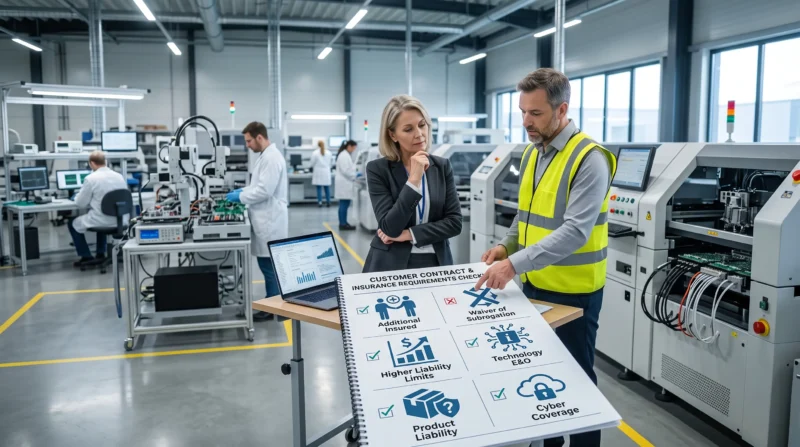
Getting ahead of these is straightforward when your broker builds your electronics manufacturer insurance with your sales pipeline in mind.
Getting caught flat is expensive and slow.
Have a customer contract you are not sure you can meet? Send it over. Contact us and we will check it against your policy.
How much does electronics manufacturer insurance cost?
Carriers price electronics manufacturer insurance on your risk, not at a flat rate, so the honest answer is that it ranges widely, from a few thousand dollars a year for a small operation to well into five figures for a larger manufacturer with real product-liability and recall exposure. What actually moves the number is more useful to understand than any single quote, because it is where you have leverage.
Industry cost data for manufacturers generally puts broker-placed programs somewhere between roughly 3,000 and 28,000 dollars a year depending on size, and electronics operations often sit in the upper part of that range because of product and recall exposure.
Here is what drives your premium:
Cost driver |
Pushes premium up when |
|---|---|
|
Product type |
Devices can injure, catch fire, or be recalled |
|
Annual revenue and volume |
More units in the field means more exposure |
|
Export and distribution |
Selling into strict-liability markets or big retail |
|
Sourcing |
Imported or unbranded components raise liability questions |
|
Compliance and testing |
Weak UL, safety, or QA processes raise risk |
|
Claims history |
Prior losses signal future ones |
Strong testing, documented quality control, and clean loss history all pull your number down over time.
Want a real range for your specific operation? Book a call and I will give you a straight answer.
Why work with a specialist instead of a generic agent or online quote?
Because in electronics, the gap between electronics manufacturer insurance that looks fine and a policy that pays is enormous, and only someone who understands your operation will catch it. A generic agent processes a renewal; a specialist in electronics manufacturer insurance audits your actual exposure. That difference is the whole ballgame when a recall or a defective-component claim lands on your desk.
Over 40 years, I have worked with seven, eight, and nine figure business owners, and the pattern is consistent.
The manufacturers who get burned are almost never the ones who paid too much, they are the ones whose broker never looked closely.
A specialist reads the business-risk exclusions, confirms your recall and contingent business interruption coverage, checks your contract requirements against your limits, and knows which underwriters will actually write your risk.
To be straight with you, not every maker needs a full program.
If you are a hobby-scale builder selling a handful of units a year, a basic policy may be plenty, and I would tell you so rather than sell you something you do not need.
I wrote this page for those established electronics brands, the companies where a single loss would genuinely hurt. If that is you, you have outgrown a policy built off a template.
Ready for a real review? Book a call and let’s make sure your coverage is one that pays.
How do you buy the right policy for your electronics business?
You buy the right electronics manufacturer insurance by starting from your actual exposures and your customer contracts, not from a premium number, then making sure the policy structure still holds up years down the road. The steps are simple, but the order matters, because the cheapest quote is almost never the one built around how you really operate.
Here is the sequence I walk owners through:

A few policy-level details quietly decide whether your electronics manufacturer insurance actually holds. Occurrence-based coverage, which responds to incidents that happen during the policy period even if the claim arrives years later, is usually safer for a manufacturer than claims-made coverage, where a lapsed policy or a missing retroactive date can leave an older product uncovered.
If you run multiple entities or a holding company, your named insured structure must list every one of them, because an omitted entity is a denied claim waiting to happen.
And your limits deserve a fresh look every time your revenue, product line, or largest contract changes, not only at renewal.
Want help running this sequence for your operation? Book a call and we will build it in the right order.
How to evaluate your current electronics manufacturing policy
You can evaluate your own policy faster than you think by checking the handful of places electronics coverage usually breaks. The goal is not to become an insurance expert, it is to spot whether the big exposures are actually addressed, so you know which questions to ask about your electronics manufacturer insurance before your next renewal.
Run this quick check against your current program:

If you cannot answer three or more of these with confidence, that is not a failure on your part, it is a sign your electronics manufacturer insurance was never built for how you actually operate.
That is a fixable problem, and it is exactly the kind of work we do.
What to know before you buy
If you read nothing else, here is the whole page in one place. Use it as your pre-purchase checklist for electronics manufacturer insurance.
Ready to put this into a real policy? Book a call and let’s make sure your coverage is one that pays.
Questions about Electronics Manufacturer Insurance?
Get the Right Coverage for Your Electronics Manufacturer Insurance
You know insurance is hard to buy in this industry, and you’re not sure the policy you have now would actually pay if a defective unit started a fire or triggered a recall.
This guide breaks down what electronics manufacturer insurance actually covers, the three gaps standard policies leave open, and what it really costs.
Written by Gordon Coyle, who has spent over 40 years closing the exact coverage gaps that turn one bad batch into a business-ending loss.

This article was written by the CEO of The Coyle Group, Gordon B. Coyle, CPCU, ARM, AMIM, PWCA, who has over 40 years of experience working with business owners of all sizes and industries across the US, solving their insurance challenges.
Here’s how to take the next step
Schedule Your Insurance Confidence Assessment
In our 30-minute call, you’ll discover:
Not ready for a call?
Get Free Access to Our Gated Video:
“How to Finally Feel Confident in Your Coverage. “
And discover the exact system we use to help business owners eliminate hidden coverage gaps, stop overpaying, and finally feel confident in their protection.
What Peace of Mind Looks Like
Trusted by business owners across the U.S.
The Coyle Group is 1st class! Gordon and his team are knowledgeable, responsive, and attentive to detail. Gordon is that rare breed of professional who genuinely cares for his clients and works hard to exceed their expectations. I highly recommend them.

The insurance brokerage service was truly tailored to my needs, nothing like those big brokers who steer you toward random policies that don’t fit your profile. Thank you to the team for your help.

I was working with another broker and having difficulty acquiring General Liability coverage. A colleague recommended The Coyle Group. They were able to get coverage bound in just a couple of business days and a policy issued in ten days, and with a solid carrier at a competitive premium. Truly impressive results, plus it was a pleasure working with them. I highly recommend the Coyle Group!

If any business is looking to work with an insurance brokerage firm that is not only excellent at what the firm does, but one that deeply values the needs of the clients, then The Coyle Group is the firm for you. Give them a call and see for yourself. I can assure that you will quickly agree.

Want to know more?
See related blogs

The Crowdstrike Debacle and Cyber Insurance
Third Party Employment Practices Liability Insurance. Protect Your Business

Are You Overpaying or Underinsured on Your Business Insurance?
