
Machine Shop Insurance
What it costs, why it is difficult to obtain, and how to structure a program that actually protects your operation.
Index

Gordon B. Coyle
CEO, The Coyle Group
845-474-2924
How to get started
Standard carriers regularly decline machine shops, push them to surplus-lines brokers, or quote rates that make no sense for the actual risk. As a result, shops end up operating with generic coverage full of gaps, or no coverage at all.
This guide breaks down exactly what machine shop insurance is, what it costs, why it is difficult to obtain, and how to structure a program that actually protects your operation.
The Coyle Group approach to machine shop insurance:
Machine shops are a specialty risk. Off-the-shelf business owner policies rarely cover the combination of high-value equipment, workers’ compensation exposure, and product liability that a shop faces every day. We structure machine shop insurance programs around the specific hazards of precision manufacturing, and we work with markets that understand the class.
What Is Machine Shop Insurance?
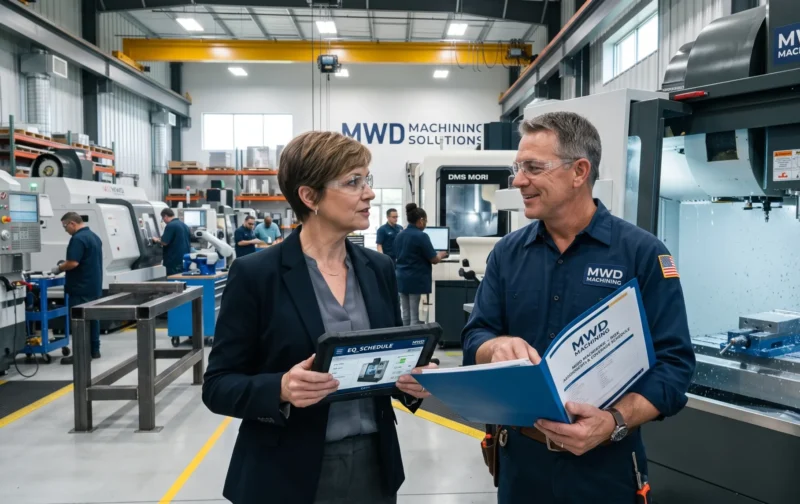
Machine shop insurance is a package of commercial policies designed to protect fabrication, CNC, welding, and precision manufacturing operations from the layered risks that standard business insurance often misses or excludes. A complete program covers your employees, your equipment, your building, and the parts you make and ship.
The term “machine shop insurance” is not a single policy. It is a combination of coverages, including general liability, commercial property, equipment breakdown, workers’ compensation, product liability, and inland marine, structured together for the specific hazards of metalworking and precision manufacturing.
Because a standard business owner policy (BOP) targets a retail store or an office, it will not address the equipment values, the injury exposure, or the product liability tail that a machine shop generates. As a result, settling for the wrong policy instead of real machine shop insurance leaves financial gaps that only become visible when a claim arrives.
A sole proprietor running a small home-based shop with no employees, no products shipped to customers, and no outside liability exposure may only need a scaled-down general liability and property policy until the business grows. Machine shop insurance becomes essential once you hire employees, ship parts to customers, or own equipment worth protecting at replacement cost.
For context on how manufacturers are covered more broadly, see Manufacturing Insurance.
Why Is Machine Shop Insurance So Hard to Get?
Machine shops are declined by standard carriers more often than almost any other small manufacturing business, and shop owners often spend months finding workable coverage or settle for policies that leave major gaps. As a result, the financial consequences of being underinsured or uninsured in this industry are severe.
The real cost of skipping machine shop insurance, or getting the wrong policy:
A CNC machine fire at a small shop can result in a property and equipment loss exceeding $150,000, plus the cost of business interruption while the machine is replaced or repaired
Manufacturing has a higher nonfatal injury rate than private industry overall, according to BLS data, and hand and upper-extremity injuries from cutting and machining equipment are common; the average medically consulted workplace injury cost $48,000 in 2024, according to the National Safety Council, and severe hand injuries with lost time routinely reach or exceed that average
A product liability lawsuit tied to a machined component failure can reach six or seven figures, even when the shop performed the work exactly to specification
The solution is a broker who specializes in manufacturing risks and has access to admitted and surplus-lines carriers who write machine shops as a regular part of their book. That combination typically produces better coverage and better pricing than a standard agent who submits the account cold to carriers unfamiliar with the class.
What Coverage Does Machine Shop Insurance Include?
A machine shop insurance program starts with six core coverages. Depending on the size of the operation, the type of work performed, and the industries the shop serves, several additional policies should also be considered. Skipping any of the core six creates a predictable gap that surfaces at the worst possible time.
Core Coverage Checklist
Coverage |
What It Protects |
Why Machine Shops Need It |
|---|---|---|
|
General Liability |
Third-party bodily injury and property damage |
Required by most commercial landlords and customers; covers incidents on your premises |
|
Commercial Property |
Building, CNC machines, tooling, fixtures, raw stock |
Needs to reflect actual replacement cost of specialty equipment, not book value |
|
Equipment Breakdown |
Electrical failure, motor burnout, mechanical breakdown |
Excluded from most standard property policies; essential for CNC-dependent operations |
|
Workers’ Compensation |
On-the-job injuries and occupational illness |
Mandatory in most states; machine shops carry above-average injury rates for manufacturing |
|
Product Liability |
Claims that a machined part caused injury or damage after leaving the shop |
Critical if parts are incorporated into other products; often underestimated by owners |
|
Inland Marine / Tools |
Off-premises tools, customer-owned material in your care |
Covers equipment or customer-supplied stock not protected under standard property forms |
Additional Coverages Worth Considering
Beyond the six core coverages, a handful of additional policies round out a mature machine shop insurance program.
How Much Does Machine Shop Insurance Cost?
A complete machine shop insurance program typically costs between $5,000 and $25,000 or more per year for a small to mid-size shop once you include workers’ compensation. The exact number depends on the key pricing variables, payroll, equipment value, loss history, and end-use industry, which differ widely from one shop to the next, so the ranges below reflect real-world data across small to mid-size operations.
Typical Annual Premium Ranges
Coverage |
Typical Annual Cost |
|---|---|
|
General Liability |
$1,000 to $6,000 |
|
Commercial Property |
$2,000 to $20,000+ (depends on equipment value) |
|
Equipment Breakdown |
$300 to $1,800 |
|
Workers’ Compensation |
Approximately $6.50 per $100 of payroll (industry average) |
Payroll is the single largest variable in that total: a shop with $250,000 in covered payroll carries approximately $16,250 in workers’ comp alone before state adjustments and experience modifiers, while a shop with $500,000 in payroll would be closer to $32,500.
What Drives Machine Shop Insurance Costs Up
What Brings Costs Down
For more on how workers’ comp rates are calculated and what you can do to reduce the experience modifier, see Workers’ Compensation Insurance.
Do Machine Shops Need Product Liability Insurance?
Product liability is the most underestimated coverage in a machine shop insurance program. The short answer is yes: almost every machine shop that supplies parts to other businesses needs product liability coverage, regardless of whether the shop designs anything, and regardless of whether the customer’s engineering department created the print. The narrow exception is a shop that never ships a finished part beyond its own walls, and that scenario is rare in this industry.
The most common misconception is that product liability only applies to companies that design products. In practice, any shop that produces, modifies, or contributes to a component that later causes harm faces product liability exposure. A machined part with a dimensional error, a heat-treating mistake, or a surface finish that creates a fatigue point can all result in claims that bypass the customer and land directly on the machine shop.
For more on how product liability interacts with a broader manufacturing program, see Product Recall Insurance.
What Policy Structure Details Actually Matter for a Machine Shop?
Machine shop insurance is not just about which coverages you buy: it is about how you structure those policies, and structure decisions are where claims get paid or denied. Four structural details matter more than most owners realize, and getting one wrong creates the same kind of gap as skipping a coverage altogether.
Get these four details wrong, and even a shop with every core coverage in place can find a legitimate claim denied on a technicality.
What Should I Give My Broker to Quote a Machine Shop?
Give your broker eight pieces of information to get an accurate machine shop insurance quote: annual payroll by job classification, total insured equipment value at replacement cost, revenue, a description of your operations, your end-use industries, whether you handle customer-supplied materials, three to five years of loss runs, and current certificates of insurance. Incomplete submissions are the single biggest reason shops get inflated quotes or are declined, so gathering this before you call closes that gap.
Information to gather before contacting a broker:
Why a specialist broker matters:
Standard agents submit machine shop insurance accounts to standard carriers and often get poor results: either a decline, or a quote from a carrier using a generic manufacturing rate with no understanding of the actual operation. A broker who specializes in manufacturing knows which admitted and surplus-lines markets write machine shops, how to structure the submission to avoid underwriting red flags, and which coverage gaps to close before a claim exposes them.
The difference in outcome is not marginal. Shops placed with the right carrier commonly pay less and carry better coverage than the same shop placed by a non-specialist with a carrier that treats all manufacturing as interchangeable.
What Raises Machine Shop Insurance Premiums?
Machine shop insurance premiums rise most because of CNC equipment worth over $500,000, welding or open-flame work inside the building, flammable materials stored in quantity, aerospace or medical device customers, high employee turnover, and prior workers’ comp claims for lacerations or crush injuries. Some of these factors you control, and some you do not, and knowing the difference is what lets you manage cost instead of just accepting the renewal number.
Workers’ comp is usually the most variable and most expensive part of a machine shop insurance program. The experience modification rating, which reflects your claims history relative to the industry average, can add or subtract 20 to 40 percent from your base premium depending on how it moves.
Real-World Example: When the Right Coverage Made the Difference
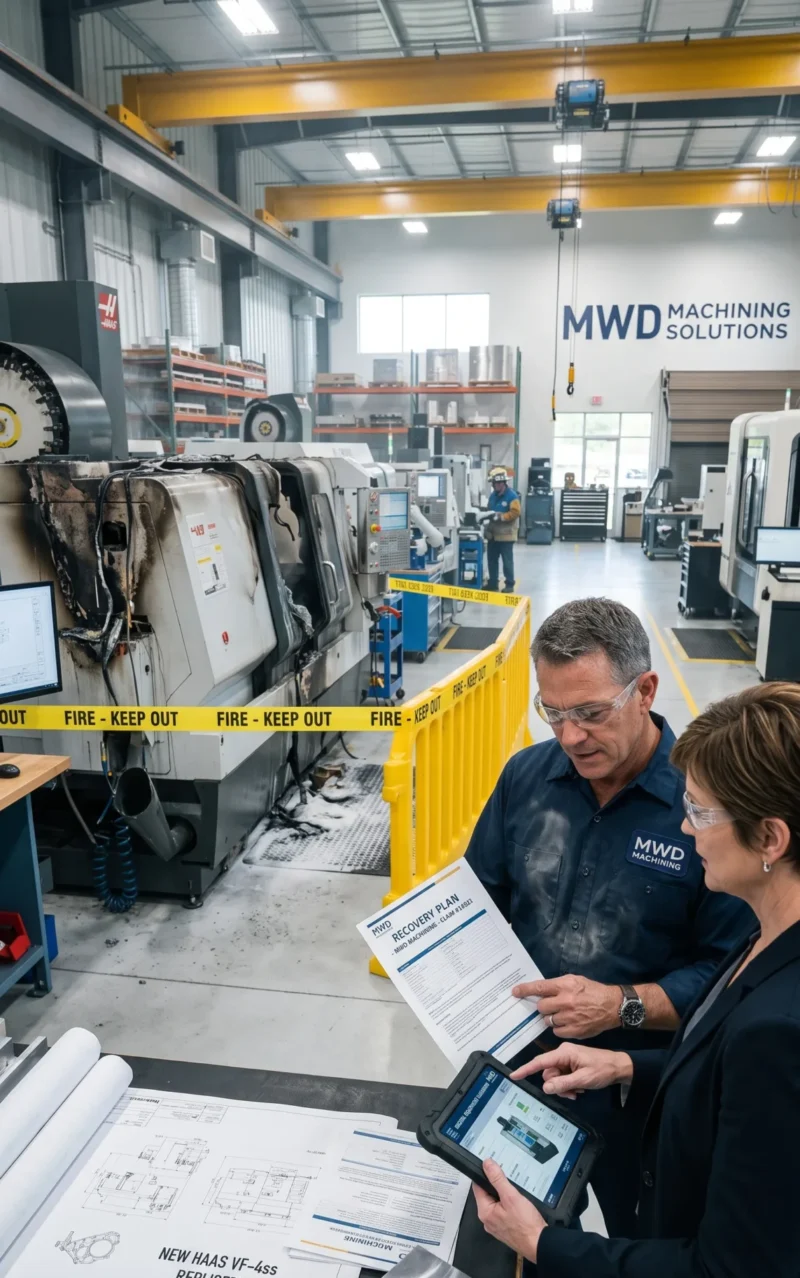
A mid-sized machine shop we work with had been placed by a retail agent with a standard BOP and a generic commercial property policy. The shop primarily machined aluminum and steel components for the automotive aftermarket. When a motor failure on their flagship CNC lathe triggered a fire that destroyed the machine and damaged adjacent equipment, the claim came back partially denied.
The reason: the policy did not include equipment breakdown as a standalone endorsement, and the carrier argued the fire originated from a mechanical failure, not a covered external cause under the property form. The shop faced an uninsured loss exceeding $80,000.
After the loss, they came to The Coyle Group. We rebuilt their machine shop insurance program with explicit equipment breakdown coverage, confirmed that property limits reflected current replacement costs rather than depreciated values, and placed workers’ comp with a carrier that had manufacturing experience and an appetite for the class. At the next renewal, total premium was lower, and the coverage was substantially stronger across every line.
How Does Workers’ Compensation Work for a Machine Shop?
Carriers price workers’ comp for a machine shop against payroll and assigned classification codes that reflect the specific type of work each employee performs. It is almost always the largest single line item in a machine shop insurance budget, and it is also the line with the most opportunity for cost management.
Manufacturing classification codes typically carry higher base rates than most other industries because of the injury frequency associated with heavy machinery, sharp tooling, and physical labor. The specific code applied to machinists, welders, and fabricators determines the base rate, which is then multiplied by total payroll in that class and adjusted by the shop’s experience modifier.
Key factors in workers’ comp pricing for machine shops:
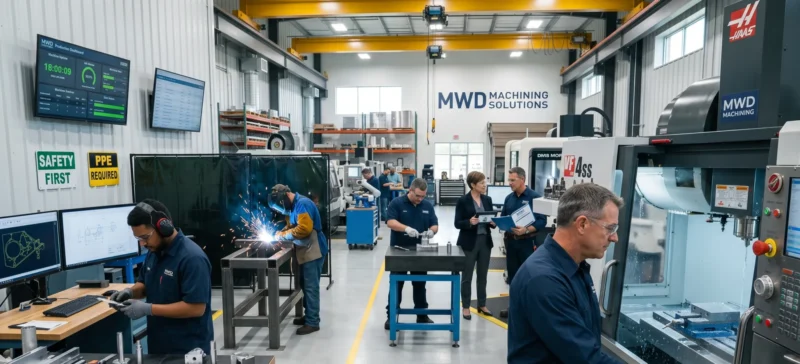
A strong workers’ comp program, one piece of a complete machine shop insurance strategy, starts with correct classification, builds in a documented safety protocol, and includes a return-to-work policy that keeps injured workers engaged and reduces the total cost of each claim. For a complete explanation of how workers’ comp experience modifiers work and how to reduce yours, see Workers’ Compensation Insurance.
What Are the Most Common Machine Shop Insurance Claims?
The most common machine shop insurance claims are workers’ comp lacerations and crush injuries, equipment breakdown from motor or control failures, fire from welding sparks or electrical faults, product liability claims tied to tolerance or specification failures, and theft of tools, carbide inserts, or copper wiring. Knowing which of these actually triggers claims, and how much each one typically costs, tells you where to focus your loss-control effort instead of guessing.
Most common claim types and their average impact:
How to Evaluate a Machine Shop Insurance Broker
The fastest way to evaluate a machine shop insurance broker is to ask five questions: which carriers in your market write machine shops, what class codes apply and how they determined that, whether they have loss control resources for metalworking, whether they can give references from shops they currently insure, and how they handle surplus-lines placement. A broker who cannot answer confidently is not the right fit.
What to ask a prospective broker:
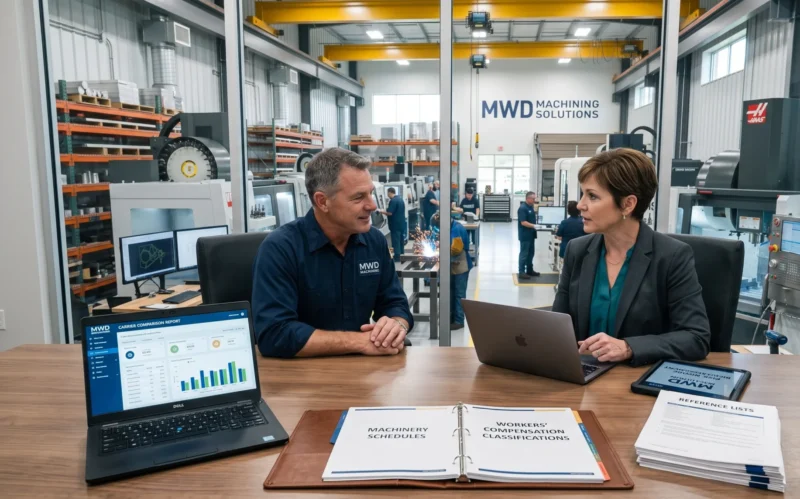
A specialist who knows the class will have clear answers, direct access to the relevant markets, and a process for reviewing your machine shop insurance every year as the shop grows and the risk profile evolves.
The Coyle Group works with machine shops and precision manufacturers across the United States. We structure programs through the Manufacturing Insurance hub that covers the full range of manufacturing-specific exposures, and we place the coverages through carriers who understand the class and price it accordingly.
Quick Answers: What to Know Before You Buy Machine Shop Insurance
The Coyle Second Opinion
9 out of 10 business insurance policies we review have a gap that would sink a claim
Yours might be one of them, and the only time you find out is when you file a claim and it gets denied. Send us your policy for an independent, confidential read: what’s covered, what’s missing, what you’re overpaying for. We never contact your broker or shop the market. Flat $2,500, refunded in full if you don’t get real value.




The team that reads your policy, line by line.
Questions about Machine Shop Insurance?
Get The Right Coverage For Your Machine Shop
With over 40 years of experience placing commercial insurance for manufacturing businesses, Gordon B. Coyle understands the specific risks machine shops carry: equipment breakdown on high-value CNC machinery, product liability exposure when a part you manufactured ends up in someone else’s finished product years later, and the workers’ compensation claims that come with running heavy cutting and machining equipment every day.
At The Coyle Group, we specialize in commercial insurance for machine shops and precision manufacturers. We know which carriers write this class correctly, which exclusions to test for before binding, and how to structure a program that covers your equipment, your product liability exposure, and your workforce without leaving the gaps that surface at the worst possible time.
If you are ready to review your current machine shop insurance program or build the right coverage from the ground up.

This article was written by the CEO of The Coyle Group, Gordon B. Coyle, CPCU, ARM, AMIM, PWCA, who has over 40 years of experience working with business owners of all sizes and industries across the US, solving their insurance challenges.
Here’s how to take the next step
Schedule Your Insurance Confidence Assessment
In our 30-minute call, you’ll discover:
Not ready for a call?
Get Free Access to Our Gated Video:
“How to Finally Feel Confident in Your Coverage. “
And discover the exact system we use to help business owners eliminate hidden coverage gaps, stop overpaying, and finally feel confident in their protection.
What Peace of Mind Looks Like
Trusted by business owners across the U.S.
The Coyle Group is 1st class! Gordon and his team are knowledgeable, responsive, and attentive to detail. Gordon is that rare breed of professional who genuinely cares for his clients and works hard to exceed their expectations. I highly recommend them.

The insurance brokerage service was truly tailored to my needs, nothing like those big brokers who steer you toward random policies that don’t fit your profile. Thank you to the team for your help.

I was working with another broker and having difficulty acquiring General Liability coverage. A colleague recommended The Coyle Group. They were able to get coverage bound in just a couple of business days and a policy issued in ten days, and with a solid carrier at a competitive premium. Truly impressive results, plus it was a pleasure working with them. I highly recommend the Coyle Group!

If any business is looking to work with an insurance brokerage firm that is not only excellent at what the firm does, but one that deeply values the needs of the clients, then The Coyle Group is the firm for you. Give them a call and see for yourself. I can assure that you will quickly agree.

Want to know more?
See related blogs

The Crowdstrike Debacle and Cyber Insurance
Third Party Employment Practices Liability Insurance. Protect Your Business

Are You Overpaying or Underinsured on Your Business Insurance?
