
Quick Answer
An indirect loss cost is any expense a claim creates that insurance does not reimburse, such as lost productivity, overtime, retraining, downtime, and administrative time. On a workplace injury, these uninsured costs often run several times the insured medical and wage bill, and the employer absorbs every dollar.
We hear from business owners all the time who were blindsided by what a single claim actually cost them. The insurance company paid the medical bills and the lost wages, so on paper the claim looked handled. Then the real invoice arrived: overtime to cover the missing worker, a production line that sat idle, a temporary hire who needed weeks of training, a supervisor pulled off the floor to write incident reports, and a workers compensation premium that jumped at the next audit. None of that showed up on the claim file, and none of it was reimbursed.
That gap is the single most misunderstood number in commercial insurance, and it is where The Coyle Group does its most valuable work. We specialize in the complex, high-value risks that other agencies do not know how to structure, and indirect loss cost management is exactly that kind of discipline. It is well established in the Fortune 500 world, yet it gets almost no attention in the middle market, which is a costly oversight.
The problem, in plain terms
You are negotiating your insurance renewal on premium alone, while the far larger cost of your claims goes unmanaged. Most brokers chase a small premium discount and ignore the uninsured costs that actually move your profit margin. The Coyle Group flips that priority through The Strategic Risk Process, and we have delivered cost reductions many times larger than any premium cut.
Book a call and we will show you where your money is really going.
What Is an Indirect Loss Cost?
An indirect loss cost is any cost incurred during a claim that is typically not reimbursed by insurance. These costs can follow any claim, including auto crashes, slip and fall liability claims, product liability claims, and direct damage to property from a fire or flood. The insurer pays the visible bill, and the business quietly absorbs everything else the disruption sets in motion.
The indirect loss cost conversation is most common among risk managers and decision-makers dealing with workplace accident claims, because these tend to generate the highest ratio of indirect to direct costs. That is why so much of this discussion centers on workers compensation, even though the same pattern shows up in property and liability losses too. There is one important distinction to clear up first, because the phrase gets used two different ways, and confusing them will cost you money.
A quick note on terminology. In property insurance, an “indirect loss” often means business income or consequential loss that follows physical damage, such as lost revenue while a building is repaired. In risk management and workers’ compensation, “indirect loss costs” means the uninsured operational and financial ripple effects of a claim. This article focuses on that second meaning, the hidden costs that stay with the employer, because that is where the largest unmanaged dollars sit.
Direct vs Indirect Loss Costs: What Is the Difference?
The difference is simple. Direct costs are the obvious, insured, or easily measured expenses of a claim, such as medical payments, wage replacement, repair bills, and legal settlements. Indirect costs are the ripple effects that do not appear on the claim file but still hit the business, such as downtime, lost productivity, retraining, and administrative time. One arrives as a bill you expect. The other is everything the disruption forces you to absorb.
Below is how the two compare on a typical workplace injury.
Cost type |
Typical items |
Who usually pays |
|---|---|---|
|
Direct costs |
Workers comp benefits, medical care, claim settlement, repair bills, legal fees |
Insurer, employer, or both depending on coverage and deductibles |
|
Indirect costs |
Overtime, lost output, downtime, retraining, supervision, quality defects, admin time, morale effects |
Employer, almost always outside the insurance policy |
This distinction matters because your insurance conversation is usually built entirely around the first row. Most agents are focused on the direct, insured costs, because that is what they can quote and negotiate. The far larger second row goes unmanaged, and that raises an obvious question: how much larger is it, really? The answer is what makes this topic worth your time.
Why Indirect Loss Costs Matter So Much to Your Bottom Line
They matter because they are genuine, significant costs that quietly erode profit while everyone stares at the premium. Industrial expert opinions vary on the exact size of the indirect costs of workers compensation claims, but they are usually expressed as a multiple of the direct or insured costs. Depending on the size of the injury claim, that multiple can be as low as 1.1 and as high as 10 times. Most industrial experts settle on a multiple of 4.
Put that into dollars. A worker injury that incurs $10,000 of direct costs in medical bills and replacement wages will also incur roughly $40,000 of indirect costs, which are uninsured and borne entirely by the employer. That is the same claim, four times larger than it looked. The federal government reinforces this on the OSHA Safety Pays estimator, which states plainly that the employer always pays the indirect costs, and uses an indirect cost multiplier and your profit margin to project how much revenue you need to generate just to break even on an injury.
The uninsured mass beneath the surface
According to the National Safety Council, the total cost of work injuries in 2024 was $181.4 billion, which included $15.5 billion in employers’ uninsured costs and worked out to roughly $48,000 per medically consulted injury. OSHA’s own Business Case for Safety and Health notes that employers pay more than $1 billion per week in direct workers compensation costs alone, and that the total societal impact ran past $1.3 trillion in a single year.
The insured tip of that is enormous. The uninsured mass beneath it is larger still. That is the cost of leaving these numbers unmanaged, and the good news is that they respond to the right process.
The Types of Indirect Loss Costs When a Worker Is Injured
When a worker is injured, the indirect costs stack up quickly across production, staffing, administration, and morale. Most of them never touch the insurance claim, yet each one draws directly from your operating profit. Some are easy to spot within days. Others, like a reputation hit or a premium increase, do not fully surface until months later, which is what makes them so easy to underestimate at the time of the accident.
Here are the indirect costs a company commonly absorbs after an industrial accident:
These are all borne by the company, and that list does not even touch the human, emotional, and financial toll on the injured worker and their family, which can easily outweigh the cost to the employer. Many of these drivers trace back to a small number of root problems, which is why a disciplined root cause analysis often uncovers savings that a premium negotiation never could.
Which Industries Face the Highest Indirect Loss Costs?
The industries with the highest indirect loss costs are those where a single injury halts output or the injured worker is hard to backfill, such as manufacturing, warehousing and logistics, construction, and healthcare. The exposure is not equal across them, and the reason one sector absorbs far more per claim than another comes down to how fast the work can resume after an incident.
Industry |
Top indirect cost drivers |
|---|---|
|
Manufacturing |
Line stoppage, scrap and rework, overtime, temporary staffing. |
|
Warehousing and logistics |
Disrupted picking and loading, delivery delays, investigation time. |
|
Construction |
Crew reassignment, milestone delays, idle equipment, subcontractor coordination. |
|
Healthcare and services |
Staff shortages, overtime, service delays, reputational impact. |
The common thread is recovery speed. A manufacturer that can reroute a line loses less than one that cannot, and a contractor who can reassign a crew loses less than one whose project stalls. That is why the reduction tactics later in this guide focus on preventing incidents and restoring productive work quickly, because those two levers move the largest numbers in the table above.
The Iceberg Model: Total Cost of Risk Below the Waterline
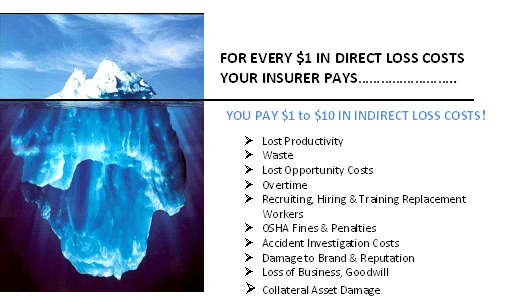
The iceberg is the classic metaphor for direct versus indirect loss costs, and it holds up because it captures the proportions so well. For most insurance brokers and their clients, only the tip is visible above the waterline. Those are the direct costs of claims, the amounts the insurer pays to remediate a loss. Below the surface sits the far larger mass of indirect costs.
That hidden ballast is what quietly sinks a firm’s profit margin. This is also the foundation of a concept called Total Cost of Risk, or TCOR. TCOR reframes the conversation from how much did the claim pay to how much did this event actually cost the company.
A complete TCOR view includes retained losses, premiums, deductibles, administrative costs, risk control spending, and the hidden indirect losses that disrupt operations. When you measure TCOR instead of premium alone, the priorities change immediately, because the biggest number on the page is no longer the one your broker has been optimizing. That shift in measurement is the first step in our process, and it changes what a renewal is even for.
How the Indirect Cost Multiplier Works
The multiplier is a shorthand for estimating indirect costs from the direct cost you already know. If a claim has $25,000 in direct costs and you apply a 4x multiplier, you are looking at roughly $100,000 in indirect costs on top, for a true cost near $125,000. The multiplier is not a precise measurement of any single claim. It is a planning tool that turns an invisible cost into a number you can budget, defend to leadership, and target for reduction.
Estimate your true cost in three steps
First, start with the direct cost of the claim, meaning the medical bills plus the indemnity or wage replacement.
Second, multiply that figure by about 4 for a serious lost-time claim to estimate the indirect costs on top.
Third, divide the combined total by your profit margin to see the amount of sales you would need just to break even on the injury.
The exact multiple depends on severity, workforce size, how hard the injured worker is to replace, and your industry. OSHA’s Safety Pays estimator applies the multiplier against your profit margin to show something most owners have never seen: the amount of additional sales required just to cover an injury. That framing is powerful because it converts a safety problem into a revenue problem, which is the language your CFO and your operations team actually use.
A Real Example: The Eight-Fold Cost Reduction
The clearest way to prove all of this is with numbers, so here is a worked example. It is academic by design, but we have delivered similar results in real engagements. It shows the difference between a traditional broker’s approach and ours on the exact same account, and the gap between the two outcomes is not small.
The subject company is a cookie manufacturing firm in New York with 300 employees. Based on Bureau of Labor Statistics data, a company this size averages about 4.7 claims per 100 employees per year. To stay conservative, we round down to 4 claims per 100 employees, so this company can expect about 12 claims a year. For the example, half of those involve lost time, giving us 6 major claims and 6 minor claims.
The average cost of a lost-time injury claim is statistically around $40,000. That means this company incurs about $240,000 in direct loss costs, which are insured, and about $960,000 in indirect costs, which are uninsured, based on the generally accepted 4x multiple. The workers compensation insurer pays the direct costs such as lost wages and medical bills. The employer pays the rest.
The average profit margin in cookie manufacturing is 5.2 percent. At that margin, the company would need to generate an additional $18 million in sales just to cover those indirect costs, which is not an easy feat in any economy. This manufacturer pays about $900,000 a year in workers compensation premium for a guaranteed cost policy.
At the next renewal, a typical broker competing for the account will try to leverage the marketplace for a better premium. Unfortunately this account is average in every way, and the competing broker can only achieve a 6 percent reduction, or about $54,000. That is nothing to sneeze at, but compare it to how we would approach the same deal.
The first thing we do is get realistic about time frames. This is a long-term cost reduction project. We can still secure the same 6 percent premium reduction, but we focus on the $960,000 of indirect costs as the primary target. Reducing the number of serious claims each year lowers indirect costs directly, and it also gives us far greater leverage to negotiate better insurance terms now and at every renewal that follows.
By the end of year one, an aggressive risk control program can realistically cut losses by 25 percent, which reduces indirect loss costs by $240,000. That is on top of the $54,000 premium reduction. In year two, we eliminate another 15 percent of indirect loss costs for a further $108,000 reduction. With the risk control program working and claims performance clearly improved, the owner now has the confidence to move from a guaranteed cost program to a high deductible workers comp program. Under that structure the business takes on more risk in exchange for a much lower premium. By the end of year three, the net difference between the high deductible program and where the company would have been under guaranteed cost is about $200,000 in annual savings.
An eight-fold improvement in cost reduction
Add it up. The difference between the traditional broker’s methodology and ours is roughly $1.1 million, an eight-fold multiple over the premium-only approach. In the mergers and acquisitions world, a buyer who does not appreciate indirect loss costs puts capital at risk and may overpay, which is why we build this analysis into our risk diligence work.
How to Reduce Your Indirect Loss Costs
You reduce indirect loss costs the same way you reduce the events that create them: by preventing incidents and recovering from them faster, not by handling claims after the fact. The strongest results come from a coordinated program rather than treating each claim as an isolated insurance matter. The specific levers are well understood, and most middle-market firms are using almost none of them.
Here is where we focus in a typical engagement:
This is the heart of The Strategic Risk Process, the framework we use to identify and control risk for larger firms. It is also worth watching the coverage mechanics that magnify indirect costs, such as a dangerous workers comp exclusion or a gap in employer’s liability in workers comp, both of which can turn a manageable loss into an uninsured one.
Why Work With The Coyle Group
Because most brokers sell you a policy, and we manage your total cost of risk. The premium reduction that a typical agency treats as the finish line is where our work begins. We build the risk control program, the claims strategy, and the coverage structure that drive down the uninsured costs quietly draining your margin, and we hold that plan accountable renewal after renewal.
That approach matters most for firms that have outgrown one-size-fits-all coverage. If you run a manufacturing operation, carry meaningful workplace risk, or suspect you are overpaying or underinsured, the indirect cost conversation usually uncovers real money. Protecting your physical operations with the right terms, such as a properly structured protective safeguards endorsement or equipment breakdown insurance, is part of the same discipline.
Frequently Asked Questions
About the Author
This article was written by Gordon B. Coyle, CPCU, ARM, AMIM, PWCA, CEO of The Coyle Group, who has spent more than two decades structuring risk management and insurance programs for middle-market and industrial firms. If your business carries meaningful workplace or operational risk and you want to understand what your claims truly cost, book a call or contact us and we will map your total cost of risk together.


