
Investment Adviser Insurance New York
6 Gaps the Custodian’s Checkbox Misses

Index

Gordon B. Coyle
CEO, The Coyle Group
845-474-2924
How to get started
TL;DR. executive Summary
No New York or SEC rule requires E&O, and New York has no net capital or bonding rule for advisers, so custodians and contracts decide what you carry. That’s exactly why nobody checks it.
Most New York advisers I meet bought their insurance because a custodian told them to.
One E&O policy, maybe a cyber endorsement, and a renewal that shows up every year with a bigger number on it.
Then they leave a broker-dealer and learn that “your previous work isn’t automatically covered.”
You carry the coverage your custodian asked for, but nobody has checked it against an Attorney General inquiry, an SEC exam, a wire-fraud loss or New York’s breach and employee rules. We manage the market for you: we review what you have, find the insurers that fit, and bring back options you can compare side by side. 95% of our clients stay with us.
Book a call for a 15-minute conversation, not an application.
The Coyle Group is a commercial insurance agency that handles the complex, high-value risks other agencies don’t know how to structure, where the details in the policy are the difference between a paid claim and a denied one.
For the full RIA program, from E&O to fiduciary to crime, start with our guide to investment management insurance and the wider financial services hub.
This page covers what New York adds on top.
Is Investment Adviser Insurance Required in New York?
No law requires E&O for New York advisers, and the state has no bond or net capital rule. But “not required” is the reason most programs go unchecked. Custodians, institutional clients, and New York’s employee laws still decide much of what you must carry, and the gaps hide in the parts nobody forces you to read.
So the pressure comes from elsewhere:
I call the result the custodian checkbox: a program bought to satisfy a requirement, not to answer a claim.
Good investment adviser insurance New York firms can rely on starts where the checkbox stops.
The New York Exposure Map
Here’s how each New York exposure lines up with the policy that has to respond:
New York exposure |
Who it hits |
Policy that has to respond |
What I check in the wording |
|---|---|---|---|
|
Client claim of unsuitable advice or breach of fiduciary duty |
Every adviser |
“Professional services” definition matches what you actually do |
|
|
SEC exam or enforcement; Attorney General inquiry |
Firm and individual principals |
E&O regulatory coverage, management liability |
Whether a subpoena or exam letter counts as a “claim” |
|
SHIELD Act and Regulation S-P breach duties |
Anyone holding client data |
Cyber |
Notification, forensics, regulatory defense |
|
Wire fraud on a client distribution |
Firms that move money on instructions |
Crime plus cyber social engineering |
The fraudulent-instruction sublimit |
|
Employee theft of client funds |
Firms with staff |
Crime / fidelity |
Client property coverage, ERISA bond if you run plans |
|
NYC employment claim |
Firms with staff |
Discrimination, retaliation, wage-related carve-outs |
|
|
Staff injury, disability or leave |
Any firm with an employee |
Workers’ comp, DBL, PFL |
Every New York employee covered from day one |
|
Client documents in your care, office injury, client meetings by car |
Most firms |
Care, custody and control exclusions |
What Doing Nothing Costs
The cost of an unchecked program is easy to put in numbers:
Want to see your program against this map? Book a call and we’ll walk through it in 15 minutes.
How Does SEC or New York Registration Change the Insurance a NY Adviser Needs?
It changes who examines you, not who can investigate you. A New York-based firm moves to SEC registration at $25 million in assets, far below the $100 million line elsewhere.
The $25 million line is unusual.
Below that line, you’re state-registered with the Attorney General.
Either way, New York stays in your file:
If those answers don’t match your Form ADV, the carrier has grounds to fight the claim later.
Will Your E&O Policy Pay for an SEC Exam, Enforcement Action or NYAG Investigation?
Sometimes, and the policy wording decides it. Many base E&O forms exclude regulatory proceedings or cap them with a small sublimit, so the client lawsuit is covered but the subpoena that comes first isn’t. The bigger surprise is how often the exclusion sits in a different policy than the one you’d check.
Courts have shown how this plays out:
Five Wording Checks for Regulatory Coverage
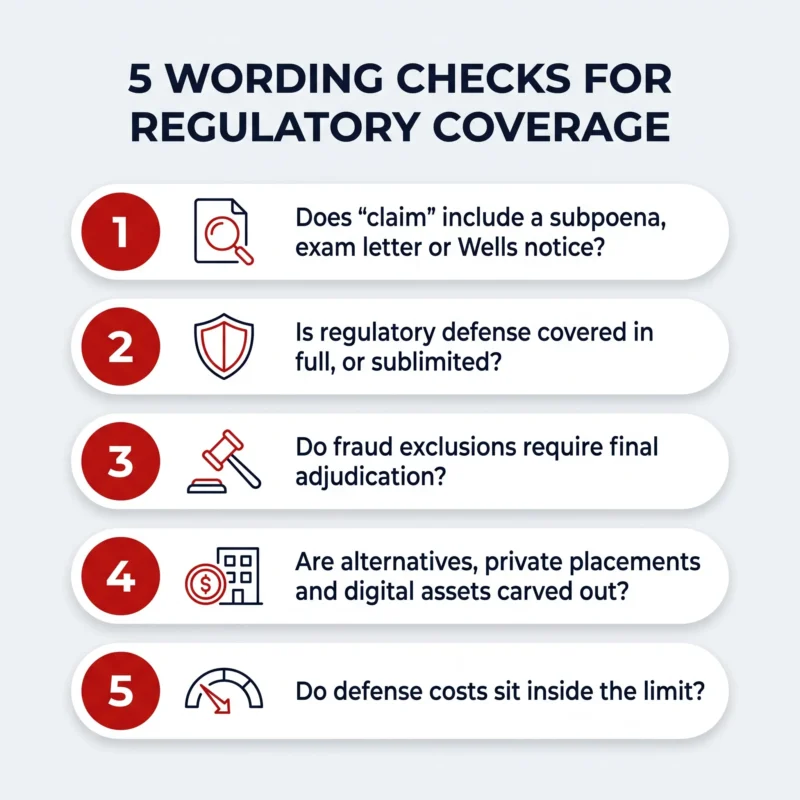
Not sure how your form reads? Contact us and we’ll check it against these five points.
What Happens to Your Coverage When You Leave a Broker-Dealer or Switch Carriers?
Your old coverage stays behind, and your new policy may not reach back far enough. E&O is claims-made, so a gap in the retroactive date leaves years of past advice uninsured. The timing problem is sneakier than most breakaway advisers expect, because claims often surface long after the advice.
Here’s what I see in practice.
The Breakaway Checklist
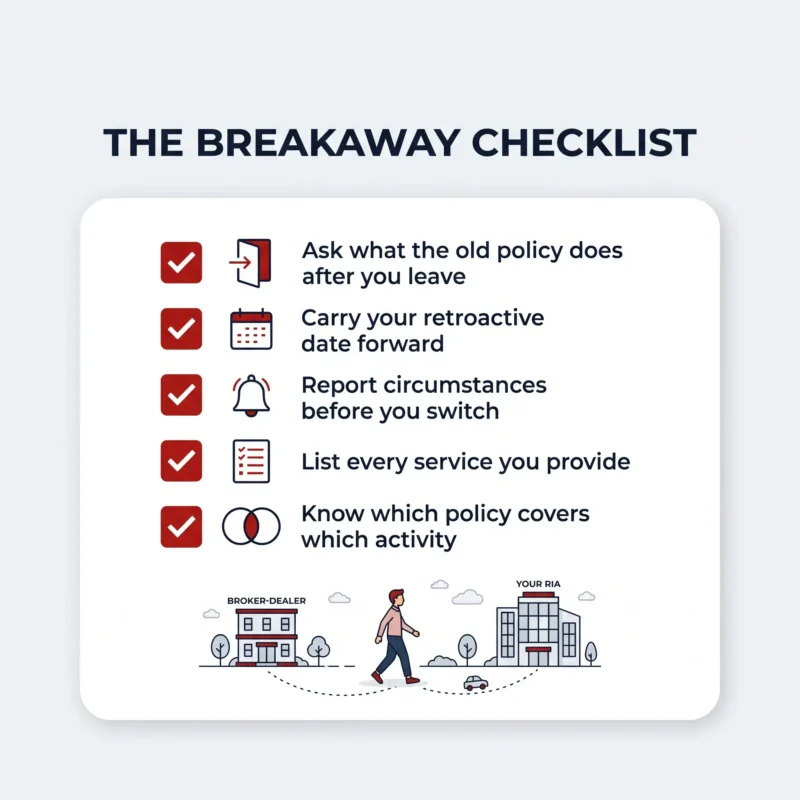
For the broader view of a growing firm’s program, our page on registered investment advisor insurance covers the basics.
What Cyber and Wire-Fraud Coverage Does a New York RIA Need?
You need cyber that pays for breach response and regulatory defense, plus real social-engineering coverage for wire fraud. New York’s SHIELD Act and the SEC’s amended Regulation S-P set the duties. The catch is that most advisers buy a big cyber limit and never look at the much smaller number underneath it.
Two sets of rules now apply to your client data:
The Sublimit Under the Limit
This is the Cyber Coverage Mirage: coverage that looks like protection until you read the schedule.
The distinction advisers miss is between “a general cyber insurance policy and the specific coverage for social engineering or fraudulent instructions.”
I’ve reviewed programs carrying $50,000 of social-engineering coverage when $250,000 is a common standard.
And ordinary policies often exclude cases where you voluntarily send funds, even when deception caused it.
What to check:
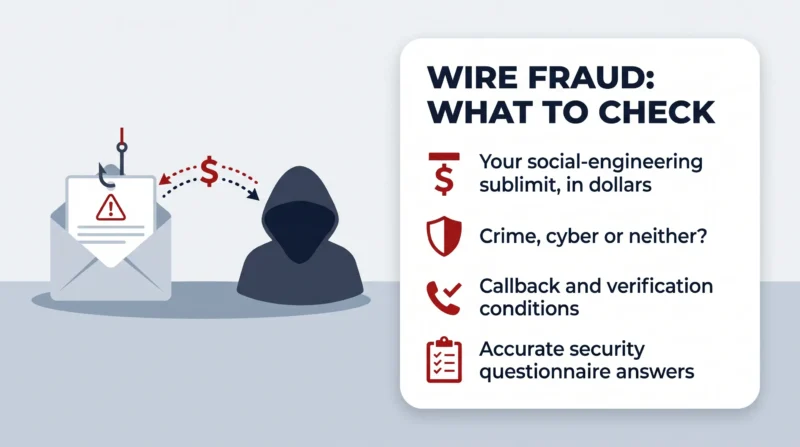
Cyber is now the fastest-moving piece of investment adviser insurance New York firms carry.
Our pages on cyber insurance for RIAs and social engineering coverage go deeper.
Want your sublimits checked? Book a call and send the declarations page ahead of time.
What Does New York Require for Your Advisory Firm’s Employees?
New York requires workers’ compensation, disability benefits and Paid Family Leave once you have employees, even at a small advisory firm. These aren’t optional add-ons. The trap I see most is the person you think is a contractor but New York would treat as an employee.
The rules are simple to state:
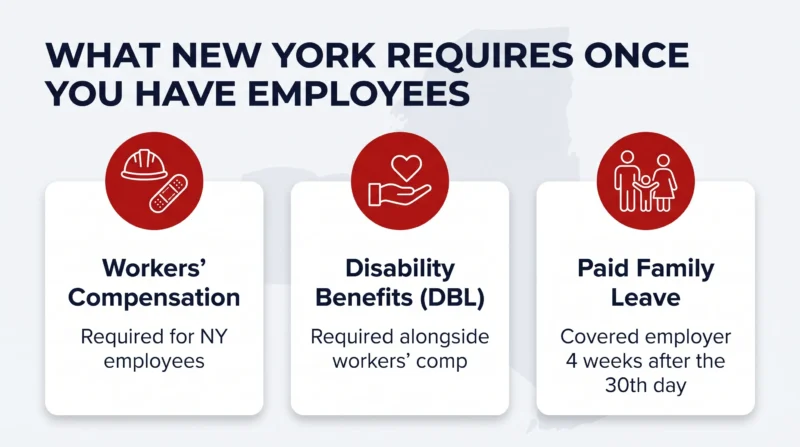
EPLI matters too: discrimination, harassment and retaliation claims come from current and former staff, and New York City employers face a broad local standard on top of state law.
Have staff in New York? Contact us and we’ll confirm your workers’ comp, DBL and PFL are in place.
How Do We Review a New York Adviser‘s Insurance Program?
We read your policies privately before anything goes to market or any broker changes, then tell you what works and what we’d change. It’s called the Confidential Review. What surprises most advisers is that it doesn’t disturb the broker you have now.
We call it Review First, Market Later. If you have coverage, we review the existing policies before deciding what to improve.
If you’re buying new coverage, we build the underwriting picture first.
The Coyle process runs the same way either time:
The workload benefit: fewer applications, fewer duplicate requests and one point of contact for the whole program.
Real-world example
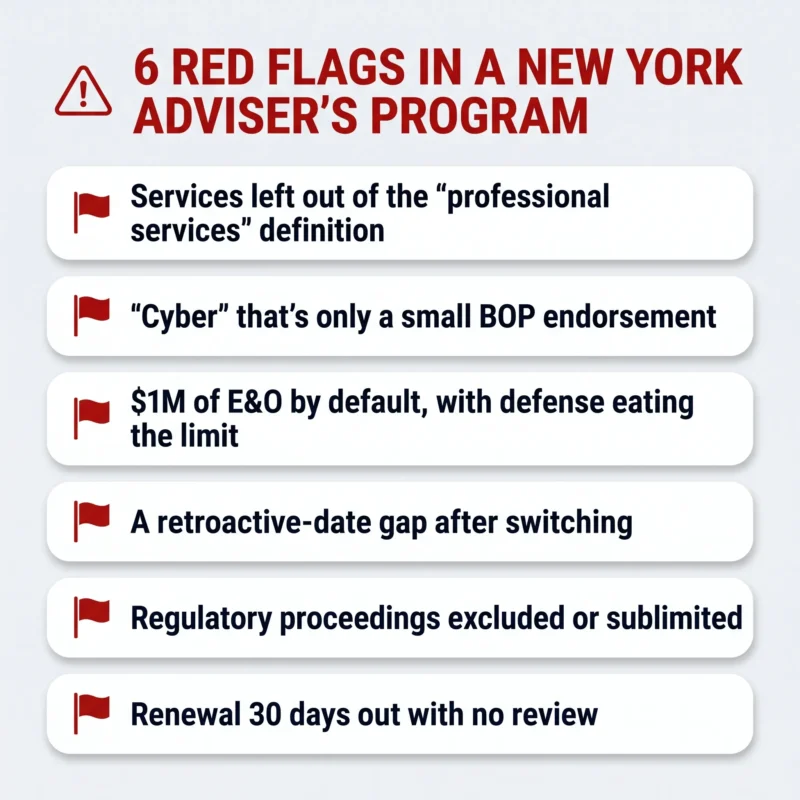
A boutique financial advisory firm, an M&A adviser, brought us a program that looked complete on paper. The “cyber” turned out to be a $50,000 endorsement on a business owners policy that covered only third-party claims. The E&O definition of “professional services” left out two of the services the firm actually sold, and it carried $1 million of E&O with defense costs inside the limit.
We swapped the $280 endorsement for a $1,300-a-year standalone cyber policy, fixed the E&O definition with a $200-a-year endorsement, recommended higher limits and added crime coverage. We identified about $2 million in gaps. The full story is in our M&A advisory firm case study.
Who Reads Your Policies
I hold the CPCU and ARM designations, and I’ve been auditing business insurance programs since 1984.
Donna Richard, our Senior Account Manager, has 41 years in insurance, including eight in cyber and E&O. We return calls and emails within one business day.
Red Flags in a New York Adviser’s Program
What Do Underwriters Look At, and What Does Investment Adviser Insurance New York Cost?
Price depends on what you manage, what you sell and how clean your history is, not on a state rate card. Two firms with the same AUM can pay very different premiums. The reason usually sits in the product mix and the application, which is where a review earns its keep.
The small-business E&O medians that come up in search don’t fit RIAs.
Advisers report that assets under management and alternatives drive the price, and that private placements “drive up cost of insurance a lot.”
The Five Underwriting Factors
Here’s what underwriters weigh, and what to have ready:
Factor |
Why underwriters care |
What to have ready |
|---|---|---|
|
AUM and client mix (HNW vs. institutional) |
Bigger accounts mean bigger alleged losses |
Current AUM, client count, largest client relationships |
|
Services and products |
Planning, tax, insurance sales, alternatives and crypto widen the exposure |
Form ADV Part 2A and a list of every service you bill for |
|
Registration and regulatory history |
Exams, deficiency letters and complaints predict claims |
Exam history, complaint log, disciplinary disclosures |
|
Claims history and prior acts |
Continuity shows the risk is known |
Five-year loss runs, current retroactive date |
|
Controls |
Wire verification and cyber controls drive cyber and crime terms |
Callback procedures, MFA, incident response plan |
Clean history, documented controls and a narrower product mix pull it down.
For premium ranges across RIAs and funds, see the pricing section in our investment management insurance guide.
Want to know which factors are hurting your price? Contact us and we’ll walk through your last application.
How Do You Choose a Broker for Investment Adviser Insurance New York Firms Need?
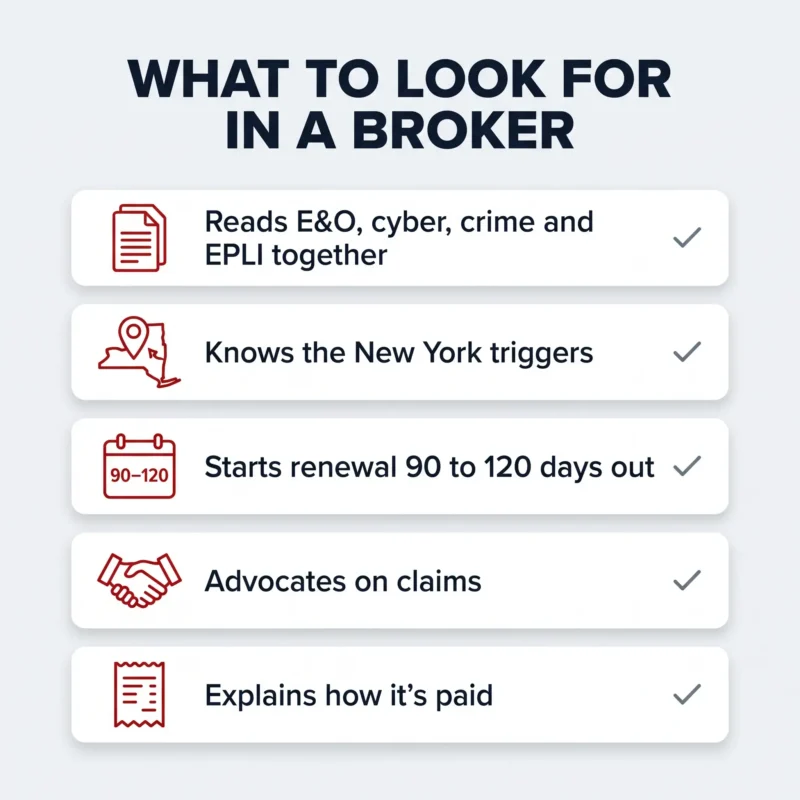
Choose the broker who reads your wording against your services before asking anyone for a price. Advisory programs fail in the definitions, retro dates and sublimits, not in the premium. There’s a second test most firms skip: how the broker plans to take your account to market.
What to look for:
What About Getting Quotes From Several Brokers?
Comparing options is smart.
But sending the same account to three or four brokers usually backfires. The same insurers get approached by several brokers, underwriters see duplicate submissions and may block or deprioritize the account, you fill out the same application again and again, and a generalist can misclassify an advisory risk.
The decision then falls back to price because nobody compared coverage.
We’re not the right fit if you want someone to rubber-stamp your current program at a lower price.
We’re also not the right broker if the plan is to put three brokers in a race; we get hired to win, not to bid. Our sweet spot is established advisory firms with real AUM, staff and complex services. A solo adviser who only needs a custodian’s minimum may be well served by a simple program, and I’ll tell you so.
Ready for a straight answer? Book a 15-minute call, not an application.
Questions about Investment Adviser Insurance New York?
Build an RIA Program That Answers to New York
An advisory firm’s insurance has to fit what you actually do: the services you bill for, the clients you serve and the regulator who can knock on your door. That’s the difference between being covered and being adequately covered. It shows up when an exam letter arrives, when a client wire goes to a fraudster, and when you leave a broker-dealer with years of advice behind you.
Our family has been in the insurance business since 1929, and we only do business insurance. We’re independent, not captive to any carrier. We review contracts before you sign and re-underwrite your firm every year. You don’t need five brokers shopping your insurance. You need one capable broker making sure the right insurers compete for your business.
The first step costs nothing and doesn’t disrupt your current broker. We put your E&O, cyber and crime policies side by side against your services and your New York exposures, then tell you what’s working, what’s missing and what I’d change.
Book a 15-minute call. If your program is solid, I’ll tell you that too.

This article was written by the CEO of The Coyle Group, Gordon B. Coyle, CPCU, ARM, AMIM, PWCA, who has over 40 years of experience working with business owners of all sizes and industries across the US, solving their insurance challenges.
Here’s how to take the next step
Schedule Your Insurance Confidence Assessment
In our 30-minute call, you’ll discover:
Not ready for a call?
Get Free Access to Our Gated Video:
“How to Finally Feel Confident in Your Coverage. “
And discover the exact system we use to help business owners eliminate hidden coverage gaps, stop overpaying, and finally feel confident in their protection.
What Peace of Mind Looks Like
Trusted by business owners across the U.S.
The Coyle Group is 1st class! Gordon and his team are knowledgeable, responsive, and attentive to detail. Gordon is that rare breed of professional who genuinely cares for his clients and works hard to exceed their expectations. I highly recommend them.

The insurance brokerage service was truly tailored to my needs, nothing like those big brokers who steer you toward random policies that don’t fit your profile. Thank you to the team for your help.

I was working with another broker and having difficulty acquiring General Liability coverage. A colleague recommended The Coyle Group. They were able to get coverage bound in just a couple of business days and a policy issued in ten days, and with a solid carrier at a competitive premium. Truly impressive results, plus it was a pleasure working with them. I highly recommend the Coyle Group!

If any business is looking to work with an insurance brokerage firm that is not only excellent at what the firm does, but one that deeply values the needs of the clients, then The Coyle Group is the firm for you. Give them a call and see for yourself. I can assure that you will quickly agree.

Want to know more?
See related blogs

The Crowdstrike Debacle and Cyber Insurance
Third Party Employment Practices Liability Insurance. Protect Your Business

Are You Overpaying or Underinsured on Your Business Insurance?
