
Insurance Requirements for Government Contractors
What the Contract Really Asks For, and Where Coverage Breaks

Index

Gordon B. Coyle
CEO, The Coyle Group
845-474-2924
How to get started
TL;DR. Executive Summary
You won the contract.
Then the insurance exhibit arrives, and it asks for five different things.
You send it to your agent, buy what gets quoted, and the prime still insists you lack coverage for cyber liability and professional liability.
Or the agency wants a $2 million auto policy when, as one owner put it, “there is no driving on this contract at all.”
You did what you were told, and you still can’t start.
You need to be compliant on paper, and you need coverage that actually pays when something goes wrong.
The Coyle Group is a commercial insurance agency that handles the complex, high-value risks other agencies don’t know how to structure, where the details in the policy are the difference between a paid claim and a denied one.
This guide to insurance requirements for government contractors is for established mid-market companies, such as manufacturers, distributors, and IT or services firms, that are winning or expanding government work.
The stakes are large: the federal government committed about $755 billion on contracts in fiscal year 2024, according to the U.S. Government Accountability Office.
A government contract or a prime’s insurance exhibit lists coverages, limits, and endorsements, and you can’t tell whether your program meets them or which ones you can push back on. Our approach is to review the contract against your actual policies first, then manage the market for you so the right insurers compete for your business. We review contracts before you sign to flag requirements you may not be able to meet, and 95% of our clients stay with us.
The next step is a 15-minute call, not an application. Book a call.
What Insurance Do Government Contractors Need Federally?
Federally, most government contractors need workers’ compensation with employer’s liability, general liability, and auto liability, at the minimums set in FAR 28.307-2. That’s the short answer, and it’s also where most owners stop reading too early. The contract you actually sign can add coverages the FAR never mentions, and those additions are where the trouble starts.
Meanwhile, a $2 million auto requirement on a contract with no driving drains margin every month.
Here’s the federal baseline next to what contracts commonly add:
Coverage |
FAR baseline (28.307-2) |
What contracts commonly ask |
When it applies |
|---|---|---|---|
|
Workers’ compensation and employer’s liability |
State and federal statutes; employer’s liability at least $100,000 |
Waiver of subrogation in favor of the agency or prime |
Anyone with employees on the contract |
|
Bodily injury at least $500,000 per occurrence |
Often higher; the solicitation or prime sets the number |
Nearly every contract |
|
|
Auto liability |
$200,000 per person and $500,000 per occurrence bodily injury; $20,000 property damage |
Often higher, even on low-driving work |
Vehicles used on the contract, or required by the solicitation |
|
Not set |
Used to reach higher limits |
Higher-limit contracts |
|
|
Not set |
Set by the contract or prime |
IT, engineering, consulting, services |
|
|
Not set |
Common on IT, cloud, and data contracts |
Work that touches government data |
|
|
Defense Base Act |
Required by law for covered overseas work |
Same |
Employees working outside the U.S. |
|
Aircraft or vessel liability |
Aircraft: $200,000 per person, $500,000 per occurrence, $200,000 property damage |
Set by the agency |
Aircraft or vessels used on the contract |
|
Surety bonds |
Not insurance |
Performance and payment bonds |
Federal construction over $150,000 |
The minimums come straight from FAR 28.307-2.
However, the contract’s own schedule controls.
Book a call and we’ll compare this table against your current policies.
Are the FAR Minimums Enough for a Government Contract?
Usually not. The FAR limits are a floor the government uses when it asks for insurance at all, and the contracting officer can raise them. The bigger surprise is that on many fixed-price contracts, the government barely asks. So your real requirement usually comes from somewhere other than the FAR.
When the installation clause applies, the contracting officer may require more coverage and higher limits.
State and city contracts follow their own rules, so a FAR clause is never automatically the standard for a county job.
Three details most guides skip, all straight from the FAR:
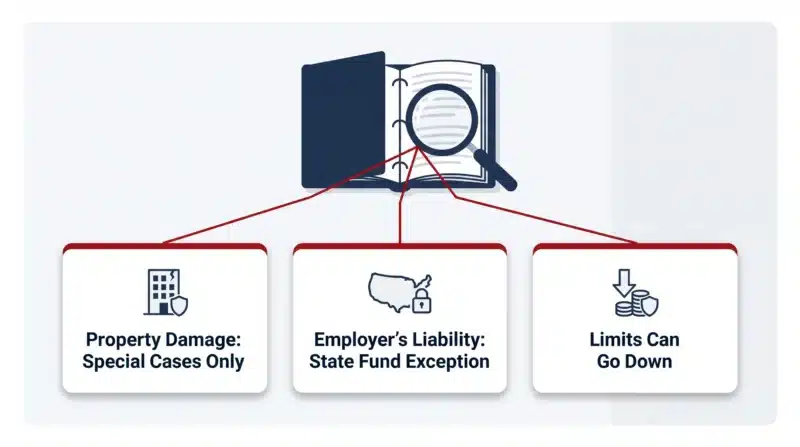
That’s why most insurance requirements for government contractors trace back to four sources, and I check all four before I recommend a limit:
Source of the limit |
Who sets it |
What it tells you |
|---|---|---|
|
FAR 28.307-2 |
Federal regulation |
The floor |
|
Contract schedule or solicitation |
Contracting officer |
The legal requirement for this job |
|
Prime’s insurance exhibit |
Prime contractor |
What you must prove to get paid |
|
Your actual exposure |
You and your broker |
What a real claim would cost |
I hold the CPCU and ARM designations, and most programs I review only answer the first three.
I call the result the Million-Dollar Illusion: a limit chosen because it was the default, not because anyone measured the exposure.
Your general liability limits should come from the fourth row.
Contact us and we’ll size your limits against the fourth row, not just the floor.
Does Your Current Liability Policy Cover Government Contract Requirements?
Partly, in most cases. Your policy may carry the right limits and still fail the contract, because government work leans on endorsements and wording, not just dollar amounts. A certificate can show everything the contracting officer wants to see while the policy underneath says something different, and that difference decides your claim.
Here’s what contracts usually ask for and what each request means for your policy:
What the contract asks for |
What it means for your policy |
|---|---|
|
Named additional insured |
The agency or prime gets coverage under your policy through an endorsement. Being the certificate holder isn’t the same thing. |
|
Primary and non-contributory |
Your policy pays first and doesn’t ask their insurer to share the loss. |
|
Your insurer gives up its right to recover from them after it pays a claim. |
|
|
30-day notice of cancellation |
An endorsement delays cancellation or a material change until the later of state law or 30 days after written notice to the contracting officer. |
|
Written notice before work starts |
You tell the contracting officer in writing that the required insurance is in place before you begin. |
|
Umbrella counted toward the limit |
The umbrella has to follow form over the underlying policies. See umbrella vs. excess liability. |
|
Indemnification clause |
You may promise more than your policy insures. See risk transfer and indemnity agreements. |
|
Description of operations |
Your policy’s classification has to match the work in the contract. |
The notice rules come from FAR 52.228-5, the clause for work on a government installation.
Keep in mind that a certificate of insurance reports coverage; it doesn’t create it.
Contact us and send the exhibit. We’ll tell you which lines your current policies already meet.
Why Do Subcontractors Face Tougher Insurance Requirements Than Primes?
Because primes pass their risk down to you. The government often asks little of a prime on fixed-price work, but the prime’s client contract, its insurer, and its lawyers all push requirements onto subcontractors. Some of those requirements fit your work. Others are boilerplate, and you’re allowed to ask about them.
Here’s what drives flow-down requirements:
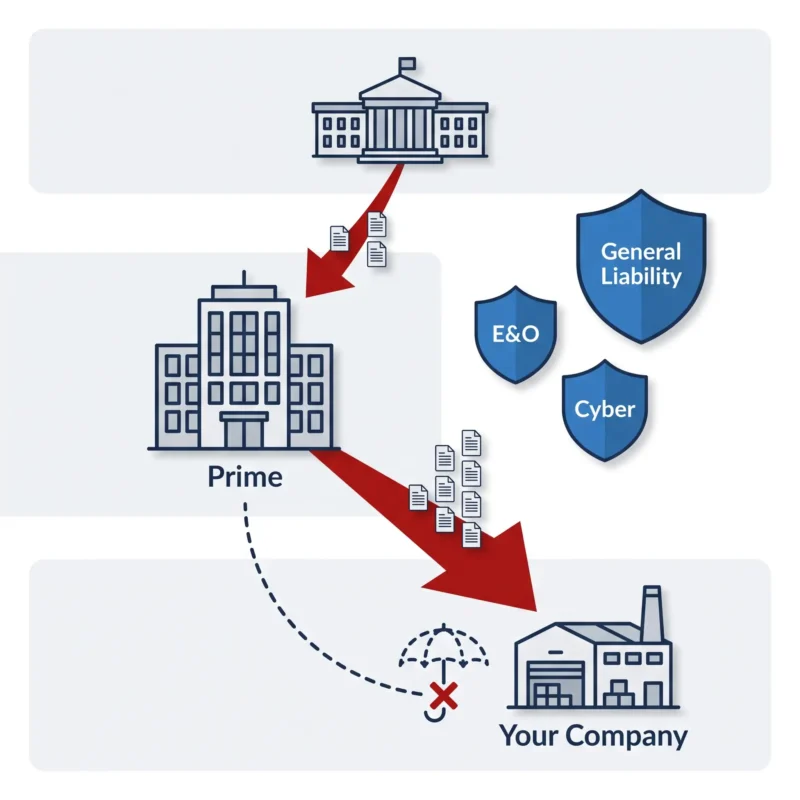
Sometimes the answer is still no, but you’ll know before you pay for it.
The same discipline applies to any contract insurance requirements a customer sends you.
Do You Need Coverage Before You Bid, at Award, or Before Work Starts?
You need it in place before work starts, and sometimes much earlier. Some solicitations want proof of coverage with the bid; many want it after award but before performance. However, the risky part isn’t the start date. It’s the stretch in between, when you might pay for coverage on a contract that hasn’t produced a dollar.
Here’s the usual sequence:
Also, ask whether effective dates can line up with the notice to proceed.
Book a call before you bind anything for a new award.
Which Extra Coverages Show Up by Contract Type?
It depends on what you deliver. IT and consulting contracts add professional liability and cyber; product suppliers face product liability questions; overseas work adds Defense Base Act coverage. In other words, the contract type predicts most of the add-ons, so you can usually see them coming before the exhibit lands.
Contract type |
Coverages that usually get added |
What to check |
|---|---|---|
|
IT, cloud, and IT consulting |
Professional liability, cyber |
The policy’s definition of professional services matches what you deliver |
|
Defense suppliers handling government data |
Cyber |
Data requirements in the subcontract and the limit the prime sets |
|
Manufacturers selling products to the government |
Product liability, completed operations, recall |
Products and completed operations limits sized to the contract |
|
Distributors and suppliers |
Product liability, cargo |
|
|
Construction |
General liability with completed operations, surety bonds |
Bond requirements over $150,000 |
|
Overseas work |
Defense Base Act, travel, evacuation |
Who covers your employees abroad |
|
Aviation or marine |
Aircraft or vessel liability |
Limits in FAR 28.307-2 |
From what I’ve seen, IT firms get caught most often, because general liability doesn’t answer a claim that your work caused a client’s financial loss.
That’s the job of E&O insurance, and a data incident belongs to cyber insurance.
Does Your Prime’s Defense Base Act Policy Cover Your Employees?
No. The prime’s Defense Base Act policy covers the prime’s employees, not yours. If your people work overseas on a covered contract, you need your own DBA coverage. That surprises many subcontractors, and learning it after an injury costs far more than the premium.
The Defense Base Act provides workers’ compensation protection to civilian employees working outside the United States on U.S. military bases or under a U.S. government contract for public works or national defense. DBA coverage also brings war-hazard protection under the War Hazards Compensation Act, according to FAR 28.305.
The exposure is real: Department of Labor data shows DBA injuries and deaths reported rose from 366 in 2002 to over 13,000 in 2009.
One more detail few owners know: the Secretary of Labor can waive the Defense Base Act for a contract, location, or group of employees, but only on the agency head’s recommendation.
Even then, FAR 28.305 says you must still provide workers’ comp and take on liability for war-hazard injury, death, capture, or detention yourself. A waiver shifts the risk to you; it doesn’t remove it.
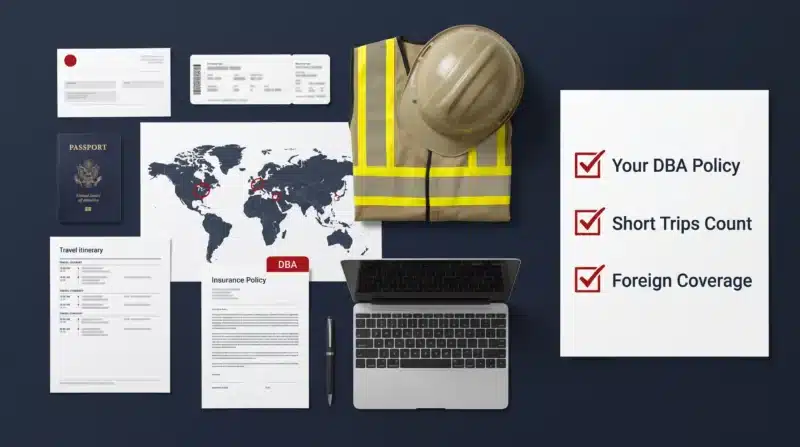
Before anyone travels, confirm:
Bonds or Insurance: Which Does the Contract Actually Require?
Construction contracts often require both, and they do different jobs. Insurance protects your company when something goes wrong. A surety bond protects the government if you don’t finish the work or pay your subcontractors. People mix them up all the time, and no liability policy will ever satisfy a bond requirement.
Contact us if a solicitation asks for both and you’re not sure which documents go where.
We Won a Federal Contract: What Insurance Gaps Might Exist?
The gaps are usually in what the contract added, not in what you already carry. Your core policies may be fine for commercial work. But the new contract changes who you insure, what you promise, and where you work, and those changes rarely prompt anyone to update the program. Here’s what I check first.
Bottom line is that almost all insurance programs we review contain at least one fatal mistake.
Government work just adds new places for one to hide.
These are the red flags I look for:
Real-world example
This published case wasn’t a government contractor, but it shows the exact gap primes flag. A boutique M&A advisory firm believed it had cyber coverage. It was a $50,000, third-party-only endorsement on a business owners policy. Its E&O definition of professional services also left out two core services, with only $1 million in E&O and defense costs inside the limit. We replaced the endorsement with a standalone cyber policy for about $1,300 a year, broadened the E&O definition with a $200 endorsement, and identified roughly $2 million in gaps. I call this the Cyber Coverage Mirage. Read the full case study.
They come from carelessness, not cost.
Book a call to run these checks against your new award.
Why Do Government Contract Insurance Claims Get Denied?
Most denials come down to the policy, not the contract. The claim lands, the adjuster reads the actual policy language, and the coverage the contract assumed simply isn’t there. Government work doesn’t create new denial reasons so much as more chances to trigger the old ones, and you can fix each one ahead of time.
Why the claim gets denied |
The gap behind it |
How to prevent it |
|---|---|---|
|
The work falls outside the policy’s description of operations |
Scope grew mid-contract and nobody told the insurer |
Report scope changes before the new work starts |
|
The agency or prime isn’t actually an additional insured |
A certificate went out without the endorsement |
Get the endorsement page, not just the certificate |
|
The contract promises more than the policy insures |
Nobody reviewed the indemnity clause |
Compare the clause to the policy before you sign |
|
A professional error claim hits a general liability policy |
No E&O, or a narrow definition |
Match the E&O definition to your actual services |
|
The insurer got notice too late |
Nobody reported the incident promptly |
Report incidents as soon as you know about them |
|
The policy lapsed or changed |
A renewal slipped past a contract date |
Track renewals against contract periods |
I’ve been auditing business insurance programs since 1984, and the pattern rarely changes. There’s a difference between covered and adequately covered.
A certificate checks the box; only the right policy language pays the claim.
What Do Insurers Look at Before Covering Government Contract Work?
Insurers look at what you’ll actually do, where, and under what promises. Underwriters price your scope of work, locations, contract terms, people, and loss history. Get those wrong on the application and the policy may not fit the job, which is why diagnosis has to come before any quote.
Meeting insurance requirements for government contractors starts with these five underwriting factors:
Factor |
Why underwriters care |
What to have ready |
|---|---|---|
|
Scope of work and classification |
Rates and coverage follow what you actually do |
Statement of work and a plain description of operations |
|
Where the work happens |
Installations, multiple states, or overseas sites change the exposure |
Site list, states, and any work outside the U.S. |
|
Contract terms |
Additional insured, waivers, and indemnity shift risk to the insurer |
The full insurance exhibit and indemnity clause |
|
Payroll, revenue, and subcontractors |
They set the size of the exposure |
Payroll by job class, government revenue share, subs’ certificates |
|
Loss history and controls |
Past claims and security controls predict future claims |
Loss runs and, for cyber, security documentation |
If those items reach the right underwriter clearly, the policy fits the contract.
If they don’t, you get a quote for a business that doesn’t quite exist.
Contact us and we’ll walk through these five factors with you before any application goes out.
What Should a Broker Who Handles Government Contracts Do Before You Sign?
A broker who handles government work should read the contract before quoting anything. That means mapping every requirement to a policy and endorsement, flagging what’s negotiable, and telling you what compliance costs. If yours just sends a certificate, the work that protects you in a claim probably hasn’t happened yet.
Here’s what your broker should be doing on a government contract:

How We Work
Michael Vanderwerker, our Chief Integration Officer, brings 41 years in commercial insurance, including 25 years with municipalities and 38 years building umbrella and excess programs, which is exactly the layering public contracts demand.
One client described our process as “thorough, comprehensive and easy,” adding that it allows companies “to uncover risks they may not have been aware of.”
For you, that means fewer applications, fewer duplicate requests, and one point of contact.
We call it Review First, Market Later.
You can also start with a second opinion on your current program.
Should You Collect Quotes From Several Brokers?
Comparing options is smart.
However, sending the same contract to several brokers usually backfires.
Underwriters see duplicate submissions, the same insurers hear from more than one broker, and a generalist may misclassify your work.
As a result, the decision falls back to price, and price doesn’t tell you whether the endorsements are on the policy.
If you’re a very small business with one simple, standard contract, a basic packaged policy may serve you well, and I’ll tell you so.
What It Costs
Your premium depends on scope of work, payroll, revenue, required limits, and any overseas exposure, so an honest number comes after the diagnosis.
We’re paid through commissions from insurance carriers, and we don’t charge upfront fees for standard placements.
Get Your Government Contract Insurance Reviewed Before You Sign
The right time to review your coverage is before you sign, while you can still ask questions and adjust the program. A short call tells you whether your current policies meet the insurance requirements for government contractors in your contract, which ones are worth questioning, and what compliance will cost.
You don’t need five brokers shopping your insurance. You need one capable broker making sure the right insurers compete for your business. That’s what we do: we manage the market for you, and we start with the contract.
Book a call for a 15-minute conversation, not an application.
Questions about Insurance Requirements For Government Contractors?
Get Coverage That Meets Government Contract Requirements Before You Sign
Government work rewards the contractor whose paperwork is right the first time. Our family has been in the insurance business since 1929, and we only do business insurance, so contracts, endorsements, and certificates are our daily work, not a side task. We’re an independent brokerage, not captive to any carrier, and we place coverage for clients across the US.
Winning the award is the start, not the finish line. We manage certificate requests and contract compliance as new agencies, primes, and option years come in, and we re-underwrite your business every year because your operations change. If a claim does land, we work with adjusters and carriers to push it forward, so you’re not left arguing policy wording on your own.
If you’d like to see how I think before you call, I’ve published more than 600 educational videos on business insurance. When you’re ready, bring the contract or the prime’s insurance exhibit to a 15-minute conversation, and we’ll tell you plainly where your program stands.

This article was written by the CEO of The Coyle Group, Gordon B. Coyle, CPCU, ARM, AMIM, PWCA, who has over 40 years of experience working with business owners of all sizes and industries across the US, solving their insurance challenges.
Here’s how to take the next step
Schedule Your Insurance Confidence Assessment
In our 30-minute call, you’ll discover:
Not ready for a call?
Get Free Access to Our Gated Video:
“How to Finally Feel Confident in Your Coverage. “
And discover the exact system we use to help business owners eliminate hidden coverage gaps, stop overpaying, and finally feel confident in their protection.
What Peace of Mind Looks Like
Trusted by business owners across the U.S.
The Coyle Group is 1st class! Gordon and his team are knowledgeable, responsive, and attentive to detail. Gordon is that rare breed of professional who genuinely cares for his clients and works hard to exceed their expectations. I highly recommend them.


The insurance brokerage service was truly tailored to my needs, nothing like those big brokers who steer you toward random policies that don’t fit your profile. Thank you to the team for your help.

I was working with another broker and having difficulty acquiring General Liability coverage. A colleague recommended The Coyle Group. They were able to get coverage bound in just a couple of business days and a policy issued in ten days, and with a solid carrier at a competitive premium. Truly impressive results, plus it was a pleasure working with them. I highly recommend the Coyle Group!

If any business is looking to work with an insurance brokerage firm that is not only excellent at what the firm does, but one that deeply values the needs of the clients, then The Coyle Group is the firm for you. Give them a call and see for yourself. I can assure that you will quickly agree.

Want to know more?
See related blogs

The Crowdstrike Debacle and Cyber Insurance
Third Party Employment Practices Liability Insurance. Protect Your Business

Are You Overpaying or Underinsured on Your Business Insurance?
