
Chemical Manufacturer Insurance
The Coverage Gaps That Sink Chemical Companies (and How to Close Them)

Index

Gordon B. Coyle
CEO, The Coyle Group
845-474-2924
How to get started
You have a general liability policy, a property policy, and a broker who told you that you were “all set.”
In my experience, that is the moment most chemical manufacturers discover the truth: the yearly premium was never the real concern.
What truly matters is whether the policy will stand up when a major disaster occurs. From what I have seen over 40 years, an ordinary business policy usually does not.
That gap is why I wrote this. Chemical manufacturer insurance is not one policy you buy and forget.
The short version:
You are a chemical, coatings, adhesives, solvent, or specialty-chemical manufacturer, you suspect your current coverage has holes, and you cannot get a straight answer about whether you are protected. The Coyle Group is a commercial insurance agency that handles the complex, high-value risks other agencies do not know how to structure, where the details in the policy are the difference between a paid claim and a denied one. If you want a specialist to pressure-test your program, book a call and we will walk your exposures line by line.
The Coyle Group works with manufacturers across the country, and chemical operations sit squarely in the category we build manufacturing insurance programs for every day.
Let me show you where the gaps hide and how to close them.
What is chemical manufacturer insurance, and what does it actually cover?
Chemical manufacturer insurance is a coordinated program of policies that protects a chemical operation against product, pollution, property, and liability losses that ordinary business coverage excludes or underinsures. Here is the part most owners miss: no single policy does the job, and the cheapest one on the market is cheap for a reason. It leaves you exposed exactly where a chemical business gets hurt.
A single willful OSHA violation can run up to $165,514 per violation under the agency’s 2026 penalty schedule, and that is before a lawsuit.
Under the federal Superfund law, CERCLA imposes strict liability on the parties connected to a contaminated site, which means you can owe cleanup costs whether or not you were negligent.
Here is the core stack a real chemical program layers together:
Coverage |
What it protects against |
|---|---|
|
General & product liability |
Third-party bodily injury or property damage from your operations or finished chemicals |
|
Spills, releases, gradual seepage, cleanup, and legal defense that general liability excludes |
|
|
Property & equipment breakdown |
Fire, explosion, reactor and processing-equipment failure, raw materials, and inventory |
|
Business interruption |
Lost income and fixed costs when an insured event shuts you down |
|
Tracing, withdrawing, and replacing contaminated or mislabeled product |
|
|
Medical and wage costs for employees in a hazardous production environment |
|
|
Commercial auto & cyber |
Transport of hazardous cargo and attacks on automated process controls |
Every line on that list answers a real loss scenario.
The job of a specialist is to make sure they connect with no gap in between. Not sure which of these you actually carry? Have us map your program against this list in a no-obligation coverage-gap review.
Who needs this coverage, and who can keep their program lighter?
Any business that makes, blends, reacts, formulates, repackages, stores, or transports chemicals needs this protection, but not every operation needs the full tower. Here is the distinction most owners miss: your exposure scales with your chemistry and with how much of your product reaches the market, so a small, low-hazard shop can start leaner than a high-volume reactive-chemical plant.
From what I have seen, the profile sorts into two groups:
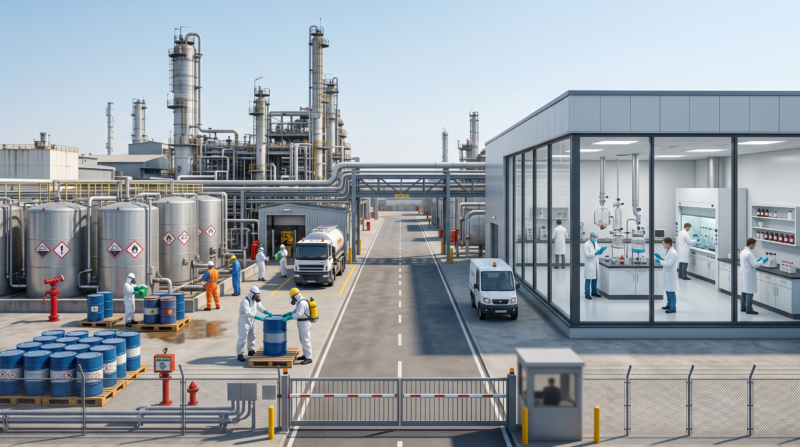
The point is not to over-buy.
It is to match the program to the real exposure, then expand it as you scale. Not sure where you land? Book a call and we will right-size it with you.
Does general liability cover a chemical spill, fumes, or a pollution lawsuit?
Almost always, no. A standard commercial general liability policy contains an absolute pollution exclusion that removes coverage for bodily injury, property damage, and legal defense arising from a release of pollutants. Here is the twist that catches owners off guard: your GL policy can be completely valid, fully paid, and still pay zero on the exact event a chemical maker fears most.
That exclusion is not a fluke.
What we see in practice is that the exclusion defines a “pollutant” so broadly, covering any solid, liquid, gaseous, or thermal irritant including smoke, vapor, fumes, acids, alkalis, and chemicals, that almost anything you manufacture qualifies.
The fix is dedicated pollution liability insurance, and it comes in distinct forms you have to match to your exposure:
Insurers can issue this coverage on a sudden-and-accidental basis, a gradual basis, or both, and the difference decides whether a slow leak that surfaces years later falls inside the policy at all.
Want yours reviewed? Book a call.
Product liability, products-pollution liability, or environmental coverage: which do you actually need?
Most chemical manufacturers need all three, because each answers a different claim. Product liability covers a defective-product injury. Products-pollution covers a pollution condition your product creates. Environmental covers your site.
Think about how the same product can fail three ways. Your cleaner burns a customer, that is a product liability claim. Your solvent off-gasses and contaminates the air inside a client’s plant, that is products pollution.
A storage tank at your own facility leaks into the water table, that is site pollution. One incident can trigger more than one of these, and a gap in any of them leaves you paying out of pocket. Frankly, most owners assume they are basically the same thing with different labels.
They are not.
One strategic point decides whether these policies still pay years from now.
Carriers write most pollution and products-pollution coverage on a claims-made basis, not occurrence, so you have to file the claim while the policy is active, and the policy’s retroactive date controls how far back a covered condition can have started.
Let a policy lapse or switch carriers without matching that retro date and buying tail, or extended reporting, coverage, and a slow release that began under the old policy can fall straight into a gap.
General liability, by contrast, is usually occurrence-based. Getting these triggers lined up is exactly the kind of detail that separates a paid claim from a denied one. This is a classic coverage gap that I see in the majority of chemical programs we review, and it never has to exist.
Have us pinpoint which of the three you are missing before your next renewal.
Beyond liability: property, equipment breakdown, recall, and the rest of the stack
A chemical program does not stop at liability. Your building, your reactors, your income stream, your finished product, your employees, and your process controls all need their own protection, and each carries a chemical-specific twist. The nuance owners overlook: the property and time-element coverages are often where the biggest dollars actually sit, and they are frequently the most underinsured.
Over 40 years I have found that they get treated as afterthoughts, then become the claim that hurts most:
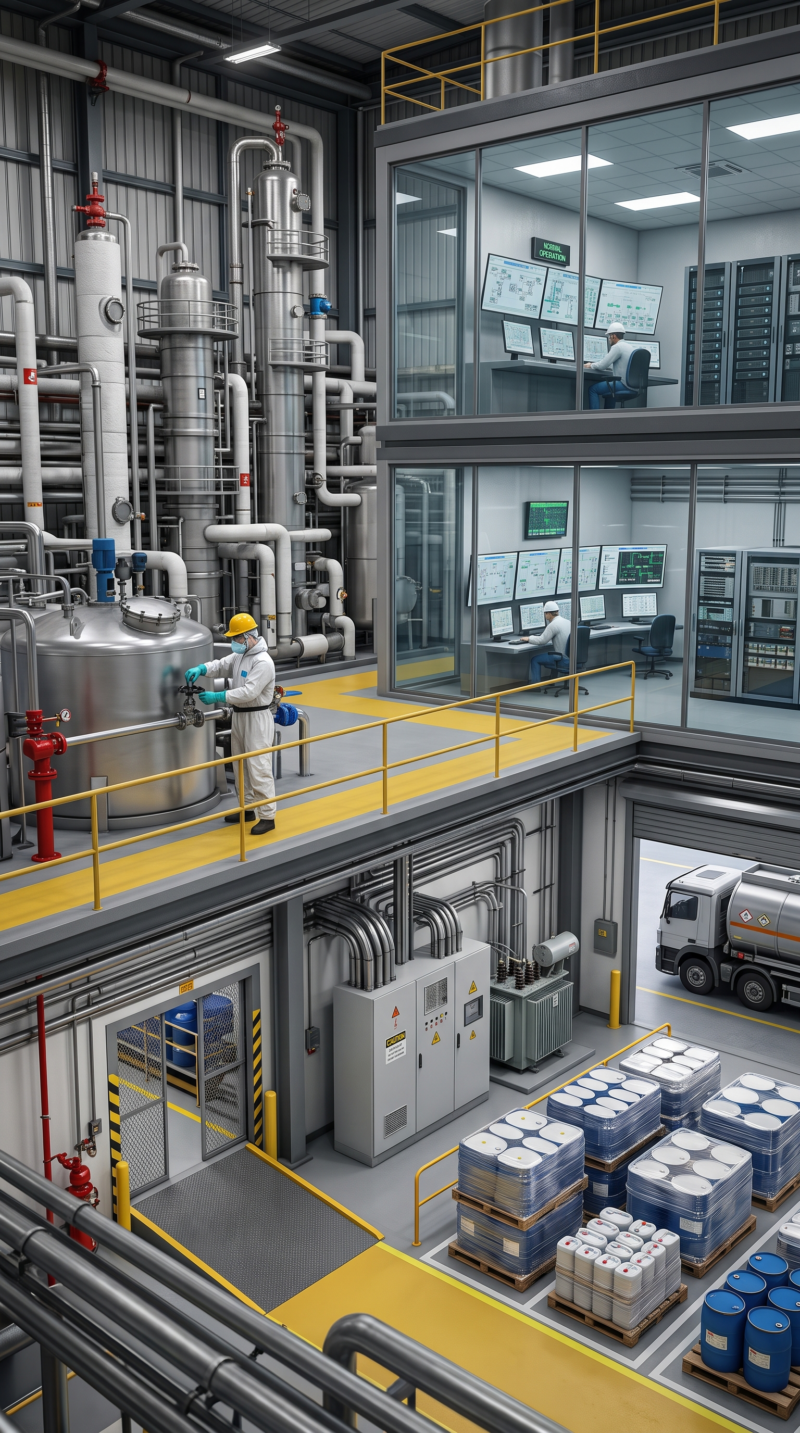
Book a no-obligation coverage review and we will tell you which of these is thin.
How much does chemical manufacturer insurance cost, and what drives the price?
There is no honest flat rate for chemical manufacturer insurance, because your chemistry, your volumes, your controls, and your loss history drive the price, not a rate card. Here is what most quote engines will not tell you: two chemical plants of the same size can price very differently, and the reason is almost entirely about risk quality, not luck.
What I can tell you is exactly what an underwriter looks at, because that is what you control:
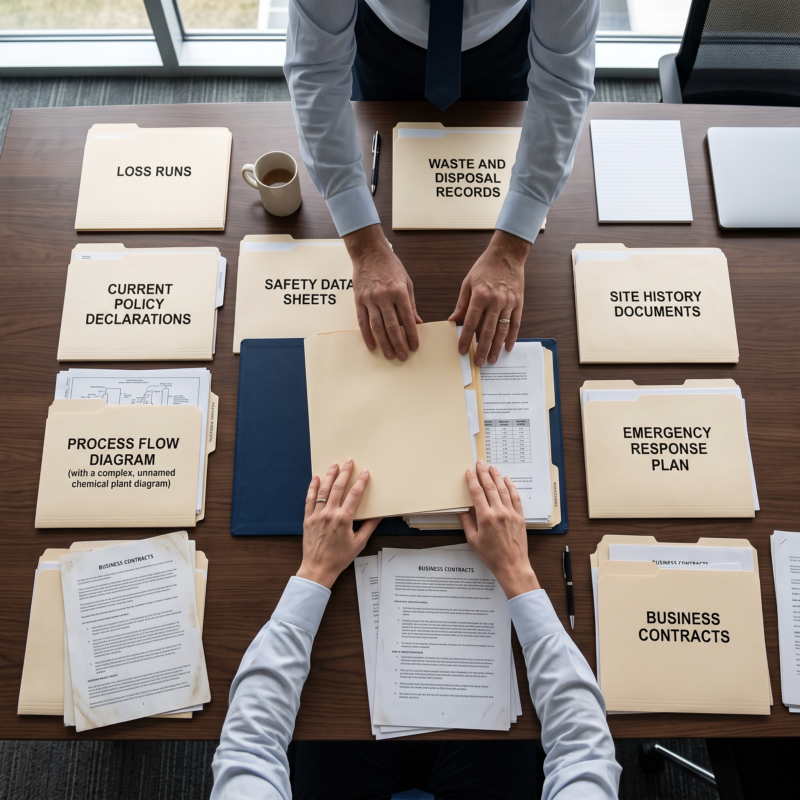
For context, carrier forms in this space commonly offer products-pollution limits up to $5 million with minimum premiums in the low thousands, while packaged manufacturing programs can build combined limits into the tens of millions with excess.
The real lever on your price is risk quality, and that is where good pollution liability insurance cost planning pays for itself. Want a real range for your operation, not a guess? Book a call and bring your loss runs.
How to buy chemical coverage the right way
Buy on wording and triggers, not on the lowest premium. Here is the trap: two policies with identical limits can respond completely differently to the same spill. Over 40 years I have found that the chemical programs that actually hold up are the ones built around a handful of specific questions, not around the cheapest number on the page.
Before you sign, work through this checklist with whoever places your coverage:
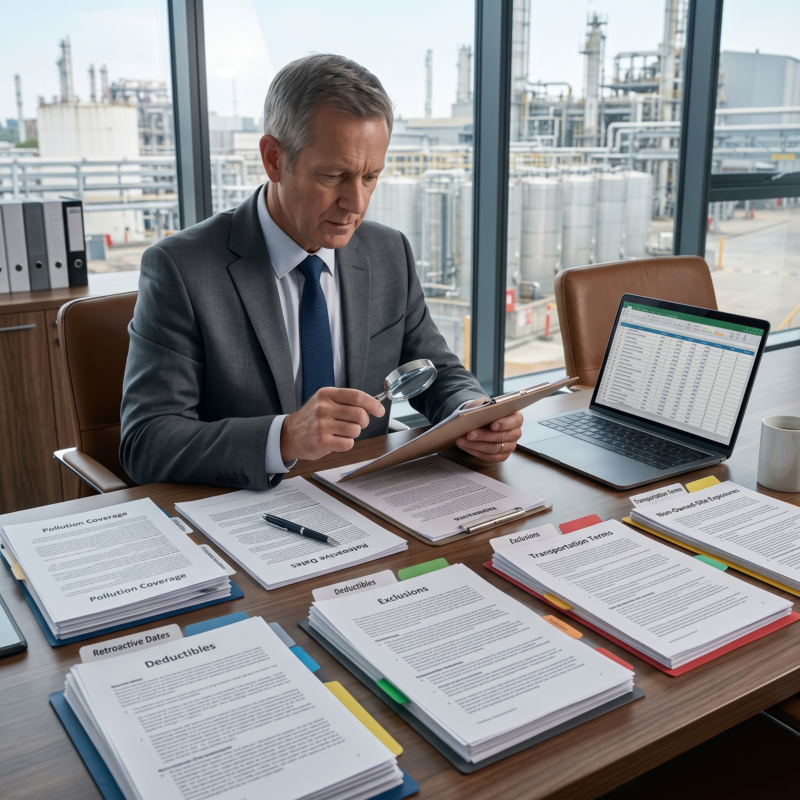
Do this and you buy protection that responds.
Skip it and you buy a certificate that looks fine until the day you need it. Want a second set of eyes on a quote? Book a call before you sign.
Why chemical manufacturers get declined or non-renewed, and how to get to “yes”
Chemical operations get declined, non-renewed, or quoted with heavy exclusions because carriers see hazardous chemistry, thin documentation, or a rough loss history and walk away. The part nobody explains: most of those declinations are not about how dangerous your business is. They are about how well your broker packages and presents your risk to the market.
Underwriters say no when they cannot see controls, cannot understand the operation, or do not get the data they need.
So we fix the submission.
Over the years we have built what I call a get-to-yes file, and it turns a declined risk into a quotable one:
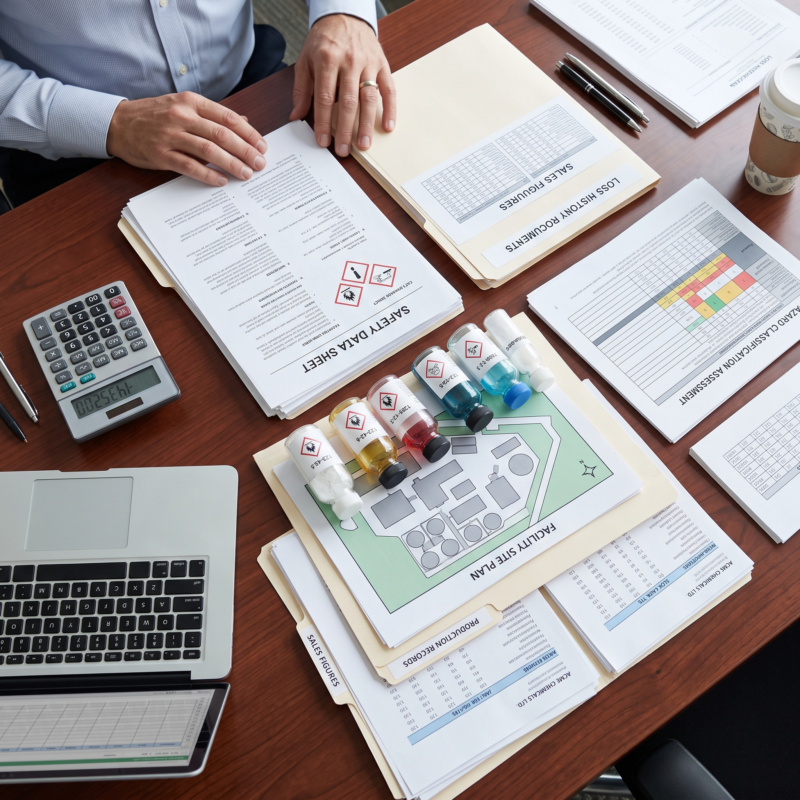
When a specialist brings a complete, credible package to an underwriter they trust, specialty carriers write hard-to-place chemical risks.
That is the whole game. Been declined or non-renewed? Contact us before you accept a stripped-down policy.
What OSHA and the EPA mean for your chemical insurance
Federal safety and environmental rules shape both your risk and your insurability, so your coverage has to line up with them. The connection owners miss: the same conditions that trigger an OSHA or EPA obligation are the conditions underwriters price, and a compliance gap quickly becomes a coverage gap.
Compliance and insurability move together, and good chemical manufacturer insurance reflects both. Not sure how your regulatory profile affects your program? Book a call.
Meeting customer, lender, and landlord insurance requirements
Your customers, lenders, and landlords will dictate coverage terms you must carry, and failing to meet them can cost you the contract. What surprises owners: these contractual requirements are often stricter and more specific than anything a regulator asks, and a generic policy rarely satisfies them out of the box.
From what I have seen, the requirements that trip chemical manufacturers up are the technical ones buried in a supply agreement or a lease:
Miss one of these and a customer can hold your payment, or a lender can freeze a deal, until you produce compliant coverage.
This is exactly the kind of detail a non-specialist broker skips and a specialist builds in from the start. Have a contract with insurance requirements you are not sure you meet? Send it over and we will check it against your program line by line.
What to do in the first hours after a spill or contamination claim
In the first hours after a spill or a contamination allegation, what you do can protect or destroy your coverage. The detail that matters: insurers have notice and cooperation requirements, and a well-meaning owner can weaken a valid claim simply by acting before the policy machinery kicks in.
Here is the sequence I walk clients through when something goes wrong:
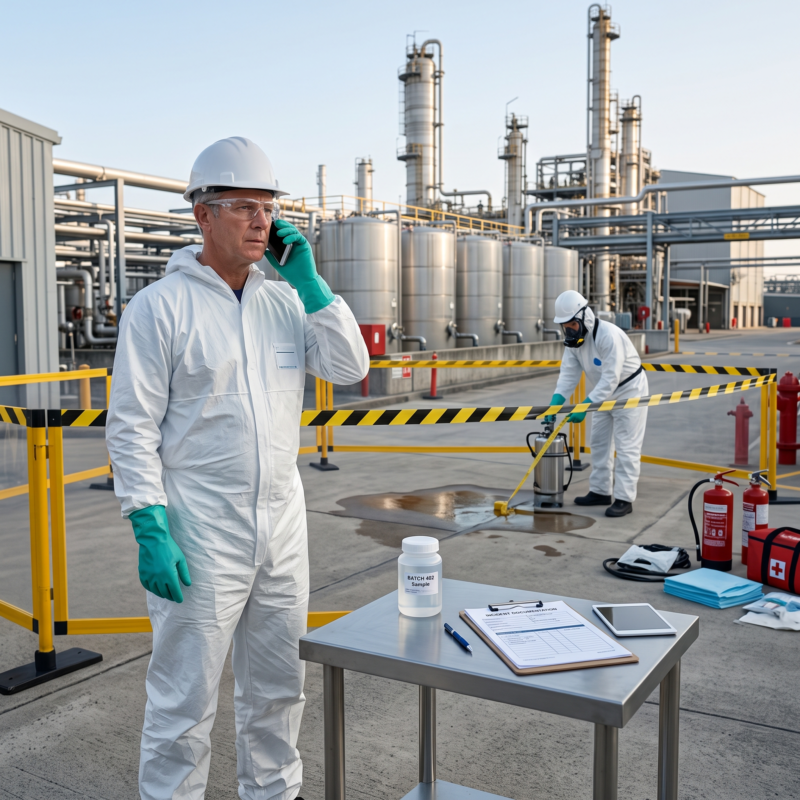
Handled right, the program you paid for does its job. Handled wrong, you hand the carrier a reason to fight.
This is why the relationship with your broker is not a once-a-year transaction. Insurance is not a commodity, and the moment you hand off a policy and never look at it again is the moment problems start multiplying.
Real-world example
Years ago a manufacturer expanded into a second location and did not update the property policy to reflect it. When a fire broke out at the new facility, it was not covered, and that oversight cost them hundreds of thousands of dollars out of pocket. Nothing about the fire was unusual. The only failure was that nobody revisited the coverage when the business changed. For a chemical maker adding a product line, a new tank farm, or a new site, that same silent gap is one incident away from becoming a catastrophe.
According to the Bureau of Labor Statistics, chemical manufacturing recorded about 1.6 recordable injury cases per 100 full-time workers in 2024, below the 2.7 rate for manufacturing overall.
That safety record lulls owners into buying a thin program.
Set against an industry the American Chemistry Council estimates generates roughly $673 billion in annual economic activity, the stakes for getting the coverage right are enormous.
In 40 years of auditing insurance programs, I have found that roughly 9 out of 10 contain at least one fatal flaw.
What to know before you buy: a quick-reference summary
Here is the entire page distilled into one scannable checklist you can keep in front of you before you talk to any broker.
Next step: book a specialist coverage-gap review and we will pressure-test your program against every line above.
Questions about Chemical Manufacturer Insurance?
Get the Right Coverage for Your Chemical Manufacturer Insurance
For more than 40 years I have helped business owners structure insurance that actually pays when it matters, and chemical operations are exactly the kind of complex risk we specialize in. Reactive processes, pollution exposure, product liability, and hard-to-place operations are where most programs quietly fall apart.
The trouble I see again and again is a chemical manufacturer who assumed a standard general liability policy had them covered, then learned after a spill or a product claim that the pollution exclusion left them paying out of pocket. My job is to find those gaps before a loss does, and to build a program around your real exposure instead of a template.
If your coverage has never been pressure-tested by a specialist, that is the first thing we should fix. Book a call and I will walk your program line by line, show you where you are exposed, and lay out exactly what it takes to close the gaps.

This article was written by the CEO of The Coyle Group, Gordon B. Coyle, CPCU, ARM, AMIM, PWCA, who has over 40 years of experience working with business owners of all sizes and industries across the US, solving their insurance challenges.
Here’s how to take the next step
Schedule Your Insurance Confidence Assessment
In our 30-minute call, you’ll discover:
Not ready for a call?
Get Free Access to Our Gated Video:
“How to Finally Feel Confident in Your Coverage. “
And discover the exact system we use to help business owners eliminate hidden coverage gaps, stop overpaying, and finally feel confident in their protection.
What Peace of Mind Looks Like
Trusted by business owners across the U.S.
The Coyle Group is 1st class! Gordon and his team are knowledgeable, responsive, and attentive to detail. Gordon is that rare breed of professional who genuinely cares for his clients and works hard to exceed their expectations. I highly recommend them.


The insurance brokerage service was truly tailored to my needs, nothing like those big brokers who steer you toward random policies that don’t fit your profile. Thank you to the team for your help.

I was working with another broker and having difficulty acquiring General Liability coverage. A colleague recommended The Coyle Group. They were able to get coverage bound in just a couple of business days and a policy issued in ten days, and with a solid carrier at a competitive premium. Truly impressive results, plus it was a pleasure working with them. I highly recommend the Coyle Group!

If any business is looking to work with an insurance brokerage firm that is not only excellent at what the firm does, but one that deeply values the needs of the clients, then The Coyle Group is the firm for you. Give them a call and see for yourself. I can assure that you will quickly agree.

Want to know more?
See related blogs

The Crowdstrike Debacle and Cyber Insurance
Third Party Employment Practices Liability Insurance. Protect Your Business

Are You Overpaying or Underinsured on Your Business Insurance?
