
Pollution Liability Insurance Cost

What You’ll Pay, What Drives Price, and How to Lower It

Home » Insurance By Coverage » Pollution Liability Insurance » Pollution Liability Insurance Cost. Pricing Guide

Executive Summary

You just opened a bid package and saw “Contractors’ Pollution Liability” buried in the insurance requirements. Now you’re Googling to figure out what this coverage actually costs so you can decide if the job is worth it.
Here’s the straight answer: Pollution liability insurance cost typically ranges from $2,500 to $15,000 annually for most contractors, depending on what you do, where you work, and how much coverage the contract requires.
Lighter-risk trades often land in the lower end of that range, while high-exposure operations can exceed $20,000.
The range is wide because pollution risk varies dramatically across construction trades, and every carrier prices differently based on what they think could go wrong.

The Bottom Line (Key Takeaways)

  • Annual premiums commonly range from $2,500 to $15,000 for most contractors, with specialized trades sometimes paying more
  • Industry data shows small businesses typically pay around $2,500 to $3,000 per year for basic environmental liability coverage
  • Contractors handling hazardous materials or working near water often pay significantly more than office-based operations
  • Type of work, jobsite location, and claims history are the three biggest cost drivers
  • According to IRMI research, minimum premiums for contractors typically start around $2,500 for $1M coverage
  • Claims-made policies (where you’re only covered if you report the claim while the policy is active) cost less initially, but require tail coverage when you stop
  • Strong safety programs and documentation can meaningfully reduce premiums

How Much Does Pollution Liability Insurance Cost?

You got hit with an insurance requirement, and now you’re trying to budget it. You need a number that helps you decide whether to pursue the contract, adjust your bid, or walk away.

Here’s what contractors typically pay:

Business Size/Type

Annual Premium Range

Small trade contractors (1-10 employees)

$2,500 – $6,000

Mid-sized contractors (11-50 employees)

$6,000 – $12,000

Large contractors (50+ employees)

$12,000 – $25,000+

Environmental remediation specialists

$10,000 – $30,000+

According to industry data, 38% of small businesses pay less than $150 per month ($1,800 annually), while the median sits at $223 monthly ($2,675 annually).

Why the Range is Wide

The spread exists because insurers price based on:

  • Type of operations (excavation vs HVAC vs office consulting)
  • Materials handled (diesel fuel, solvents, refrigerants, asbestos, lead)
  • Jobsite sensitivity (near schools, waterways, or occupied buildings)
  • Coverage limits ($1M vs $5M per occurrence)
  • Claims history (past incidents drive premiums up fast)
  • Geographic scope (single state vs multi-state operations)

If you do excavation near waterways or handle refrigerants in schools, expect the higher end of these ranges. If you’re a general contractor managing subs on greenfield sites, you’ll likely land in the middle.
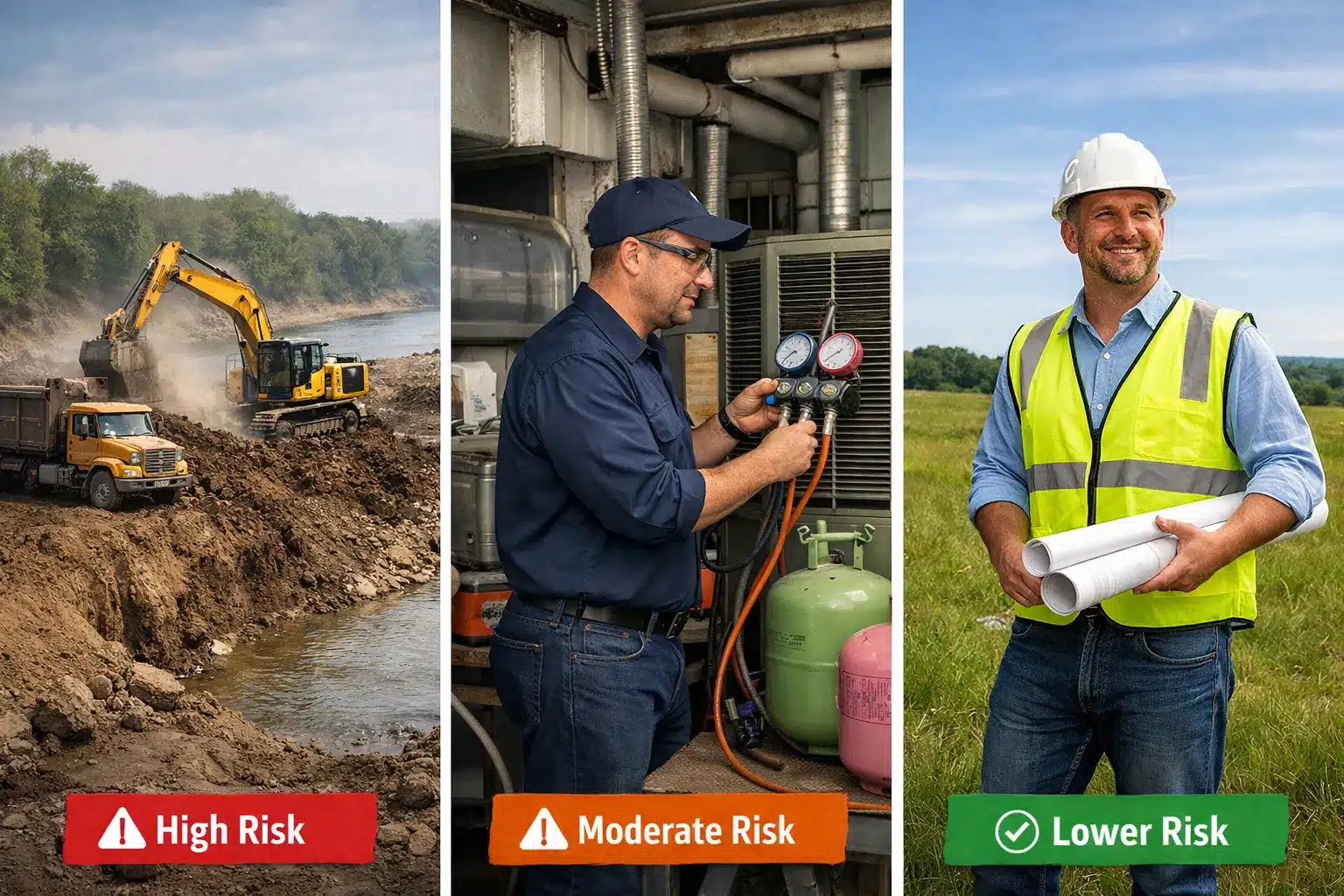
Three-panel comparison of excavation near water, HVAC work with refrigerants, and a general contractor on a greenfield, explaining jobsite risk levels that influence Pollution Liability Insurance Cost.

Quick Price Estimate

Want a ballpark for your situation? Consider these five factors:

  • Your trade: Excavation/environmental remediation = higher end | GC/light trades = middle to lower end
  • Annual revenue: Under $1M = $2,500-$5,000 | $1M-$5M = $5,000-$12,000 | $5M+ = $12,000-$25,000+
  • Where you work: Near water, schools, hospitals = add to baseline | Rural/greenfield = standard pricing
  • Required limits: $1M = baseline | $2M = noticeable increase | $5M = substantial increase
  • Clean loss history: Yes = baseline pricing | Previous claims = expect increases

Based on these factors, most contractors land between $3,000 and $18,000 annually.

Want exact pricing for your situation? We provide accurate quotes in 48-72 hours and handle all certificate of insurance requirements to satisfy contract exhibits fast.

Why is Pollution Coverage So Expensive Compared to General Liability?

Your general liability insurance typically costs $500 to $3,000 per year for similar limits. So why does pollution liability cost more?

Most GL policies exclude pollution entirely through the “absolute pollution exclusion” added in the 1980s. That means even if you think you’re covered, you’re not when pollution incidents happen.

The real reason for the cost difference

Cleanup expenses are mandated by government agencies, not negotiable settlements. A diesel spill can trigger $50,000 to $150,000 in cleanup costs before legal defense, third-party claims, or regulatory fines. According to EPA regulations, construction sites with one or more acres of land disturbance must comply with stormwater discharge requirements, and violations can carry penalties of tens of thousands of dollars per day.

The takeaway

Pollution insurance costs reflect catastrophic risk. One incident can bankrupt a contractor.

Learn more about general liability insurance coverage limits and how they compare.

What Are Insurers Actually Pricing When They Quote This?

When you submit an application, underwriters build a risk model of how likely a pollution event is and how expensive it could get.

What Underwriters Evaluate
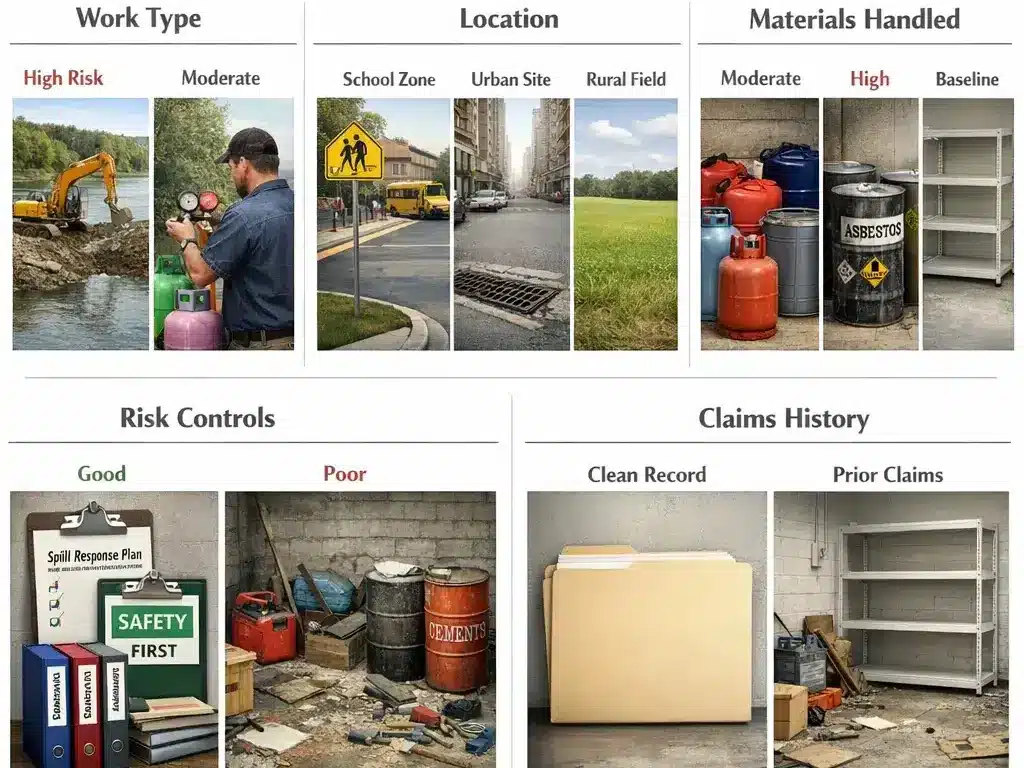
  • What work you do: Excavation near water = high risk | HVAC with refrigerants = moderate | Office consulting = low risk
  • Where you work: Near waterways, storm drains, occupied buildings, schools = higher pricing | Rural greenfield sites = lower pricing
  • What you handle: Diesel fuel, hydraulic fluids = moderate | Asbestos, lead, chemical solvents = high | No hazardous materials = baseline
  • How you prevent problems: Written spill plans, maintenance logs, sub controls, training documentation = reduces premium | No documentation = pay full price
  • Past incidents or claims: Clean history = best pricing | Prior incident = significant increase | Open regulatory action = some carriers won’t quote
Visual chart of underwriting factors—work type, jobsite location, materials handled, risk controls, and claims history—showing how each one affects Pollution Liability Insurance Cost.

What 40+ Years Taught Me About This Risk

The contractors who understand what underwriters are pricing get better rates. If you can show documented safety programs, equipment maintenance, and subcontractor controls, you’ll consistently beat contractors who just fill out applications without context.

What Factors Raise Your Premium the Fastest?

Let’s be direct about what moves the needle on pollution liability insurance cost.

Biggest Premium Drivers

Type of Operations (Major Impact)

These trades consistently pay more:

  • Excavation and site work (soil disturbance, underground tanks)
  • Environmental remediation (asbestos, lead, mold abatement)
  • Demolition and renovation (uncovering unknown contaminants)
  • HVAC/mechanical (refrigerant releases, legionella exposure)
  • Utilities contractors (sewer line breaks, fuel line damage)

Jobsite Sensitivity (Substantial Impact on Premium)

Work in these locations drives premiums up:

  • Within 100 feet of waterways or wetlands
  • Storm drain systems on urban sites
  • Schools, hospitals, or occupied buildings
  • Brownfield or contaminated sites
  • Dense residential neighborhoods

According to EPA stormwater regulations, construction sites must maintain buffers around surface waters to reduce downstream impacts. Failing to comply adds both regulatory risk and insurance cost.

History of Losses or Regulatory Issues (Severe Impact)

  • Previous pollution claims = significant premium increases
  • Open regulatory action = some carriers decline entirely
  • Multiple incidents = expect major surcharges or non-renewal

See real pollution insurance claims examples to understand how incidents impact pricing.

Higher Limits or Broader Coverage (Incremental Increases)

  • $1M per occurrence = baseline
  • $2M per occurrence = noticeable premium increase
  • $5M per occurrence = substantial premium increase
  • Adding gradual pollution = meaningful additional cost
  • Adding transportation coverage = additional premium

Multiple Locations or Multi-State Work (Moderate Impact)

  • Single-state operations = standard pricing
  • Multi-state but regional = modest increase
  • Nationwide operations = more significant increase
  • International work = specialty markets required

Subcontractor Exposure (Can Vary Significantly)

If you’re responsible for subcontractor work:

  • Subs have their own CPL = minimal impact
  • You’re managing subs without their coverage = notable premium increase
  • No subcontractor controls = some carriers won’t quote

The good news? Understanding these drivers lets you know which factors you can control (safety programs, sub management) to reduce pollution liability insurance cost and which are just the cost of doing business (trade type, jobsite location).

What Lowers the Cost (Without Gutting Coverage)?

You can’t change your trade or magically move jobsites away from water. But you can control how underwriters view your risk management, which directly impacts pollution liability insurance cost.

Practical Cost-Reduction Checklist

Let’s talk about the two levers you can pull when getting quotes: how much coverage you buy (limits) and how much you pay out-of-pocket before insurance kicks in (deductible).

Coverage Limits

Most contracts require $1M to $5M per occurrence. Here’s how premiums typically scale:

Coverage Limit

Typical Premium Impact

$1M per occurrence / $2M aggregate

Baseline

$2M per occurrence / $4M aggregate

Moderate increase

$5M per occurrence / $5M aggregate

Substantial increase

$10M per occurrence / $10M aggregate

Significant increase

Rule-of-thumb budgeting framework:

  • Start with the contract requirement (if you have one)
  • Then ask: “If a claim hits $500K+, can my business survive the financial gap?”
  • Consider: Your largest contracts, worst-case jobsite scenarios, proximity to high-value property

For example: If you’re doing $2M excavation contracts near luxury homes or commercial developments, carrying only $1M in coverage means a single major claim could exhaust your policy and expose your business assets.
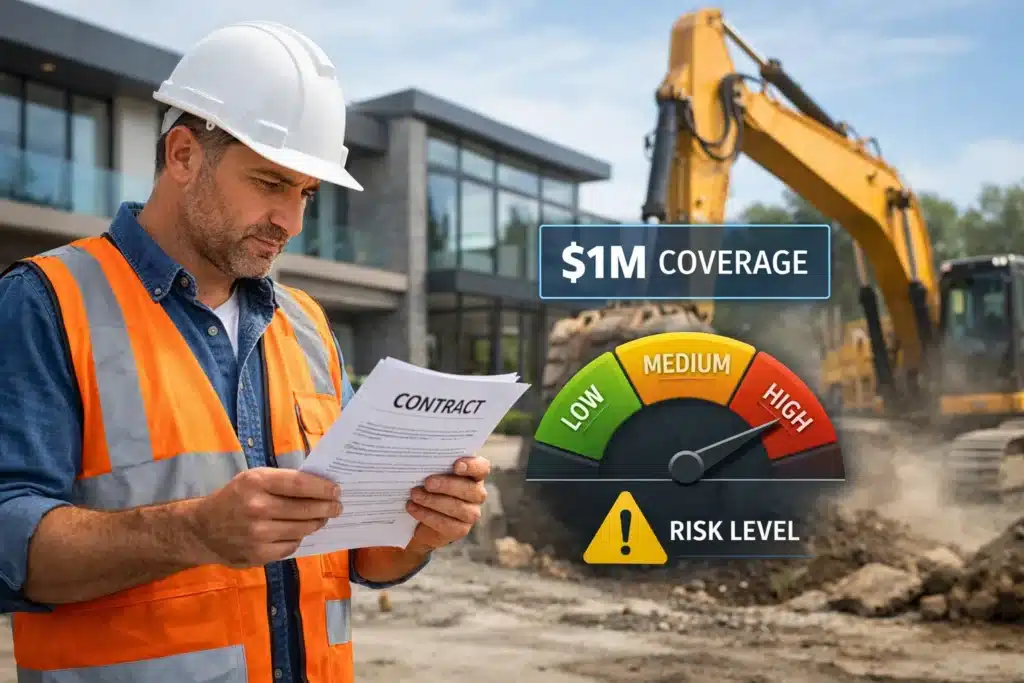
Contractor reviewing insurance needs at excavation site near high-end property with $1M coverage and high-risk meter, demonstrating how inadequate limits raise Pollution Liability Insurance Cost.

Deductibles

Contractors pollution liability policies typically offer deductibles from $2,500 to $25,000. Here’s how it works:

Deductible

Premium Impact

Out-of-Pocket Risk

$2,500

Baseline

Low risk if claim happens

$5,000

Modest savings

Manageable for most contractors

$10,000

Moderate savings

Moderate risk

$25,000

Larger savings

High risk if cash flow is tight

Don’t Do This

Don’t buy a huge deductible you can’t actually fund mid-project.

I’ve seen contractors choose $25,000 deductibles to save $2,000 on premium, only to face financial strain when a $75,000 claim hits and they need to come up with $25K immediately before the carrier pays anything.

Better approach

Choose a deductible you could write a check for tomorrow without disrupting payroll, subcontractor payments, or material purchases.

→ Read about commercial insurance deductibles and how they impact your financial planning.

Is Claims-Made Cheaper and What’s the Hidden Cost?

You’ll see two policy structures: claims-made and occurrence.
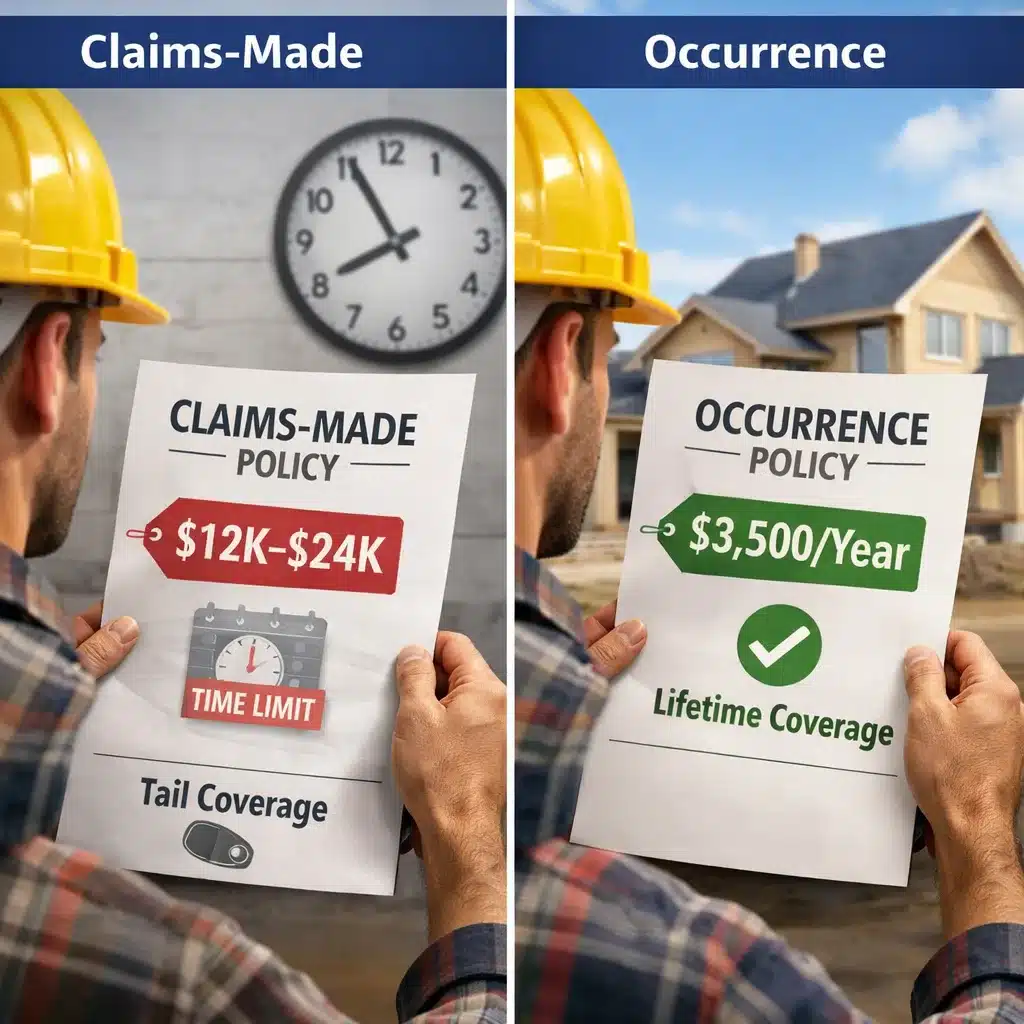
  • In plain English: Claims-made covers you only if the claim gets reported while your policy is active. Occurrence covers you forever for incidents that happened during the policy period, even if the claim comes years later.
  • Claims-made: Costs less initially but requires “tail” coverage when you stop (typically 1.5 to 3 times your annual premium). Example: $8,000 annual premium = $12,000 to $24,000 one-time tail cost.
  • Occurrence: Costs more upfront but provides lifetime coverage with no tail concerns.
  • Choose claims-made if: You’ll carry coverage continuously for 10+ years. Choose occurrence if: You want no future surprises or might change carriers frequently.
Side-by-side image of contractor comparing claims-made and occurrence policies, illustrating short-term vs long-term costs and how policy structure affects Pollution Liability Insurance Cost.

What Add-Ons Move the Price (and When You Actually Need Them)?

Standard CPL policies cover jobsite pollution. Most contractors need additional endorsements:
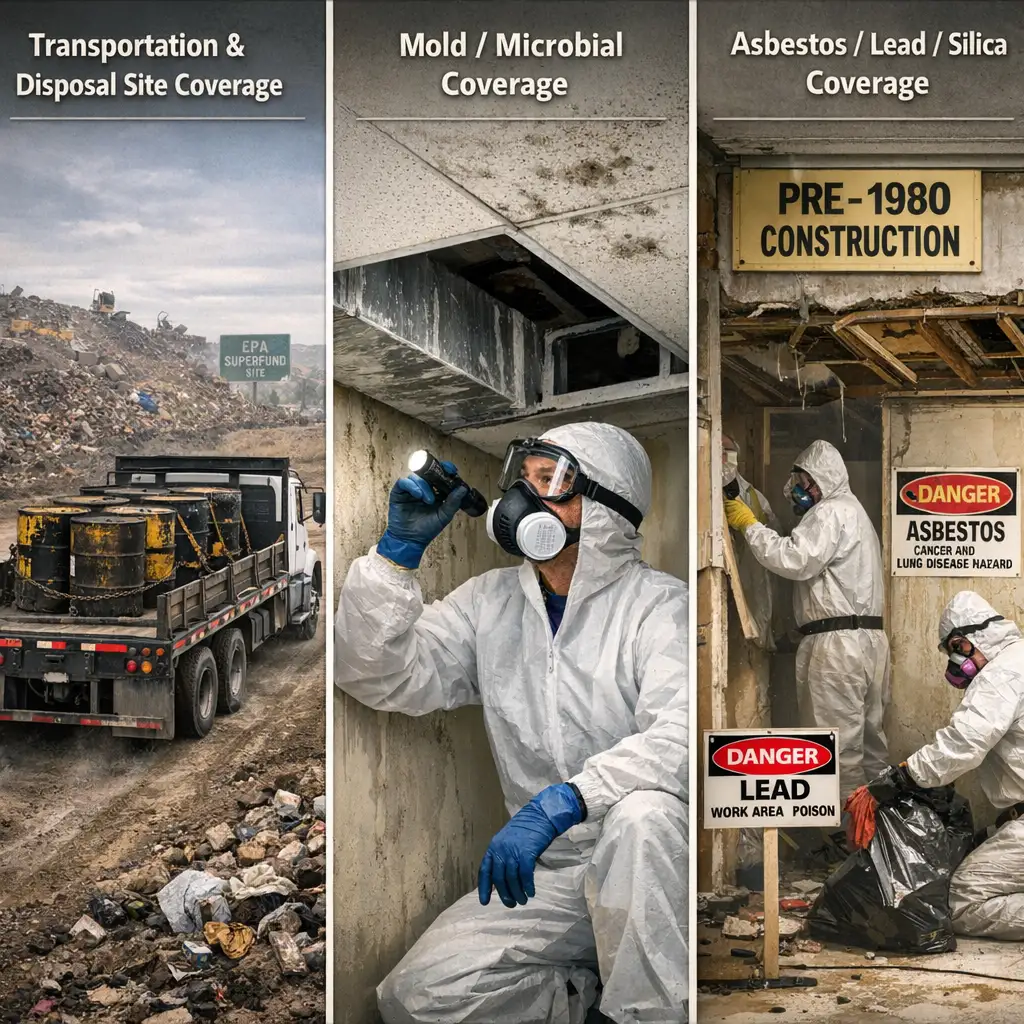
  • Transportation & Disposal Site Coverage – Covers pollution during transport and at disposal facilities. Required if you haul fuel, chemicals, waste, or contaminated materials off-site. If the disposal facility later becomes a Superfund site, EPA can pursue generators under CERCLA for cleanup costs.
  • Mold/Microbial Coverage – Covers mold, bacteria, and fungi claims. Essential for HVAC contractors (legionella risk), restoration work, and demolition in moisture-damaged buildings.
  • Asbestos/Lead/Silica Coverage – Requires specialty underwriting. Needed for environmental remediation, pre-1980 demolition, and school renovation projects.
Photorealistic breakdown of pollution insurance add-ons including transportation, mold/microbial, and asbestos/lead/silica coverage—all of which increase Pollution Liability Insurance Cost based on exposure.

Why Two Quotes Differ

If you get quotes of $4,500 and $8,000, ask: Does it include transportation? Disposal sites? Gradual pollution or only sudden/accidental? Mold coverage? What deductible? These differences explain pricing gaps. Learn more about coverage options in our pollution liability insurance complete guide.

What Does a ‘Normal’ Quote Look Like by Business Type?

Let’s get specific. Here’s what contractors in different trades typically pay, based on industry data and our experience working with contractors nationwide.

Premium Ranges by Trade

Light Consulting / Office-Only Operations

  • Annual Premium: $2,500 – $4,000
  • Why: Minimal hands-on exposure, limited equipment use, primarily professional services

General Contractor Managing Subs

  • Annual Premium: $4,000 – $8,000
  • Why: Moderate exposure, liability for subcontractor work, varied jobsite conditions

HVAC/Mechanical Contractors

  • Annual Premium: $5,000 – $10,000
  • Why: Refrigerant handling, legionella exposure, work in occupied buildings

Roofing/Coatings Contractors

  • Annual Premium: $4,000 – $9,000
  • Why: Chemical exposures from coatings, stormwater runoff concerns

Excavation/Site Work Contractors

  • Annual Premium: $7,000 – $15,000+
  • Why: Soil disturbance, underground tank risks, work near waterways

Manufacturing/Facility Runoff Exposure

  • Annual Premium: $8,000 – $20,000+
  • Why: Continuous operations, storage of chemicals, discharge permits

Environmental Remediation Specialists

  • Annual Premium: $10,000 – $30,000+
  • Why: Direct handling of asbestos, lead, mold, contaminated soil

These ranges assume:

  • $1M-$2M coverage limits
  • Annual revenues under $5M
  • Clean loss history
  • Single-state operations
  • Standard policy with basic enhancements

If you’re outside these parameters (higher limits, multi-state, significant sub exposure), expect adjustments.

What Documents Do You Need to Get an Accurate Cost Fast?

Speed matters when you’re under a bid deadline. Here’s what to have ready before you request quotes so you can get accurate pricing in days, not weeks.

Quote-Ready Checklist

Contract Insurance Exhibit (If Any)

  • Full insurance section from the bid package
  • Specific limits, coverage types, and endorsements required
  • Additional insured language requirements
  • Certificate of insurance deadlines

Description of Operations + % of Revenue by Type

  • Break down your work: excavation 40%, utilities 30%, grading 30%
  • List typical equipment used
  • Explain subcontractor arrangements
  • Describe typical project size and duration

Typical Jobsites + Any Near Water

  • List geographic areas where you work
  • Note proximity to waterways, schools, hospitals
  • Describe jobsite access and sensitivity
  • Mention any brownfield or contaminated site experience

Past 5 Years of Claims/Incidents (If Any)

  • Full loss runs from current carrier
  • Describe any pollution-related incidents (even if no claim filed)
  • Note any regulatory inspections or fines
  • Explain corrective actions taken

Subcontractor Controls / Certificates Process

  • How you verify sub insurance coverage
  • What limits you require from subs
  • How you track certificate compliance
  • Whether you require subs to carry their own CPL

Any Environmental Plans Already in Place

  • Spill response procedures
  • Storm Water Pollution Prevention Plan (SWPPP)
  • Equipment maintenance schedules
  • Employee training programs

The more documentation you provide upfront, the faster underwriters can quote and the better pricing you’ll receive.

How Do You Avoid Overpaying for Pollution Liability Insurance?

After four decades helping contractors, I’ve seen the same mistakes repeatedly. Here’s how to avoid them:

  • Match Policy to Risk – CPL covers jobsite work. PPL covers owned/leased property. Buying the wrong type costs you significantly.
  • Don’t Guess on Limits – Use contract requirements plus realistic worst-case scenarios. Don’t underbuy to save $1,000 if it exposes you to $500,000 in uninsured loss.
  • Confirm What’s Included – Ask: On-site and off-site cleanup? Defense costs inside or outside limit? Gradual pollution or only sudden/accidental? Transportation and disposal coverage?
  • GL Endorsements Won’t Satisfy Contracts – Limited pollution endorsements on general liability policies rarely meet construction contract requirements due to low limits and narrow coverage.
  • Don’t Hide Incidents – Disclose spills, complaints, or inspections. Hiding incidents voids coverage retroactively and causes claim denials. Carriers understand incidents happen but won’t tolerate dishonesty.
  • Compare Coverage, Not Just Premium – The $4,000 quote might exclude transportation, mold, and disposal sites that the $7,000 quote includes.

→ Learn about reducing general liability costs for additional savings strategies.

Questions About Pollution Liability Insurance Cost

Premium increases typically result from claims activity, revenue growth, scope changes, or market-wide tightening. Even one incident can trigger significant increases. If your premium jumped without obvious changes, get competitive quotes. Loyalty doesn’t always pay in commercial insurance.

Most contractors pay between $2,500 and $15,000 annually, depending on trade type, operations, and coverage limits. Excavation and environmental remediation contractors often pay $7,000 to $30,000+, while office-based consultants typically pay $2,500 to $4,000. Costs vary based on what work you do, where you work, what materials you handle, and your claims history.

It depends on your contracts and exposure. Match or exceed contract requirements, consider your largest project values, and factor in jobsite locations. According to The National Association of Insurance Commissioners, contractors should evaluate limits based on contract requirements and realistic claim scenarios. If you’re doing $3 million excavation projects near commercial developments, $1 million is likely inadequate.

The three biggest cost drivers are type of work (excavation and demolition cost more than office consulting), jobsite location (near waterways, schools, or occupied buildings increases premiums), and claims history (prior incidents trigger significant increases). Revenue, coverage limits, deductibles, and whether you have documented safety programs also impact pricing.

Transportation coverage (for hauling fuel, chemicals, or waste off-site), non-owned disposal site coverage (protects you if disposal facilities become Superfund sites), mold and microbial coverage (essential for HVAC and restoration work), and asbestos, lead, or silica coverage (requires specialty underwriting) all increase premiums. Many contract insurance requirements specifically include transportation and disposal coverage, so check your exhibits carefully before buying.

Yes, project-specific policies are available for one-time large projects requiring CPL coverage. They typically cost more per dollar of coverage compared to annual programs but avoid paying for year-round coverage you don’t need. Most contractors benefit from annual blanket policies if they work consistently throughout the year.

Typically yes, but with conditions. The spill must be sudden and accidental (not intentional or due to negligence), must occur during covered operations (not storage at your yard), and must be reported promptly. Gradual seepage may require specific coverage endorsements. Spills at your business premises usually require separate Premises Pollution Liability coverage.

Claims-made covers you only if the claim gets reported while your policy is active. If you cancel, you need expensive “tail” coverage (typically 1.5 to 3 times your annual premium). Occurrence covers you forever for incidents that happened during the policy period, even if claims come years later. Occurrence costs more upfront but eliminates tail coverage surprises.

Usually, but verify before you buy. Your policy must meet specified limits (typically $1M to $5M per occurrence), include “additional insured” endorsement for the GC or project owner, cover “ongoing and completed operations,” and provide “primary and non-contributory” coverage. Send insurance requirements to your broker before binding coverage to ensure all contract language is met.

Document your safety programs including spill response plans, equipment maintenance logs, employee training records, and subcontractor insurance verification. Require subs to carry their own CPL coverage, which reduces your exposure. Choose manageable deductibles ($5,000 to $10,000 is typical). Compare quotes on coverage, not just premium, as cheaper policies may exclude critical endorsements like transportation or disposal site coverage.

Ready to Get Pricing That Makes Sense?

If you’re bidding on projects requiring pollution liability, let’s talk.

What makes The Coyle Group different:

  • We specialize in contractor insurance
  • We explain coverage in plain English
  • We document your safety programs to get better pricing
  • We access 20+ carriers
  • We handle COIs fast – most delivered within 24-48 hours to meet bid deadlines

To discuss your requirements.

This article was written by Gordon B. Coyle, CPCU, ARM, AMIM, PWCA, CEO of The Coyle Group, who has over 40 years of experience working with business owners across the US, solving their insurance challenges. Gordon specializes in helping contractors develop comprehensive insurance programs that protect their operations without unnecessary complexity or cost.

Here’s how to take the next step

Schedule Your Insurance Confidence Assessment

In our 30-minute call, you’ll discover:

  • Whether your current coverage matches your actual risks
  • If you’re getting fair value for what you’re paying
  • How your service experience compares to what’s possible
  • What questions you should be asking but probably aren’t

Not ready for a call?

Get Free Access to Our Gated Video:
How to Finally Feel Confident in Your Coverage.

And discover the exact system we use to help business owners eliminate hidden coverage gaps, stop overpaying, and finally feel confident in their protection.


What Peace of Mind Looks Like

Trusted by business owners across the U.S.

  • The Coyle Group is 1st class! Gordon and his team are knowledgeable, responsive, and attentive to detail. Gordon is that rare breed of professional who genuinely cares for his clients and works hard to exceed their expectations. I highly recommend them.
    Jeff Carton
    Partner, Denlea & Carton, LLP
  • The insurance brokerage service was truly tailored to my needs, nothing like those big brokers who steer you toward random policies that don’t fit your profile. Thank you to the team for your help.

    Yohann Josselin
    Founder & Director, RankForge
  • I was working with another broker and having difficulty acquiring General Liability coverage. A colleague recommended The Coyle Group. They were able to get coverage bound in just a couple of business days and a policy issued in ten days, and with a solid carrier at a competitive premium. Truly impressive results, plus it was a pleasure working with them. I highly recommend the Coyle Group!

    Tim McCarthy
    Director of Operations, Dalmatian Company LLC
  • If any business is looking to work with an insurance brokerage firm that is not only excellent at what the firm does, but one that deeply values the needs of the clients, then The Coyle Group is the firm for you. Give them a call and see for yourself. I can assure that you will quickly agree.
    Dahiema Grant
    Accountant, DSG Advisory CPA

Want to know more?

See related blogs