
D&O vs General Liability Insurance
Which Lawsuit Does Each Actually Cover?
D&O vs General Liability Insurance Explained
Index

Gordon B. Coyle
CEO, The Coyle Group
845-474-2924
How to get started
You bought general liability when you started the company, so when an investor, a board seat, or a renewal form brings up D&O, the honest reaction is usually, “I am unsure how D&O insurance works, and not sure if it’s something I should consider.” Plenty of owners go further and assume the general liability policy already sitting in the drawer will answer any lawsuit that lands on the business, including one aimed at the people running it.
It won’t.
The Coyle Group is a commercial insurance agency that handles the complex, high-value risks where the details in the policy are the difference between a paid claim and a denied one.
Over 40 years, I’ve watched founders and board members discover, at the worst possible moment, that the difference between D&O and general liability is not a technicality.
It decides whether a lawsuit gets paid or gets paid out of your personal checking account.
You’re not overthinking this, and you’re not covered the way you assume. Most owners believe one liability policy protects everyone and everything.
In practice, general liability protects the business from physical harm claims, and D&O protects the humans making decisions. We help you see which lawsuit each policy answers before a claim proves it the hard way.
Book a call, and we’ll map your real exposure in 20 minutes.
TL;DR. The Short Answer
General liability insurance covers third-party bodily injury and property damage caused by your business operations, a customer who slips in your lobby, a product that hurts someone, or damage you cause on a client’s site.
D&O insurance covers claims that a director or officer made a bad decision, breached a duty, or mismanaged the organization, and it protects their personal assets when they get sued for how they led. The two policies almost never overlap, which is why most organizations with a board, investors, or real decision-making authority need both.
What is the difference between D&O and general liability insurance?
The difference between D&O and general liability comes down to who and what each one protects: general liability protects the business entity from third-party physical harm claims, while D&O protects individual leaders from claims about their decisions.
That distinction sounds small until you see which lawsuits fall through the crack between them, because a claim against your judgment is not a claim against your premises.
Here is the cleanest way I’ve found to explain it after 40 years of coverage reviews.
General liability responds when something physical happens: a body gets hurt, property gets damaged, your advertising injures someone’s reputation. Directors and officers liability responds when someone alleges a management decision caused financial harm: a shareholder, an investor, a regulator, an employee, or a competitor claims your leadership got it wrong.
Frankly, most business owners assume they’re basically the same thing with different labels.
They are not, and the space between them is where personal assets live.
Want the two-minute version before you keep reading? Book a call and we’ll tell you which gap applies to your business.
What does general liability insurance cover (and not cover)?
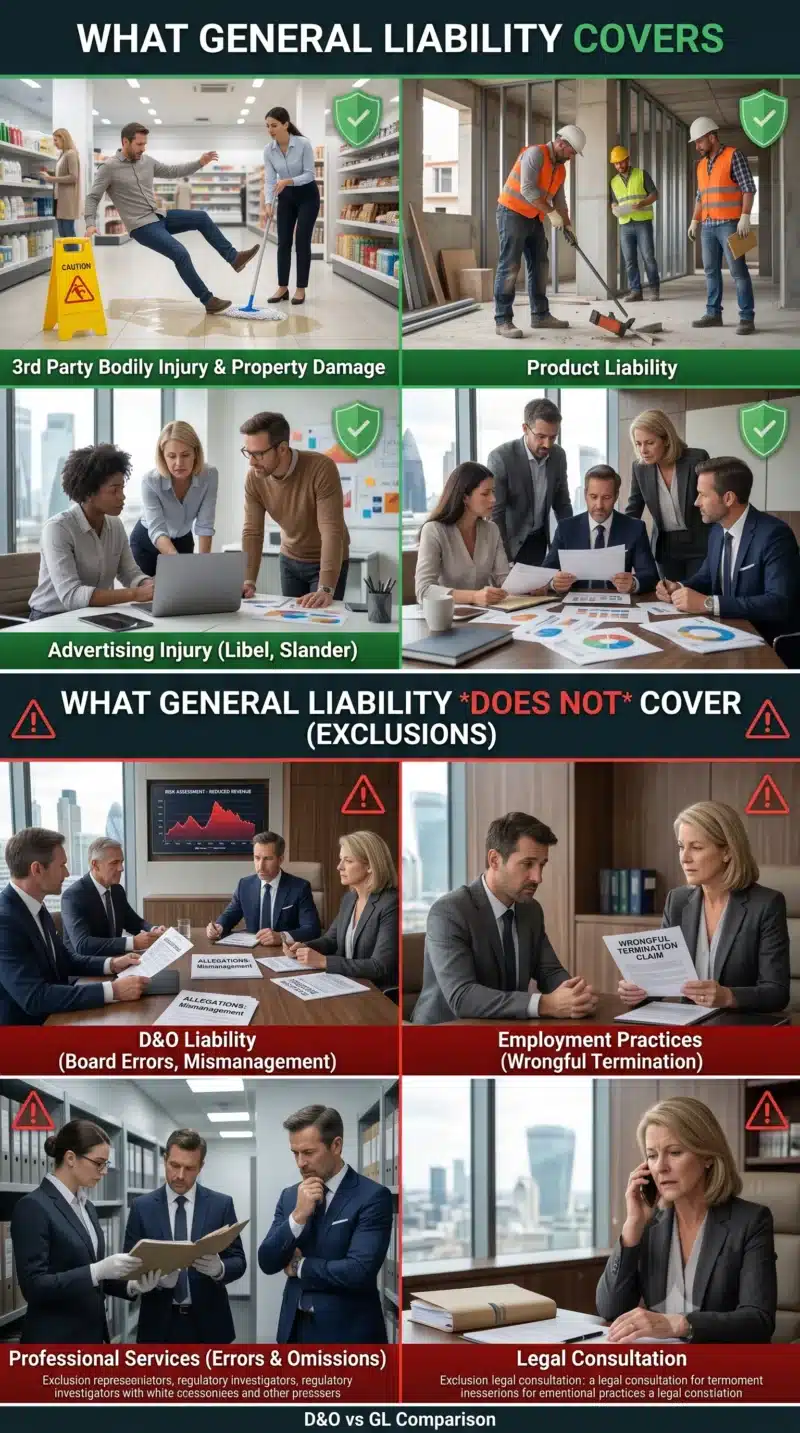
General liability covers third-party bodily injury, property damage, and personal or advertising injury that arise from your operations, premises, or products. It is the foundation policy almost every business carries, but it stops cold at the office door of decision-making, and that limit is where owners get surprised. It answers accidents, not judgment calls.
In practice, that means:
What general liability will not touch is just as important:
Owners describe how general liability “often surprises owners” at claim time, because they assumed it covered lawsuits it was never designed to answer.
It covers the accident, not the allegation.
What does D&O insurance cover (and not cover)?
D&O insurance covers directors and officers when they are sued for a wrongful act in their leadership role, breach of duty, misrepresentation, mismanagement, or decisions that allegedly caused financial loss, and it pays defense costs and settlements that would otherwise hit personal assets. What trips people up is the structure, because D&O splits into three parts that decide who gets paid first. That structure is the whole point of the coverage.
Covered claims typically include:
The three “sides” of a D&O policy matter more than any brochure lets on:
D&O will not cover bodily injury, property damage, or fraud and criminal acts once proven.
Not sure which “side” you actually need? Contact us, and we’ll walk your structure line by line.
D&O vs general liability: the side-by-side comparison
Here is the difference between D&O and general liability in one view. General liability sits on the left as your physical-harm policy; D&O sits on the right as your decision-harm policy. Read the “Who’s Insured” and “Asset Protection” rows first, because that is where the two policies stop overlapping and start protecting completely different things. Most comparison tables skip the rows that actually decide a claim.
Feature |
General Liability (GL) |
Directors & Officers (D&O) |
|---|---|---|
|
Protects against |
Accidents, injuries, property damage |
Management decisions, mismanagement, breach of duty |
|
Who’s insured |
The business entity |
Directors, officers, and often the entity |
|
Who it protects |
Third parties who are harmed |
The people making decisions, plus the company |
|
Primary claims |
Slips, defective products, advertising injury |
Shareholder suits, regulator actions, employment claims |
|
Asset protection |
Shields company assets from third-party suits |
Shields personal assets (homes, savings) of leaders |
|
Defense costs |
Paid in addition to limits (typically) |
Usually paid inside the limit, so defense erodes coverage |
|
Coverage trigger |
Occurrence-based (when the harm happened) |
Claims-made (when the claim is filed) |
|
Main cost driver |
Location, payroll, premises, products |
Industry, financials, governance, prior claims |
And because D&O is claims-made, timing and continuity matter, which is why the D&O tail policy exists to protect you for past acts after a policy ends.
Want this table filled in with your actual limits and gaps?
Which lawsuit does each one actually cover?
The fastest way to know which policy responds is to ask one question: did something physically happen, or did someone challenge a decision? Physical harm goes to general liability. A challenged decision goes to D&O. The reason this test matters is that a single event can spin off both kinds of claims at once, and only one policy answers each.
Run it against real scenarios and the line gets obvious:
A real coverage surprise (the D&O blind spot). In my experience the most painful reviews involve a founder or director who assumed the company’s liability policy had their back. When a decision-based lawsuit hits and the entity cannot indemnify, that individual can be defending a two million dollar lawsuit out of their own pocket. That is the D&O blind spot, and general liability never sees it coming. It is the one that keeps me up at night for my clients, because it is about your personal assets, not the company’s.
Get the question right and you always know which policy to call.
Worried a decision-based claim would land on you personally? Contact us for a straight answer.
Do I need both D&O and general liability?
For most organizations with a board, investors, employees, or real decision-making authority, yes, you need both, because general liability and D&O cover mutually exclusive risks and neither one fills the other’s gap. The pushback I hear is that D&O feels like just another expense, and I understand it, but that framing is exactly what leaves personal assets exposed. One policy protects the business; the other protects the people who run it.
Think of it this way:

Owners openly debate whether a policy is “really necessary or just another expense.” With D&O, the answer depends on one thing: whether anyone can sue your leaders for a decision.
If you have investors, a board, or employees, someone can.
What we see in practice is that 9 out of 10 programs we review have at least one gap like this hiding in plain sight.
Not sure if “both” applies to you? Book a call, and we’ll settle it fast.
D&O vs general liability for startup founders
For startup founders, general liability is your operational baseline, but D&O is the policy that protects your personal assets the moment you take outside money or seat a board. Investors frequently require it, and that requirement is not red tape, it is a signal that your decisions are now legally exposed in ways a general liability policy will never address. The funding round is usually when the risk becomes real.
Here is what that founder is really buying:

A bare-bones startup package bought online usually does not come close to satisfying an investor’s requirements.
Founders acquiring or running through a search structure have their own version of this exposure, which is why search fund D&O insurance is structured differently from an operating company’s.
Raising soon or got a term sheet asking for D&O? Contact us, and we’ll get you compliant.
D&O for nonprofit boards
Nonprofit board members need D&O because volunteer directors are personally liable for governance decisions, and general liability does not protect them, no matter how good-hearted the mission. The dangerous assumption is that volunteering shields you from lawsuits. It does not, and the people most surprised by that are the ones who joined a board to help. Good intentions are not a legal defense.
The National Council of Nonprofits notes that nonprofit directors face real personal liability for their decisions, exposure that general liability was never built to cover.
For a nonprofit board, D&O typically answers:
I have seen board members walk into disputes like the one described in the r/nonprofit thread titled “Directors and Officers Insurance, Founding Director Denies Requests for Coverage.” Those conflicts get personal and expensive quickly.
Funders and grantmakers increasingly expect the coverage, too.
On a nonprofit board and unsure if you’re protected? Book a call.
How much does each cost, and how do I size limits?
Carriers price general liability and D&O on completely different factors, so there is no single number, but the sizing logic is straightforward once you know what drives each. General liability tracks your physical footprint; D&O tracks your decisions and financial profile. The mistake is buying either one by price alone, because the cheapest limit is usually the one that runs out mid-claim. Underinsuring is the quiet default, and it only shows up at claim time.
What actually moves the price:
For sizing, I use a few principles honed over 40 years:

Employment lawsuits alone hit nearly 40% of US companies over a five-year period, which is why the limit conversation matters.
Want limits sized to your real exposure, not a template?.
How D&O and general liability fit with EPLI, E&O, and cyber
D&O and general liability are two pieces of a larger program, and the coverage gaps between them are filled by EPLI, E&O, and cyber, each answering a claim the other two will not. Knowing where one policy ends and the next begins is how you avoid paying for overlap or discovering a hole. The goal is a program that fits together, not a stack of separate policies.
Here is how the pieces align:
The point of a real program is that a specialist coordinates these policies so a claim lands cleanly on the right one.
Want your whole program reviewed for gaps and overlap?
What most brokers get wrong about the D&O and general liability split
The single thing most generalist brokers get wrong is treating D&O and general liability as two boxes to check, which means they miss the fine-print wiring that decides whether a claim actually pays. Four errors show up again and again in the policies I review, and any one of them can turn a covered-looking claim into a denied one.
Here is where I watch coverage quietly fail:
None of this appears until a claim does.
That is the real difference between a broker who sells you a policy and a specialist who structures one that answers your actual lawsuits.
Get the right coverage before a claim proves you wrong
The difference between D&O and general liability is not academic. One protects your business from accidents; the other protects you, personally, from lawsuits over your decisions. In my experience the owners who sleep well are the ones who stopped guessing and got both policies structured to fit together. If you have a board, investors, employees, or real decision-making authority, you almost certainly need both, and you deserve to know exactly where each one responds.
For a no-obligation review of your coverage.
Questions about D&O Vs General Liability Insurance?
Get The Right Coverage For Your D&O And Liability Risk
You have seen the real scenarios, the personal exposure, and the coverage gaps. The only question left is a simple one: if a lawsuit named you tomorrow, would it land on the company’s policy or your own bank account?
Find out with The Coyle Group. We size your true exposure, read your current D&O and general liability limits and exclusions, and show you in plain English which policy answers which lawsuit and where you are still on the hook.
No pressure, and no need to leave your current agent to get a straight answer.
Book a short call or reach out, and you will walk away knowing exactly which claims land where and whether your personal assets are protected.
It takes only a few minutes to stop guessing and finally know your business and the people running it are covered.

This article was written by the CEO of The Coyle Group, Gordon B. Coyle, CPCU, ARM, AMIM, PWCA, who has over 40 years of experience working with business owners of all sizes and industries across the US, solving their insurance challenges.
Here’s how to take the next step
Schedule Your Insurance Confidence Assessment
In our 30-minute call, you’ll discover:
Not ready for a call?
Get Free Access to Our Gated Video:
“How to Finally Feel Confident in Your Coverage. “
And discover the exact system we use to help business owners eliminate hidden coverage gaps, stop overpaying, and finally feel confident in their protection.
What Peace of Mind Looks Like
Trusted by business owners across the U.S.
The Coyle Group is 1st class! Gordon and his team are knowledgeable, responsive, and attentive to detail. Gordon is that rare breed of professional who genuinely cares for his clients and works hard to exceed their expectations. I highly recommend them.


The insurance brokerage service was truly tailored to my needs, nothing like those big brokers who steer you toward random policies that don’t fit your profile. Thank you to the team for your help.

I was working with another broker and having difficulty acquiring General Liability coverage. A colleague recommended The Coyle Group. They were able to get coverage bound in just a couple of business days and a policy issued in ten days, and with a solid carrier at a competitive premium. Truly impressive results, plus it was a pleasure working with them. I highly recommend the Coyle Group!

If any business is looking to work with an insurance brokerage firm that is not only excellent at what the firm does, but one that deeply values the needs of the clients, then The Coyle Group is the firm for you. Give them a call and see for yourself. I can assure that you will quickly agree.

Want to know more?
See related blogs

The Crowdstrike Debacle and Cyber Insurance
Third Party Employment Practices Liability Insurance. Protect Your Business

Are You Overpaying or Underinsured on Your Business Insurance?
