
Gig Economy Platform Insurance
What Your Marketplace Must Cover (Not Just Your Workers)

Index

Gordon B. Coyle
CEO, The Coyle Group
845-474-2924
How to get started
TL;DR. executive Summary
Gig economy platform insurance is the set of commercial coverages that protect the marketplace company itself, not the individual gig worker.
The single biggest misconception is that 1099 status removes your exposure. It does not.
Then an enterprise client sends over a contract demanding proof of insurance, or a courier gets hurt on a job booked through the app and names the platform in the suit.
Suddenly the question is not what your workers carry. It is what your company carries, and whether the generic policy you bought online actually responds.
Closing that gap is the whole point of gig economy platform insurance.
The Coyle Group is a commercial insurance agency that handles the complex, high-value risks other agencies don’t know how to structure, where the details in the policy are the difference between a paid claim and a denied one.
Gig and marketplace platforms are a textbook example, because the exposure sits in a place most brokers never look: the platform itself.
You want peace of mind, but what you have feels like guesswork.
You are not sure your general liability or tech E&O responds when a gig goes wrong, whether you owe workers’ comp on 1099 contractors, or how to meet an enterprise client’s insurance demand. Our approach is to insure the platform, not just the people on it, and we have restructured tech programs to close those gaps and still cut cost by around 30%.
The next step is a short conversation. Book a call.
What Is Gig Economy Platform Insurance, and Who Actually Needs It?
Gig economy platform insurance protects the company that runs the marketplace, not the drivers, couriers, or freelancers on it. That distinction matters more than it sounds, because nearly 40% of US companies face an employment-related lawsuit over a five-year period, and when a platform gets named in an injury or misclassification claim, “the worker was a contractor” is a defense you pay lawyers to argue, not a force field.
Here is what I see in practice
Founders read “gig insurance” online and land on pages about a driver’s rideshare add-on or a freelancer’s health plan.
That is worker coverage. It does nothing for the platform when your company is the defendant.
You need a program built for the entity that operates the app, holds the data, moves the money, and connects strangers for a fee.
If you are past the hobby stage and have live transactions, enterprise pilots, or investors, this is your risk.
A quick way to see the split:
Worker coverage (what the SERP mostly shows) |
Platform coverage (what your company needs) |
|---|---|
|
Personal or commercial auto for the driver |
Platform and contingent liability for the company |
|
Freelancer’s own errors and omissions |
Technology E&O for your software and matching |
|
Occupational accident paid to the worker |
Cyber for the data and payments you hold |
|
The worker’s health, disability, income |
Directors and officers for founders and the board |
Do gig workers need insurance? Often, yes.
But that is their coverage decision.
Your job is to protect the platform, and then decide, separately, whether you want to offer or require worker coverage on top.
Talk to us about your platform.
Which Gig Platform Insurance Covers Contractor Injuries?
When a contractor or customer is injured during a gig, the coverage that responds for the platform is usually contingent (vicarious) liability, backed by your commercial general liability, and, for platform-sponsored injury benefits, occupational accident.
Over 40 years I have watched this exact scenario play out.
A worker gets hurt on a job your app arranged, or a customer is injured by a provider you connected, and the lawsuit names the platform because that is where the money and the insurance are.
The regulator view is blunt on this point: the National Association of Insurance Commissioners says the primary concern is identifying the liable party when something goes wrong in the gig economy, and platforms sit right in the middle of that question.
The coverages that actually respond:
In my experience, almost every insurance program we review contains at least one fatal mistake. And with platforms, the fatal mistake is usually assuming a contractor injury can never become the company’s problem. Left uncovered, one serious claim can mean defending a seven-figure suit, or paying a $2 million judgment out of your own pocket.
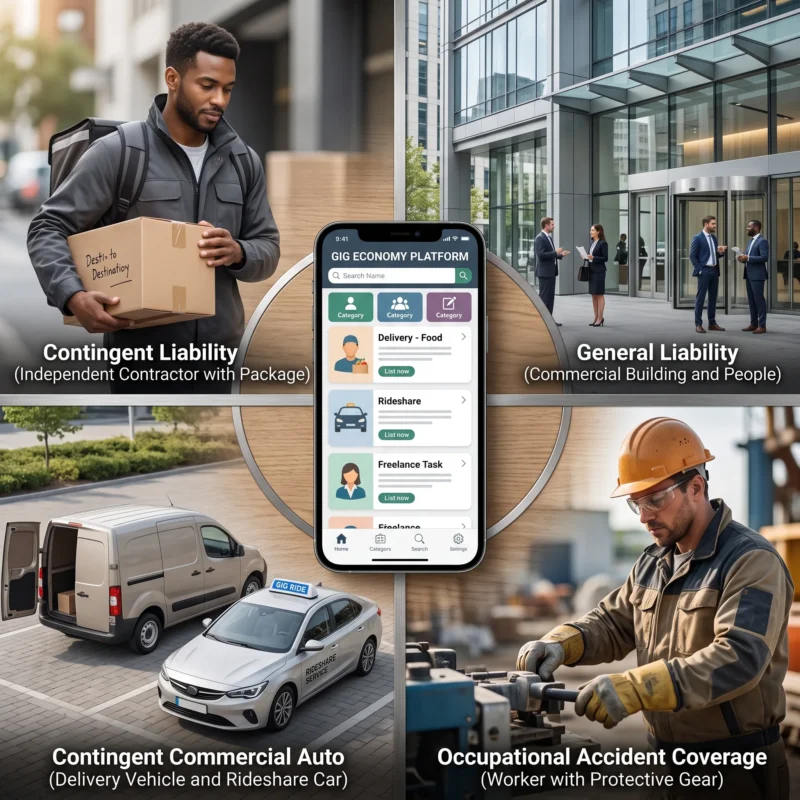
Book a call if you are not sure your GL responds to contractor injuries.
What Insurance Does a Gig Platform Itself Need? The Core Coverage Stack
A gig platform itself needs six core coverages: platform and contingent liability, technology errors and omissions, cyber, commercial or contingent auto (for vehicle-based models), directors and officers, and employment practices liability. The nuance that trips founders up is that these are not add-ons to a small-business policy. They are a program, and the order you buy them in should follow your real exposure, not whatever a website upsells.
Treat gig economy platform insurance as a program you build in order of exposure, not a single policy you check off. From what I have seen, the platform’s biggest risks live in the software and the relationships, not the storefront.
A generic business owner’s policy addresses almost none of that.
This is where technology firm insurance built for a marketplace earns its keep.
Coverage |
What it protects the platform from |
Example trigger |
|---|---|---|
|
Platform / commercial general liability |
Third-party injury and property damage tied to operations |
A customer is hurt at a job the app arranged |
|
Contingent / vicarious liability |
Being held responsible for a contractor’s acts |
Injured party sues the platform, not the worker |
|
Technology E&O |
Claims your software or matching caused financial loss |
An outage or bad dispatch costs a client revenue |
|
Cyber |
Data breach, ransomware, payment and fraud loss |
Customer records or payment data are exposed |
|
Directors and officers |
Personal liability of founders and the board |
An investor or regulator sues leadership |
|
Employment practices (EPLI) |
Misclassification, wage, and employment claims |
A worker sues claiming they were an employee |
Founders raising or governing a funded company also need directors and officers coverage before their personal assets are on the line.
What Drives a Gig Platform’s Insurance Cost
Pricing is not a flat rate. When we structure gig economy platform insurance, the premium and the limits track a handful of exposure drivers, and knowing them tells you where your cost and your risk actually sit:

Contact us to map your stack.
Best Cyber Liability Insurance for Gig Platforms
The best cyber liability insurance for a gig platform is a customized standalone policy with real limits and sublimits sized to the data and payments you handle, not a cookie-cutter online policy sold on speed.
Your platform is a data and payments business whether you think of it that way or not.
You store customer and provider personal information, you process transactions, and you control the systems that move money between strangers.
That is exactly the profile attackers target, and cyber insurance is where I see the widest gap between what founders bought and what they need.
A widely cited industry estimate puts the share of small and midsize businesses that fail after a serious cyber event near 60%; whatever the exact figure, in my experience a platform rarely absorbs a six-figure uncovered loss and keeps going, so this is not a line to shop on price alone.
What to insist on in a platform cyber policy:
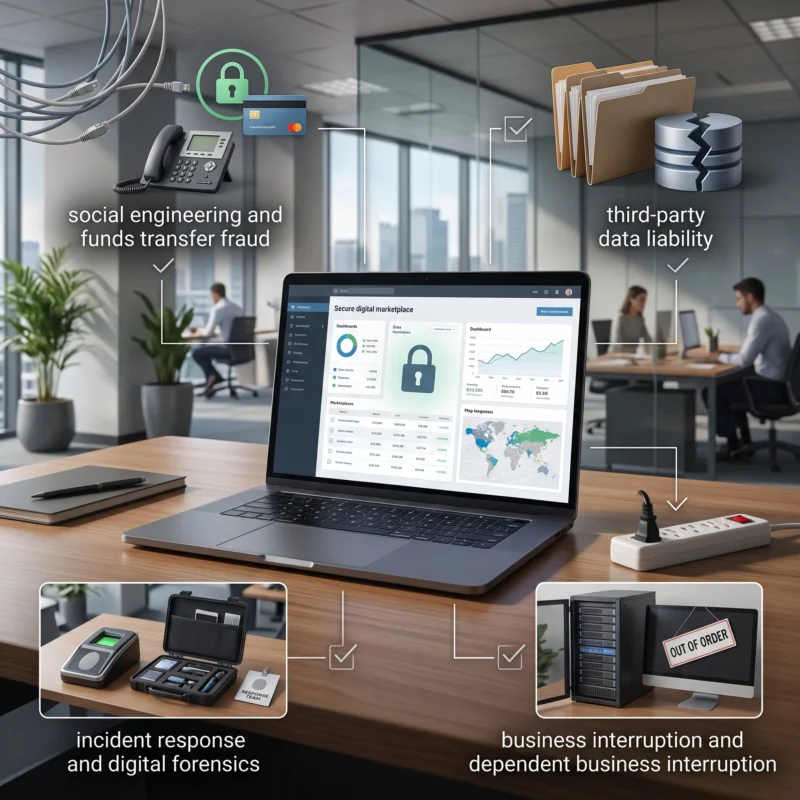
Real example (why the cheap policy fails)
A tech startup bought cyber insurance through an insuretech platform, believing they got a good deal. When a wire transfer scam hit, the policy covered only $50,000 of the $250,000 loss. Industry standard for that coverage is $250,000. The company paid $200,000 out of pocket. When we rebuilt a similar client’s program, we closed that gap and still cut their cost by about 30%.
Book a call before you renew a bargain cyber policy.
Do You Need Workers’ Comp If Everyone on Your Platform Is a 1099 Contractor?
Maybe, and assuming you do not is one of the most expensive guesses a platform can make. If your workers are genuinely independent contractors, most states do not require workers’ comp on them. The open loop is the word “genuinely,” because misclassification is common, the rules vary by state, and if a court decides your contractors are really employees, the exposure lands on the platform, not the worker.
This is the part founders wave off. Paying by 1099 does not settle the question.
Regulators and courts weigh behavioral control, financial control, and the nature of the relationship, and the IRS lays out those classification tests directly.
The bar is not uniform, and that is where platforms get caught.
Because misclassification suits often proceed as class actions, defense costs multiply fast, which is why workers’ compensation and employment practices liability belong in the conversation even when your headcount is “all contractors.”
Your realistic options:

Talk to us about where your workforce really sits.
Should You Offer Insurance to Your Workers Through the Platform?
You can, and increasingly it is a growth lever, not just a cost. Platforms embed per-gig or occupational accident coverage to attract workers, build trust, and win enterprise deals. The nuance to decide up front is which of the three marketplace insurance models you are running, because that choice shapes your liability, your pricing, and how much of the coverage decision you actually own.
That is embedded insurance, and it is real.
Airbnb, for example, offers host protection that the NAIC describes as covering claims up to $1 million in bodily injury or property damage, a platform-sponsored model that protects both the company and its participants.
You partner with an insurer or managing general agent to build it into the app.
The three models, in plain terms:
Model |
How it works |
Trade-off |
|---|---|---|
|
Platform-only |
The platform buys coverage for its own liability |
Simplest; leaves workers to self-insure |
|
Decentralized |
Each worker carries their own required policy |
Lower platform cost; hard to verify and enforce |
|
Centralized / embedded |
The platform provides per-gig or group coverage |
Best trust and retention; more to structure |
Embedded coverage can be per-trip, per-task, or group personal accident. Done right, it becomes a reason workers choose your platform over the next one.
Book a call to design an embedded program.
What Insurance Do Enterprise Clients and Investors Expect From a Gig Marketplace?
Enterprise clients and investors expect a real program: commercial general liability and technology E&O at meaningful limits, cyber, and directors and officers coverage, usually with combined limits in the $5 to $10 million range and certificates on demand. The surprise that stalls deals is timing. The requirement shows up in a contract or a term sheet, and platforms scramble to buy coverage they should have structured months earlier.
We call this the enterprise contract shock, and it is one of the deadly mistakes platform founders make.
A large customer’s procurement team hands you an insurance schedule with specific limits, additional insured status, and a cyber requirement, and the $600 starter policy you bought does not come close.
Marketplaces like Amazon already mandate minimum coverage levels to participate, and enterprise buyers apply the same logic to any vendor.
What to have ready before the requirement lands:

Contact us before your next enterprise contract or raise.
The Coverage Gaps Gig Platforms Discover Too Late
The gaps that hurt platforms most are contractor-injury exclusions in general liability, thin cyber sublimits, pollution exclusions when workers enter client sites, and period-based auto gaps between personal and commercial coverage.
This is the pattern behind a number I use often. In my experience, 9 out of 10 insurance programs we review contain at least one fatal flaw, and platforms are no exception.
The gaps are not expensive to fix.
They are the result of a generic policy that was never built for a marketplace.
Here is where I look first:
Finding these is not luck.
It is what a coverage audit is for, and it is why gig economy platform insurance should be built for your model rather than pulled off a shelf.
Book a call for a no-obligation review of your program.
How to Choose a Broker Who Understands Marketplace Risk
Choose a broker who audits your actual program and understands platform exposure, not an order-taker who requotes whatever you already have. The distinction that matters: a specialist reads the gaps in a marketplace policy, has the carrier relationships to place hard risks, and builds from your real model, while an online platform sells you a cookie-cutter form and hopes nothing happens.
What I would look for:

When we restructured a tech client’s program, we closed the gaps and still saved around 30% annually, because specialists have negotiating power and market access that direct platforms do not. Talk to a specialist.
Work With a Specialist Who Insures the Platform, Not Just the People on It
Building a gig economy platform is hard enough without discovering, at claim time, that your coverage protected everyone except your company. I have spent over 40 years helping business owners find the gaps before the gaps find them, and marketplaces are where those gaps hide best.
If you run a platform with real traction, let’s have a conversation about what your program actually covers, and what it quietly does not.
Book a call and we will start with a no-obligation review.
Questions about Gig Economy Platform Insurance?
Get the Right Coverage for Your gig economy platform insurance
Most founders insure the gig workers and leave the platform itself exposed. When a worker or customer is hurt, or a contractor claims they were misclassified, the marketplace is who gets named in the suit.
For over 40 years I’ve placed the risks other agencies don’t know how to structure: contingent liability, technology E&O, cyber, and D&O, built for how your marketplace actually runs, not copied off a shelf.
You get a program that holds up when a claim hits and satisfies the enterprise clients and investors who demand proof of coverage. Let’s protect the platform, not just the people on it.

This article was written by the CEO of The Coyle Group, Gordon B. Coyle, CPCU, ARM, AMIM, PWCA, who has over 40 years of experience working with business owners of all sizes and industries across the US, solving their insurance challenges.
Here’s how to take the next step
Schedule Your Insurance Confidence Assessment
In our 30-minute call, you’ll discover:
Not ready for a call?
Get Free Access to Our Gated Video:
“How to Finally Feel Confident in Your Coverage. “
And discover the exact system we use to help business owners eliminate hidden coverage gaps, stop overpaying, and finally feel confident in their protection.
What Peace of Mind Looks Like
Trusted by business owners across the U.S.
The Coyle Group is 1st class! Gordon and his team are knowledgeable, responsive, and attentive to detail. Gordon is that rare breed of professional who genuinely cares for his clients and works hard to exceed their expectations. I highly recommend them.


The insurance brokerage service was truly tailored to my needs, nothing like those big brokers who steer you toward random policies that don’t fit your profile. Thank you to the team for your help.

I was working with another broker and having difficulty acquiring General Liability coverage. A colleague recommended The Coyle Group. They were able to get coverage bound in just a couple of business days and a policy issued in ten days, and with a solid carrier at a competitive premium. Truly impressive results, plus it was a pleasure working with them. I highly recommend the Coyle Group!

If any business is looking to work with an insurance brokerage firm that is not only excellent at what the firm does, but one that deeply values the needs of the clients, then The Coyle Group is the firm for you. Give them a call and see for yourself. I can assure that you will quickly agree.

Want to know more?
See related blogs

The Crowdstrike Debacle and Cyber Insurance
Third Party Employment Practices Liability Insurance. Protect Your Business

Are You Overpaying or Underinsured on Your Business Insurance?
