
Importer of Record Insurance
What the IOR Title Makes You Liable For, and the One Bill No Policy Pays
Food Importer Insurance: Cargo, Product Recall and Liability Explained
Index

Gordon B. Coyle
CEO, The Coyle Group
845-474-2924
How to get started
TL;DR. Executive Summary
You signed the entry documents, so you’re the importer of record.
Then the bond renewal arrives, the tariff bill doubles, and nobody can tell you which of these risks your insurance actually pays.
That moment deserves a straight answer.
The Coyle Group is a commercial insurance agency that handles the complex, high-value risks other agencies don’t know how to structure, where the details in the policy are the difference between a paid claim and a denied one.
If you want the full coverage menu first, start with our importer insurance guide.
You’re the importer of record, and you can’t tell what that title makes you liable for, what your customs bond really does, or which risks your policies leave uncovered. Our approach is to map your IOR exposures against your bond, contracts, and policies first, then manage the market for you so the right insurers compete for your business. I’ve been auditing business insurance programs since 1984.
The next step is a 15-minute call, not an application. Book a call.
What Does Being the Importer of Record Make You Responsible For?
The importer of record is legally responsible for the entry: declared value, classification, country of origin, and payment of duties, taxes, and fees. That’s the customs side. The part most owners miss is that the same title also changes how courts and insurers see you when a product goes wrong, and those two exposures need different protection.
Under customs rules, the IOR is usually the owner, purchaser, or consignee of the goods, or a licensed customs broker acting in that role.
CBP can challenge that status and ask for proof, like the bill of lading, delivery order, power of attorney, or proof of payment. Your broker may file the paperwork, but the liability stays with the name on the entry.
Level of fault |
Maximum civil penalty under § 1592 |
|---|---|
|
Negligence |
The lesser of the domestic value of the goods or 2x the duties, taxes, and fees lost. If duties weren’t affected: 20% of dutiable value |
|
Gross negligence |
The lesser of the domestic value or 4x the duties, taxes, and fees lost. If duties weren’t affected: 40% of dutiable value |
|
Fraud |
Up to the domestic value of the merchandise |
Customs liability
Duties, taxes, fees, classification, valuation, origin, and recordkeeping. Supplier-provided codes don’t shift it; as one importer put it, “just because the code comes from your supplier doesn’t exempt you from liability.”
Product liability
When the factory is overseas, an injured customer’s lawyer looks for a U.S. defendant, and that’s usually you. Our post on product liability insurance for importers explains why.
Contract liability
Retailers, marketplaces, and distributors push requirements onto the importer: additional insured status, limits, indemnity, and certificates.
The IOR is the party they hold to it.
Is a Customs Bond the Same as Importer of Record Insurance?
No. A customs bond guarantees CBP (U.S. Customs and Border Protection) gets paid; it doesn’t protect you. It’s a three-party contract between you, a surety, and CBP. If you don’t pay what you owe, CBP collects from the surety, and then the surety comes after you. So the bond works like required credit, which raises a sizing question most importers never revisit.
CBP’s bonds program treats it as security for what you owe, not coverage for what you lose.
That’s why tariffs matter here.
When duties jump mid-year, a bond sized on last year’s numbers can become insufficient.
Our post on how tariffs affect your business insurance covers the broader impact.
Customs bond |
Importer insurance program |
|
|---|---|---|
|
Who it protects |
CBP |
You |
|
What triggers it |
You don’t pay duties, fees, penalties, or liquidated damages |
Physical loss, injury claims, recalls, lawsuits |
|
What it pays |
CBP’s claim, then the surety bills you |
Your loss or your defense, up to the limits |
|
Do you still owe? |
Yes, in full |
No, for covered losses (after deductibles) |
|
Required? |
Yes, for most commercial entries |
Not by CBP; often by contracts and lenders |
|
How it’s priced |
The surety sets the premium on your credit, duty volume, and record |
Underwriters price your products, values, and loss history |
Book a call and we’ll check whether your bond is still sized for this year’s duty load, alongside your policies.
What Can CBP Do to an Importer of Record, and How Often Does It Happen?
CBP can assess penalties, claim liquidated damages, seize goods, and audit your past entries. And it’s doing more of it. Liquidated damages claims more than doubled in a single year. The enforcement numbers tell you whether this is a theoretical risk or a line item, and for an active importer, the trend points to a line item.
Here’s what CBP’s trade enforcement looked like over three fiscal years, as reported by trade law firm Sandler, Travis & Rosenberg:
CBP trade enforcement |
FY 2023 |
FY 2024 |
FY 2025 |
|---|---|---|---|
|
Trade penalties issued |
2,592 |
2,204 |
2,218 |
|
Trade liquidated damages claims |
19,832 |
22,399 |
46,835 |
|
Penalty and liquidated damages collections |
$33.3M |
$26.3M |
$37.9M |
|
Collections from audits |
$114.5M |
$117.67M |
$197.8M |
How far back can CBP reach?
Further than most importers expect. CBP generally has five years from the date of a negligent or grossly negligent violation to sue, and five years from discovery when fraud is involved, under 19 U.S.C. § 1621.
What happens if your FDA shipment is refused?
Refused entry lands on the IOR too.
When FDA refuses a shipment, it must be destroyed or exported under CBP and FDA supervision within 90 days of the refusal notice, according to FDA’s import refusal guidance.
You carry the storage, the export or destruction cost, and the lost inventory.
FDA can’t extend that deadline, and a refusal is a final decision. If you don’t redeliver the goods in time, CBP may assess liquidated damages against your bond, which puts the surety, and then you, on the hook.
Standard cargo insurance pays for physical loss or damage, not a government refusal. Some marine cargo forms offer a rejection or denial-of-entry extension, so ask whether yours has one and read its conditions.
Food importers face this most often; our food importer insurance page covers FSVP and perishable exposures.
Will Any Insurance Pay a CBP Penalty?
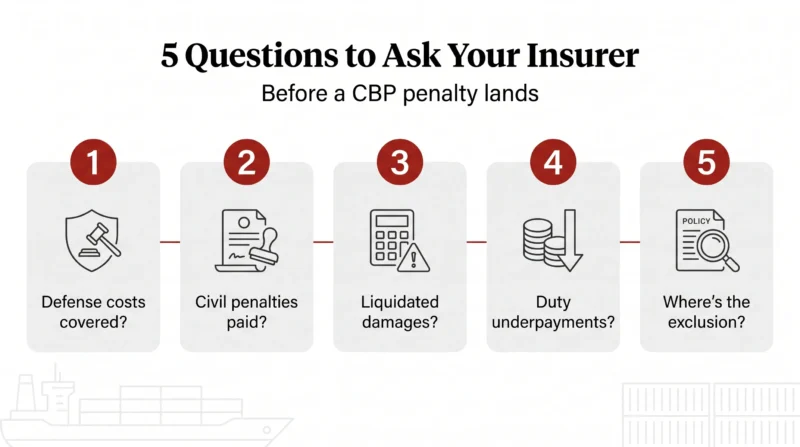
Generally, no. Most policies, including the ones people call importer of record insurance, exclude fines and penalties imposed by a government authority, and nothing insures fraud. That’s the honest answer, and I’d rather you hear it from me than from an adjuster. One nuance matters, though: defense costs may be treated differently from the penalty itself.
That depends entirely on the wording, so get the answer in writing before you need it.
Ask your insurer or broker these five questions:
Prior disclosure: the one lever that shrinks a penalty
Here’s a detail most guides skip.
If you disclose a violation to CBP before a formal investigation starts, the law caps what CBP can collect.
Under § 1592(c)(4):
If the violation came from |
Maximum penalty after a prior disclosure |
|---|---|
|
Negligence or gross negligence |
Interest on the unpaid duties, taxes, and fees, if you pay the shortfall |
|
Fraud |
100% of the duties, taxes, and fees lost, if you pay the shortfall (10% of dutiable value if duties weren’t affected) |
The merchandise also can’t be seized after a valid prior disclosure. Timing is everything here, and it’s a decision to make with a customs attorney.
From an insurance standpoint, it’s one more reason to find classification problems yourself, before CBP does.
The IOR Liability Map
This is how I sort an importer’s exposures before I recommend anything.
Every risk lands in one of three columns:
IOR exposure |
Insurable? |
Where protection comes from |
|---|---|---|
|
Cargo lost or damaged in transit |
Yes |
Marine cargo insurance |
|
Injury or damage from your product |
Yes |
Product liability, with no foreign-manufacturer exclusion |
|
Recall or withdrawal costs |
Yes, separately |
Product recall insurance |
|
Broker or IOR provider error |
Partly |
Their E&O, plus your contract and indemnity |
|
Defense of a CBP investigation |
Sometimes |
Specific E&O or professional liability wording |
|
CBP penalties, liquidated damages, duty owed |
Generally no |
Compliance, bond sizing, contracts, prior disclosure |
Contact us and we’ll put your program into this map.
Should You Be the Importer of Record, or Hand It Off?
Being the IOR yourself gives you control, but it keeps the full customs liability with you. Handing the role to a supplier or a service shifts the CBP-facing risk, but not all of it, and it can create new gaps. Before choosing, look at what each structure leaves on your desk, because that’s what your insurance has to cover.
Most importers end up in one of four setups:
Structure |
Who CBP pursues |
What stays with you |
Insurance to check |
|---|---|---|---|
|
You are the IOR; a broker files |
You |
Full duty, penalty, and recordkeeping liability; product liability |
Your bond, cargo, product liability, the broker’s E&O |
|
Supplier ships DDP (duties paid) |
Whoever is named on the entry |
Product liability, customer contracts, supply interruption, little control of entry data |
Confirm who is actually named; your product liability and cargo |
|
Third-party IOR service |
The IOR provider, if properly set up and bonded |
Indemnity you owe the provider, product and regulatory exposure, data control |
Their E&O and bond; your contract terms |
|
Non-resident importer (foreign seller) |
The foreign entity, through a U.S. resident agent and U.S. surety bond |
Your commercial exposure as the buyer and seller in the U.S. |
Your product liability; contract indemnity |
Some importers set up a separate company to act as the IOR to isolate liability.
Book a call before you move to DDP or an IOR service, and I’ll read the contract against your coverage.
If Your Broker or IOR Provider Makes a Mistake, Who Pays?
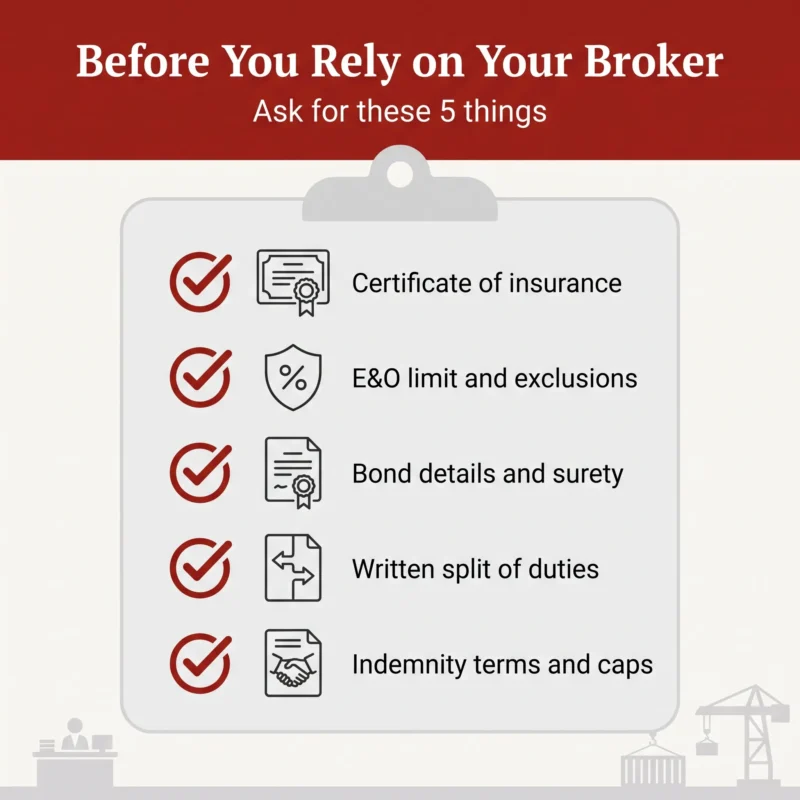
You do, first. A customs broker’s error doesn’t move CBP liability off the importer of record. CBP bills the IOR, and your remedy is a claim against the broker or provider under your contract and their errors and omissions insurance. That remedy is only as good as their coverage, which is why it pays to check before anything goes wrong.
Before you rely on a broker or IOR provider, ask for these:
What Insurance Program Does an Importer of Record Need?
An importer of record typically needs marine cargo, product liability, product recall, and coverage for goods in storage, with E&O and trade credit where they fit. The bond sits alongside them but doesn’t replace any of them. The catch is that each policy has to recognize the importer role, not just the product, or the gaps open at the seams.
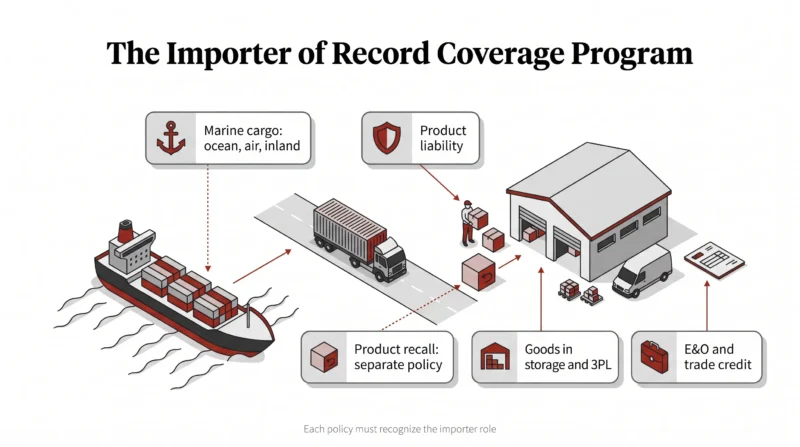
For the full breakdown, see our guide to the five coverages every import business needs.
Food importers carry extra weight as the IOR. Under FDA’s Foreign Supplier Verification Programs rule, importers must perform risk-based verification of their foreign suppliers, and perishables add spoilage, temperature failure, contamination, and refused-entry risk.
Recall is the gap I flag most, since product liability won’t pay it.
Real-world example
An importer came to us with an ocean cargo policy that carried a profit-sharing clause nobody had ever acted on. The clause meant a $10,000 to $12,000 dividend was owed to them for the current year. The prior broker also took about two weeks to respond and had told them employers liability and EPLI were the same thing. Moving the cargo policy would have cost the client that dividend, so we became broker of record with the existing carrier instead, at a lower commission for us (15% instead of 25%), and remarketed the other lines. Read the ocean cargo case study.
What Do Underwriters Look At Before Insuring an Importer of Record?
Underwriters price importer of record insurance on what you bring in, where it comes from, and who carries the risk in your contracts. Diagnosis comes before quotes. If you can show these five factors clearly, more insurers will engage. And here’s the part owners rarely hear: a vague submission gets priced as a worst case.
Factor |
Why underwriters care |
What to have ready |
|---|---|---|
|
Products and their hazard |
A kitchen gadget and a battery-powered device are different risks |
Product list, specs, testing, certifications |
|
Country of origin and suppliers |
Recovery against an overseas factory is hard |
Supplier list, their insurance, quality audits |
|
Volume, values, and routes |
Drives cargo limits and accumulation in one container or warehouse |
Annual import value, largest shipment, ports, storage |
|
Sales channels and contracts |
Retail and marketplace contracts add limits and indemnity |
Key contracts and insurance requirements |
|
Loss and compliance history |
Prior claims, recalls, or CBP actions |
Five-year loss runs, any CBP correspondence |
Red flags in an importer of record program
How Much Does Importer of Record Insurance Cost?
There are two separate costs: the customs bond premium and the insurance program. CBP sets the bond amount, and the surety prices the premium on your credit and record. The insurance program varies far more, because it’s priced on your products, values, and losses, and that’s where shopping on price alone backfires.
Here’s what moves each cost (as of October 2026):
Cost |
What moves it up |
What moves it down |
|---|---|---|
|
Continuous bond premium |
Higher duty volume, weaker credit, past CBP claims |
Clean record, strong financials |
|
Bond amount (not premium) |
Duties, taxes, and fees over the prior 12 months, including tariff increases |
Lower duty load |
|
Marine cargo |
High-value or theft-prone goods, long inland legs, large single shipments |
Strong packing, lower accumulations |
|
Product liability |
Higher-hazard products, children’s products, weak supplier recourse |
Testing, certifications, supplier insurance |
|
Product recall |
Food, consumer, and regulated products; past recalls |
Traceability, batch control, recall plan |
I won’t quote you a number for the program before I know what you import, because that number would be a guess.
What I can tell you is that most problems I find aren’t expensive to fix.
They come from carelessness, not cost.
How Do You Choose a Broker for Importer of Record Coverage?
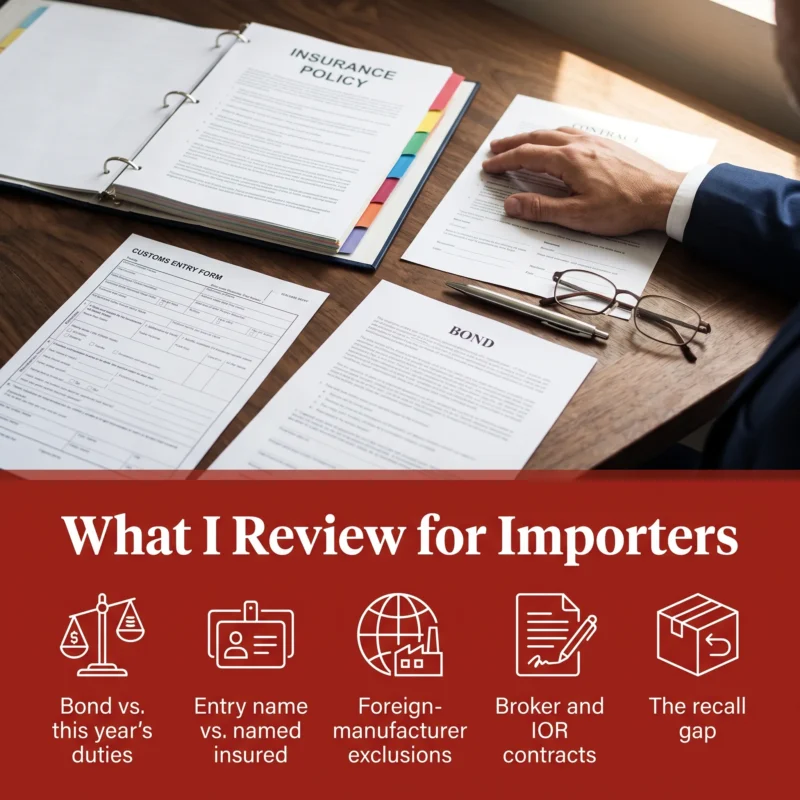
Choose a broker who starts with your IOR structure, not with an application. The Coyle Group is an independent commercial insurance brokerage that works with importers and distributors with international supply chains, and we only do business insurance. The question to ask anyone quoting importer of record insurance is what they’ll review before they approach a single insurer.
For an importer of record, here’s what I review:
How we work
We diagnose the risk, identify the insurers that fit, explain where we’re going and why, then bring viable options back for comparison. For you, that means fewer applications, fewer duplicate requests, and one point of contact. We return calls and emails within one business day, and 95% of our clients stay with us.
We’re paid through carrier commissions when policies are placed, and we don’t charge upfront fees for standard placements.
Should you collect quotes from several brokers?
Comparing options is smart.
Sending the same account to several brokers usually isn’t.
The same insurers get approached more than once, duplicate applications pile up, and a generalist may classify an importer as a simple wholesaler. The decision then falls back to price instead of fit.
Who this isn’t right for
If you’re importing a pallet or two of simple, low-risk goods, a basic packaged policy may serve you well, and I’ll say so.
Our sweet spot is established, mid-market importers with complex supply chains.
And if the plan is to put three brokers in a race, we’re not the right fit.
We get hired to win, not to bid.
Get Your Importer of Record Program Reviewed Before the Next Container Lands
The best time to review an importer of record program is before a refusal, an audit, or a claim. That’s when you still have options. Afterward, the conversation is about what the policy says, not what it should have said.
I tell importers the same thing every time: you don’t need five brokers shopping your insurance.
You need one capable broker making sure the right insurers compete for your business. That’s what we do.
We manage the market for you, and we start with your IOR structure.
Book a call for a 15-minute conversation, not an application.
Questions about Importer Of Record Insurance?
Get Your Importer Of Record Insurance Right
Being the importer of record is a legal role, and your insurance has to be built around it. That’s the difference between being covered and being adequately covered. One checks a box. The other protects your business when CBP sends a bill, a shipment gets refused at the port, or a customer gets hurt by a product you didn’t make.
Our family has been in the insurance business since 1929, and we only do business insurance. We’re an independent brokerage, not captive to any carrier, so the only question we answer is what’s right for your import program. We review your contracts before you sign, start renewals 90 to 120 days out, and re-underwrite your business every year, because tariffs, suppliers, and product lines change faster than most policies do.
The first step costs you nothing and doesn’t disrupt your current broker. Our Confidential Review puts your bond, your entries, and your policies side by side, then tells you what’s working, what’s missing, and what I’d change.
Book a 15-minute call. If your program is solid, I’ll tell you that too.

This article was written by the CEO of The Coyle Group, Gordon B. Coyle, CPCU, ARM, AMIM, PWCA, who has over 40 years of experience working with business owners of all sizes and industries across the US, solving their insurance challenges.
Here’s how to take the next step
Schedule Your Insurance Confidence Assessment
In our 30-minute call, you’ll discover:
Not ready for a call?
Get Free Access to Our Gated Video:
“How to Finally Feel Confident in Your Coverage. “
And discover the exact system we use to help business owners eliminate hidden coverage gaps, stop overpaying, and finally feel confident in their protection.
What Peace of Mind Looks Like
Trusted by business owners across the U.S.
The Coyle Group is 1st class! Gordon and his team are knowledgeable, responsive, and attentive to detail. Gordon is that rare breed of professional who genuinely cares for his clients and works hard to exceed their expectations. I highly recommend them.


The insurance brokerage service was truly tailored to my needs, nothing like those big brokers who steer you toward random policies that don’t fit your profile. Thank you to the team for your help.

I was working with another broker and having difficulty acquiring General Liability coverage. A colleague recommended The Coyle Group. They were able to get coverage bound in just a couple of business days and a policy issued in ten days, and with a solid carrier at a competitive premium. Truly impressive results, plus it was a pleasure working with them. I highly recommend the Coyle Group!

If any business is looking to work with an insurance brokerage firm that is not only excellent at what the firm does, but one that deeply values the needs of the clients, then The Coyle Group is the firm for you. Give them a call and see for yourself. I can assure that you will quickly agree.

Want to know more?
See related blogs

The Crowdstrike Debacle and Cyber Insurance
Third Party Employment Practices Liability Insurance. Protect Your Business

Are You Overpaying or Underinsured on Your Business Insurance?
