
Plastics Manufacturer Insurance
The Coverage Gaps That Catch Molders and Extruders Off Guard

Index

Gordon B. Coyle
CEO, The Coyle Group
845-474-2924
How to get started
You have a general liability policy, a property policy, and a broker who told you that you were “all set.”
Then a customer’s mold gets damaged, a press goes down for six weeks, or an old part shows up in a product liability lawsuit, and you find out what your policy actually says.
In my experience, that is the moment most plastics manufacturers discover the truth: the yearly premium was never the real issue.
From what I have seen over 40 years, a generic “manufacturers” policy usually does not respond.
That gap is why I wrote this. Plastics manufacturer insurance is not one policy you buy and forget.
It is a layered program built around how an injection molder, extruder, thermoformer, or blow molder actually loses money, and the gap between a paid claim and a denied one almost always lives in two places: whose mold is in your building, and who your part ends up serving.
The short version:
If this sounds familiar. You run an injection molding, extrusion, thermoforming, blow molding, or plastic fabrication operation, and nobody has walked you through what happens if a customer’s mold gets damaged or a part you made ends up in a lawsuit. The Coyle Group is a commercial insurance agency that handles the complex, high-value risks other agencies don’t know how to structure, where the details in the policy are the difference between a paid claim and a denied one. Want a specialist to pressure-test your program?
Book a call and we will walk your exposures line by line.
This is not a fit for every operation: a single in-house press under a parent company’s program, or a pre-revenue shop, usually needs less.
For everyone else, let me show you where the gaps hide.
What does plastics manufacturer insurance actually cover?
Plastics manufacturer insurance is a coordinated stack of policies that protects an injection molding, extrusion, thermoforming, or blow molding operation against the product, property, equipment, and liability losses that a generic manufacturing policy excludes or underprices.
Before you look at the list, look at what inaction costs. Bureau of Labor Statistics data for 2024 puts plastics and rubber products manufacturing’s total recordable injury rate at 2.8 per 100 full-time workers, modestly above the 2.7 rate for manufacturing overall. OSHA’s own plastics industry material flags safety and health concerns across this industry, from raw-material handling through processing, and highlights a machine-guarding profile built around amputation hazards on equipment like injection molding machines, which is a real severity exposure, not a theoretical one.
Here is the core stack a real plastics program layers together:
Coverage |
What it protects against |
|---|---|
|
General & product liability |
Third-party injury or property damage from a defective part, wherever it ends up in the supply chain |
|
Mold and tooling coverage |
Company-owned and customer-owned molds and dies stored in your facility |
|
Property & equipment breakdown |
Fire, mechanical or electrical failure of presses, extruders, chillers, and auxiliary equipment |
|
Business interruption |
Lost income and fixed costs when a breakdown or fire halts production |
|
VOC emissions, resin dust, and waste that general liability excludes |
|
|
Withdrawing, replacing, and cleaning up after a defective or contaminated part |
|
|
Medical and wage costs from machine-related and repetitive-motion injuries |
|
|
Commercial auto & umbrella |
Delivery and material transport, plus a catastrophic layer above the rest |
Every line answers a real loss scenario specific to how plastic actually gets processed. Not sure which of these you already carry? Have us map your program against this list in a no-obligation coverage-gap review.
Are your customer’s molds and tooling actually covered?
In most cases, not automatically, and this is the single most expensive blind spot in the plastics industry. Here is the twist that catches processors off guard: your customer’s mold can sit in your building for years, worth more than most of the equipment around it, and never once show up on your property schedule as something you actually insured.
Custom injection molds and dies commonly run $50,000 to $500,000 or more per tool, and complex, high-cavitation, or large-format molds can price well beyond that.
Injection molding presses themselves typically run $500,000 to $2 million.
When a customer ships you their tooling to run their parts, you take on what is known as a bailees exposure, meaning you are responsible for property that belongs to someone else while it sits in your care, custody, and control.
A standard commercial property policy is not automatically built to pick that up.
What I tell every plastics processor shopping for plastics manufacturer insurance for the first time, or reviewing what they already bought:
Bottom line is that almost all insurance programs we review contain at least one fatal mistake, and for a molder or extruder, this is usually it. Want us to check whether your customers’ tooling is actually protected? Book a call and bring your customer list.
Does general liability cover a defective plastic part?
Sometimes, but only for the injury or damage itself, almost never for a recall, and it depends on where that part ends up. Here is what surprises most owners: the exact same part is underwritten differently depending on whether it lands in a consumer toy or an aircraft, because liability is priced by end use, not material.
A molded or extruded part follows the product chain long after it leaves your dock.
From what I have seen, when a component fails in an automotive safety system, a medical device, or an industrial machine, the molder is routinely named in the lawsuit right alongside the OEM, the designer, and the assembler, sometimes years after the part shipped.
That is why product liability, product recall, and manufacturers errors and omissions have to be understood as three separate things:
One incident can trigger more than one of these, and a gap in any of them leaves you paying out of pocket.
This is exactly the distinction a generic manufacturing package glosses over, and it is one of the first things a real plastics manufacturer insurance review should check. Not sure your program actually separates these three? Contact us, and we will pull it apart line by line.
What about fire, dust, and chemical exposure in a plastics plant?
Plastic dust is a recognized fire and explosion hazard, and pollution from resin and process chemicals is a separate gap from general liability, not an extension of it. Most competitors only flag VOCs as a pollution issue, but plastic dust from grinding and trimming is also an OSHA-recognized combustible-dust hazard, a property and life-safety issue, not just an environmental one.
OSHA’s combustible dust program lists plastics among the materials that can be explosible in dust form, alongside grain, wood, and metal dust, and cites the U.S. Chemical Safety and Hazard Investigation Board’s finding of 281 combustible dust incidents between 1980 and 2005 that killed 119 workers and injured 718 across covered industries.
On the environmental side, heated resins emit volatile organic compounds, and process chemicals, mold releases, and scrap resin create waste streams that fall outside a standard general liability policy entirely.
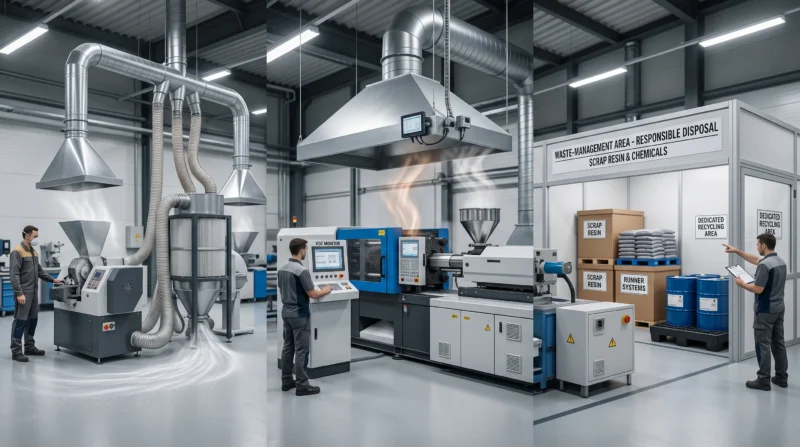
This is a genuinely under-discussed risk in the plastics insurance conversation. Want your program checked against this exposure specifically? Book a call.
The rest of the program: equipment breakdown, business interruption, workers’ comp, auto, and umbrella
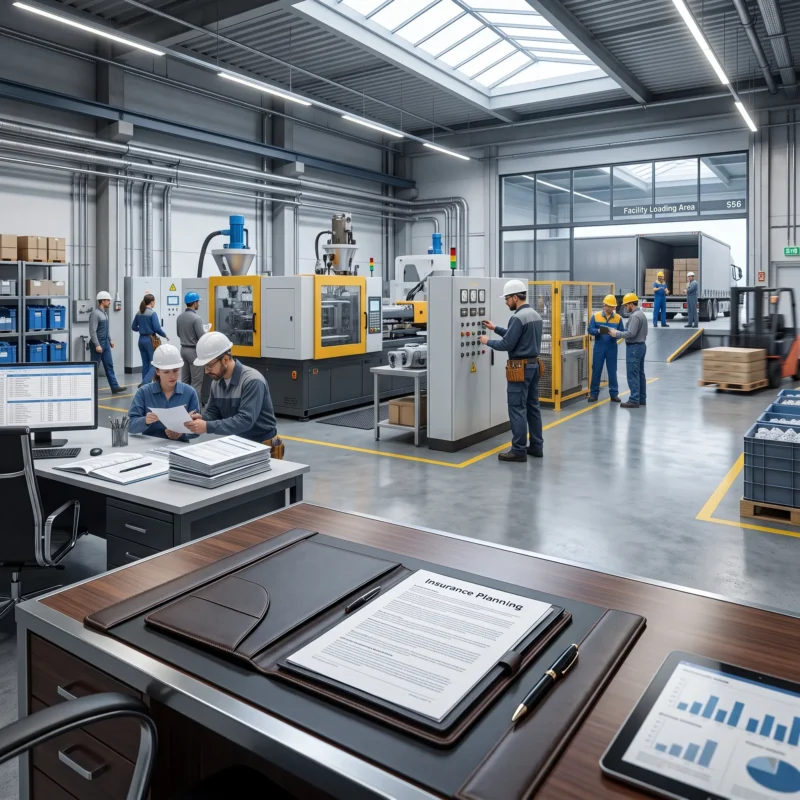
A complete plastics program does not stop at liability and molds. Your presses, your income while they are down, your people, your vehicles, and a catastrophic layer above all of it each carry their own coverage, and the biggest dollar amounts often sit in the pieces owners think about least.
Real-world example
In my experience, I have seen a plastics manufacturer’s injection press go down over a failed component that had to be sourced from overseas. The direct repair cost was a few thousand dollars. The weeks of lost production while the part shipped ran into the hundreds of thousands, because a standard property policy’s business income coverage does not respond to an internal mechanical or electrical breakdown. Equipment breakdown insurance is the only line built to pay for that gap, and processors running presses around the clock are exactly the businesses that need it most.
Over 40 years I have found that these coverages get treated as afterthoughts, then become the claim that hurts the most:
How much does plastics manufacturer insurance cost?
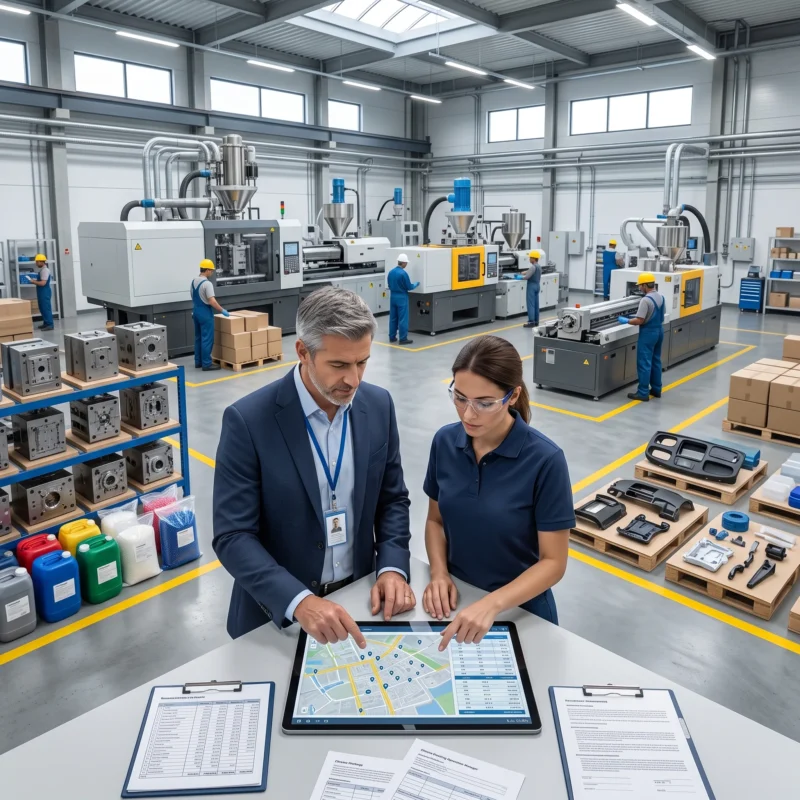
There is no honest flat rate for plastics manufacturer insurance, because your process, press count, mold values, and end-use customers drive the price, not a rate card. Here is what a quote engine will not tell you: two shops the same size can price completely differently, because one runs commodity packaging parts and the other runs automotive safety components.
What I can tell you is exactly what an underwriter looks at, because that is what you control:
For context, one specialty broker’s published range for a small custom molder around $1 million in revenue running standard commercial parts lands around $8,000 to $15,000 a year for general liability alone, with automotive, medical, and aerospace-facing operations pricing meaningfully higher.
Treat that as one broker’s stated figure, not a market average.
Manufacturing and distribution accounts more broadly were seeing relatively soft, single-digit rate movement as of mid-2025, though your own loss history and risk quality still set the real number. Want a real range for your operation, not a guess? Book a call and bring your loss runs.
What happens when a customer requires $5 million or $10 million in product liability?
You meet it with the right underlying limits and umbrella coverage, structured so the excess layer actually follows the policies your customer relies on. The part that trips people up: that clause is not a request for a bigger policy number, it is a request for a specific certificate, specific endorsements, and coordination between your primary and excess layers.
From what I have seen, the requirements buried in a customer’s purchase order or supply agreement are often stricter than anything a regulator asks for:

Miss one of these and a customer can hold payment, or a program manager can flag your account, until you produce compliant coverage.
This is exactly the kind of detail a non-specialist broker skips. Have a contract with insurance requirements you’re not sure you meet? Send it over and we will check it against your program line by line.
Why plastics manufacturers get flagged as hard to place, and how to get to “yes”
Plastics operations get declined, non-renewed, or quoted with heavy exclusions because underwriters see a hazardous process, thin documentation, or an end-use industry they are not comfortable with, and walk away. What nobody explains: most of those declines are a submission problem, not a risk problem.
I have watched too many owners get dropped, then hear the worst sentence in this business: my broker said they cannot find insurance for me.
That usually means the underwriter never saw a complete picture.
So we fix the submission.
Over the years we have built what I call a get-to-yes file, and it turns a declined risk into a quotable one:

That is the whole game.
In 40 years of auditing insurance programs, I have found that roughly 9 out of 10 contain at least one fatal flaw.
In plastics manufacturing, that flaw is almost always the mold that never made it onto the schedule. Been declined or non-renewed? Contact us before you accept a stripped-down policy.
The Coyle Second Opinion
9 out of 10 business insurance policies we review have a gap that would sink a claim
Yours might be one of them, and the only time you find out is when you file a claim and it gets denied. Send us your policy for an independent, confidential read: what’s covered, what’s missing, what you’re overpaying for. We never contact your broker or shop the market. Flat $2,500, refunded in full if you don’t get real value.




The team that reads your policy, line by line.
What to know before you buy: a quick-reference summary
Here is the entire page distilled into one scannable checklist you can keep in front of you before you talk to any broker.
Questions about Plastics Manufacturer Insurance?
Build Your Plastics Manufacturer Insurance Program
Right
If you run a plastics processing operation, you need a program built for the specific risks of your work, not a generic manufacturing policy. The gaps in most plastics manufacturer insurance programs are not obvious. They show up when a customer’s mold gets damaged in your building, when a press goes down and your property policy won’t cover the lost production, or when a part you shipped years ago ends up named in a product liability lawsuit.
Your job is to make the decision to review your coverage. Our job is to find every gap and fix it before a claim does.
Start with a conversation. We will walk you through exactly what a complete plastics manufacturer insurance program looks like for your specific operation, with no obligation and no pressure.

This article was written by the CEO of The Coyle Group, Gordon B. Coyle, CPCU, ARM, AMIM, PWCA, who has over 40 years of experience working with business owners of all sizes and industries across the US, solving their insurance challenges.
Here’s how to take the next step
Schedule Your Insurance Confidence Assessment
In our 30-minute call, you’ll discover:
Not ready for a call?
Get Free Access to Our Gated Video:
“How to Finally Feel Confident in Your Coverage. “
And discover the exact system we use to help business owners eliminate hidden coverage gaps, stop overpaying, and finally feel confident in their protection.
What Peace of Mind Looks Like
Trusted by business owners across the U.S.
The Coyle Group is 1st class! Gordon and his team are knowledgeable, responsive, and attentive to detail. Gordon is that rare breed of professional who genuinely cares for his clients and works hard to exceed their expectations. I highly recommend them.

The insurance brokerage service was truly tailored to my needs, nothing like those big brokers who steer you toward random policies that don’t fit your profile. Thank you to the team for your help.

I was working with another broker and having difficulty acquiring General Liability coverage. A colleague recommended The Coyle Group. They were able to get coverage bound in just a couple of business days and a policy issued in ten days, and with a solid carrier at a competitive premium. Truly impressive results, plus it was a pleasure working with them. I highly recommend the Coyle Group!

If any business is looking to work with an insurance brokerage firm that is not only excellent at what the firm does, but one that deeply values the needs of the clients, then The Coyle Group is the firm for you. Give them a call and see for yourself. I can assure that you will quickly agree.

Want to know more?
See related blogs

The Crowdstrike Debacle and Cyber Insurance
Third Party Employment Practices Liability Insurance. Protect Your Business

Are You Overpaying or Underinsured on Your Business Insurance?
