
The Questions Your Broker Should Ask You Every Year at Renewal
And What It Means If They Don’t


If you have ever thought, “My premium jumped, and nothing actually changed in my business,” or “the broker sent forms, I signed them, and I still have no idea what was actually reviewed”
Knowing what your insurance broker should review at renewal is the starting point for changing that. What follows is a complete checklist of the questions your broker should be asking, and what it signals if they are not.
The Coyle Group is a commercial insurance agency for business owners who have outgrown one-size-fits-all coverage and need a specialist who understands the nuances of complex, multi-line programs.
A Renewal That Doesn’t Ask These Questions Is Just a Transaction
A proper renewal is a structured conversation between a broker and a business owner about what the business looks like today, what has changed since last year, and what needs to be adjusted in the insurance program to keep pace. It should feel like an examination, not an invoice.
Every business insurance program has a renewal date. And every year, as that date approaches, some form of renewal process is supposed to take place.
For many mid-market companies, that process looks something like this:
That is not a renewal. That is a transaction. And there is a meaningful difference.
If your broker is not asking you questions at renewal, they are processing your account the same way they would process a small retail shop. And for a company doing $25 million, $50 million, or $100 million in revenue, that is not good enough.
The cost of that gap is not always immediate, but it is real and it is preventable.
These are not hypothetical consequences. They are what happens when a renewal process does not ask the right questions. What follows are the questions a broker should be asking you every year.
Before the Questions: When the Process Should Start
For most mid-market accounts, the renewal process should start 90 to 120 days before the policy expiration date.
A thorough renewal does not start two weeks before the expiration date.
The other variable is the client themselves.
If we know it takes a client a long time to return applications and provide information, we start earlier. None of this is complicated, but it requires planning. A broker who waits until the last minute will rush through the process, and that is when things get missed.
If your next renewal is approaching and you are not sure what to expect, schedule a conversation with our team before the process begins. Starting early is the difference between a strategic review and a rushed transaction.
Questions About Revenue and Growth
Your broker should ask about revenue projections, where growth is coming from, and whether anything about how you generate revenue has changed.
Revenue affects almost every aspect of the insurance program, and the number alone is only part of the story. How and why revenue changed determines whether the risk profile has shifted.
If revenue grew 20%, the natural question is where that growth came from. A company that grew by adding a new product line has a different risk profile than one that grew by doing more of the same.

A new product line may:
Each of those changes has insurance implications.
This is why a form alone cannot do the job. A renewal application will ask for projected sales and payroll. It will not ask why your sales numbers changed, what product lines are growing, or whether the nature of your revenue has shifted. Those conversations uncover exposure changes that a standard form will never capture. And those exposure changes are where coverage gaps form.
The same applies to revenue shrinkage. If a client is losing revenue, we want to understand why.
The answers may affect the program’s structure. A company under financial stress needs different advice than one that is simply going through a cyclical dip.
Ready to have a real renewal conversation? Contact our team and we will walk through what a structured review looks like for a company at your stage.
Questions About Operations and Exposures
Your broker should ask about:
This is the category where the most dangerous coverage gaps tend to hide, because operational changes often happen without the business owner considering insurance implications. They are focused on running the business, and insurance is not top of mind.
New locations are an obvious one. A company opens a distribution center in another state and never mentions it to the broker.
Supply chain changes are another. A company that was buying domestic starts importing directly from overseas. There is now an ocean cargo exposure that did not exist before.
A manufacturer adds a new production line with a $6 million piece of equipment that never gets added to the property schedule because the owner assumed it was covered. It is not, and neither is the machinery breakdown exposure that comes with it.
Real-World Example: A Food Manufacturer
We had a situation with a food manufacturer where a facility tour uncovered three separate issues in a single visit.
None of these issues came up on a form. They came up because we asked questions and walked the facility.
That is the difference between processing a renewal and actually reviewing one.
For importers and companies with cross-border supply chains, the exposure inventory at renewal needs to go well beyond domestic operations. Origins, transit methods, and contractual relationships all affect what is and is not covered.
If your operations have changed in the past 12 months, book a call with our team before your next renewal. We will identify what changed and what needs to change in your program.
Questions About Loss History and Claims Activity
Your broker should review what claims occurred in the prior year, whether there are patterns in workers comp activity, and whether any near-misses went unreported. Loss history directly affects pricing and is one of the most actionable data points available for managing your program and your costs.

This matters financially as well as operationally. Workers’ compensation claims activity over the prior four years directly affects the experience modification rating, which is the multiplier applied to the premium. The National Council on Compensation Insurance (NCCI) administers experience rating for most states. A pattern of frequent claims, even small ones, can push that modifier up and drive a significant premium increase at renewal.
A broker who does not review the loss history at renewal is missing one of the most actionable pieces of information available. It tells you where the problems are, what they are costing, and what needs to change.
Seeing patterns in your claims that you have not been able to explain? Reach out to our team for a loss run analysis before your renewal hits.
Questions About Contracts and Compliance
Your broker should ask about new contracts with insurance requirements, whether certificate demands have changed, and whether lender, landlord, or customer requirements need to be addressed. Contracts are one of the most overlooked areas in a renewal conversation, and the problems they create only show up after the fact.
Business owners sign contracts all the time that include insurance requirements, and they rarely check with their broker before signing. The problem shows up after the fact when a certificate of insurance is requested and the limits do not match what the contract requires.
We pay attention to certificate activity over the prior year because it tells us where the market is heading. If we are seeing an increase in the limits that customers and contract partners are demanding, that tells us what to expect next year.
A client who has been getting by with $1 million in umbrella coverage may need to be at $5 million or $10 million if the contracts they are pursuing require higher limits. Certificates issued under ACORD standards carry specific obligations, and when the limits on file do not match the contract, the broker’s failure to flag that gap becomes the business owner’s problem.
This is a forward-looking conversation. We are not just reconciling what happened. We are asking the client what they anticipate in terms of new contracts and new relationships, and making sure the insurance program is positioned to support that growth rather than becoming an obstacle to it.
Questions About Whether Your Coverage Is Adequate
Your broker should verify that property values and business income limits are current, that limits have been stress-tested against a worst-case scenario, and that any deferred recommendations from prior years are revisited.
This is the conversation that ties everything else together. After discussing revenue, operations, losses, and contracts, the question is whether the current coverage actually matches where the business is today.
Property values are the most common area where we find inadequacy, and we covered this in depth in a separate article. But it extends to liability limits, business income projections, and specialty coverages like directors and officers liability, cyber insurance, and professional liability.
The question is not just “do you have this coverage” but “are the limits appropriate for a company of your size and complexity.”
We also use renewal as a checkpoint for open recommendations.
If we suggested higher umbrella limits last year and the client declined, that recommendation does not disappear. We bring it back, explain why it still matters, and let the client make an informed decision. A broker who makes a recommendation once and then drops it is not doing their job. Recommendations that were deferred need to come back to the table until they are either addressed or formally declined with a full understanding of the risk.
This is also where benchmarking comes in.
If we have data showing that companies in the client’s industry and revenue range are typically carrying $5 million in D&O coverage, and the client is at $1 million, that is a conversation worth having. It is not about selling more insurance. It is about making sure the client understands where they stand relative to their peers and what the consequences of being underinsured look like in a real-life scenario. Context changes decisions.
Renewal is also the time to ensure specialty line applications are up to date.
Many lines of coverage, including ocean marine, management and professional liability, and cyber liability, require annual applications with current information. If those applications are not completed thoroughly, the underwriter is pricing and covering risks based on outdated information. That can lead to problems at claim time if the information on file does not match the current state of the business.
If you are not sure whether your limits are adequate for a company of your size, schedule a coverage review with our team. We will benchmark your program against what comparable companies are carrying and flag anything that needs attention.
Questions About Costs and What Is Driving Them
Your broker should explain what is driving rate changes at renewal, whether from the market, your loss history, or changes in exposure, and identify structural adjustments to optimize cost without reducing coverage.
Business owners want to understand what they are paying and why. A broker who just presents a premium number without context is not giving the client what they need to make an informed decision.
At renewal, we explain what is driving rate changes.
Understanding the why helps the client make better decisions about where to invest in coverage and where there may be room to optimize.
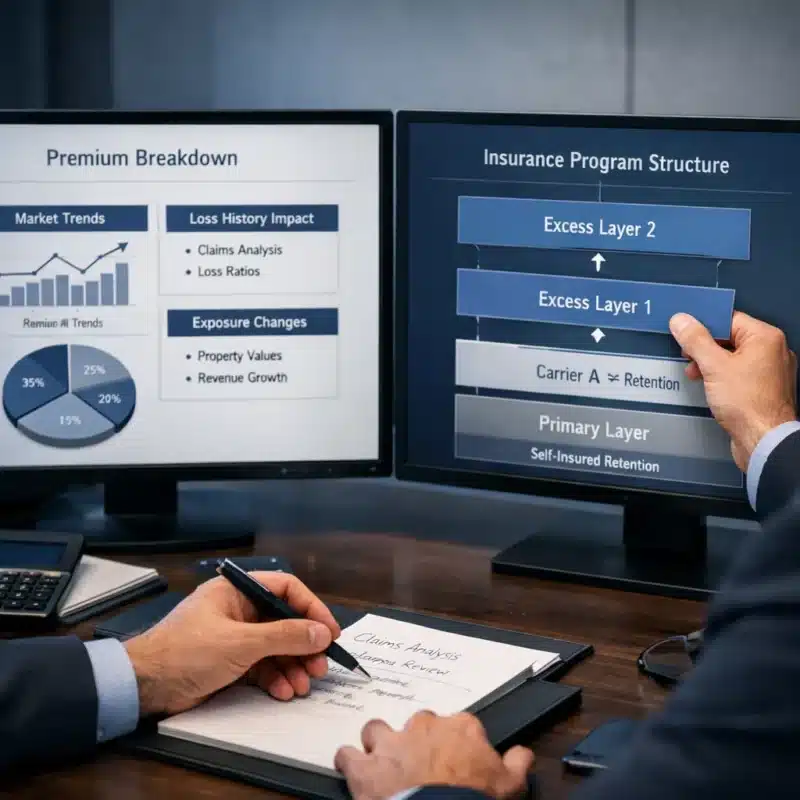
And optimization is different from cutting.
These are broker-level decisions that require expertise, not just a quote.
The Complete Renewal Question Checklist
This checklist covers all six renewal conversation categories:
Use it as your benchmark going into any renewal meeting. If your broker is not covering these categories, you have a gap.
Category |
Questions Your Broker Should Be Asking |
|---|---|
|
Revenue and Growth |
What are your revenue projections? Where is the growth coming from? Has anything changed about how you generate revenue? |
|
Operations and Exposures |
Have you added or closed locations? Are you importing or exporting anything new? Any significant capital purchases? Have production methods changed? |
|
Loss History and Claims |
What claims have you had and what drove them? Are there workers comp claim patterns we should address? Any near-misses that did not result in a claim? |
|
Contracts and Compliance |
Have you signed new contracts with insurance requirements? Have certificate demands changed? Are there lender, landlord, or customer requirements we need to address? |
|
Coverage Adequacy |
Are property values and business income limits current? Have we stress-tested your limits? Are there open recommendations from prior years to revisit? |
|
Costs and Market |
What market conditions will affect your renewal pricing? Are there structural changes to optimize cost without reducing coverage? |
What It Means If Your Broker Is Not Asking These Questions
If your renewal experience does not include most of these conversations, your account is likely being processed rather than reviewed. The question is not whether your broker is a bad person. The question is whether they are treating your account with the depth it requires.
The most common reason brokers skip these questions is not laziness or incompetence. It is that they handle large accounts the same way they handle small ones. They process the renewal, send out the quote, and move on to the next account.
The cost of this gap is invisible until something goes wrong. These are all preventable problems, and they are all the direct result of a renewal process that did not ask the right questions.
The questions listed above are not exotic or unreasonable. They are what any experienced commercial insurance broker should be asking a company of meaningful size and complexity.
According to the Insurance Information Institute, commercial insurance program misalignment is among the leading drivers of disputed claims, and most of those disputes trace back to exposures that were never identified or reported at renewal.
Use This as Your Benchmark
Print this list and bring it to your next renewal meeting. If your broker covers most of these topics without prompting, you are in good hands. If your renewal looks nothing like what is described here, that is the signal worth acting on before your next expiration date.
Let’s start with a conversation to talk about what a real renewal process looks like for a company at your stage. No obligation, no pressure. Just a clear picture of where you are and where you should be.
Book a renewal review with The Coyle Group and find out what a thorough process actually looks like.
Questions about What Your Broker Should Review at Renewal?
Get the Right Coverage for Your Renewal
At The Coyle Group, we have spent over 40 years building renewal processes that actually work.
That means starting early, asking the right questions, and treating every renewal as an opportunity to make sure the program fits the business as it exists today, not as it existed last year.
We work with mid-market companies across a range of industries, including manufacturers, importers, wholesalers, distributors, and technology companies, that have outgrown the transactional approach and need a broker who treats their account with the depth it requires.
If your current renewal experience does not look like what is described on this page, that is worth a conversation. Contact the team to talk through what a structured renewal review looks like for a company at your stage.
This article was written by the CEO of The Coyle Group, Gordon B. Coyle, CPCU, ARM, AMIM, PWCA, who has over 40 years of experience working with business owners of all sizes and industries across the US, solving their insurance challenges.
Here’s how to take the next step
Schedule Your Insurance Confidence Assessment
In our 30-minute call, you’ll discover:
Not ready for a call?
Get Free Access to Our Gated Video:
“How to Finally Feel Confident in Your Coverage. “
And discover the exact system we use to help business owners eliminate hidden coverage gaps, stop overpaying, and finally feel confident in their protection.
What Peace of Mind Looks Like
Trusted by business owners across the U.S.
The Coyle Group is 1st class! Gordon and his team are knowledgeable, responsive, and attentive to detail. Gordon is that rare breed of professional who genuinely cares for his clients and works hard to exceed their expectations. I highly recommend them.


The insurance brokerage service was truly tailored to my needs, nothing like those big brokers who steer you toward random policies that don’t fit your profile. Thank you to the team for your help.

I was working with another broker and having difficulty acquiring General Liability coverage. A colleague recommended The Coyle Group. They were able to get coverage bound in just a couple of business days and a policy issued in ten days, and with a solid carrier at a competitive premium. Truly impressive results, plus it was a pleasure working with them. I highly recommend the Coyle Group!

If any business is looking to work with an insurance brokerage firm that is not only excellent at what the firm does, but one that deeply values the needs of the clients, then The Coyle Group is the firm for you. Give them a call and see for yourself. I can assure that you will quickly agree.

Want to know more?
See related blogs
Third Party Employment Practices Liability Insurance. Protect Your Business

Are You Overpaying or Underinsured on Your Business Insurance?

Liberty Mutual Business Insurance Quotes
