
Jewelry Store Insurance
Will Your Policy Actually Pay at Retail?

Index

Gordon B. Coyle
CEO, The Coyle Group
845-474-2924
How to get started
TL;DR
Jewelry store insurance is specialized commercial coverage for established retail jewelers, built around a jewelers block policy that insures diamonds, gold, watches, and finished pieces at agreed retail value, whether they sit in your vault, travel to a trade show, or ship to a customer.
A standard business owners policy alone caps and undervalues that stock, thins out transit, and often leaves customer property in your care uncovered. It suits fine-jewelry, watch, and bridal retailers, frequently multi-location, holding real inventory. The one question jewelry store insurance answers: when high-value goods are stolen, lost, or damaged, will your policy actually make you whole?
Most jewelers I talk to found out, or are about to find out, that on a standard business policy “jewelry stock is typically capped at around $1,000,” and that the coverage they bought settles a loss at what they paid, not what the piece is worth on the floor.
That gap stays invisible until a burglary, a robbery, or a lost customer ring turns it into a settlement check for a fraction of the loss.
Over 40 years, from what I have seen, that fear is usually pointed at the wrong villain.
The problem is rarely the carrier.
It is how the store built the policy in the first place.
The Coyle Group is a commercial insurance agency that handles the complex, high-value risks other agencies do not know how to structure, where the details in the policy are the difference between a paid claim and a denied one. Jewelry store insurance is not a friendlier retail package.
Not sure your program would hold up?
If your inventory is capped and settled at cost while your cases hold six or seven figures at retail, you have a gap you cannot see until claim time. We pressure-test your valuation, limits, transit, and security in plain language, then show you exactly where a loss would fall short.
Book a call with us for a no-obligation coverage and gap review.
Why does a standard business owners policy leave a jewelry store underinsured?
A standard business owners policy leaves most jewelry stores dangerously underinsured because it values inventory at cost or actual cash value, not the retail price you would charge, and it sublimits or excludes exactly the high-value stock you depend on. Here is the part owners miss: the gap does not show up on the declarations page. It shows up on the claim check, when it is far too late to fix.
The numbers are not abstract.
Now put that against a policy that caps jewelry stock near $1,000 of business personal property.
In the programs I have audited over 40 years, 9 out of 10 carry at least one fatal flaw, and for a jeweler the flaw is almost always the same one.
The recurring failures I find on jewelry store insurance policies:

If you are unsure where you stand, our guide on whether your business is underinsured is a useful starting point.
One distinction matters before you shop.
This is commercial coverage for a business that holds stock for sale, not a personal valuable-articles floater for your own collection, and the two are not interchangeable.
A very small operation with minimal inventory may get by on a well-structured business owners policy, but once you carry real stock, take in customer pieces, or move goods off-site, you have outgrown it.
Search results blur the commercial and personal versions constantly, so if you own and sell as a store, you need the commercial build.
Contact us and we will pressure-test your current inventory valuation in plain language.
Jewelers block vs. a business owners policy: what actually covers your stock?
Jewelers block is the specialty policy that actually insures your inventory; a business owners policy mainly covers your building, fixtures, and general liability. Most owners assume the two are interchangeable labels for the same thing, and that assumption is where the money leaks out. A BOP treats your diamonds like ordinary shelf goods. Jewelers block treats them like what they are.
Think of jewelers block as an inland marine form built for the trade.
Here is how the two compare on the points that decide a claim.
Coverage point |
Standard business owners policy |
Jewelers block policy |
|---|---|---|
|
Inventory valuation |
Cost basis or actual cash value |
Agreed / retail value terms |
|
High-value pieces |
Low sublimits per item |
Scheduled or blanket high limits |
|
Goods in transit |
Thin or excluded |
Nail-to-nail transit cover |
|
Trade shows, trunk shows |
Usually excluded off-premises |
Covered with off-premises terms |
|
Memo and consignment goods |
Often not covered |
Covered when scheduled |
|
Customer property for repair |
Rarely addressed |
Covered under bailee terms |
|
Loose stones, gold, work in progress |
Ambiguous |
Defined as covered stock |
In practice, the jewelers who sleep well pair the two deliberately rather than trusting one policy to do everything.
Jewelers block is broad, but it is not everything, and knowing its edges keeps you honest at claim time.
Most forms exclude or limit:

Book a call with Gordon to see how your current policy would respond to a stock loss.
What does jewelry store insurance actually cover?
Jewelry store insurance covers the full set of exposures a real retail jeweler faces: inventory at agreed value, goods in transit, customer property in your care, commercial crime and employee dishonesty, high-limit liability, business interruption, and cyber for your client data and payments. The layer buyers overlook is not on the standard checklist, and it is the one that decides whether a claim actually pays.
A properly built jewelry store insurance program stacks several coverages that a generic policy either thins out or leaves off entirely.
From what I have seen, the owners who stay whole after a loss are the ones who understand each layer, not the ones who trust a single package.
Coverage layer |
What it protects |
What a standard BOP often misses |
|---|---|---|
|
Jewelers block |
Stock: diamonds, gold, watches, finished pieces |
Agreed retail valuation, high per-item limits |
|
Bailee’s / care, custody, control |
Customer pieces left for repair, cleaning, resizing |
Usually a separate rider, not assumed |
|
Transit and shipping |
Goods shipped or carried off-site |
Carrier liability alone is not enough |
|
Commercial crime |
Employee theft, robbery, burglary, fraud |
BOP crime sublimits near $25,000 |
|
General and product liability |
Customer injury, a product defect claim |
Adequate limits for an affluent clientele |
|
Business interruption |
Lost income if you are forced to close |
Power-outage and off-premises triggers |
|
Cyber liability |
Client data, digital POS, wire fraud |
Standalone social-engineering cover |
|
Workers’ compensation |
Injured staff, part-time and freelance |
Coverage for every worker, not some |
Two of these deserve a hard look.
And wire fraud is now routine, where a criminal changes a supplier’s payment instructions and you pay the wrong account.
Your jewelry store insurance sits inside our broader insurance by industry work, and it is the retail-jeweler build of our luxury retail insurance program.
Contact us for a plain-language walk through your coverage stack.
Is my customers’ jewelry covered while it’s in my care?
Only if you carry bailee coverage, and this is one of the most common gaps I find. A standard policy rarely addresses property that belongs to someone else, so a customer’s ring left for resizing or an heirloom watch in for repair can sit in your shop completely uninsured. The exposure is bigger than most owners assume, because it runs on trust.
The details decide the claim, so the questions worth asking are specific:

When a customer hands you a ring, they are handing you their trust and their most sentimental asset.
A policy that quietly excludes it is the fastest way to lose both.
Does my coverage follow the jewelry off premises?
Not automatically, and this is where standard policies fail quietly. The moment stock leaves your store, for a trade show, a repair vendor, an appraisal, an employee’s bag, or a shipment to a customer, a typical property form stops responding. Jewelers block follows the goods, but only for the exposures you actually schedule, which is why the details matter.
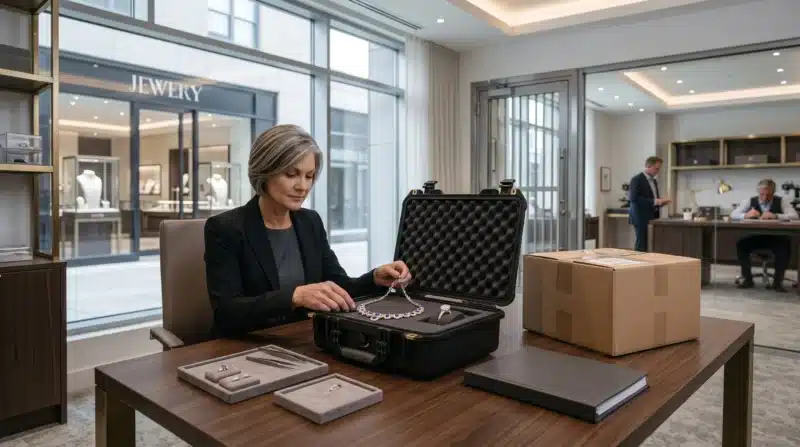
The exposures a jeweler needs to confirm:
The FBI investigates organized jewelry, gem, and metal theft rings precisely because these goods move, and criminals know the routes.
Book a call with Gordon to map your off-premises exposure before your next show.
What security does an insurer require, and how does it change my premium?
Insurers require documented physical controls before they will write or pay a jewelers block policy, and those same controls are your strongest lever on price. A rated safe, a central-station alarm, cameras, and smash-resistant showcases are not red tape. They are underwriting conditions, and here is the part that bites: if the policy required a control that was not running at the time of loss, the carrier can deny the claim.
The controls carriers weigh most heavily:
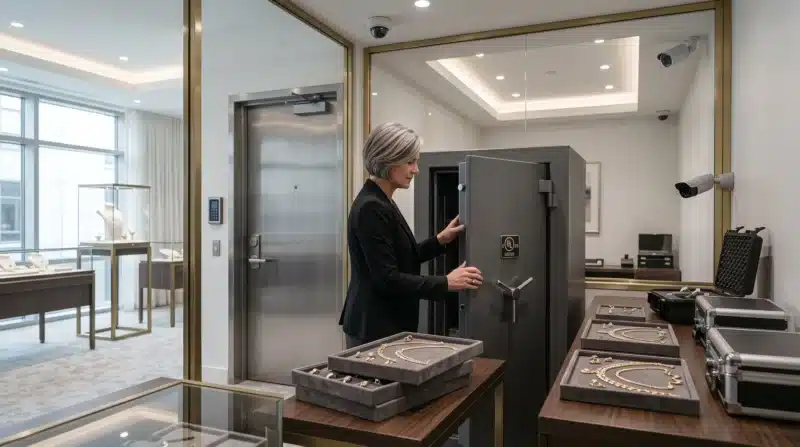
Treat these as leverage.
The goal is a program where your security investments are working for you at renewal, not sitting unnoticed until a claim exposes a condition you did not meet.
How much does jewelry store insurance cost, and what drives the price?
Jewelry store insurance typically costs about $900 to $1,500 a year for a micro-store business owners policy, and $8,000 to $35,000 or more annually for an established jeweler’s full specialty program. Your premium reflects your actual inventory and security, not a category average, so any number you see online is a starting guess, not a quote. Published figures range widely, from micro-store business owners policies near $900 to $1,500 a year to full specialty programs that can run $8,000 to $35,000 or more for an established jeweler with real inventory. The reason for the spread is the point: your premium reflects your actual risk, not a category average.
What genuinely moves the number:

A cheap policy that settles stock at cost is not a saving; it is a deferred loss.
Watch the coinsurance clause too, because if you insure your stock for less than the required percentage of its value, the carrier applies a coinsurance penalty and pays only a fraction of even a partial loss.
The honest answer to “what will it cost” is a quote checklist, not a sticker price, and a specialist should walk you through it in plain terms.
Contact us for a real quote checklist built around your store, not an average.
What does an underinsured jewelry store claim actually look like?
It looks like a paid loss that still bankrupts you. You carry coverage, the carrier accepts the claim, and the check still falls six figures short of what it costs to restock at retail. That is the Retail Value Gap in the real world, and it is the scenario I have watched play out more times than any owner should have to hear about.
Real-world example
A jeweler carries a policy that settles inventory at cost. Overnight, a burglary crew defeats the alarm and clears the primary case, taking $600,000 of watches and diamonds at retail value. The claim is valid and the carrier pays, but it pays the wholesale cost basis, roughly $320,000. The owner is left to find nearly $280,000 to restock the same merchandise, on top of the deductible and the lost selling season. Nothing in the policy was fraudulent. It simply settled at cost, and no one closed the gap before the loss.
It is that valuation, not the promise to pay, is what determines whether a claim makes you whole.
Agreed retail-value terms are the fix, and they have to be in place before the loss.
Why did my premium rise even though I didn’t file a claim?
Because your premium reflects the whole market and your rising inventory values, not just your own claims. Jewelers are surprised to see a renewal climb after a clean year, and the reasons are almost always outside their four walls: carriers repricing for industry crime trends, higher metal and stone values inflating your stock, and tighter underwriting appetite across the trade.
The forces behind a no-claim increase:

This is exactly why you should review your values before the renewal lands, not after.
A specialist who checks your inventory basis and controls ahead of time can often blunt the increase or requalify you with a better-fit carrier.
Our guidance on what your broker should review at renewal walks through the conversation to have.
What is the best jewelry store insurance for independent retailers?
The best jewelry store insurance for an independent retailer is a jewelers block program written by a carrier that specializes in the jewelry trade, placed by a broker who reads the valuation and security terms line by line. The carrier name matters less than the build. Here is why a generalist package usually fails an independent store.
What to look for in any jewelry store insurance provider:
Because the details in a jewelry store insurance program are the whole game, and a generalist does not know where the bodies are buried. A generalist sells a retail package on price, checks a box for business personal property, and moves on. A specialist knows that valuation basis, per-item limits, off-premises terms, bailee coverage, and security conditions are where a claim is won or lost. That difference is not cosmetic. It is the claim check.
Over 40 years, I have worked with business owners across every industry, and jewelry is one of the clearest examples of a trade where a one-size policy quietly fails.
The stock is high-value, portable, and irreplaceable, and the standard form handles none of that.
What we do at The Coyle Group is structure your jewelry store insurance around how your store actually runs, a jeweler with a vault, a bridal retailer holding customer pieces, a multi-location operator moving stock between stores, and then review it before every renewal so the coverage keeps pace with your inventory.
The point is not more insurance.
It is the right build, so a loss makes you whole and the claim holds up.
Book a call with Gordon for a no-obligation review of your jewelry store program.
What to know before you buy jewelry store insurance
Before you buy, get clear on eight things: what the coverage is, who needs it, the core layers, the exclusions, what drives price, how your own situation changes the build, where standard policies fail, and why a specialist matters. Miss one and you inherit the gap. Here is the whole picture on a single screen.
That is the buying checklist in one place.
If any line raises a question about your own store, that is the conversation to have before renewal, not after a loss.
Questions about Jewelry Store Insurance?
Get the Right Coverage for Your jewelry store insurance
Your cases likely hold six or seven figures at retail, if your policy still settles at cost, that gap is real money you’d have to cover yourself.
We pressure-test your valuation, transit, and security in plain language, then show you exactly where a claim would fall short.
No obligation, no jargon, just a clear picture of your program and what it would take to close the gap before a loss forces the question.

This article was written by the CEO of The Coyle Group, Gordon B. Coyle, CPCU, ARM, AMIM, PWCA, who has over 40 years of experience working with business owners of all sizes and industries across the US, solving their insurance challenges.
Here’s how to take the next step
Schedule Your Insurance Confidence Assessment
In our 30-minute call, you’ll discover:
Not ready for a call?
Get Free Access to Our Gated Video:
“How to Finally Feel Confident in Your Coverage. “
And discover the exact system we use to help business owners eliminate hidden coverage gaps, stop overpaying, and finally feel confident in their protection.
What Peace of Mind Looks Like
Trusted by business owners across the U.S.
The Coyle Group is 1st class! Gordon and his team are knowledgeable, responsive, and attentive to detail. Gordon is that rare breed of professional who genuinely cares for his clients and works hard to exceed their expectations. I highly recommend them.

The insurance brokerage service was truly tailored to my needs, nothing like those big brokers who steer you toward random policies that don’t fit your profile. Thank you to the team for your help.

I was working with another broker and having difficulty acquiring General Liability coverage. A colleague recommended The Coyle Group. They were able to get coverage bound in just a couple of business days and a policy issued in ten days, and with a solid carrier at a competitive premium. Truly impressive results, plus it was a pleasure working with them. I highly recommend the Coyle Group!

If any business is looking to work with an insurance brokerage firm that is not only excellent at what the firm does, but one that deeply values the needs of the clients, then The Coyle Group is the firm for you. Give them a call and see for yourself. I can assure that you will quickly agree.

Want to know more?
See related blogs

The Crowdstrike Debacle and Cyber Insurance
Third Party Employment Practices Liability Insurance. Protect Your Business

Are You Overpaying or Underinsured on Your Business Insurance?
