
FDA Import Rejection Insurance for Food Importers
Who Pays When Your Container Is Refused?
Index

Gordon B. Coyle
CEO, The Coyle Group
845-474-2924
How to get started
TL;DR. Executive Summary
The container reaches port with nothing broken, nothing spoiled, and nothing stolen. Then the FDA refuses it.
Next comes the bill nobody planned for, because refused food has to be destroyed or shipped back out, at your expense.
That’s the moment this page is for.
The Coyle Group is a commercial insurance agency that handles the complex, high-value risks other agencies don’t know how to structure, where the details in the policy are the difference between a paid claim and a denied one.
I wrote this guide to FDA import rejection insurance for food importers for established importers of record, distributors, and food processors bringing in ingredients under their own name.
If you want the full program first, start with our food importer insurance guide.
You import food, and you can’t tell whether your cargo policy pays anything if the FDA refuses a container. Our approach is to read your cargo wording, bond, and supplier contracts against the refusal process first, then manage the market for you so the right insurers compete for your business. I hold the Associate in Marine Insurance Management (AMIM) designation, and 95% of our clients stay with us.
Book a 15-minute call before your next container ships.
Why Doesn’t Standard Cargo Insurance Pay When the FDA Refuses Your Food?
Standard cargo insurance pays for physical loss or damage, and an FDA refusal is neither. Your goods can arrive in perfect condition, and the FDA can still refuse them. The bigger surprise sits in the exclusions, though, because many cargo forms also exclude detention by government order, so even the losses that follow a hold can fall outside the policy.
What an uninsured refusal costs you
Here’s what lands on you when nothing in the program responds:
Why cargo insurers say no
Ocean cargo insurance covers physical perils like sinking, theft, and damage in transit.
A refusal is a government decision about whether your goods may enter.
Two clauses usually close the door:
Real-world example
In Blaine Richards & Co. v. Marine Indemnity Insurance Co., decided by the federal appeals court in New York in 1980, an importer bought 10,400 bags of beans from a supplier in France. Against the importer’s instructions, the supplier’s fumigation company treated the beans with a pesticide the FDA had not approved. The FDA detained the shipment as adulterated. Six weeks later, the importer applied to clean and rebag the affected beans, and the FDA approved the plan and released 9,387 clean bags. Even so, the importer paid for the reconditioning, lost its original sales contracts, and had to sell the beans at lower prices. Its cargo policy and its war risk policy both carried exclusions for detention, seizure, or delay, and the court agreed the detention losses fell inside them. Only losses tied to physical damage to the beans went back to the lower court for another look. The supplier’s contractor made the mistake, the shipment was eventually released, and the importer still carried the loss.
Not sure what your cargo form says about government detention? Book a call and I’ll read it with you.
What Happens After the FDA Detains or Refuses Your Food Shipment?
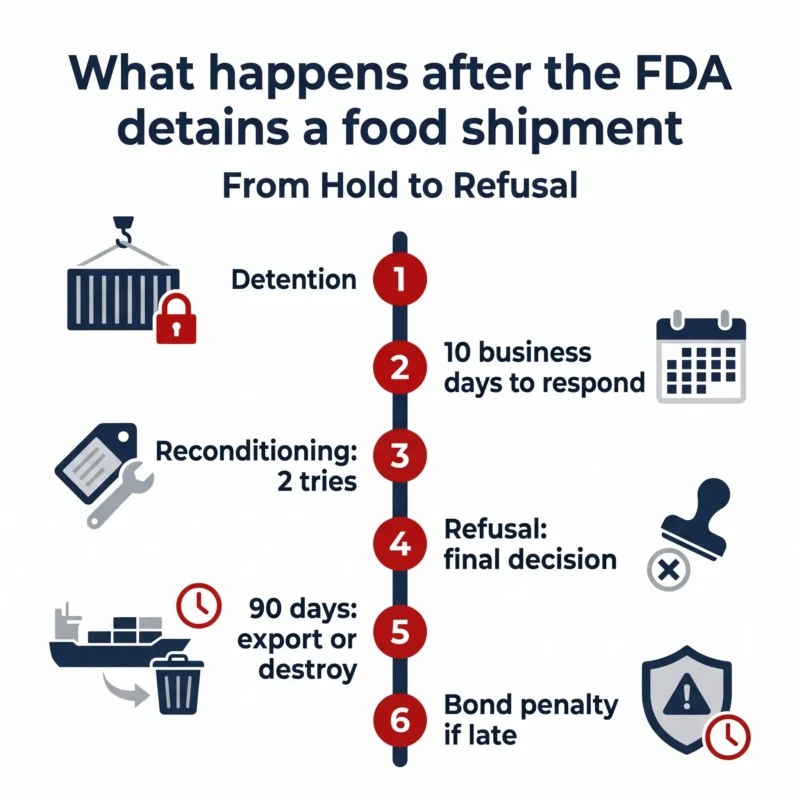
The FDA detains the shipment first, gives you a short window to prove it complies or fix it, and only then refuses it. Every step has a clock. Miss one and your options shrink fast, which is why the order of events matters to your insurance as much as it matters to your customs broker.
Here’s how the sequence runs under the FDA’s own process:
Detention, refusal, and import alerts
Importers mix up three terms all the time.
Through import alerts, the FDA can detain future shipments of a flagged product without testing them, which shifts the burden of proof onto you.
This table separates the three:
Term |
What it means |
What it does to your shipment |
|---|---|---|
|
Detention |
The FDA holds the goods while it decides |
Food sits at port while storage and demurrage keep running |
|
Refusal |
The FDA’s final decision that the goods violate the law |
Export or destroy within 90 days |
|
Import alert, or detention without physical examination (DWPE) |
The FDA flags a product or supplier with a history of violations |
Future shipments can be held without testing until you prove they comply |
Here’s why the order matters: costs pile up for weeks before a refusal is ever issued, and a policy that pays only on refusal may ignore everything you spent fighting the detention.
If a container is on hold right now, contact us and we’ll check what your current policy can still do.
Who Pays for a Refused Container If You Don’t Have Rejection Coverage?
You do. Federal law puts storage, cartage, and labor costs on the owner or consignee, and the export or destruction bill lands there too. What catches importers off guard is how many separate charges stack up before the container ever leaves, and how few of them any standard policy touches.
I call this the Refusal Cost Stack, because each charge sits on top of the last while the clock runs:
Layer |
When it hits |
Who pays without rejection coverage |
|---|---|---|
|
Invoice value of the food |
At refusal, since it can’t be sold here |
You |
|
Demurrage and detention |
Every day the container sits |
You |
|
Storage, cartage, and labor |
From the hold onward |
You |
|
Private lab testing and relabeling |
During detention, if you try to fix it |
You |
|
Re-export freight or supervised destruction |
Within 90 days of refusal |
You |
|
Liquidated damages |
If the deadline is missed |
You, through your bond |
Why re-export rarely saves you
The exits aren’t equal, either.
When re-export costs more than the food is worth, destruction becomes the default, and you pay for that too.
Spoilage while the food sits on hold
Perishable food adds one more layer.
So a refused container of frozen seafood can turn into two losses: the refusal, and the spoilage while you waited.
Contact us and we’ll run your largest container through the Refusal Cost Stack against your current policies.
What Does FDA Import Rejection Insurance for Food Importers Actually Pay For?
Rejection coverage pays the insured value of food the FDA refuses, plus the costs of handling the refusal, when the wording includes them. That last part is the catch. Two policies can both say “rejection” and pay very different amounts, so the list of covered costs matters more than the name on the endorsement.
Here’s how the main costs usually line up across the policies importers carry:
Cost |
Standard cargo policy |
Rejection clause or endorsement |
Where else it might respond |
|---|---|---|---|
|
Value of refused goods |
Generally no |
Yes, at the insured value |
Rarely anywhere else |
|
Storage and demurrage during the hold |
No |
Often, sometimes under a sublimit |
Nowhere, in most programs |
|
Re-export freight |
No |
Often, if the wording lists it |
Nowhere, in most programs |
|
Supervised destruction |
No |
Often, if the wording lists it |
Contaminated products coverage, if contamination caused the refusal |
|
Spoilage during detention |
Often excluded as delay |
Depends on the wording |
Temperature and delay clauses decide it |
|
Lost sales and customer penalties |
No |
Usually not |
Business interruption, if it’s written for supplier problems |
Lost sales deserve their own look. If a key supplier lands on an import alert and your shelves go empty for months, the question becomes whether business interruption covers supplier problems, and that’s a separate policy decision.
The Five-Clause Rejection Wording Check
When I read a rejection clause, I check five things before anything else. If any one of them is weak, the clause can look like coverage and still pay very little:
Clause |
What to look for |
Red flag |
|---|---|---|
|
1. Trigger |
Refusal or detention by the FDA or any government agency, for any reason |
Pays only on final refusal, or only for listed causes |
|
2. Covered costs |
Goods value plus storage, demurrage, testing, re-export, and destruction |
Goods value only |
|
3. Valuation |
The same basis your cargo policy uses, such as invoice plus freight |
Bare invoice value, below what it cost you to land the goods |
|
4. Limits and deductible |
Limits that match your peak container, with storage limits sized for a long hold |
Small sublimits for storage and demurrage |
|
5. Conditions and exclusions |
Clear notice, documentation, and supplier rules you can actually meet |
Exclusions for known suppliers you still buy from |
The trigger matters more than most importers realize. In the beans case above, the FDA released the shipment after reconditioning, and the importer still lost money. A clause that pays only on final refusal would have paid nothing there either.
Covered vs. adequately covered
This is where I separate being covered from being adequately covered. One checks a box; the other protects your business.
A rejection clause that pays only the invoice value, after a deductible, can leave most of the cost stack uninsured.
Ask for the actual wording, not the summary page.
Book a call and we’ll line your wording up against this table.
Which FDA Refusal Reasons Are Covered, and Which Get Claims Denied?
Broad rejection wording covers refusal for nearly any reason the FDA gives, while narrow wording covers only the causes it lists. The difference shows up on the refusal notice. The FDA refuses most food for contamination or labeling problems, and some of those causes are exactly what underwriters try to exclude, so know which ones your policy names.
Most refusals trace back to a short list of problems.
According to the Economic Research Service at the Department of Agriculture, most violations behind FDA food import refusals in both 1998 to 2004 and 2005 to 2013 involved adulteration: pathogens, pesticide residues, unsafe color additives, poisonous ingredients, and filth.
Here’s how rejection wording usually treats each cause:
Refusal cause |
Covered or excluded? |
|---|---|
|
Contamination found on arrival (Salmonella, filth, pesticide residue) |
Usually the heart of what broad wording covers, subject to conditions |
|
Labeling or misbranding |
Varies; intentional mislabeling is commonly excluded |
|
Product already on an import alert when it shipped |
Commonly excluded or declined as a known risk |
|
Missing registration, prior notice, or required filings |
Often conditioned or excluded as a paperwork failure |
|
Known defects in the goods |
Commonly excluded |
|
Buyer rejection unrelated to the FDA |
Excluded |
Conditions matter as much as exclusions.
Rejection wording commonly requires you to follow known import rules, inspect or test before shipping, and keep proper documentation.
Fail a condition, and the cause of the refusal stops mattering.
Book a call and we’ll check which refusal causes your current wording actually names.
Can You Get Rejection Coverage Once a Supplier Is on an Import Alert?
Usually not for that supplier’s product, and almost never for a shipment the FDA has already detained. Insurance covers uncertain losses, not ones already in motion. That doesn’t leave you stuck, though, because how you handle a flagged supplier can shape what an underwriter offers on everything else you import.
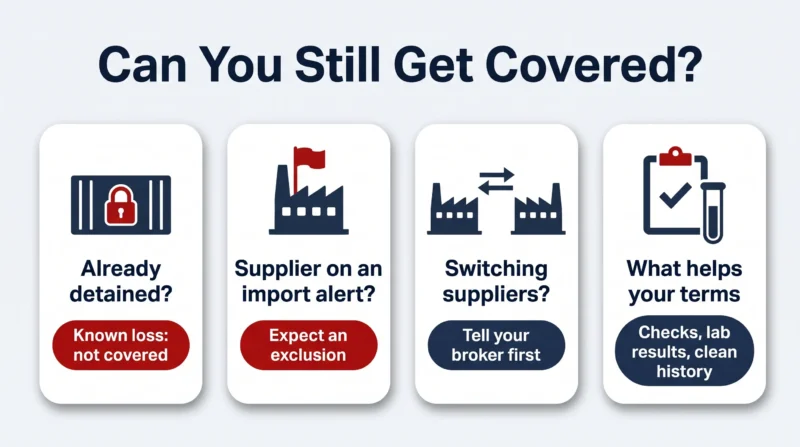
Check before you buy from a new supplier
A few minutes of homework protects both your shipment and your terms:
As the importer of record, you receive the refusal notice even when the supplier caused the problem.
So supplier vetting is also how you protect your insurability, not just your compliance file.
What Do Underwriters Look At Before Writing Rejection Coverage?
Underwriters price rejection coverage on how likely your food is to be refused and how much a refusal would cost. That sounds obvious. What’s less obvious is that most of the answers come from your own records, so diagnosis comes before any quote, and a clear submission does a lot of the work for you.
These five factors drive eligibility and price:
Factor |
Why underwriters care |
What to have ready |
|---|---|---|
|
Product category |
Seafood, spices, and produce drive many refusals |
Product list with categories and storage needs |
|
Origin and supplier |
Some origins and suppliers carry refusal histories |
Supplier list, countries, and any import alert history |
|
Refusal and claims history |
Past refusals predict future ones |
Every refusal notice and how it was resolved |
|
Verification and testing |
Shows you catch problems before shipping |
FSVP records, lab reports, and label reviews |
|
Shipment values and volume |
Sets limits and the size of a single loss |
Average and peak container values, annual volume |
Red flags in a food import program
If two or more of these sound familiar, contact us and we’ll walk through your cargo program with you.
How Much Does FDA Import Rejection Insurance for Food Importers Cost?
There’s no published rate card for rejection coverage; insurers price it shipment by shipment or account by account. The one public benchmark is old, and it’s a percentage of shipment value. What moves your price today is the risk profile underwriters see, which is why the same coverage can cost two importers very different amounts.
Treat that as history, not a quote.
What that benchmark looks like on one container
As an illustration only, here’s the 1994 range applied to a single container worth $150,000:
Container value |
2 percent |
3 percent |
|---|---|---|
|
$150,000 |
$3,000 |
$4,500 |
Compare that with the Refusal Cost Stack on the same container: the full $150,000 in goods, plus weeks of port charges, plus re-export or destruction. Today’s price for your account depends on the factors below.
What moves the price today
What moves the price, as of November 2026:
Factor |
Tends to raise cost |
Tends to lower cost |
|---|---|---|
|
Product category |
Seafood, spices, fresh produce |
Shelf-stable, low-refusal categories |
|
Origin and supplier record |
Prior refusals or import alerts |
Clean history, verified suppliers |
|
Breadth of wording |
Refusal for any reason, full cost stack |
Listed causes only, goods value only |
|
Deductible and sublimits |
Low deductible, high storage limit |
Higher deductible |
Single shipment or annual?
If you import food regularly, an annual rejection endorsement on your open cargo policy covers every container from the moment it ships, so nobody has to remember to buy it.
A single-shipment placement can make sense for a one-off order or a new supplier you’re testing.
Book a call and we’ll show you how your shipments look to an underwriter before anyone asks for a price.
Rejection Coverage vs. Product Recall vs. a Customs Bond: Which Covers What?
Rejection coverage pays when food is refused at the border, product recall pays when food already in the market has to come back, and a customs bond protects the government, not you. Frankly, most business owners assume they’re basically the same thing with different labels. They aren’t, and the table shows where each one stops.
Coverage |
What triggers it |
What it pays |
Responds to an FDA refusal? |
|---|---|---|---|
|
Marine cargo |
Physical loss or damage in transit |
Value of lost or damaged goods |
Generally no |
|
Rejection clause or endorsement |
Refusal of entry by a government agency |
Goods value plus listed refusal costs |
Yes, within its wording |
|
Product recall |
Food already distributed has to be withdrawn |
Retrieval, disposal, notification, and related costs |
No, the food never entered the market |
|
Customs bond |
Your obligations to CBP |
Guarantees duties and penalties to the government |
No, it protects CBP |
|
Stock throughput |
Loss to goods in transit and in storage |
Physical loss across the supply chain |
Only if rejection wording is added |
If contaminated food slips past the border and reaches shelves, that’s a product recall problem, and recalls get expensive fast, as our breakdown of what a product recall costs shows.
Some importers carry stock throughput insurance that follows goods from origin through storage; it can carry a rejection extension, but only if someone adds it.
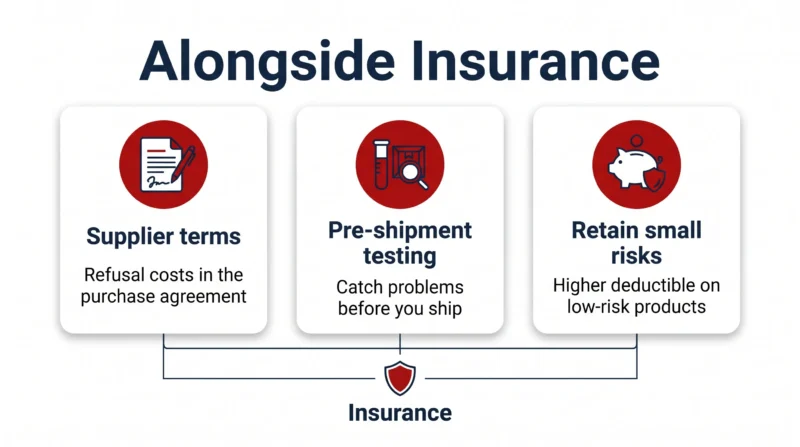
Alternatives that work alongside insurance
Insurance isn’t your only tool.
Weigh these alternatives alongside it:
How Do You File a Rejection Claim Without Giving the Insurer a Reason to Deny It?
Report the claim the day the FDA detains the shipment, not the day it refuses it, and document every step from there. Most rejection claims aren’t lost on the refusal itself. They’re lost on late notice, missing paperwork, or a condition nobody remembered, and every one of those is avoidable.
Five steps from hold to payment
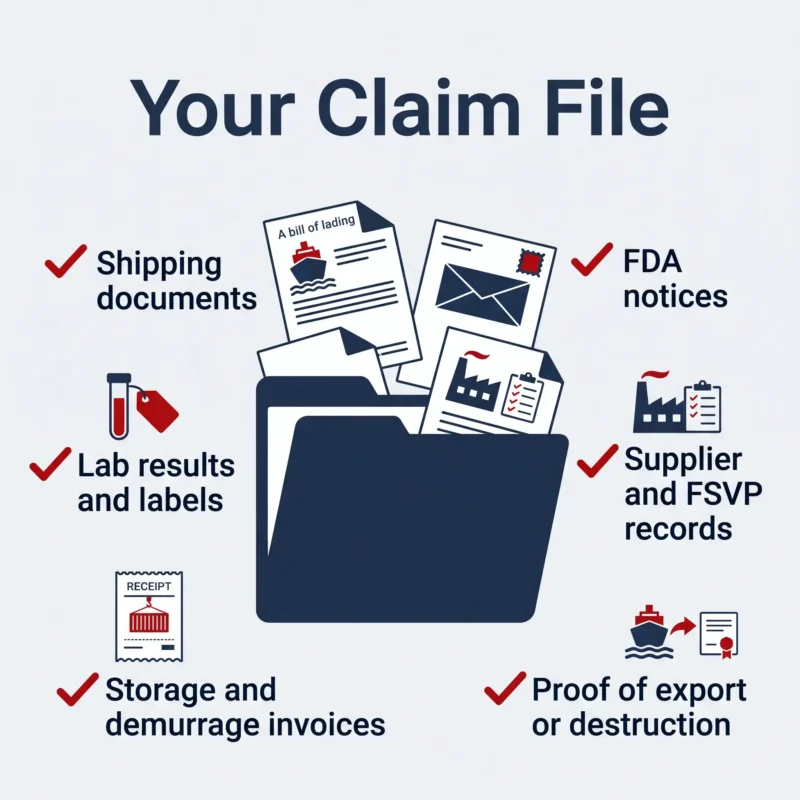
Your claim file
Keep this file from day one:
The choice between re-export and destruction is the one that trips people up.
Both cost money, and the policy may require the insurer’s agreement or expect you to pick the cheaper route.
When something goes wrong, we work with adjusters and carriers to push your claim forward.
Book a call and we’ll set up your claim file before the next container ships, not after the notice arrives.
How Do We Build Rejection Coverage Into a Food Import Program?
We start with how your food actually moves, then fit rejection coverage around it, not the other way around. Rejection wording only works when it meets your cargo, recall, and liability coverage without a seam. Getting that right takes a review before anyone asks an insurer for a price.
The coverage gaps usually sit where one policy ends and the next begins.
So we use the Strategic Risk Process:
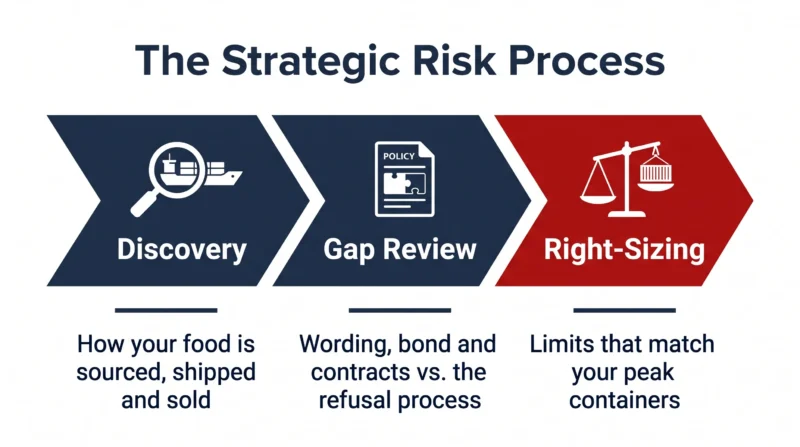
Then we identify the insurers that fit, explain where we’re going and why, and bring viable options back for comparison.
I hold the Chartered Property Casualty Underwriter (CPCU) designation, and on cargo programs I read the clause wording, not the summary sheet.
We also tell you when the right move costs us money. For one importer, we found an ocean cargo profit-sharing clause nobody had acted on and a $10,000 to $12,000 dividend owed to the client. Moving the policy would have cost them that dividend, so we kept it with the existing carrier at a lower commission for us.
For you, that means fewer applications, fewer duplicate requests, and one point of contact.
Should you collect quotes from several brokers?
Comparing options is smart. Sending one food import account to several brokers usually backfires, though. Several brokers approach the same insurers, you fill out the same applications repeatedly, and a generalist may submit your seafood or spice program as ordinary cargo.
One broker who reviews the program first and brings the right insurers to the table serves you better.
Who this isn’t right for
If you import a pallet or two of simple, shelf-stable goods, a basic cargo policy may serve you well, and I’ll say so.
Our sweet spot is established, mid-market importers with complex supply chains.
And if you’re looking for someone to rubber-stamp what you already have at a lower price, there are brokers who will do that. We’re not one of them.
Questions about Fda Import Rejection Insurance For Food Importers?
Build Rejection Coverage Before Your Next Container Ships
We have to build rejection coverage around how your food moves: your products, your suppliers, your ports, and your buyers. That’s the difference between being covered and being adequately covered. It matters most on three days: the day the FDA issues a hold, the week the storage bills start, and the 90th day, when the container has to go somewhere.
Our family has been in the insurance business since 1929, and we only do business insurance. We’re independent, not captive to any carrier. We return calls and emails within one business day and re-underwrite your business every year. You don’t need five brokers shopping your insurance. You need one capable broker making sure the right insurers compete for your business.
The first step costs nothing and doesn’t disrupt your current broker. We put your cargo wording, rejection terms, bond, and supplier contracts side by side against the FDA refusal process. Then you’ll hear what’s working, what’s missing, and what I’d change.
Book a 15-minute call. If your cargo program already handles a refusal, I’ll tell you that too.

This article was written by the CEO of The Coyle Group, Gordon B. Coyle, CPCU, ARM, AMIM, PWCA, who has over 40 years of experience working with business owners of all sizes and industries across the US, solving their insurance challenges.
Here’s how to take the next step
Schedule Your Insurance Confidence Assessment
In our 30-minute call, you’ll discover:
Not ready for a call?
Get Free Access to Our Gated Video:
“How to Finally Feel Confident in Your Coverage. “
And discover the exact system we use to help business owners eliminate hidden coverage gaps, stop overpaying, and finally feel confident in their protection.
What Peace of Mind Looks Like
Trusted by business owners across the U.S.
The Coyle Group is 1st class! Gordon and his team are knowledgeable, responsive, and attentive to detail. Gordon is that rare breed of professional who genuinely cares for his clients and works hard to exceed their expectations. I highly recommend them.


The insurance brokerage service was truly tailored to my needs, nothing like those big brokers who steer you toward random policies that don’t fit your profile. Thank you to the team for your help.

I was working with another broker and having difficulty acquiring General Liability coverage. A colleague recommended The Coyle Group. They were able to get coverage bound in just a couple of business days and a policy issued in ten days, and with a solid carrier at a competitive premium. Truly impressive results, plus it was a pleasure working with them. I highly recommend the Coyle Group!

If any business is looking to work with an insurance brokerage firm that is not only excellent at what the firm does, but one that deeply values the needs of the clients, then The Coyle Group is the firm for you. Give them a call and see for yourself. I can assure that you will quickly agree.

Want to know more?
See related blogs

Essential Insurance for beverage distributors

Best Insurance for Food Products Wholesalers & Distributors

What Type of Insurance Do Wholesalers and Distributors Need?
