
Pharmaceutical Distributor Insurance
The Coverage Gaps That Turn One Bad Shipment Into a Six-Figure Loss

Index

Gordon B. Coyle
CEO, The Coyle Group
845-474-2924
How to get started
TL;DR
Pharmaceutical distributor insurance combines product liability, product recall, property and stock, cargo and cold-chain, crime and diversion, cyber, and umbrella coverage for businesses that store, transport, and supply prescription drugs. It is not the same as DSCSA compliance, and it is not a generic distributor policy.
The two mistakes that cost the most are assuming the manufacturer’s coverage protects you and assuming compliance equals insurance. Neither is true.
This guide walks you from what you need through what your contracts require to what it costs.
You did everything the contract asked.
Most owners I talk to bought a standard distributor package or a BOP from a generalist agent and assumed prescription-drug risk was baked in.
It rarely is. Pharmaceutical distributor insurance is a specialized program, not a repriced wholesale policy, because the exposures behind a regulated drug (product liability, cold chain, recall, diversion, and contract-required limits) do not behave like the exposures behind auto parts or paper goods.
The Coyle Group is a commercial insurance agency that handles the complex, high-value risks other agencies do not know how to structure, where the details in the policy are the difference between a paid claim and a denied one.
Feel like your coverage is guesswork?
You are running a licensed, contract-bound drug distribution operation, but your policy was built for generic wholesaling. We map your real exposures (DSCSA fallout, temperature loss, recall, diversion, and every manufacturer and GPO contract limit) to coverage that actually responds. In 40 years we have found 9 out of 10 programs we review carry at least one fatal flaw.
Book a call and we will pressure-test yours.
What is pharmaceutical distributor insurance, and why isn’t DSCSA compliance the same as being insured?
Pharmaceutical distributor insurance is a bundled program that pays for the third-party claims and first-party losses a drug distribution business faces. Here is the part that trips people up: your license, your surety bond, your DSCSA controls, and your insurance are four separate risk controls, and being strong on three of them does nothing for you on the fourth. Compliance keeps bad product out of your supply chain. Insurance pays when something goes wrong anyway.
I call this the “compliance is not coverage” problem, and it is the single most expensive misunderstanding I see in this industry. A distributor tells me they are fully DSCSA compliant, so they feel covered.
But the Drug Supply Chain Security Act governs traceability, verification, and how you handle suspect product. It does not reimburse you when a lawsuit lands, a lot spoils, or a warehouse is hit by theft.
Those are insurance events, and your compliance file will not pay a dime toward them. The stakes are not abstract. Pharmaceutical distribution runs on razor-thin margins.
Data from the Healthcare Distribution Alliance shows traditional distributors moved $862 billion in 2024, which was 96 percent of all prescription drug sales, while net margins after taxes slipped to just 0.2 percent of revenue. One uninsured six-figure loss can wipe out the profit on an enormous amount of that volume. When the math is that tight, the wrong policy is not an inconvenience.
Not sure whether your current program keeps up with your compliance? Contact us for a no-obligation review.
Are you a “distributor” or a “manufacturer” when a product-liability claim lands?
You may call yourself “just a distributor,” but a product-liability claim can treat you like the manufacturer. That is the loop most owners never see coming: the label on your business card does not decide your exposure, your role in the chain of title does. If you take title, import, private-label, or repackage, you can inherit manufacturer-level liability for a drug you never made.
Here is how the industry actually looks at it
A court can deem the first entity to take title or transfer shipment the manufacturer of the product, which puts full product liability on that party. For imported pharmaceuticals, that party is very often the distributor, because the overseas maker is out of reach of a US court.
So when a patient is harmed and sues, your name is on the complaint and your policy is the one that has to answer.
And leaning on the manufacturer’s indemnity or a vendor endorsement is not the safety net people think it is. Indemnities are only as good as the counterparty’s balance sheet and the wording of the clause, and if you are the importer of record, there may be no solvent manufacturer behind you at all.
The reality that this is not hypothetical shows up in the case law.
In one Kentucky matter, a court held that a general liability insurer had no duty to defend a pharmaceutical distributor in opioid litigation, and McKesson separately lost a bid to make its insurers cover opioid defense costs.
Distributors get named, and the wrong policy structure leaves them paying alone.
Which coverages does a pharmaceutical distributor actually need?
A complete pharmaceutical distributor insurance program layers roughly a dozen coverages, and which ones carry the weight depends on your role and product mix. The trap here is buying a “package” and assuming every box is checked. What we see in practice is that the package covers the easy risks and quietly excludes or sub-limits the ones that actually threaten a drug distributor.
Below is the coverage stack I walk clients through.
Note which lines pay third parties (liability) and which protect your own business (first-party), because owners consistently over-buy one side and under-buy the other.
Coverage |
What it responds to |
Type |
|---|---|---|
|
Commercial general liability |
Premises and operations bodily injury and property damage |
Third-party |
|
Product liability / products-completed operations |
Injury from a distributed or imported drug |
Third-party |
|
Product recall / contamination expense |
Withdrawal, notification, disposal, replacement, lost revenue |
First-party |
|
Property / stock throughput |
Warehouse building, equipment, and high-value inventory |
First-party |
|
Temperature spoilage / equipment breakdown |
Refrigeration or power failure ruining stock |
First-party |
|
Cargo / inland marine + warehouse legal liability |
Product in transit, in a 3PL’s care, or in returns |
First-party / mixed |
|
Crime / diversion |
Theft, employee dishonesty, drug diversion |
First-party |
|
DSCSA data, ERP/WMS systems, ransomware, business interruption |
Mixed |
|
|
Commercial auto |
Owned delivery fleet |
Third-party / first-party |
|
Workers’ compensation |
Warehouse and driver injuries |
First-party (statutory) |
|
Extra limits over liability lines |
Third-party |
|
|
D&O / EPLI |
Management and employment exposure |
Third-party |
The right stack is assembled around how you operate, not copied from a template. A cold-chain specialty distributor, a controlled-substance wholesaler, and an importer of finished generics each need a different center of gravity.
Want this mapped to your exact operation? Book a call, and we will build the stack with you.
What happens when refrigerated drugs are damaged in transit, and will your policy pay?
A temperature excursion in transit is often covered on paper and contested in practice. Here is the loop: the coverage exists, but whether it pays turns on documentation and exclusions most distributors never read. Cold-chain claims are among the most technically complex and most frequently contested in all of insurance, and the dispute usually starts with your temperature logs.
Insurers pay the value of ruined temperature-sensitive stock, but typically only if you can prove good distribution practice with a complete, unbroken temperature record. Miss part of the log and the claim slows to a fight.
On top of that, standard cargo and property forms carry exclusions for spoilage, delay, mechanical breakdown, or improper packing that can swallow a pharmaceutical loss whole.
Real-world pattern we see
A distributor expands a high-value biologic line and increases weekly shipments from its wholesaler. The existing policy includes stock deterioration and on-site fridge cover, but no transit protection for product damaged en route. One warm shipment later, the loss sits entirely with the distributor, because the coverage stopped at the warehouse door. The fix was simple and cheap before the loss and impossible after it: a transit and stock-throughput layer that follows the product from dock to dock.
The same logic extends to a broader supply-chain shock. If a key supplier or your own distribution center goes down, contingent business interruption insurance can replace the income a temperature failure or facility loss takes off the table.
Property coverage rebuilds the building. It does not, by itself, replace the revenue you lose while you are dark.
Getting a straight answer on cold-chain exclusions is hard alone. Contact us, and we will read your policy with you.
How do DSCSA obligations turn into insurance exposures?
DSCSA does not require a specific insurance policy, but nearly every DSCSA obligation creates a loss scenario your insurance has to be ready for. The nuance owners miss: the law tells you what controls to run, and the failure of those controls is what becomes an insurable, or uninsurable, event. Mapping one to the other is where a specialist earns their keep.
Since the enforcement discretion ended on August 27, 2025, wholesale distributors operate under the enhanced, package-level requirements of Section 582(g)(1): interoperable electronic tracing, authorized-trading-partner verification, and package-level product identifiers.
Each of those touches an insurance line. A data compromise in your tracing system is a cyber and business-interruption claim. A suspect or illegitimate product moving through your dock can trigger quarantine, investigation, and, once you determine a product is illegitimate, a duty to notify FDA within 24 hours.
Diversion and theft are crime and cargo claims. None of that is paid by your compliance program.
Your SOPs, serialization, verification, and quality agreements reduce the frequency of loss. Your policy pays for the severity when a loss gets through anyway. Treat them as one system and you stop leaving money on both sides of the table.
Want your DSCSA workflow mapped to your coverage? Watch our short distributor risk briefing, then book a call.
Recall, counterfeit, diversion, and theft: which policy actually responds?
These are four different losses, and four different coverages pay them, though owners routinely blur them into one. The loop to close: a single bad event can touch all four buckets at once, and a policy strong in one can be silent in the others. Knowing which form responds keeps you from discovering the gap during the claim.
Here is the clean split, because the words get used loosely:
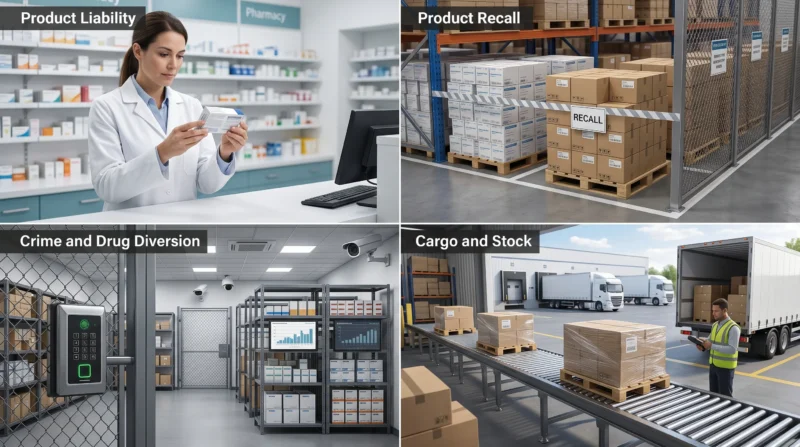
Threat-intelligence firm BSI tracked 166 pharmaceutical cargo-theft incidents globally from 2024 through the first half of 2026, with roughly $42 million in disclosed losses across 56 of them, and GLP-1 and specialty medicines increasingly targeted by organized crime. Pharmaceutical distributor insurance that treats crime, cargo, and recall as one set closes all three sides of the same event. Structure them as a set, not as afterthoughts, and a bad quarter stays a bad quarter instead of becoming the end of the business.
What insurance do drug manufacturers, GPOs, and hospitals require from you?
Your biggest customers will dictate your insurance long before a claim ever does. The catch most distributors learn the hard way: the required limits and endorsements in a manufacturer, GPO, or hospital contract routinely exceed what a standard distributor policy provides, and a non-compliant certificate can stall the contract you were counting on. Read the contract first, then buy the policy, never the reverse.
Vendor schedules from the large hospital purchasing groups are demanding for a reason, and they enforce them through the certificate of insurance.
The items that trip distributors up most:

The correct answer is never “the standard limit is X.” It is: what does this specific contract require, and does your program deliver it on paper and in a claim?
Get that wrong and you either lose the deal or, worse, win it while carrying a limit that cannot absorb the loss the contract was written to transfer.
Facing a COI deadline? Contact us, and we will turn your contract into a compliant program fast.
What’s required to hold a wholesale drug distributor license: bond or insurance?
Licensing requires a surety bond and, in many states, minimum liability insurance, and the two are not the same thing. The distinction matters more than owners expect: a bond protects the state and the public, while your liability insurance protects you. Satisfying one does not satisfy the other, and neither one is optional.
Federal standards for prescription-drug wholesale distributors call for a $100,000 surety bond or equivalent security to issue or renew a license, with a reduced $25,000 bond available where prior-year annual gross receipts are $10 million or less.
States layer their own rules on top, and they vary.
Requirement |
What it is |
Who it protects |
|---|---|---|
|
Federal surety bond |
$100,000, or $25,000 if gross receipts are $10M or less |
The state / the public |
|
State minimum liability insurance |
Required in many states (amount often unspecified) |
Third parties you injure |
|
State bond or security |
Commonly $100,000 per license type |
The state / the public |
|
Your commercial program |
Product liability, cargo, recall, crime, cyber, and more |
Your business |
For example, Illinois requires wholesale drug distributors and third-party logistics providers to maintain minimum liability insurance for the license term plus a $100,000 bond, and Minnesota requires minimum liability and other insurance “as may be required” alongside a $100,000 surety bond. Do not copy one state’s numbers into another state’s file. The requirements are not uniform, and this is wholesalers and distributors insurance territory where a specialist keeps you compliant across every jurisdiction you operate in.
How much does pharmaceutical distributor insurance cost, and what drives the premium?
There is no single market price for pharmaceutical distributor insurance, and any source quoting you one is selling, not underwriting. The honest answer opens a more useful loop: your premium is built from a specific set of drivers, and understanding them is how you control the number instead of just reacting to it.
You will see published figures online.
A generalist page might quote a small drugs wholesaler at $87 to $129 per month for basic general liability, while a broker page lists a pharmaceutical distributor starting near $850 per month and large operations at $2,500 to $15,000 or more, with product-liability limits ranging from $5 million to $50 million. Treat every one of those numbers as marketing, not a benchmark. None is an actuarially validated average, and most blend pharmacies, manufacturers, and 3PLs into one figure that does not describe your business.
What actually drives your premium:
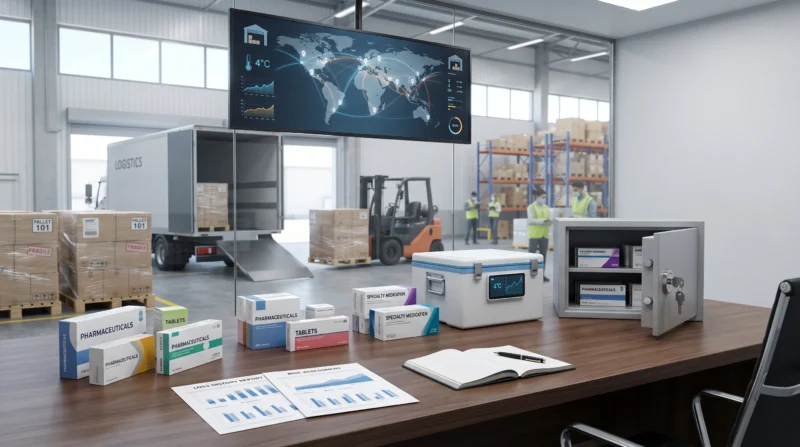
It is the right limits and terms at a defensible cost, with the exclusions, sublimits, and recall and cargo treatment spelled out before you bind.
That is a conversation with a broker who knows the class, not a number from a quote form.
Ready for a real number built on your operation? Book a call.
How The Coyle Group structures pharmaceutical distributor programs
We build pharmaceutical distributor insurance from your operation outward, not from a template inward. The difference shows up at claim time, which is the only time anyone really tests coverage. Over 40 years working with seven, eight, and nine figure business owners, I have found that almost every program we review contains at least one fatal flaw, and for drug distributors it is usually a cold-chain, recall, or contract-limit gap nobody caught until it was too late.
The way I work a distributor program is a short decision tree:

That is how you turn a stack of policies into one program that actually responds.
If your coverage feels like guesswork, or you have simply outgrown a generalist who does not understand drug distribution, let’s have a conversation and make sure you are truly protected.
Get a second set of expert eyes on your program. Book a call for a no-obligation review.
Questions about Pharmaceutical Distributor Insurance?
Get the Right Coverage for Your Pharmaceutical Distributor Insurance
Most pharmaceutical distributor coverage gaps are invisible until a claim turns them into a denied one. Whether you’re treated as the deemed manufacturer, whether your cold-chain documentation holds up, whether recall and diversion are actually scheduled, and whether your limits match what the manufacturer, GPO, or hospital contract requires all determine whether a claim gets paid, and most distributors have never had those four points reviewed together.
The Coyle Group has spent over 40 years reviewing commercial insurance programs for mid-market and enterprise companies. Our pharmaceutical distributor reviews are structured around the coverage gaps documented on this page, not a generic policy summary. We identify where compliance ends and insurance has to take over, find the markets that write the class properly, and structure the endorsements before renewal, not after a loss.
Book a 30-minute pharmaceutical distributor coverage review. No obligation. No generic pitch. A structured review of whether your current program would actually pay if a shipment ran warm, a lot got recalled, or a claim named you as the manufacturer tomorrow.

This article was written by the CEO of The Coyle Group, Gordon B. Coyle, CPCU, ARM, AMIM, PWCA, who has over 40 years of experience working with business owners of all sizes and industries across the US, solving their insurance challenges.
Here’s how to take the next step
Schedule Your Insurance Confidence Assessment
In our 30-minute call, you’ll discover:
Not ready for a call?
Get Free Access to Our Gated Video:
“How to Finally Feel Confident in Your Coverage. “
And discover the exact system we use to help business owners eliminate hidden coverage gaps, stop overpaying, and finally feel confident in their protection.
What Peace of Mind Looks Like
Trusted by business owners across the U.S.
The Coyle Group is 1st class! Gordon and his team are knowledgeable, responsive, and attentive to detail. Gordon is that rare breed of professional who genuinely cares for his clients and works hard to exceed their expectations. I highly recommend them.

The insurance brokerage service was truly tailored to my needs, nothing like those big brokers who steer you toward random policies that don’t fit your profile. Thank you to the team for your help.

I was working with another broker and having difficulty acquiring General Liability coverage. A colleague recommended The Coyle Group. They were able to get coverage bound in just a couple of business days and a policy issued in ten days, and with a solid carrier at a competitive premium. Truly impressive results, plus it was a pleasure working with them. I highly recommend the Coyle Group!

If any business is looking to work with an insurance brokerage firm that is not only excellent at what the firm does, but one that deeply values the needs of the clients, then The Coyle Group is the firm for you. Give them a call and see for yourself. I can assure that you will quickly agree.

Want to know more?
See related blogs

The Crowdstrike Debacle and Cyber Insurance
Third Party Employment Practices Liability Insurance. Protect Your Business

Are You Overpaying or Underinsured on Your Business Insurance?
