
Does Insurance Cover Stolen Cargo?
Who Actually Pays When Your Shipment Disappears

Index

Gordon B. Coyle
CEO, The Coyle Group
845-474-2924
How to get started
Yes, stolen cargo is usually covered, but the policy that pays is almost always your own, not the carrier’s, and coverage is conditional on the wording in your contract. Whether a claim actually gets paid comes down to the type of policy you hold, where the goods were when they were taken, and the exact theft terms buried in the fine print.
If you are reading this, something has probably already gone wrong.
Now you are staring at a six-figure invoice, and the question every owner ends up asking, does insurance cover stolen cargo, has a better answer than the forums suggest.
That fear is real, but it is usually preventable.
The Coyle Group is a commercial insurance agency that handles the complex, high-value risks other agencies don’t know how to structure, where the details in the policy are the difference between a paid claim and a denied one.
Most owners we meet after a theft say the same thing: they assumed the carrier’s insurance had them covered, and it didn’t. We structure cargo, transit, and warehouse coverage around your actual custody chain, so a stolen load meets a policy that responds instead of a gap that does not.
Over 40 years we have seen exactly where these programs quietly break.
Book a call and we will pressure-test your coverage before a loss does.
How common is cargo theft, and what gets covered?
Cargo theft is common and rising, and the right cargo policy does cover it, though a listed theft peril is not a guaranteed payout. U.S. and Canadian thefts rose 27% in 2024, so a stolen load is a real risk, and the gap between what a policy covers and what it actually pays is where owners get hurt.
Cargo theft is not a rare event you can afford to ignore.
The problem is global, too: IUMI, citing TAPA EMEA data, recorded 157,421 cargo crimes across 129 countries between 2022 and 2024.
The policies that typically respond to stolen cargo:
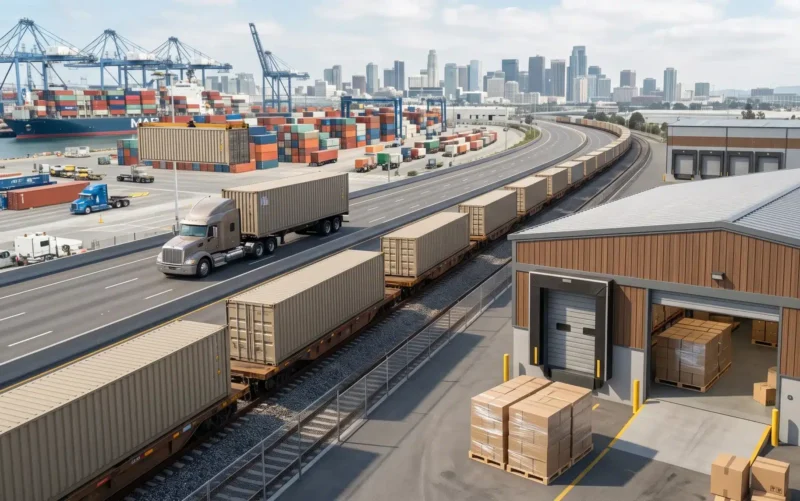
The catch is that each one covers a different leg of the journey, and none of them covers all of it by default.
That is the loop we will close section by section.
Not sure which of these is actually in force for your shipments? Book a call and we will map it out.
Who pays when cargo is stolen: you, the carrier, or the broker?
You usually pay first, then chase the carrier, and that surprises almost everyone. When cargo is stolen, your own cargo policy is designed to reimburse your invoice value quickly, after which your insurer pursues the carrier or broker for recovery. Relying on the other party’s insurance instead is the single most expensive assumption I see owners make.
Here is why the carrier’s coverage rarely makes you whole
A carrier’s liability is a legal-liability claim under the bill of lading, governed by the Carmack Amendment, not automatic first-party insurance on your goods.
The carrier can assert declared-value limits, statutory defenses, and proof-of-fault requirements.
On top of that, the federal cargo-insurance requirements enforced by the FMCSA apply chiefly to household-goods carriers and forwarders, not to every ordinary freight carrier hauling your product.
Freight brokers add another layer, because a broker writes contingent cargo coverage to protect itself, not to guarantee your invoice value.
Whose policy actually pays depends on who had custody at the moment of the theft, and whether that party’s coverage will actually make you whole.
Whose policy pays?
A quick reference
Where the theft happened |
Policy most likely to respond |
The limitation that trips owners up |
|---|---|---|
|
In transit (ocean, air, rail, road) |
Your marine or inland marine cargo policy |
Theft wording, route, and valuation must match the loss |
|
Trucker robbed or load hijacked |
Carrier’s motor truck cargo; your cargo policy may respond first |
Carrier liability is capped by contract and law |
|
Handed to a fraudulent “carrier” |
Often no one, unless you have theft-by-deception cover |
Standard forms exclude voluntary parting |
|
After arrival, in temporary storage |
Stock throughput or warehouse coverage |
Ordinary cargo cover may end at delivery |
|
At your distribution warehouse |
Commercial property, warehouse, or stock coverage |
Employee-theft and security warranties apply |
For businesses that move product through multiple hands, the right structure often looks less like a single policy and more like a coordinated program, which is exactly what our work with wholesalers and distributors is built around.
Want to know whose policy pays for your loads? Contact us for a straight answer.
Does cargo insurance cover theft, or do you need a separate policy?
Sometimes yes, sometimes you need more, and the deciding factor is whether your policy is all-risk or named-perils. All-risk cargo cover generally pays for physical loss unless something is excluded, so theft is usually in. Named-perils cover only pays for listed causes, and some leave theft off entirely. Knowing which one you hold changes everything.
The distinction most owners never hear about comes straight from the standard Institute Cargo Clauses:
How the main forms treat theft
Coverage type |
How theft is treated |
Best for |
|---|---|---|
|
All-risk cargo (Institute Cargo Clauses A) |
Physical loss and theft covered unless specifically excluded |
Owners wanting the broadest transit protection |
|
Named-perils cargo (Clauses B and C) |
Only listed causes; theft may be limited or absent |
Lower-cost cover with narrower protection |
|
Motor truck cargo (the carrier’s form) |
Carrier’s liability only, subject to theft warranties |
The trucker, not the cargo owner |
|
Stock throughput |
Transit plus storage combined in one program |
Importers and distributors covering the full journey |
Often, yes.
Importers and distributors who want their goods protected from the supplier’s dock through to their own shelves usually need their own cargo or stock throughput program rather than trusting whatever the trucker carries.
Over 40 years, I have found that the owners who sleep best are the ones who stopped borrowing someone else’s coverage.
Book a call, and we will tell you whether your current policy actually needs a companion.
The exclusions that get stolen–cargo claims denied
Most denials trace back to a handful of exclusions and security conditions, not to bad luck. Insurers deny stolen-cargo claims when you break a policy condition, when the form excludes the theft type, or when you cannot prove the loss. The frustrating part is that these triggers are predictable, which means they are also preventable once you know them.
From the claims and complaints owners describe publicly, the recurring denial reasons are consistent:
That is the outcome we design programs to prevent.
Contact us to find the exclusions hiding in your policy before a thief does.
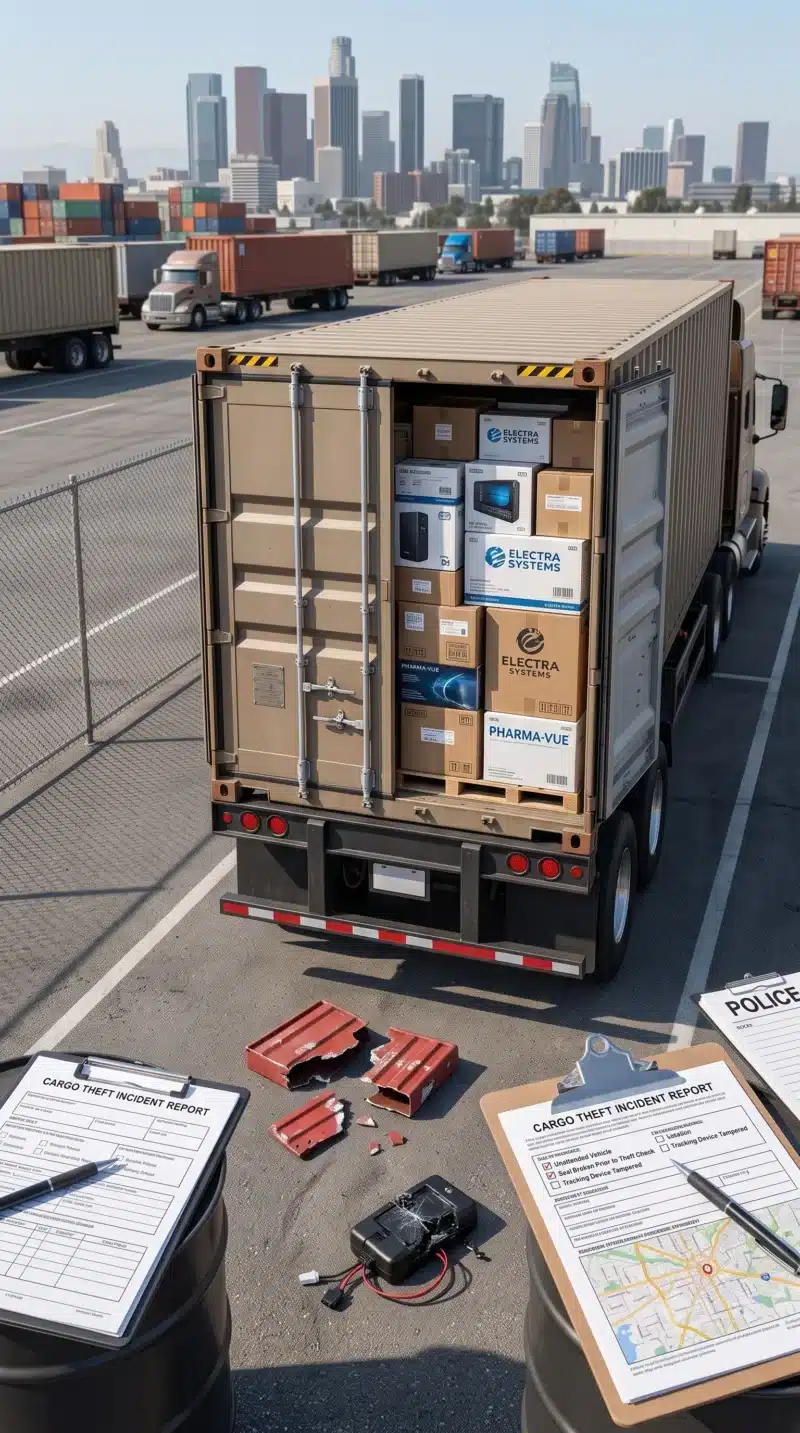
Strategic cargo theft and fictitious pickups: is “theft by deception” even covered?
Often it is not, and this is the fastest-growing gap in cargo coverage today. Strategic cargo theft, including the fictitious pickup or theft by deception, happens when a criminal uses forged credentials to impersonate a legitimate carrier and drives off with it. Many standard policies treat that as voluntary parting and exclude it, a brutal surprise mid-claim.
The mechanics matter, because they decide whether you are covered:
Real-world example.
In a case documented by insurance broker Brown & Brown, criminals stole $500,000 in high-end clothing during a fraudulent pickup. The insurer denied the claim because the policy only covered cargo entrusted to a legitimate motor carrier. The shipper had handed the goods to an impostor, so the coverage did not apply.
The fix is specific, not general.
As one specialist put it, “ask your agent specifically whether theft by deception is covered or excluded.”
Book a call and we will check whether your policy treats a fictitious pickup as theft or as your mistake.
Does cargo insurance cover warehouse theft and stored inventory?
Not always, and this is where importers get caught. Standard cargo insurance often ends at delivery or after a short storage window, so goods stolen from your warehouse can fall outside it entirely. Once product sits in inventory, you are usually relying on property, warehouse, or stock coverage instead. The handoff between transit and storage is a classic custody gap.
For businesses that import and warehouse goods, the exposure stacks up across several stages:
This is why our importer insurance approach and our work with third-party logistics providers focus on covering the whole journey, including the moments your product is stationary.
From what we see in practice, the warehouse leg is the one most programs quietly leave exposed, and it often holds the most value in one place.
A stock throughput policy is designed to smooth that seam, keeping one set of terms in force from the supplier’s dock through transit and into your inventory, so there is no window where the goods belong to no one’s coverage.
Contact us if your goods spend time in storage and you are not sure they are covered there.
What a stolen cargo insurance claim actually requires
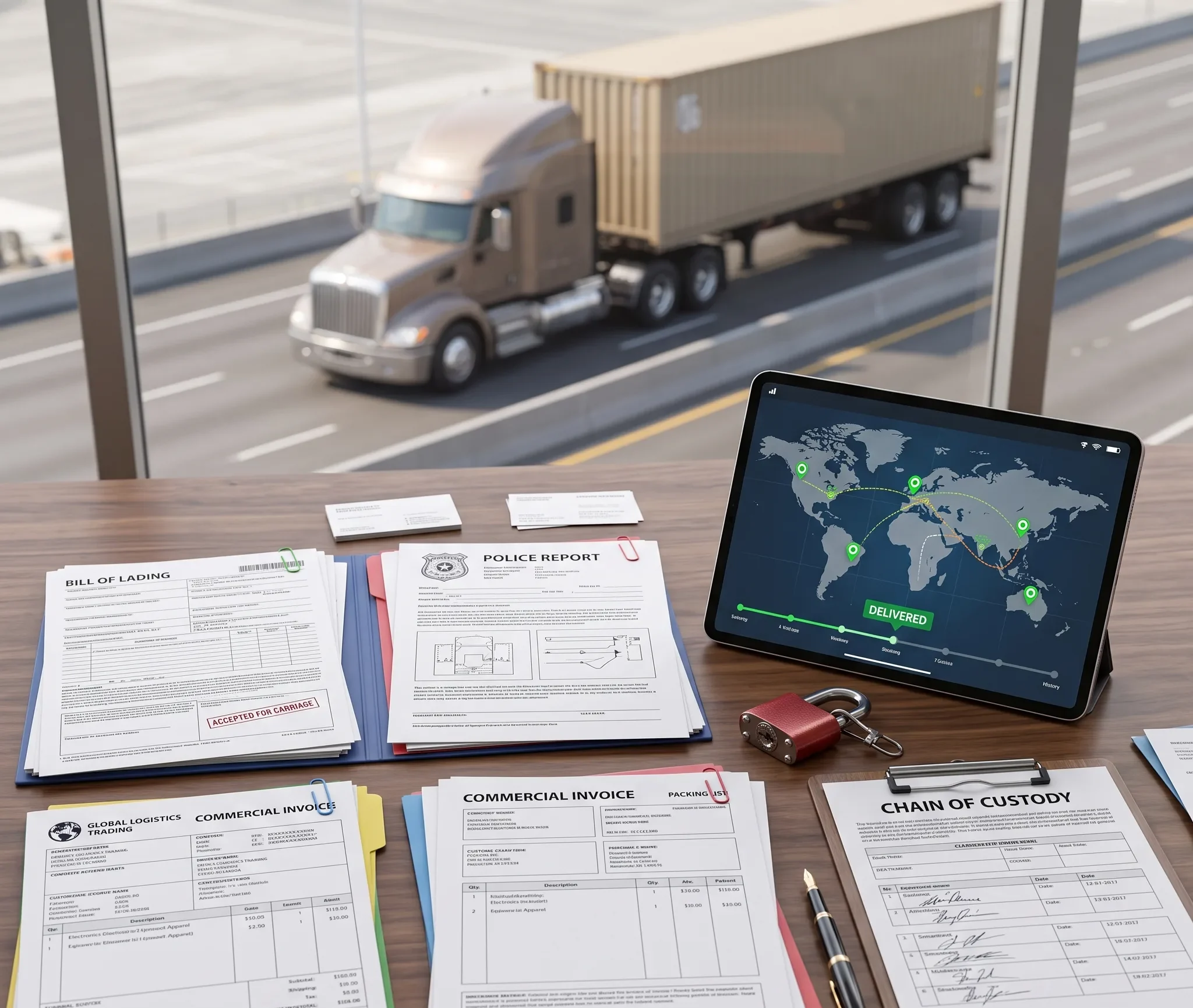
A stolen cargo insurance claim lives or dies on documentation and speed. Insurers want proof of what was loaded, who had custody, when the loss happened, and what the goods were worth, and they want the theft reported fast. Miss those, and even a covered loss can stall. The good news is that the requirements are knowable in advance.
What you will typically need to file:
One point owners rarely think about until it is too late: many policies pay the value of the goods but exclude the ripple effects.
Book a call before you ever need to file, so the paperwork is ready if you do.
How to protect against cargo theft and prevent claim denials
You prevent cargo theft losses by hardening the shipment and closing the policy gaps at the same time. Physical security stops some thefts; the right coverage structure makes sure the rest are actually paid. Doing one without the other is how owners end up technically insured and practically exposed. The two jobs are separate, and both matter.
Practical steps that reduce both theft and denials:
Our work with clients who need insurance for distributors almost always starts by finding that gap before a loss does.
What affects the cost of cargo insurance?
Your premium tracks the risk you ask the insurer to carry, so the value of your goods, what you ship, and where it travels move the price the most. That is the short version, but two shippers with identical revenue can pay very different rates, and the reason usually sits inside their own operations, not the market.
The main cost drivers for cargo and stock coverage:
One honest note, because not every shipper needs a standalone cargo policy.
If you move low-value domestic freight, or your Incoterms put the risk of loss on your supplier or your customer, the carrier’s liability or the other party’s coverage may be enough.
Book a call, and we will price the coverage against your real exposure, not a generic online quote.
How The Coyle Group structures cargo theft protection
We build cargo theft protection around your actual custody chain, not around a single off-the-shelf policy. That means coordinating cargo, transit, storage, and crime coverage so every stage of your shipment has a policy that responds, and closing the exclusions that sink most claims. For importers and distributors, that is coverage that pays, not just coverage on paper.
This is also where a specialist earns the fee, because the details that decide a claim live in the underwriting.
a generalist package agent rarely touches:

That is not a sales line; it is what four decades of reviewing programs has shown me.
When the details are right, a stolen load becomes a claim you file, not a loss you eat.
When they are wrong, you find out at the worst possible moment.
We would rather find the gap first.
So, does insurance cover stolen cargo for a business like yours?
It can, and it usually should, but only if someone has built the program on purpose to respond across every leg of your supply chain.
If you move, import, or store products of real value, let’s have a conversation before the next shipment leaves the dock. Book a call or contact us, and we will pressure-test whether your coverage would actually pay if your cargo disappeared tomorrow.
Questions about Does Insurance Cover Stolen Cargo?
Get the Right Coverage for Your cargo insurance
Cargo insurance is not a policy you pick off a shelf. The right program requires a broker who understands how your freight actually moves, can read your bills of lading, contracts, and transit exposures, and has placed all-risk cargo, stock throughput, and theft-by-deception coverage for shippers like yours.
The Coyle Group has structured cargo and stock programs for importers, wholesale distributors, manufacturers, third-party logistics providers, and multi-location shippers across the US. Our approach starts with your custody chain and how your goods actually travel, not a generic application.
Contact us with your current declarations pages and a description of what you ship, how it moves, and how it is valued. We will identify every coverage gap in one call.

This article was written by the CEO of The Coyle Group, Gordon B. Coyle, CPCU, ARM, AMIM, PWCA, who has over 40 years of experience working with business owners of all sizes and industries across the US, solving their insurance challenges.
Here’s how to take the next step
Schedule Your Insurance Confidence Assessment
In our 30-minute call, you’ll discover:
Not ready for a call?
Get Free Access to Our Gated Video:
“How to Finally Feel Confident in Your Coverage. “
And discover the exact system we use to help business owners eliminate hidden coverage gaps, stop overpaying, and finally feel confident in their protection.
What Peace of Mind Looks Like
Trusted by business owners across the U.S.
The Coyle Group is 1st class! Gordon and his team are knowledgeable, responsive, and attentive to detail. Gordon is that rare breed of professional who genuinely cares for his clients and works hard to exceed their expectations. I highly recommend them.

The insurance brokerage service was truly tailored to my needs, nothing like those big brokers who steer you toward random policies that don’t fit your profile. Thank you to the team for your help.

I was working with another broker and having difficulty acquiring General Liability coverage. A colleague recommended The Coyle Group. They were able to get coverage bound in just a couple of business days and a policy issued in ten days, and with a solid carrier at a competitive premium. Truly impressive results, plus it was a pleasure working with them. I highly recommend the Coyle Group!

If any business is looking to work with an insurance brokerage firm that is not only excellent at what the firm does, but one that deeply values the needs of the clients, then The Coyle Group is the firm for you. Give them a call and see for yourself. I can assure that you will quickly agree.

Want to know more?
See related blogs

The Crowdstrike Debacle and Cyber Insurance
Third Party Employment Practices Liability Insurance. Protect Your Business

Are You Overpaying or Underinsured on Your Business Insurance?
