
3D Printing Business Insurance

What Additive Manufacturers Need to Know

Home » Insurance By Industry » Manufacturing Insurance » 3D Printing Business Insurance | The Coyle Group

Why Standard Insurers Reject 3D Printing Businesses

Most insurers reject 3D printing businesses because generalist underwriters lack a classification that accurately reflects additive manufacturing risk, so they default to denial or over-pricing.

The financial cost of that gap is not a nuisance. A single uninsured product liability claim in this space can exceed $500,000, and one intellectual property dispute can run $200,000 to $1,000,000 in legal fees before a verdict. Operating without proper coverage is not a savings strategy. The consequences that follow a denied claim tend to be permanent.

Here is why generalist carriers consistently struggle with 3D printing businesses:

  • Underwriting unfamiliarity: Most standard underwriters do not have an additive manufacturing risk class. They attempt to force the business into a manufacturing or retail box, which leads to wrong coverage or no coverage.
  • Product liability complexity: When a 3D-printed part fails, liability can fall on the designer, the printer, the material supplier, or all three. Generalist policies often exclude manufactured goods entirely in the products-completed operations section (the part of a CGL, or commercial general liability policy, that covers injury or damage caused by products after they leave your hands).
  • IP exposure: 3D printing businesses handle customer CAD files, proprietary designs, and licensed IP. Standard commercial general liability policies rarely address IP infringement claims.
  • Cyber vulnerability: Connected printers, cloud-based design libraries, and networked workflows expose 3D printing operations to data breaches that standard property policies do not cover.
  • Regulated industry triggers: Printing components for medical, aerospace, automotive, or children’s product applications triggers additional liability that generalist underwriters flag as unpriceable.
  • Home-based operations: Home-based 3D printing businesses that attempt to rely on homeowner’s policies find that business activities are excluded, leaving them with no coverage at all.

The path forward is working with a broker who has placed manufacturing coverage before and knows which carriers have current appetite for additive manufacturing risks.

Contact us to find out which markets are actively writing 3D printing business insurance programs right now.

What Does 3D Printing Business Insurance Cover?

A properly structured 3D printing business insurance program covers product liability, general liability, professional indemnity, commercial property, business interruption, cyber liability, IP exposure, and workers’ compensation. No single policy covers all of these at once, which is why a packaged program built around your specific business model outperforms any individual off-the-shelf policy. The coverage combination that protects a home-based prototype shop differs significantly from the program required by a commercial facility producing medical-grade components.

Here is a breakdown of the core coverages and what each one protects for 3D printing operations:

Coverage

What It Protects

Why It Matters for 3D Printing

General Liability

Third-party bodily injury, property damage, advertising injury

Covers injury at your facility or damage to client property during operations

Product Liability

Injury or damage caused by a printed product you sell or deliver

Critical if a part fails in use; covers legal fees and settlements

Professional Indemnity (E&O)

Design errors, failed prototypes, professional negligence

Protects against client claims when design flaws or printing mistakes cause financial loss

Commercial Property

Printers, workstations, filament, raw materials, inventory

Covers expensive equipment and materials from fire, theft, or damage

Business Interruption

Lost income during operational shutdowns

Compensates revenue loss when equipment failure or a disaster halts production

Cyber Liability

Data breaches, hacked systems, stolen CAD files

Protects against digital risks specific to connected 3D printing workflows

IP Liability

Patent, trademark, and copyright infringement claims

Covers legal defense costs for IP disputes involving designs or processes

Workers’ Compensation

Work-related injuries and occupational illness

Mandatory in most states; covers fume exposure, burns, and material-related illness

Product Recall

Cost of recalling a defective batch of printed products

Fills a gap that standard product liability policies leave open

Do You Need Product Liability Insurance for a 3D Printing Business?

Product liability insurance is the single most essential coverage for any 3D printing business that delivers a physical product, and it applies regardless of whether you designed the product yourself. If a 3D-printed part fails and causes bodily injury or property damage, your business faces a lawsuit. According to the Insurance Information Institute, defense and cost containment expenses are among the highest in product liability lines; legal defense alone routinely runs $75,000 to $150,000 before a settlement is reached, and a judgment can go far beyond that. The secondary risk that business owners miss is the manufacturer’s share of liability, which applies even when the design came entirely from the client.

How product liability applies based on your business model:
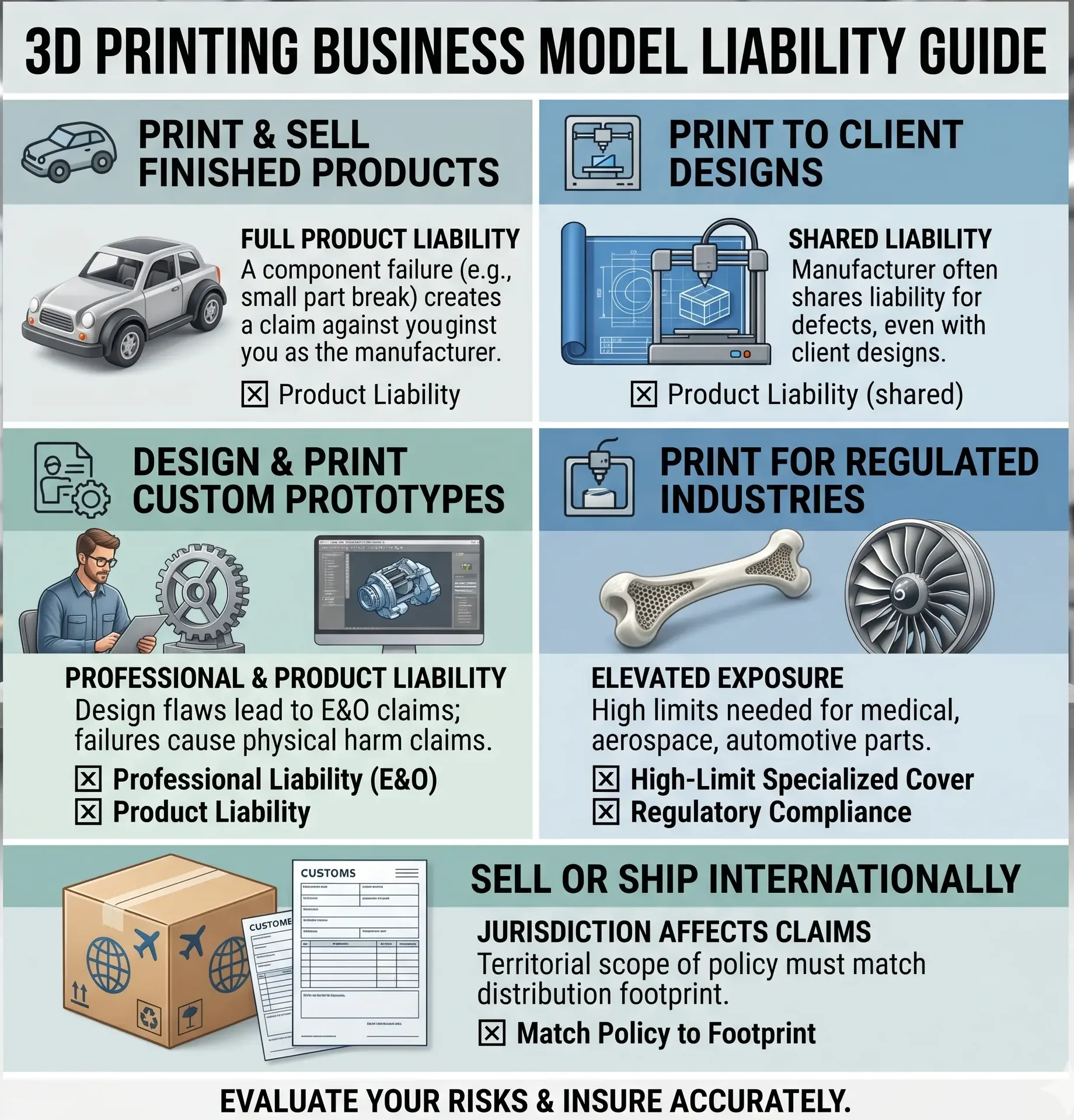
  • You print and sell finished products: You carry full product liability exposure. A consumer goods failure, a bracket that breaks, or a component that malfunctions in use can all produce claims against you as the manufacturer.
  • You print to client designs: Liability still applies. In the U.S., the manufacturer typically shares liability for defective products even when the manufacturer did not originate the design.
  • You design and print custom prototypes: Both professional liability (E&O) and product liability apply. A design flaw that leads to prototype failure generates a professional negligence claim. A failure that causes physical harm generates a product liability claim.
  • You print for regulated industries: Medical devices, aerospace components, and automotive parts carry significantly elevated liability exposure. These applications require higher coverage limits and specialized underwriting.
  • You sell or ship across state lines or internationally: Jurisdiction affects how claims are filed and where coverage must respond. Your policy’s territorial scope must match your distribution footprint.
A risk assessment guide detailing liability scenarios like printing finished products, custom prototypes, and regulated parts to help owners evaluate risks and select the right 3D Printing Business Insurance.

Real-world example

A 3D printing company produced custom mounting brackets for a commercial lighting manufacturer. The brackets failed during installation at a job site, causing $180,000 in property damage. The printing company’s standard general liability policy excluded manufactured goods under the products-completed operations section. The claim was denied in full. A properly endorsed product liability policy would have covered the entire loss.

Book a call to confirm that your product liability structure actually matches how your business delivers products.

How Much Does 3D Printing Business Insurance Cost?

A 3D printing business insurance program for a mid-size commercial operation typically runs $2,500 to $6,000 per year for a properly structured program combining general liability, product liability, professional indemnity, and commercial property.

High-volume print farm operations and businesses producing medical devices, aerospace components, or automotive parts should budget $5,000 to $10,000 or more annually, depending on revenue, equipment value, and coverage limits. The wide premium range reflects how dramatically additive manufacturing businesses vary in risk profile, and why a specialist broker who codes your business correctly consistently delivers better pricing and better coverage than a generalist who defaults to the wrong classification.
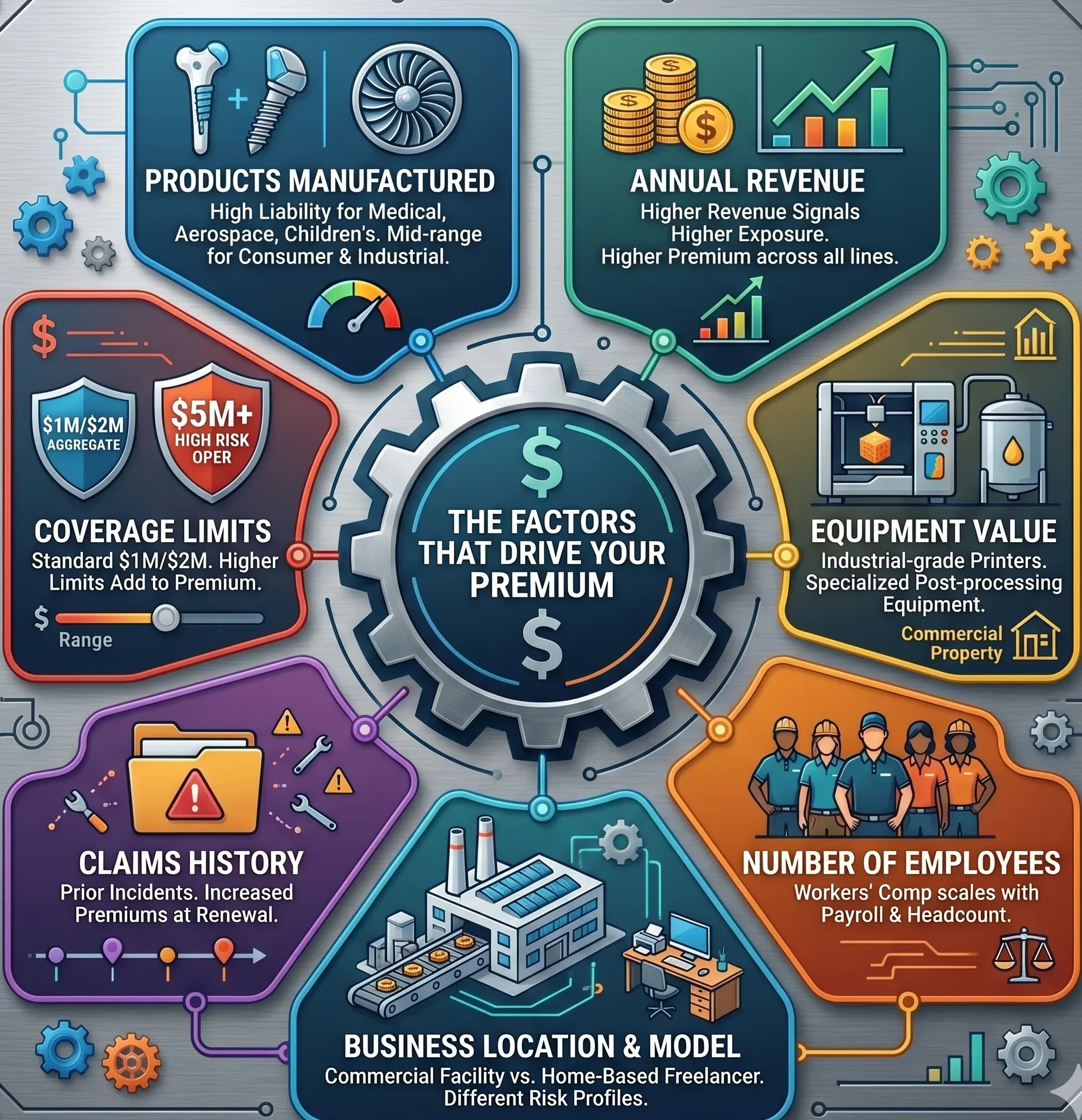
An infographic breaking down the key factors that drive your premium, including products manufactured, annual revenue, equipment value, and number of employees for a tailored 3D Printing Business Insurance policy.

The factors that drive your premium:

  • Products manufactured: Medical, aerospace, and children’s products carry the highest liability premiums. Consumer goods and industrial parts typically fall in the mid-range.
  • Annual revenue: Higher revenue signals higher exposure and produces a higher premium across all lines.
  • Equipment value: Industrial-grade printers and specialized post-processing equipment increase your commercial property premium.
  • Number of employees: Workers’ compensation premium scales with payroll and headcount.
  • Claims history: Prior incidents increase premiums across all lines at renewal.
  • Coverage limits: Standard programs run $1M per occurrence and $2M aggregate. Higher-risk operations often require $5M or more, which adds to premium.
  • Business location and model: A commercial production facility carries different risk than a home-based freelance operation.

Benchmark premiums by business type:

Business Type

Estimated Annual Premium

Freelance or light commercial prototyping

$1,200 to $2,500 per year

Mid-size commercial operation or print farm (6 to 25 employees)

$2,500 to $6,000 per year

Large-scale manufacturer or high-volume print farm

$5,000 to $10,000 per year

Regulated industries (medical, aerospace, automotive, children’s products)

$7,500 to $15,000+ per year

Premium ranges vary significantly based on how a broker classifies your business and which markets they access.

Some sources cite $1,500 to $4,000 per year for basic coverage; those figures typically reflect bare-minimum general liability placements for light operations, not the full-program structure a commercial additive manufacturer actually needs.

A mid-size facility or print farm running production volume, handling client designs, and supplying regulated industries requires coverage across multiple lines, and the premium reflects that.

The $6,600 GL quote that one operation received is an example of incorrect business classification, not an accurate reflection of specialist market pricing, and a properly structured program from a broker who codes additive manufacturing correctly consistently outperforms what a generalist delivers.

Contact us for an accurate estimate based on your actual operations, equipment, and products.

Does Standard Business Insurance Cover 3D Printing Operations?

Standard business insurance rarely covers 3D printing operations adequately, and the gap almost always shows up at claim time rather than when the policy is purchased. The most common failure point is the products-completed operations exclusion inside a standard commercial general liability policy, which eliminates coverage for injury or damage caused by products the business manufactured. Because most standard underwriters classify additive manufacturing as a manufacturing activity, that exclusion directly eliminates coverage for your core business output.

Common exclusions and coverage gaps in standard business policies for 3D printing operations:

  • Manufacturing exclusion: Standard CGL policies frequently exclude businesses engaged in manufacturing. Additive manufacturing qualifies, even if your agent did not flag it at application. Our guide to general liability insurance exclusions details which clauses to watch for.
  • Products-completed operations gap: The products-completed operations component that typically covers product liability may be excluded, sublimited, or restricted to non-manufactured goods in a standard policy.
  • No product recall coverage: Recalling a defective batch of printed products costs far more than the products themselves. Standard policies do not cover recall expenses. A separate endorsement is required.
  • CAD file theft excluded as property loss: Digital theft of design files is a cyber event. Standard commercial property policies cover physical property, not digital assets. These claims fall into a gap without cyber coverage.
  • IP infringement excluded: Copyright and patent infringement claims arising from a printed design are excluded from standard CGL policies in most cases.
  • Home-based activity exclusion: Homeowner’s policies exclude business activities. A 3D printing business operated from a home studio has no coverage under a homeowner’s policy.
  • Prototype failure as GL claim: A prototype failure that causes client financial loss is a professional liability event. Standard GL policies do not respond to pure financial loss without accompanying bodily injury or property damage.

Understanding these exclusions before binding any policy is the minimum standard for protecting a 3D printing business.

Cyber Liability Insurance for 3D Printing Companies

Cyber liability insurance covers data breaches, network intrusions, ransomware, and digital theft, and 3D printing businesses have specific cyber exposures that are larger than most owners recognize. If you store customer CAD files, client design specifications, or proprietary manufacturing data on networked systems, you have a target that ransomware operators and IP thieves actively pursue.

A breach that exposes a client’s design files can produce a liability claim against your business even if you were the victim of the attack, not the cause. That specific exposure is why cyber coverage for additive manufacturing businesses is not optional.

Key cyber risks specific to 3D printing operations:

  • CAD file theft: Stolen design files expose your business to client claims for IP loss, breach of confidentiality, and business disruption.
  • Connected printer attacks: Industrial 3D printers with network connectivity can be compromised. An attacker who alters print parameters can cause defective or structurally compromised parts to be produced without your knowledge.
  • Ransomware disruption: A ransomware attack on your production network can lock systems for days or weeks, halting all operations and triggering business interruption losses that stack on top of recovery costs.
  • Client data breach: Storing client contact information, financial data, or purchase histories triggers breach notification requirements and potential regulatory penalties under state privacy laws.
  • Cloud design library exposure: SaaS platforms used for design collaboration can be compromised. If client files stored in a shared environment are accessed by an unauthorized party, your business may bear liability.

The Insurance Information Institute documents that defense and cost containment expenses are particularly high in product liability lines, and connected manufacturing environments add a cyber dimension that standard property policies do not address, particularly as more facilities integrate IoT-enabled printers and automated production systems.

A cyber liability policy for a 3D printing business typically includes first-party coverage for your response costs (forensics, notification, credit monitoring), third-party coverage for client claims, business interruption during a cyber shutdown, and ransomware response costs.

Policies vary significantly in what they cover, particularly around social engineering and data restoration.

Working with a broker who reviews cyber policy language rather than simply comparing premiums makes a material difference in what you actually receive when a claim occurs.

Professional Liability (E&O) Insurance for 3D Printing Businesses

Professional liability insurance, also called errors and omissions coverage, protects 3D printing businesses against claims arising from design errors, failed prototypes, and professional negligence, and it applies even when no physical injury or property damage occurs.

If a client hires you to design and print a custom component and the finished product fails to meet specifications, causing the client to miss a production deadline and lose revenue, that loss generates a professional liability claim. Your general liability policy will not respond. Only professional liability applies to pure financial loss claims of this type, which means 3D printing businesses that offer design services alongside printing carry a gap in their coverage if they only hold a CGL policy.

Who specifically needs professional liability coverage in the 3D printing space:
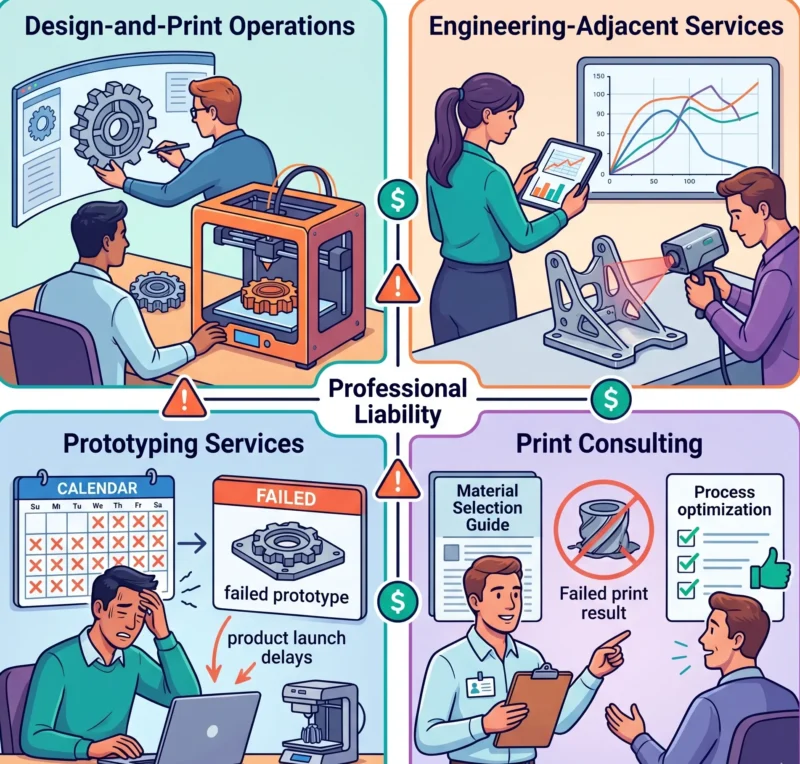
  • Design-and-print operations: You provide both the design file and the printed product. A flaw in either stage generates a professional negligence exposure on top of any product liability exposure. Our guide to manufacturer’s E&O insurance covers how this applies to production businesses specifically.
  • Engineering-adjacent services: Any business applying engineering judgment to a design before printing, including structural analysis, tolerance review, or material selection, carries E&O exposure.
  • Prototyping services: A failed prototype that causes a client to miss a product launch, a patent filing window, or a manufacturing commitment can produce a substantial financial loss claim.
  • Print consulting: If you advise clients on material selection, print settings, design optimization, or manufacturing process choices, that advice is a professional service. When it produces a bad outcome, that is an E&O claim.
A four-quadrant illustration detailing the design, engineering, prototyping, and consulting services that require specialized Errors and Omissions protection under a 3D Printing Business Insurance policy.

Professional liability policies are written on a claims-made basis, meaning the policy is active when the claim is filed, covering the loss, regardless of when the error occurred.

Maintaining continuous coverage and securing tail coverage when switching carriers protects against gaps in older claims that surface after a policy change.

Book a call to review how professional liability should be structured alongside your product liability program.

Workers’ Compensation for 3D Printing Operations

Workers’ compensation is mandatory in most U.S. states for any business with employees, and 3D printing facilities have specific occupational hazards that make this coverage more consequential than business owners typically expect.

Additive manufacturing exposes workers to ultrafine particles, chemical fumes, heat sources, and, in some operations, hazardous metal powders, all of which create injury and long-term illness risk that can generate claims years after initial exposure.

Key occupational health risks in 3D printing facilities:

  • Ultrafine particle exposure: FDM, SLA, and resin-based printers emit ultrafine particles during operation. Prolonged exposure carries documented respiratory and cardiovascular risk in improperly ventilated environments.
  • Volatile organic compound (VOC) fumes: Resin printing processes emit VOCs that require adequate ventilation and proper PPE protocols. Inadequate controls create both worker illness risk and regulatory exposure.
  • Burns and heat injuries: Heated extruders, UV curing systems, and post-processing equipment create burn risk for technicians who work in close proximity during production cycles.
  • Metal powder exposure: Metal powder bed fusion operations (selective laser sintering, direct metal laser sintering) involve fine metal powders that are simultaneously flammable and hazardous to respiratory health.
  • Ergonomic and repetitive motion: High-volume print farm operations involve repetitive material handling, bed leveling, and post-processing work that creates musculoskeletal claim exposure over time.

NIOSH’s publication on 3D printing health and safety outlines recommended engineering controls, ventilation standards, and PPE requirements for additive manufacturing environments, including specific hazard assessments for filament emissions and thermal contact risks.

Facilities that operate without compliant ventilation and PPE programs face regulatory fines alongside the workers’ compensation claims that follow an incident.

Workers’ compensation premium for a 3D printing business is calculated based on your total payroll and the occupational risk class code assigned to your operations.

Incorrect classification is a common underwriting error that leaves businesses either overpaying or, more dangerously, holding a policy with classification-based exclusions that surface at claim time.

How to Evaluate a 3D Printing Insurance Policy

A 3D printing insurance policy is only as complete as its exclusions allow, and the exclusions most likely to eliminate coverage are the ones buried in endorsements rather than visible on the declarations page.

Most coverage disputes in additive manufacturing trace back to policies that looked adequate at purchase but contained manufacturing exclusions, IP carve-outs, or cyber event gaps that stripped coverage from the claims that actually occurred. Reviewing a policy before binding it is not optional for a 3D printing business. It is the moment when gaps are fixable.

What to verify before binding any 3D printing business insurance policy:

  • Products-completed operations inclusion: Confirm this coverage is included and applies to the specific product categories you print, with no class exclusions for your product type.
  • Manufacturing activity coverage: Confirm the policy does not exclude “manufacturing” as a business activity. A surprising number of standard CGL policies do.
  • IP coverage or exclusion: If you handle client designs or proprietary processes, confirm explicitly whether IP infringement is included or excluded. Do not assume inclusion.
  • Cyber event vs. property event treatment: Confirm that digital theft of CAD files and ransomware attacks are treated as cyber events with responsive cyber coverage, not as uninsured property events.
  • Territorial scope: If you sell or ship products outside your home state or internationally, confirm your policy’s geographic coverage applies where your products go.
  • Sublimits and carve-outs: Watch for sublimits on product recall, professional services, or specific product categories that reduce your effective coverage below the stated policy limit.
  • Carrier appetite and stability: A carrier that currently writes additive manufacturing risks can exit the market at renewal. Confirm your broker monitors carrier appetite and has alternative markets available.
  • Occurrence vs. claims-made: General liability and product liability are typically written on an occurrence basis, meaning the policy in force when the incident happens responds, regardless of when the claim is filed. Professional liability (E&O) is almost always claims-made, meaning the policy active when the claim is filed responds. Mixing up these policy types at renewal creates coverage gaps that only surface at the worst possible time.
  • Retro dates on E&O: If you switch professional liability carriers, the new policy’s retroactive date must reach back to cover prior work. A retro date that starts on the new policy’s inception date leaves all prior professional services uninsured for any claim filed after the switch.
  • Named insured structure: If your 3D printing operation runs through an LLC, corporation, or as a DBA under a parent entity, confirm the correct legal entity appears as the named insured. A policy issued to the wrong entity can be voided at claim time on a technicality that a specialist broker catches at application and a generalist misses entirely.

Working with a broker who has placed additive manufacturing coverage before is the most efficient way to avoid these gaps.

A generalist broker will not know which underwriting questions to ask, and you will not discover the gaps until a claim is denied.

Quick Reference: 3D Printing Business Insurance at a Glance

Everything a 3D printing business owner should have clear before buying coverage. If any of these points describe a gap in your current program, it is worth a specialist review before your next renewal.

  • What it is: A packaged program combining product liability, general liability, professional indemnity, cyber liability, commercial property, business interruption, and workers’ compensation, structured around how additive manufacturing actually operates.
  • Who needs it: Any 3D printing business that sells or delivers a physical product, handles client CAD files, employs workers, or produces parts for regulated industries including medical, aerospace, or automotive applications.
  • Who likely does not need it: A hobbyist printing personal items at home with no commercial sales, no client work, and no third-party deliverables. Once you take your first paying order or handle a client’s design file, coverage applies.
  • The 3 most dangerous gaps in standard policies: (1) The products-completed operations exclusion that removes coverage for manufactured goods. (2) The IP infringement exclusion that strips coverage for CAD file and design-related disputes. (3) The cyber-as-property exclusion that treats digital theft as an uninsured property event.
  • Cost range: $700 to $2,500 per year for most small operations. $4,000 to $10,000 or more for businesses producing regulated or high-risk products.
  • Critical policy structure checks: Confirm occurrence vs. claims-made basis for each policy line. Confirm retro dates on E&O if switching carriers. Confirm the correct named legal entity appears on the policy.
  • Why standard insurance fails this business class: Most generalist carriers lack an additive manufacturing underwriting class. They either reject the business outright or apply a manufacturing exclusion that eliminates coverage for the core risk at claim time.
  • Why a specialist broker matters: Correct business class coding, access to surplus lines markets that write this risk, and knowledge of which underwriting questions determine whether the policy responds when a claim occurs.

Book a call to walk through your current coverage against this checklist.

Questions about 3D Printing Business Insurance?

A 3D printing business typically needs general liability, product liability, professional indemnity (E&O), commercial property, business interruption, cyber liability, and workers’ compensation. IP liability coverage is also recommended for businesses that handle client CAD files or produce designs under license. Product recall coverage is worth adding for any business operating at scale. The exact combination depends on your business model, the products you print, and whether you operate from a commercial facility or a home-based workspace.

Sometimes, but not reliably. Many general liability policies include a products-completed operations component that can cover product liability, but standard CGL policies frequently exclude manufactured goods from this section, or restrict coverage to products sold within a narrow territory. A standalone product liability policy or a specifically endorsed CGL form is typically required for any 3D printing business that sells or delivers a physical product. Do not assume that a general liability policy covers your products without reviewing the products-completed operations section of the endorsements.

Yes, in most cases. Insurance carriers classify additive manufacturing under manufacturing risk categories, which affects which carriers will write the policy, what underwriting guidelines apply, and what the premium will be. This is one primary reason generalist agents struggle to place 3D printing business insurance: they try to code the business as a retail or service operation, which results in coverage gaps, incorrect premiums, or carrier non-renewals when the classification is discovered.

Home-based 3D printing businesses cannot rely on homeowner’s insurance for any business-related coverage. Most homeowner’s policies exclude business activities, business equipment, and business liability entirely. You need a separate commercial policy, and certain carriers specifically exclude home-based manufacturing operations. A specialist broker can identify carriers with appetite for home-based additive manufacturing programs, including programs that cover both the equipment and the product liability that standard homeowner’s policies will not touch.

Standard general liability policies typically exclude IP infringement claims. If you handle client designs, produce products that incorporate licensed IP, or operate in markets where patent disputes are common, such as medical devices or consumer electronics, you need an IP liability endorsement or a standalone intellectual property insurance policy. IP disputes in additive manufacturing are increasingly common as the industry matures and design libraries expand. Legal defense costs alone frequently reach six figures before a case resolves.

Work with a broker who specializes in manufacturing or technology business insurance. Generalist agents typically do not have access to the surplus lines carriers (specialty insurance markets that cover risks standard carriers will not write) and specialty programs that underwrite additive manufacturing. A specialist broker will code your business correctly, identify active markets with appetite for your risk class, and structure a program that covers your actual operations rather than a generic policy that excludes your core activity. The rejection problem is almost always a broker problem, not a market problem.

If you produce products in volume or for regulated industries, product recall insurance is a serious consideration. A defective batch of printed components can require a recall that costs far more than the products themselves: customer notification, reverse logistics, replacement costs, and reputational management all add up quickly. Standard product liability policies cover injury and damage claims that result from a defective product, but they do not cover the cost of the recall itself. A product recall endorsement or standalone policy fills that gap and is particularly important for businesses supplying medical, automotive, or consumer safety products.

Get the Right Coverage for Your 3D Printing Operation

3D printing business insurance is not a policy you pick off a shelf. The right program requires a broker who understands additive manufacturing risk, can read your client agreements and production workflows, and has placed product liability and cyber coverage for businesses like yours.

The Coyle Group has structured insurance programs for commercial additive manufacturers, print farm operations, contract prototyping services, and businesses supplying the medical, aerospace, and automotive industries across the US. Our approach starts with your operations and your products, not a generic application.

Contact us with your current declarations pages and a description of what you print and who you print it for. We will identify every coverage gap in one call.

This article was written by the CEO of The Coyle Group, Gordon B. Coyle, CPCU, ARM, AMIM, PWCA, who has over 40 years of experience working with business owners of all sizes and industries across the US, solving their insurance challenges.

Here’s how to take the next step

Schedule Your Insurance Confidence Assessment

In our 30-minute call, you’ll discover:

  • Whether your current coverage matches your actual risks
  • If you’re getting fair value for what you’re paying
  • How your service experience compares to what’s possible
  • What questions you should be asking but probably aren’t

Not ready for a call?

Get Free Access to Our Gated Video:
How to Finally Feel Confident in Your Coverage.

And discover the exact system we use to help business owners eliminate hidden coverage gaps, stop overpaying, and finally feel confident in their protection.


What Peace of Mind Looks Like

Trusted by business owners across the U.S.

  • The Coyle Group is 1st class! Gordon and his team are knowledgeable, responsive, and attentive to detail. Gordon is that rare breed of professional who genuinely cares for his clients and works hard to exceed their expectations. I highly recommend them.

    Jeff Carton
    Partner, Denlea & Carton, LLP
  • The insurance brokerage service was truly tailored to my needs, nothing like those big brokers who steer you toward random policies that don’t fit your profile. Thank you to the team for your help.

    Yohann Josselin
    Founder & Director, RankForge
  • I was working with another broker and having difficulty acquiring General Liability coverage. A colleague recommended The Coyle Group. They were able to get coverage bound in just a couple of business days and a policy issued in ten days, and with a solid carrier at a competitive premium. Truly impressive results, plus it was a pleasure working with them. I highly recommend the Coyle Group!

    Tim McCarthy
    Director of Operations, Dalmatian Company LLC
  • If any business is looking to work with an insurance brokerage firm that is not only excellent at what the firm does, but one that deeply values the needs of the clients, then The Coyle Group is the firm for you. Give them a call and see for yourself. I can assure that you will quickly agree.
    Dahiema Grant
    Accountant, DSG Advisory CPA

Want to know more?

See related blogs