
Does Cyber Insurance Cover CIPA Claims?
CIPA Exposure. Policy Gaps. What to Do Before the Demand Letter Arrives.

Index

Gordon B. Coyle
CEO, The Coyle Group
845-474-2924
How to get started
Executive Summary
You got a demand letter, or your attorney called to say one might be coming. You use session replay software, a live chat tool, analytics pixels, or you record customer calls.
The answer is: probably not, at least not automatically.
CIPA lawsuits are one of the fastest-growing litigation categories in the country. Since 2022, nearly 4,000 online privacy claims involving digital tracking technologies have been filed nationwide, according to Constangy, Brooks, Smith & Prophete.
What Is CIPA and Why Is Your Website Suddenly a Lawsuit Target?
The California Invasion of Privacy Act allows plaintiffs to sue businesses for $5,000 per violation when electronic communications are intercepted without all-party consent. If your website uses session replay tools, analytics pixels, live chat, or call recording, you can be sued even if no data was ever breached or stolen. The legal theory is that recording or transmitting a communication without consent is itself the violation, regardless of whether any harm resulted.
CIPA was enacted decades before the modern internet, but courts and plaintiffs have applied it aggressively to today’s website technology. Any third-party tool that captures or transmits visitor data, keystroke data, or communication content can form the basis of a CIPA claim. Courts have also held that liability can attach to the business that embedded the tool, even when the actual interception was carried out by the vendor.
California Penal Code Section 630 et seq. establishes these requirements. CIPA is not a regulatory fine. It is a private right of action, meaning plaintiffs sue directly without going through a government agency, and they can represent a class of all affected California website visitors.
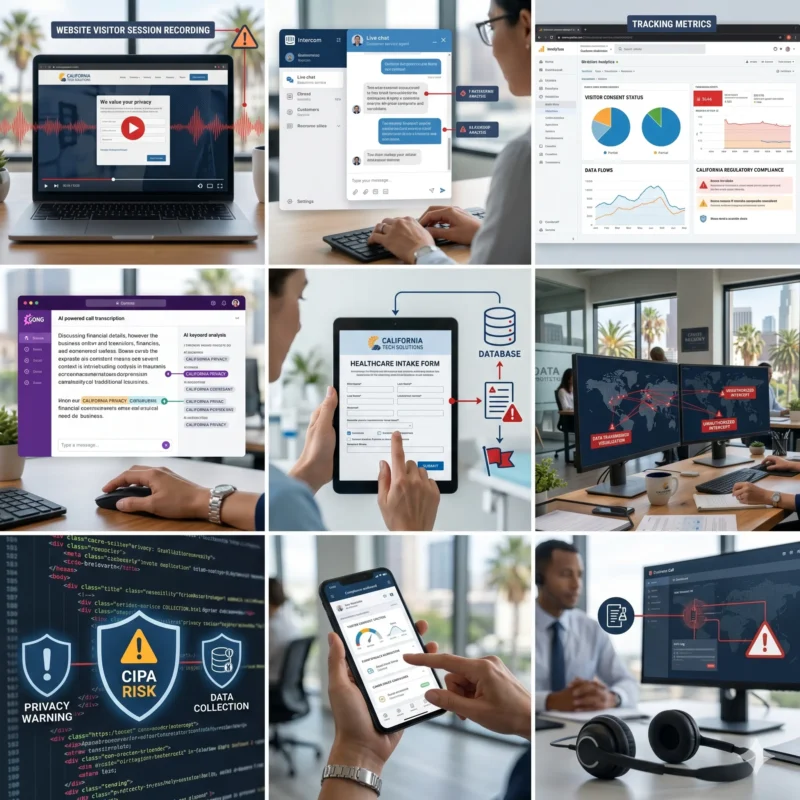
The common CIPA claim triggers in 2024 and 2025:
You do not have to control the software or intend to intercept anything. Installing the tool and allowing it to operate is often enough for plaintiffs to establish a claim.
Who is getting sued most?
Retail businesses account for 37% of California CIPA filings (1,082 of 2,935 cases), according to Fresno Chamber of Commerce CIPA filing data. Other heavily targeted sectors include e-commerce, telehealth platforms, financial services, and professional services firms. The businesses most at risk are those with high website traffic and third-party technology embedded on customer-facing pages.
Does Cyber Insurance Cover CIPA Claims? The Honest Answer
Standard cyber insurance may or may not cover CIPA claims. Coverage depends entirely on the specific language, endorsements, and exclusions in your policy. Many cyber policies were designed to respond to data breaches, hacking incidents, and regulatory fines, not wiretapping-style privacy claims. Carriers are actively updating their policy forms, and not always in the direction of more coverage.
Three Coverage Tracks Exist in the Current Market
Your policy is in Track 1 (express coverage), Track 2 (silence/disputed), or Track 3 (express exclusion).
Track 1: Express coverage
Some carriers include explicit language covering “wrongful collection,” “unlawful interception,” or “privacy law violations” within their cyber liability insuring clauses. These policies are most likely to respond to CIPA claims, although coverage still depends on the specific facts and how the claim is framed.
Track 2: Silence
Many standard cyber forms are simply silent on CIPA-style claims. There is no express grant of coverage and no explicit exclusion. This creates a disputed coverage situation at claim time: the carrier issues a reservation of rights letter, investigates under a full conflict-of-interest posture, and may ultimately deny coverage. Your defense costs accumulate throughout this process.
Track 3: Express exclusions
An increasing number of carriers have added endorsements specifically excluding claims arising from wrongful collection, monitoring, eavesdropping, or session replay activities. If your policy includes one of these endorsements, a CIPA claim is almost certainly denied from the outset.
Labels Like “Privacy Liability” Are Misleading
“Privacy liability” coverage in a cyber policy is not the same as coverage for a CIPA wiretapping claim. The labels look similar. The outcomes can be very different.
The Exclusions That Kill CIPA Coverage in Most Cyber Policies
How Each Exclusion Works
The eavesdropping exclusion, the intentional acts exclusion, and the statutory violation exclusion are the three most common reasons cyber carriers deny CIPA claims. Any one of these, if present in your policy, can result in a full denial even when the rest of the policy appears to have strong privacy liability coverage.
Understanding how each exclusion works is essential before a claim is filed.
The eavesdropping and monitoring exclusion
Carriers who have added this endorsement specifically bar claims arising from unauthorized interception, monitoring, or recording of communications. If your CIPA claim is based on a session replay tool, a live chat platform, or call recording, this exclusion is likely to be invoked immediately. It does not matter whether you knew the tool was recording anything. The act of embedding the tool is treated as enough.
The intentional acts exclusion
Most cyber policies exclude coverage for intentional or knowing conduct. In CIPA litigation, plaintiffs regularly allege that the business “knowingly” embedded a third-party tool that intercepted communications. Carriers argue that the decision to install the tool was itself an intentional act, which brings the exclusion into play even when the business had no idea what the tool was capturing.
The statutory violation exclusion
Some CGL and cyber forms exclude any claim arising from violations of specified statutes, or from violations of any privacy statute by category. These exclusions can be written broadly enough to bar any CIPA claim regardless of how the underlying facts are characterized. CIPA is a criminal statute applied as a civil cause of action, which makes this exclusion particularly dangerous.
The consent and compliance condition
Certain carriers condition coverage on the insured maintaining adequate privacy notices and consent mechanisms. If your website’s privacy policy is outdated, your cookie consent banner is non-compliant, or you lack proper call recording disclosures, coverage may be denied on the grounds that you failed to satisfy the policy conditions.
Contact us to review your full policy language, including every endorsement, before a demand letter arrives.
Does General Liability Cover CIPA? What About Other Policies?
General liability rarely covers CIPA claims; standard CGL forms have exclusions for electronic data and statutory privacy violations that effectively bar it. Other policy types can play a limited role depending on your situation, but none are a reliable substitute for affirmative cyber coverage. Here’s how each one stacks up.
Media Liability
May respond when the CIPA claim arises from content your business published or transmitted online. More relevant for publishers, content platforms, and marketing companies than for typical e-commerce or service businesses.
Technology E&O
Technology errors and omissions coverage sometimes responds when the CIPA claim relates to a product or service your company provides rather than a claim from your own website visitors. This is more relevant for software companies, SaaS providers, and technology firms.
Difference-in-Conditions (DIC)
If your cyber policy expressly excludes CIPA claims, a DIC policy written to fill that specific gap is often the most targeted and cleanest solution. DIC structures can be negotiated to respond exactly where the primary form is silent or exclusionary. This requires working with a broker who can manuscript the coverage rather than placing off-the-shelf forms.
Commercial General Liability (CGL)
Standard ISO CGL forms contain exclusions for electronic data, cyber-related liability, and statutory violations that typically bar CIPA coverage. Older or manuscript forms may lack these specific exclusions, which creates a potential coverage argument. However, counting on this gap in CGL exclusions as a coverage strategy is not a reliable approach.
Employment Practices Liability (EPL)
EPL is generally not relevant for customer-facing CIPA claims. It may play a limited role if the claim involves employee communications or internal monitoring practices.

How to Read Your Cyber Policy for CIPA Coverage Right Now
To determine whether your current cyber policy covers CIPA claims, check these five specific items in the full policy form. Do not rely on the declarations page, the policy summary, or a verbal confirmation from your broker. Pull the complete policy language.
Steps 1–5: What to Check in Your Policy Right Now
Real-World Example: Dual Denial
A mid-size telehealth company operating in California embedded a third-party live chat tool to handle patient intake. The tool logged session data and transmitted it to the vendor’s servers without explicit two-party consent disclosures in the company’s privacy policy.
A plaintiff’s attorney filed a class action complaint under CIPA, alleging unlawful interception of confidential communications. The proposed class included every website visitor over a four-year period. The company tendered the claim to its cyber carrier. The carrier issued a reservation of rights letter citing the eavesdropping exclusion and the intentional acts exclusion.
Coverage was ultimately denied. The company also tendered to its CGL carrier, which denied coverage under its electronic data exclusion. Defense costs alone reached $180,000 before the case settled. The chat tool was still the default option recommended by their web developer, and no one had reviewed the insurance implications before it was installed.
If your policy is silent on CIPA, that is not the same as being covered. It means the coverage question will be disputed at claim time, with your carrier investigating under a conflict-of-interest posture while your legal fees accumulate. For additional analysis, the National Law Review has published detailed coverage of how courts evaluate these disputes and the exclusion patterns most likely to result in denial.
Not sure if your website technology triggers CIPA exposure? Contact us for a coverage review.
What Does CIPA Coverage Cost, and What Pricing Signals Should You Watch?
Standard cyber insurance pricing for CIPA-exposed businesses is not a simple number. What your policy costs, and whether it will actually respond to a CIPA claim, depends on factors most automated quoting platforms never ask about. Understanding these pricing signals before renewal is how you avoid paying for coverage that disappears when you need it.
What drives cyber pricing for CIPA-exposed businesses:

These factors don’t just affect what you pay; they determine whether the coverage you’re buying will actually respond. A carrier that doesn’t ask about them isn’t underwriting CIPA exposure seriously, which is what the following signals tell you.
Three pricing signals that suggest a carrier will not pay CIPA claims even if they offer an endorsement:
How to Close the CIPA Coverage Gap Before You Get Sued
If your cyber policy excludes or is silent on CIPA coverage, you have five paths available. Acting before a claim is filed is far less expensive than trying to reconstruct coverage after a demand letter arrives.
Five Options to Close the Gap
Each option addresses a different part of the gap. The right combination depends on your current policy language, your industry, and your consent infrastructure.
Before choosing any option, understand the claims-made timing problem.
The Claims-Made Timing Problem
Retro Date Gap, Prior Acts Gap, and Aggregate Limit Adequacy
Cyber policies are claims-made forms, and for CIPA exposure this creates a structural risk most businesses miss entirely. The “wrongful act” in a CIPA claim is the interception itself, it occurred every time a visitor used your website while the tool was active. That means your exposure may stretch back years, and three separate timing problems can leave it uncovered.
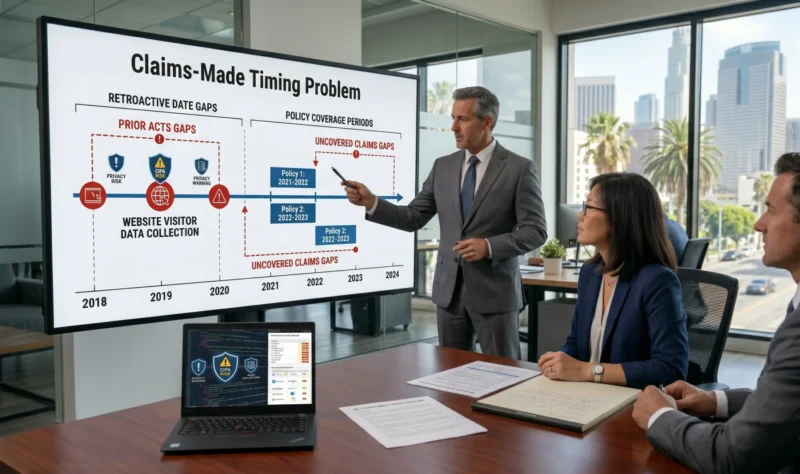
Before changing carriers or renewing your current policy, all three of these need to be addressed explicitly. Retro date continuity, tail coverage for prior acts, and limit adequacy for CIPA-exposed businesses are separate conversations, and none of them happen automatically.
What a Specialist Broker Does Differently
CIPA coverage disputes happen at claim time, not at placement. The experience behind our work is why we read policy language before a demand letter forces the issue.
95+
Years of Family Legacy in Insurance
40+
Years Personal Experience
95%
Client Retention Rate
600+
Educational Videos
Questions about CIPA Insurance Coverage?
Does Your Cyber Policy Actually Cover a CIPA Lawsuit?
You have session replay software, a live chat tool, analytics pixels, or call recording on your website. Every day those tools are active, CIPA exposure is accumulating.
With the right cyber insurance program, you get more than a privacy liability label; you get certainty. You’ll know whether your policy actually covers CIPA claims, not just data breaches, before a demand letter forces the question.
Your business, your assets, and your consent infrastructure are too valuable to leave on a policy that was never designed for wiretapping-style privacy claims. Let’s make sure your coverage actually matches your exposure.

This article was written by the CEO of The Coyle Group, Gordon B. Coyle, CPCU, ARM, AMIM, PWCA, who has over 40 years of experience working with business owners of all sizes and industries across the US, solving their insurance challenges.
Here’s how to take the next step
Schedule Your Insurance Confidence Assessment
In our 30-minute call, you’ll discover:
Not ready for a call?
Get Free Access to Our Gated Video:
“How to Finally Feel Confident in Your Coverage. “
And discover the exact system we use to help business owners eliminate hidden coverage gaps, stop overpaying, and finally feel confident in their protection.
What Peace of Mind Looks Like
Trusted by business owners across the U.S.
The Coyle Group is 1st class! Gordon and his team are knowledgeable, responsive, and attentive to detail. Gordon is that rare breed of professional who genuinely cares for his clients and works hard to exceed their expectations. I highly recommend them.


The insurance brokerage service was truly tailored to my needs, nothing like those big brokers who steer you toward random policies that don’t fit your profile. Thank you to the team for your help.

I was working with another broker and having difficulty acquiring General Liability coverage. A colleague recommended The Coyle Group. They were able to get coverage bound in just a couple of business days and a policy issued in ten days, and with a solid carrier at a competitive premium. Truly impressive results, plus it was a pleasure working with them. I highly recommend the Coyle Group!

If any business is looking to work with an insurance brokerage firm that is not only excellent at what the firm does, but one that deeply values the needs of the clients, then The Coyle Group is the firm for you. Give them a call and see for yourself. I can assure that you will quickly agree.

Want to know more?
See related blogs

The Crowdstrike Debacle and Cyber Insurance
Third Party Employment Practices Liability Insurance. Protect Your Business

Are You Overpaying or Underinsured on Your Business Insurance?
