
Cyber Insurance Not Paying Out?

Why Claims Get Denied (and How to Prevent It)

Home » Insurance By Coverage » Cyber Insurance » Cyber Insurance Not Paying Out: Key Reasons and Solutions

The Bottom Line

Your cyber insurance renewal arrived. The premium looked familiar. You signed. Six months later, a ransomware attack hits, and your claim gets denied.
Cyber insurance not paying out happens more often than decision makers realize.
According to Astra Security’s analysis of insurance data, 27% of data breach claims and 24% of first-party claims had exclusions within the insurance package that resulted in non-payout or partial payouts. Most denials are preventable, but SMBs don’t understand what voids coverage until they file a claim.

Key Takeaways:

  • 27% of data breach claims and 24% of first-party claims face non-payout or partial payout due to exclusions
  • Claims-made coverage creates timing vulnerabilities, and gaps leave zero protection
  • Security control failures (no MFA, outdated EDR) can void your entire policy
  • Policy exclusions you didn’t read carefully can eliminate coverage for scenarios you assumed were protected
  • Ransomware attacks inflict the most financial damage, though email-based attacks (BEC/FTF) are most frequent

To audit your coverage gaps

Understanding Key Terms

Before diving into why claims get denied, let’s define critical terms: understanding why cyber insurance not paying out is a common issue and what that means for policyholders.

  • Claim vs. Incident: An “incident” is any cyber event (breach, attack, system failure). A “claim” is your formal request for insurance coverage related to that incident.
  • First-Party vs. Third-Party Coverage: First-party covers direct losses to your business (ransomware payments, forensics, business interruption). Third-party covers liability when others sue you for damages (customer data breaches, regulatory actions).
  • Security Failure vs. System Failure: Security failures involve malicious acts (hacking, social engineering). System failures are non-malicious events (power outages, software bugs, human error).

Reason #1: Policy Exclusions You Didn’t Know Existed

Cyber insurance policies contain detailed exclusions that explicitly state what isn’t covered. Most SMBs don’t read them carefully, and even fewer understand how they apply to specific situations.

Common Cyber Insurance Exclusions:

  • Prior Acts – Breaches occurring before your policy started aren’t covered, even if discovered during your coverage period.
  • Known Vulnerabilities – If you knew about a security vulnerability and didn’t patch it, carriers exclude breaches exploiting that vulnerability.
  • Insider Threats – Many policies exclude or limit coverage for breaches caused by employees or contractors acting maliciously or negligently.
  • War and Terrorism – Cyberattacks attributed to foreign governments might fall under this exclusion (remember the NotPetya ransomware denials).
  • Regulatory Fines – Many policies don’t cover regulatory fines or penalties, only response costs.
  • Failure to Cooperate – If you don’t cooperate with the investigation or follow the carrier’s instructions, they might deny the claim.

What to Look for in Your Policy:

  • War/hostile acts wording and how it’s defined
  • Prior acts/retroactive date limitations
  • “Failure to maintain” or “minimum required practices” clauses
  • Contractual liability exclusions
  • Professional services carve-outs
Close-up of hands reviewing a cyber insurance policy with key exclusions highlighted, including war acts and security control clauses—showing how Cyber Insurance Not Paying Out often starts with overlooked fine print.

Real-World Impact: Mondelez vs. Zurich Insurance

During the 2017 NotPetya ransomware attack, Mondelez filed a $100 million claim. Zurich initially denied coverage, citing an “act of war” exclusion since the attack was attributed to the Russian military. The parties later settled with terms undisclosed, highlighting how war exclusion language creates coverage disputes in state-sponsored attacks.

War exclusions and ambiguous policy language create real financial exposure.

Reason #2: Coverage Lapses and Timing Issues

One of the most preventable reasons for cyber insurance not paying out is coverage gaps. Cyber insurance operates on a claims-made basis, not an occurrence basis. This distinction is critical.

How Claims-Made Coverage Works:

Coverage Type

What’s Covered

Key Risk

Occurrence-Based

Incidents that occur during your policy period, regardless of when reported

Rare in cyber insurance

Claims-Made

Only incidents that occur AND are reported during your active policy period

Coverage gaps during lapses

Common Coverage Gaps:

Business executive reacting to cyber insurance claim denial after ransomware attack, Cyber Insurance Not Paying Out
  • Renewal Gaps – Old policy ends June 30, new policy starts July 1. Breach occurs July 1st but was initiated June 30th? Coverage may be disputed.
  • Carrier Switches – Dropping one insurer for another can create gaps where neither policy is active. Any incident during that gap = zero coverage.
  • Intentional Cancellations – Letting your policy lapse to save money, then getting hit with ransomware during the uninsured period means no payout.

The Circumstances Reporting Option

Many policies allow you to report “circumstances that may give rise to a claim” before your policy expires. If you suspect an incident occurred but haven’t confirmed it, reporting it properly can preserve coverage even if the claim is filed after your policy ends. Check your specific policy language and notification requirements.
According to the NAIC’s 2025 Cyber Insurance Report, the number of claims rose almost 40% with nearly 50,000 reported in 2024, reflecting rising incident frequency, but gaps in coverage leave many businesses vulnerable.

Critical reminder

If you have a cyber incident during a period when you had no coverage, your claim will be denied. No coverage means no payout, period.
Understanding cyber insurance coverage basics prevents these timing vulnerabilities.

For a clear assessment of your protection status and potential denial triggers.

Reason #3: Failure to Maintain Required Security Controls

Many cyber insurance policies require you to maintain certain security controls as a condition of coverage. If you don’t maintain these controls, the carrier can deny your claim, citing non-compliance with policy requirements.

Required Security Controls (2026 Standards):

Security Control

Why It’s Mandatory

Compliance Challenge

Denial Risk

Multi-Factor Authentication (MFA)

Microsoft research shows MFA blocks 99.9% of automated attacks

Partial deployment across systems

HIGH

Endpoint Detection & Response (EDR)

Stops threats before they spread

Inconsistent monitoring/updates

HIGH

Verified, Immutable Backups

Required for ransomware recovery

Testing rarely documented

CRITICAL

Security Awareness Training

Employees = first line of defense

Often informal/undocumented

MEDIUM

Patch Management

Unsupported systems create exposure

Windows 10 EOL: October 2025

HIGH

The Microsoft MFA statistic demonstrates why underwriters now treat multi-factor authentication as table stakes, not because it’s an insurance requirement, but because the risk reduction is so substantial that policies without MFA are effectively uninsurable at reasonable rates.

Real-World Example: International Control Services vs. Travelers

Insurance disputes have arisen where companies had MFA on their firewall but not on servers, email, or remote access as the policy required. The case illustrates how “scope of controls” matters, having MFA somewhere isn’t the same as having it everywhere your policy specifies.

Learn more about what MFA is and why it matters.
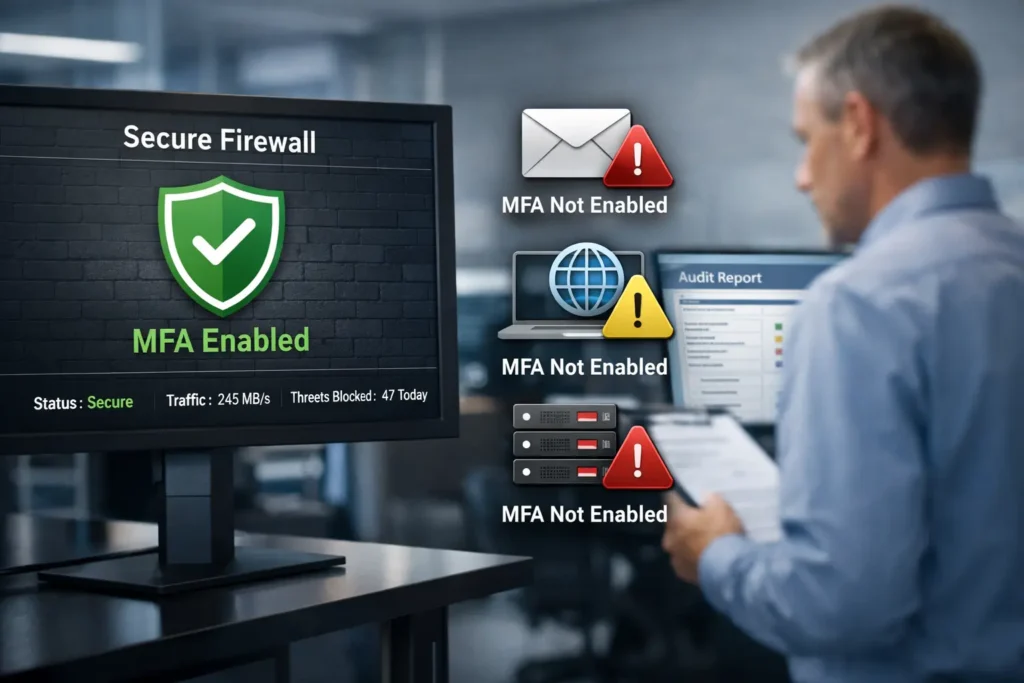
Realistic IT dashboard showing MFA enabled only on a firewall while email and servers remain unprotected, illustrating how Cyber Insurance Not Paying Out can result from non-compliant security implementations.

Reason #4: Misalignment Between What You Thought Was Covered and What Actually Is

This is perhaps the most frustrating source of cyber insurance not paying out; businesses discover coverage gaps only after filing.

Coverage Scope Confusion:

Ransomware Coverage

  • What you assume: Your cyber policy covers ransomware
  • What’s true: It covers response costs, but ransom payments may require a specific extortion endorsement
  • What you miss: Some policies exclude payments where legally prohibited

Business Interruption

  • What you assume: Policy covers income loss during downtime
  • What varies by carrier: Some policies use waiting periods (typically 8-24 hours), others use “period of restoration” language with specific time limits
  • What you miss: The mechanics vary significantly; check your specific policy wording

Legal Defense

  • What you assume: Policy covers all legal costs
  • What’s often true: Coverage is “inside the limit” or “outside the limit” This determines whether defense costs eat into your coverage maximum
  • What you miss: Regulatory defense is different from regulatory fines/penalties (usually excluded)

Common Coverage Gaps:

Coverage Type

What’s Typically Included

What Often Requires Endorsement

Typical Sublimit

Extortion/Ransomware

Negotiation, response costs

Actual ransom payment

$250K-$1M

Social Engineering/BEC

Sometimes basic coverage

Enhanced BEC/FTF protection

$100K-$500K

Dependent Business Interruption

Rarely standard

Contingent BI endorsement

$500K-$2M

PCI Assessments

Limited or excluded

Specific PCI endorsement

$50K-$250K

System Damage/Bricking

Limited first-party

Physical damage to systems

Varies widely

Reputational Harm

PR costs often sublimited

Crisis management services

$25K-$100K

The “Inside vs. Outside” Defense Cost Issue

This is critical: When your policy says it provides “up to $2M in coverage,” does that include or exclude defense costs?

  • Inside the limit: Defense costs reduce your available coverage
  • Outside the limit: Defense costs are in addition to your limit

Most SMB policies have defense costs “inside the limit.” If you face a $50K incident but spend $200K on legal defense, you’ve used $250K of your limit, not $50K.
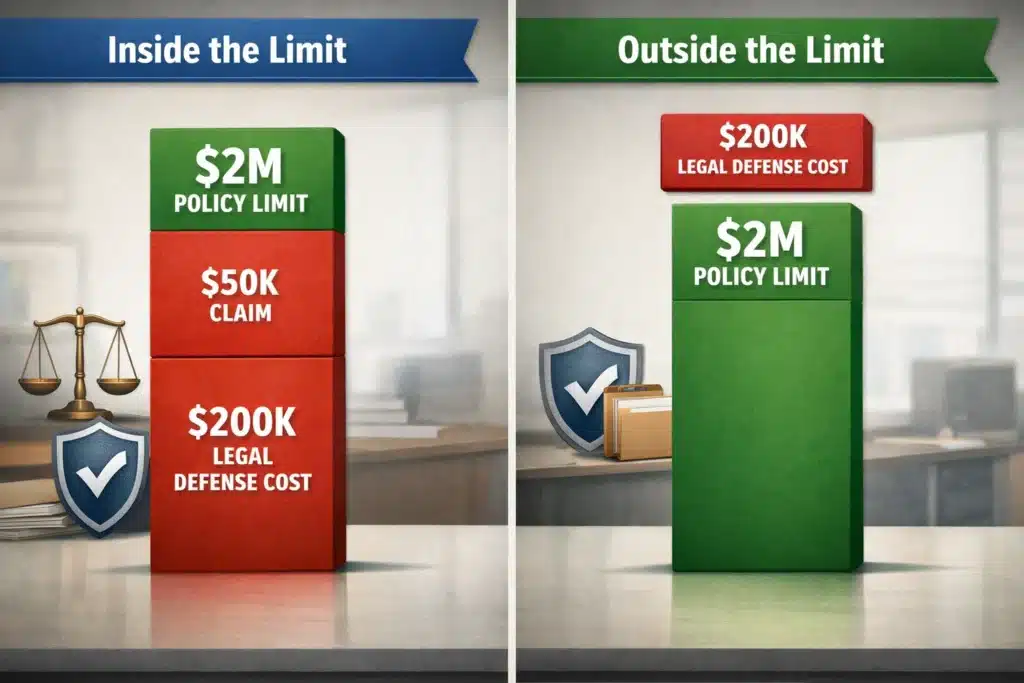
Side-by-side comparison of cyber insurance coverage with defense costs inside vs. outside the policy limit, explaining a hidden reason why Cyber Insurance Not Paying Out leaves businesses underprotected.

Real-World Example: Direct vs. Indirect Loss Disputes

Coverage disputes have arisen where business partners were compromised and funds fraudulently transferred. Carriers have denied claims stating the loss wasn’t “direct” since the partner was compromised, not the policyholder directly. The cases illustrate how social engineering coverage language varies significantly across carriers.

Understanding first-party vs third-party cyber coverages prevents these surprises.

That table probably surfaced 2-3 coverage assumptions you’re making right now

The Role of Policyholder Actions: What You Do Matters

Some cases of cyber insurance not paying out aren’t about policy language; they’re about what you did (or didn’t do) after an incident occurred.

Actions That Trigger Denials:
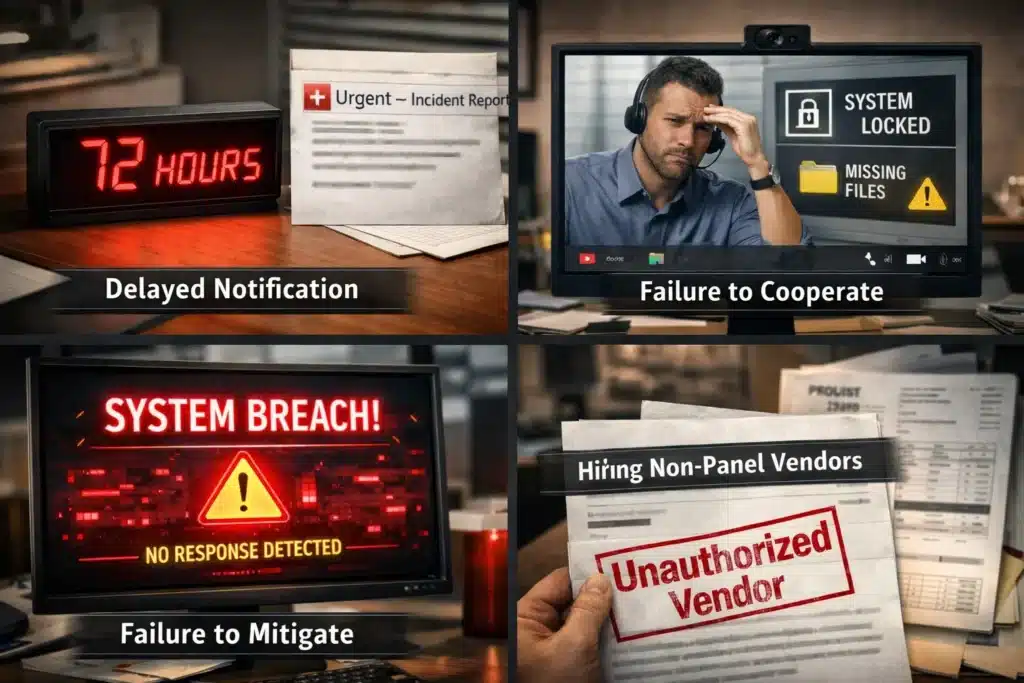
  • Delayed Notification – Your policy requires notification within 24-48 hours. You wait a week. Carrier denies based on notification delay.
  • Failure to Cooperate – Carrier investigators need system access and documentation. Slow responses or non-cooperation can result in denial.
  • Failure to Mitigate – Policies typically require “reasonable steps” to contain the incident. Not taking basic containment measures can void coverage.
  • Hiring Non-Panel Vendors – Many policies require you to use their approved vendors (breach coaches, forensic firms) or get pre-approval before engaging your own. Hiring vendors without consent can result in denied reimbursement.
Realistic collage showing four cyber claim denial triggers—delayed reporting, poor cooperation, failure to mitigate, and using unauthorized vendors—key reasons for Cyber Insurance Not Paying Out when it matters most.

The Critical First 24 Hours Checklist:

  • Notify carrier/broker immediately – Even if you’re not sure it’s a claim, report it
  • Don’t hire non-panel vendors without consent – Check your policy’s vendor requirements
  • Preserve logs/evidence – Don’t delete or alter system logs
  • Document controls in place at time of incident – Gather evidence of your security posture
  • Track all costs from hour 1 – Receipts, time logs, vendor invoices, document everything

According to the NAIC’s 2025 Cyber Insurance Report, nearly 50,000 claims were reported in 2024. Carriers are also getting more sophisticated at identifying policy violations.

These denials are within your control. They’re based on your actions or inactions after the incident occurs.

How to Protect Yourself: What Decision Makers Should Know

Understanding why cyber insurance claims get denied is the first step to preventing cyber insurance not paying out when you need it most.

  • Read your policy carefully. Get a copy and review exclusions, endorsements, sublimits, notification timelines, and cooperation requirements, or have an expert walk you through it.
  • Know your security requirements. If your policy requires MFA, EDR, backups, or training, maintain these controls consistently and document your compliance.
  • Maintain continuous coverage. Don’t let policies lapse. Coordinate your old and new policies to avoid gaps, and set renewal reminders 90 days in advance.
  • Understand claims-made coverage. Know that cyber insurance only covers incidents that occur AND are reported during your active policy period.
  • Know your reporting obligations. Understand the timeline for notifying your carrier and have a process in place for immediate notification.
  • Get expert guidance. A knowledgeable broker can walk you through your policy and flag gaps before you need to file a claim.

Current Market Context: What the 2024-2025 Data Reveals

According to the NAIC’s 2025 Cyber Insurance Report, nearly 50,000 claims were reported in 2024, up almost 40% from 2023. Business Email Compromise (BEC) and ransomware remain the dominant drivers of claims, with ransomware inflicting the most financial damage per incident. Ransomware inflicts the most financial damage per incident. Understanding patterns of cyber insurance not paying out helps you avoid common pitfalls.

What This Means for Your Coverage:

Email-Based Attacks Dominate

BEC and Funds Transfer Fraud collectively represent a significant majority of claims. Many policies require specific endorsements for full BEC/FTF coverage rather than relying on standard computer fraud clauses.

Ransomware Remains Costliest

While frequency has moderated, ransomware attacks generate the highest average losses due to ransom payments, business interruption, forensic investigation, and digital asset restoration costs.

Security Controls Drive Pricing

The market is softening with rates declining, but security control requirements are tightening. Good controls = competitive pricing. Weak controls = higher premiums or denial.

Swift Reporting Matters

Industry data shows that prompt incident reporting significantly improves recovery rates for funds transfer fraud events, but only when incidents are reported quickly.

Understanding what social engineering is helps you address all email-based threats.

How The Coyle Group Prevents Claim Denials

We don’t just sell cyber insurance, we help you understand what you’re buying and ensure you can actually use it when needed.

Our approach includes:

  • Pre-Purchase Policy Reviews – We explain exclusions, identify gaps, and flag potential denial triggers before you bind
  • Security Control Assessments – We help you document compliance with policy requirements
  • Continuous Coverage Management – Annual reviews to ensure your policy evolves with your business
  • Incident Response Planning – Clear notification procedures and vendor pre-approval guidance
  • Claims Advocacy – Support throughout the filing process to maximize recovery

Don’t wait until you’re filing a claim to discover:

  • Your policy excludes the type of incident you’re experiencing
  • You didn’t maintain required security controls
  • Your coverage lapsed during a critical period
  • The endorsement you needed wasn’t included
  • Your notification was too late to trigger coverage

95+

Years of Family Legacy in Insurance

40+

Years Personal Experience

95%

Client Retention Rate

600+

Educational Videos

Schedule free strategy call

Questions About Cyber Insurance Not Paying Out

Policy exclusions and coverage gaps. According to industry analysis, 27% of data breach claims and 24% of first-party claims had exclusions that resulted in non-payout or partial payouts. Most SMBs assume they’re covered for scenarios that are actually excluded or require specific endorsements. Understanding your actual coverage scope, not your assumptions about it, prevents this.

Review the denial letter carefully and understand the stated reason. If you believe the denial is unjustified, you can appeal or seek review from your broker or an attorney specializing in insurance coverage disputes. Some denials are legitimate based on policy language; others can be challenged based on ambiguous terms or carrier misinterpretation of facts.

Yes, if your policy requires MFA across all systems or specific categories of systems (email, remote access, servers), partial implementation can lead to claim denial for non-compliance. The key is understanding exactly what your policy requires. Some policies have general language about “reasonable security controls” while others have specific technical requirements. Documentation proving comprehensive implementation across required systems is critical.

Many policies exclude acts of war, terrorism, or hostile military action, though the wording and interpretation varies significantly. Cyberattacks attributed to foreign governments or state-sponsored groups might fall under this exclusion. The NotPetya ransomware case established this as a coverage dispute when Zurich initially denied a $100 million Mondelez claim arguing the attack constituted an act of war. The parties later settled, but the precedent highlights how war exclusion language creates ambiguity in state-sponsored attacks.

Yes, if your policy includes specific security requirements as conditions of coverage. The trend is toward more prescriptive security control requirements, MFA, EDR, verified backups, employee training. If your application represented that you had these controls in place and you didn’t, or if your policy explicitly requires them, carriers can deny claims for material misrepresentation or failure to maintain required controls.

Know your policy (what’s covered and excluded), maintain required security controls consistently, understand your reporting obligations, and notify your carrier immediately if an incident occurs. Most denials are preventable with proper understanding and action. Document everything, carriers require evidence that you met policy requirements when the incident occurred.

Most cyber policies cover ransomware response costs, but there are often conditions and exclusions. Some policies don’t cover ransom payments without a specific extortion endorsement; some do. Some require you to use panel negotiators. According to NAIC’s 2025 report, ransomware remains the most costly cyber incident type. Check whether your policy covers ransom payments where legally permissible, and understand any vendor or approval requirements. Learn more about cyber insurance and ransomware.

Most cyber policies include prior acts exclusions. If the breach occurred before your policy’s retroactive date (even if discovered during your coverage period), it likely won’t be covered. This is why continuous coverage without gaps is critical, and why you should disclose any known or suspected incidents during the application process. Some policies offer limited prior acts coverage if properly disclosed and underwritten. Understanding cyber insurance tail coverage can help address this exposure.

Notification requirements vary by policy. Many policies require notification “as soon as practicable” or “without unreasonable delay,” while some specify 24-48 hours. Delayed notification can void your coverage entirely. Review your specific policy’s requirements and have an incident response plan that includes immediate carrier notification as a first step.

This depends on your specific policy wording. Some cyber policies include FTF coverage as part of social engineering/computer fraud coverage. Others require a specific FTF endorsement. Traditional crime policies may cover employee dishonesty and forgery but often exclude losses from computer fraud or social engineering. Many businesses need both cyber and crime coverage to address the full spectrum of financial fraud exposures. Understanding the difference between cyber and crime insurance helps you avoid gaps.

The Real Question Isn’t “Will My Policy Pay?”, It’s “Can I Prove It Will?”

Most businesses assume their cyber insurance works. They paid the premium, they have the policy, they’re covered. Then a breach happens and the carrier asks for documentation they don’t have.

If your carrier called right now and asked you to prove:

  • MFA is deployed across all required systems
  • Your backups are tested and immutable
  • You’ve completed security awareness training this year
  • Your incident response plan was updated in the last 12 months

…could you send them that documentation within 24 hours? If the answer is “probably not,” you’re one breach away from a denial letter.

We help businesses close that gap before it becomes a problem. Not with more insurance, but with better documentation and a clear understanding of what your current policy actually requires.

This article was written by Gordon B. Coyle, CPCU, ARM, AMIM, PWCA, CEO of The Coyle Group, who has over 40 years of experience working with business owners of all sizes and industries across the US, solving their insurance challenges. Gordon specializes in helping SMBs develop comprehensive cyber insurance programs that protect their operations and support their growth objectives.

Here’s how to take the next step

Schedule Your Insurance Confidence Assessment

In our 30-minute call, you’ll discover:

  • Whether your current coverage matches your actual risks
  • If you’re getting fair value for what you’re paying
  • How your service experience compares to what’s possible
  • What questions you should be asking but probably aren’t

Not ready for a call?

Get Free Access to Our Gated Video:
How to Finally Feel Confident in Your Coverage.

And discover the exact system we use to help business owners eliminate hidden coverage gaps, stop overpaying, and finally feel confident in their protection.


What Peace of Mind Looks Like

Trusted by business owners across the U.S.

  • The Coyle Group is 1st class! Gordon and his team are knowledgeable, responsive, and attentive to detail. Gordon is that rare breed of professional who genuinely cares for his clients and works hard to exceed their expectations. I highly recommend them.

    Jeff Carton
    Partner, Denlea & Carton, LLP
  • The insurance brokerage service was truly tailored to my needs, nothing like those big brokers who steer you toward random policies that don’t fit your profile. Thank you to the team for your help.

    Yohann Josselin
    Founder & Director, RankForge
  • I was working with another broker and having difficulty acquiring General Liability coverage. A colleague recommended The Coyle Group. They were able to get coverage bound in just a couple of business days and a policy issued in ten days, and with a solid carrier at a competitive premium. Truly impressive results, plus it was a pleasure working with them. I highly recommend the Coyle Group!

    Tim McCarthy
    Director of Operations, Dalmatian Company LLC
  • If any business is looking to work with an insurance brokerage firm that is not only excellent at what the firm does, but one that deeply values the needs of the clients, then The Coyle Group is the firm for you. Give them a call and see for yourself. I can assure that you will quickly agree.
    Dahiema Grant
    Accountant, DSG Advisory CPA

Want to know more?

See related blogs