
Private Label Supplement Insurance
Your Contract Manufacturer’s Policy Doesn’t Cover Your Brand
Index

Gordon B. Coyle
CEO, The Coyle Group
845-474-2924
How to get started
That phrase appears constantly in founder conversations. Supplement brand owners who thought they were protected discover the hard way that the contract manufacturer’s certificate of insurance does not extend to them.
Standard general liability policies treat relabeling as a manufacturing activity, not a retail one. That single classification changes everything about how your coverage is written and who will write it.
The Coyle Group Works With Supplement Brands That Have Outgrown One-Size-Fits-All Coverage
Most founders we speak with assumed their contract manufacturer’s policy protected them. It does not.
We help you understand the full exposure and build a coverage stack that actually responds to a claim.
Why Standard Carriers Decline Private Label Supplement Insurance
Standard carriers decline private label supplement insurance because underwriters classify relabeling as a manufacturing risk, not a retail one.
That distinction costs supplement brands between $50,000 and $500,000 in uninsured losses when a product liability claim arrives. Understanding why standard policies fail gives you a clear target for what to replace them with.
Standard carriers writing retail or e-commerce policies price their books of business based on sellers who distribute other companies’ products. A supplement brand is not in that category.
The moment relabeling enters the picture, underwriters see formulation risk, label accuracy risk, and ingestible product risk all rolled into one. Most standard carriers don’t have actuarial data for that combination and won’t write it.
Financial Consequences of Going Uninsured or Underinsured
Who Is Legally Liable for a Private Label Supplement?
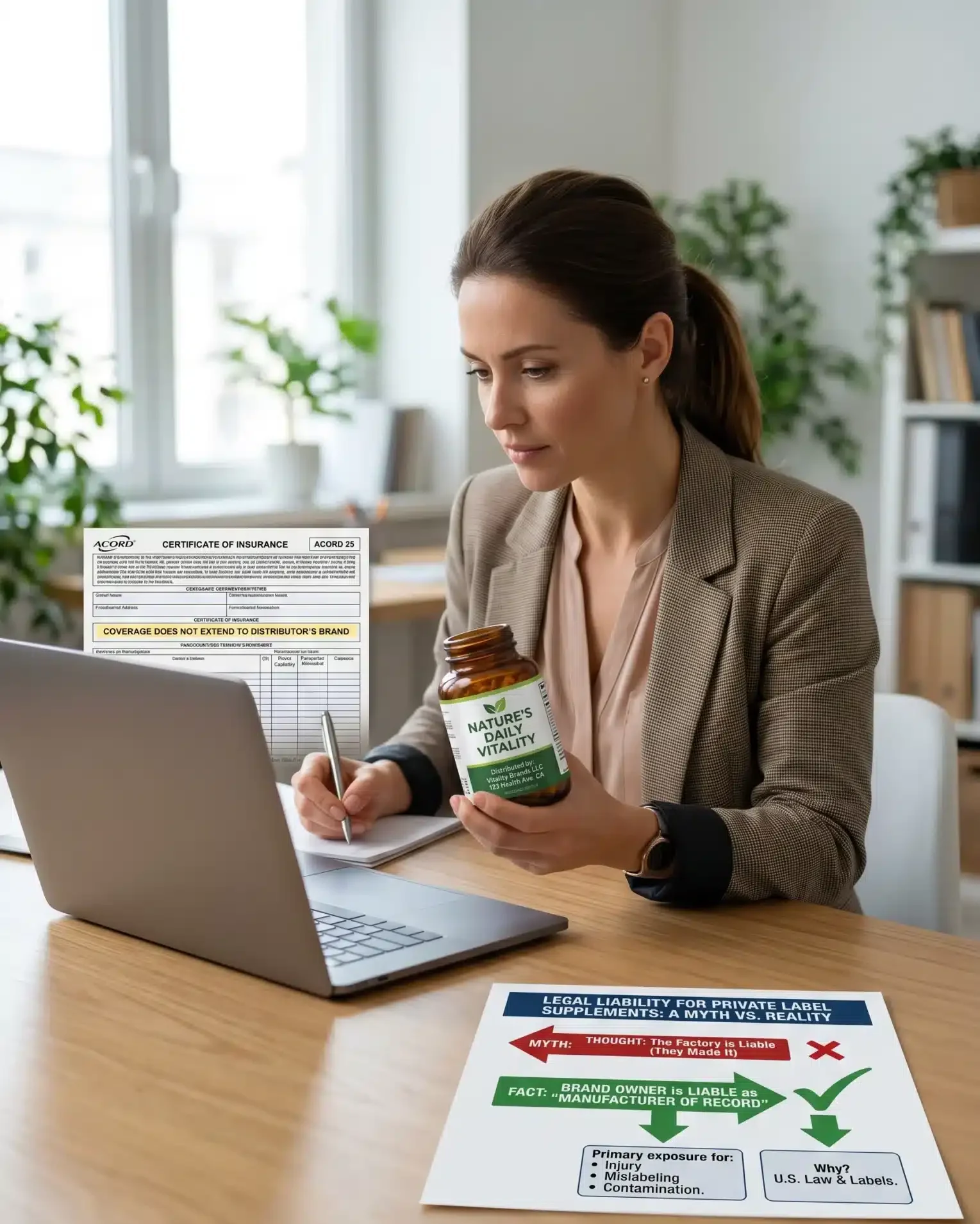
In a private label arrangement, the brand owner is the manufacturer of record under U.S. product liability law. That means your company carries primary legal exposure for any injury, mislabeling, or contamination claim, regardless of who physically made the product. This surprises almost every founder we speak with, and it is the most consequential misunderstanding in supplement e-commerce.
When a customer is harmed by a supplement product, plaintiff attorneys identify the liable party by looking at the label. The entity whose name and address appear on the label is the primary defendant.
The Manufacturer of Record Concept
What Your Manufacturer’s COI Actually Covers
Your contract manufacturer’s certificate of insurance covers the manufacturer’s operations. It does not extend to your brand.
Asking your manufacturer to add you as an additional insured provides some protection. But most supplement manufacturers’ policies include relabeling exclusions or caps that limit how much coverage actually flows to you.
What a Product Liability Claim Actually Looks Like
A sports nutrition brand received a demand letter 18 months after a customer reported adverse effects from a pre-workout supplement. The brand was named as the sole defendant because the contract manufacturer was a Chinese facility with no U.S. legal presence.
The brand had been operating for two years with a policy that would never have responded to this type of claim. The manufacturer’s COI listed the factory, not the brand. And the factory was in a jurisdiction no U.S. court could reach.
What Coverage Does a Private Label Supplement Brand Actually Need?
A properly built private label supplement insurance program includes six coverage types, not one. Most brands enter the market with only general liability, which covers a narrow slice of the actual exposure. The full stack addresses product liability, recall, advertising injury, cyber, and supply chain risk alongside standard GL.
The table below shows what each layer covers and what it does not. A broader overview of commercial coverage types is available through our insurance by coverage directory.
Coverage Type |
What It Covers |
Common Gap Without It |
|---|---|---|
|
Third-party bodily injury and property damage on your premises |
Does not extend to product defect claims once a product leaves your control |
|
|
Bodily injury or property damage caused by your product post-sale |
Often excluded from standard GL for ingestible supplements |
|
|
Costs to recall and replace a product after a safety event |
Not included in GL or product liability; purchased separately |
|
|
Advertising Injury |
Claims that your marketing language caused harm (false advertising, IP infringement, defamation) |
FTC enforcement and competitor claims; not covered by GL or product liability |
|
Data breaches, ransomware, and revenue loss from system outages |
DTC brands with customer data and subscription billing have significant uninsured exposure |
|
|
Excess / Umbrella |
Limits above your primary policies to reach required coverage thresholds |
Amazon, retail buyers, and contract manufacturers often require $2M to $5M limits |
Why Each Layer Matters for Supplement Brands Specifically
How Amazon’s Insurance Requirements Catch Supplement Sellers Off Guard
Amazon requires product liability insurance with a minimum $1 million per occurrence limit, and Amazon named as additional insured, once a seller’s monthly revenue exceeds $10,000. Most supplement sellers hit this threshold before they realize insurance is a compliance requirement, not just a risk management choice. The discovery typically happens through an account suspension notice, not a proactive alert.
The trigger is documented in Amazon’s seller insurance requirements policy, but sellers consistently report finding out through a performance warning. By that point, the window to obtain compliant coverage without interrupting sales is short.
What Amazon’s Requirement Specifies
What Standard Supplement Policies Often Miss on the Amazon Requirement

What Happens When Your Overseas Manufacturer Is Unreachable in a U.S. Court?
When a supplement brand sources from a foreign manufacturer that has no U.S. jurisdiction, 100% of the legal and financial exposure from a product liability claim falls on the domestic brand owner. This is not a theoretical risk. It is the standard outcome in supplement import litigation, and standard product liability policies are not written to address it.
The jurisdictional mechanics work against domestic importers. Foreign manufacturers with no U.S. operations, no U.S. bank accounts, and no registered agents can effectively ignore a U.S. court judgment.
What Importer-Specific Coverage Adds to Your Program
Standard product liability policies are written assuming domestic supply chain accountability. Importer liability coverage is structured differently, with explicit recognition that the insured is the first domestic party in a chain that begins overseas.
Our importer insurance page covers the full framework for brands sourcing products internationally. For supplement brands, this gap is compounded by FDA ingredient disclosure requirements.
FTC Marketing Enforcement and Advertising Injury: The Gap Nobody Talks About
The FTC has permanently banned supplement marketers for making unsubstantiated disease-treatment claims, and that enforcement creates advertising injury exposure for every supplement brand making performance or wellness claims. Most brands have no coverage for it. Advertising injury is a distinct coverage type that standard GL policies frequently exclude or sub-limit for supplement companies.
Advertising injury covers claims arising from libel, copyright infringement, false advertising, and misappropriation of advertising ideas. The FTC enforcement connection matters because a competitor or regulator can bring a claim that your marketing language falsely implies a disease treatment benefit your product cannot substantiate.
What Supplement Marketing Creates as Advertising Injury Exposure
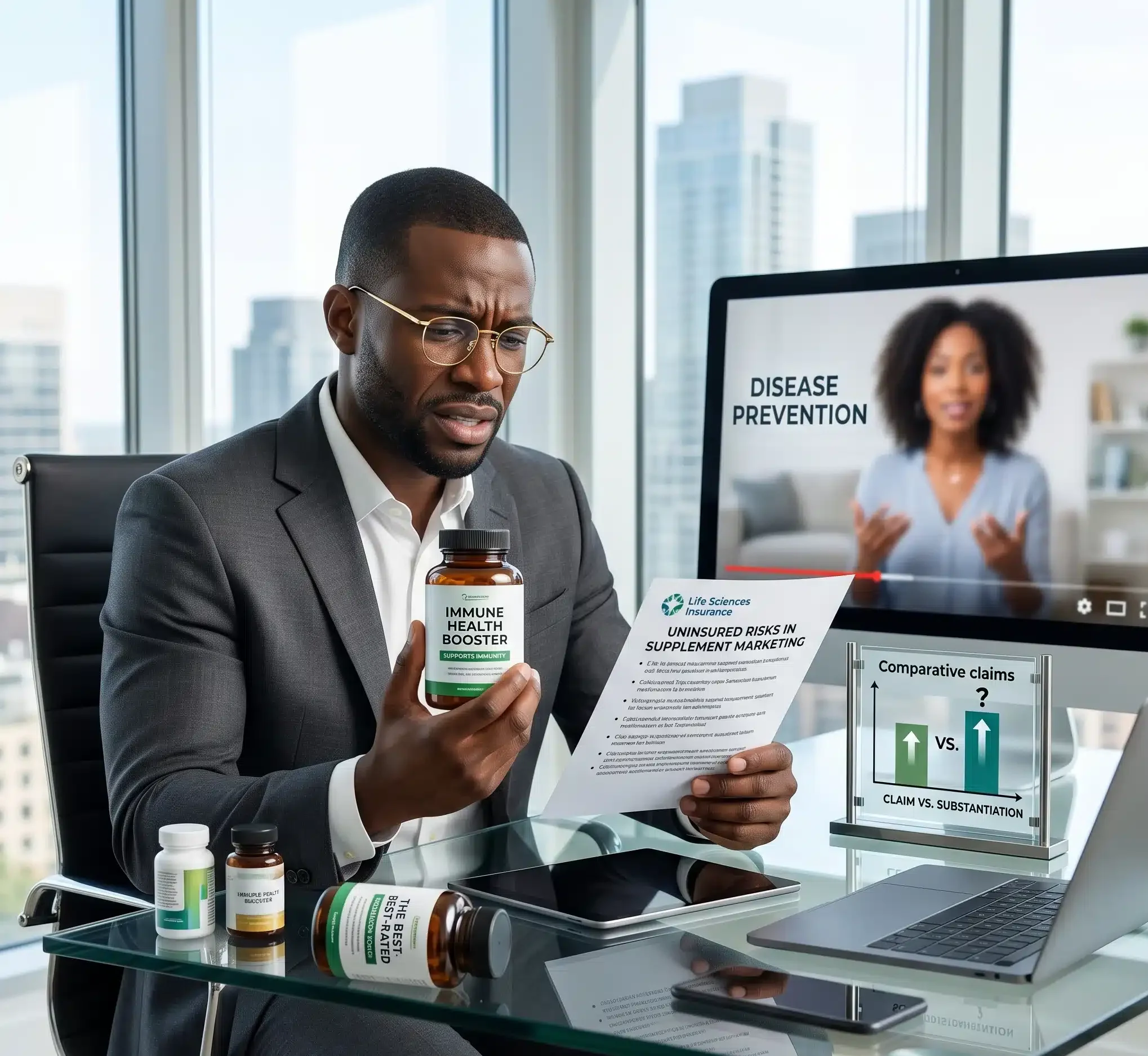
The FDA’s dietary supplement labeling guidance draws a clear line between structure/function claims and disease claims. Staying on the right side of that line reduces advertising injury exposure. But it does not eliminate it. A properly structured Life Sciences Insurance program includes advertising injury coverage sized for supplement marketing activity.
How Much Does Private Label Supplement Insurance Cost?
Private label supplement insurance costs between $3,000 and $15,000 annually for a startup to mid-size brand. The primary variables are revenue, product count, distribution channel mix, and whether sourcing is domestic or international. Higher-revenue brands and those selling on Amazon or into retail distribution should expect to quote between $8,000 and $25,000 annually for a complete coverage stack.
Most private label supplement programs are written in the surplus lines market, which includes carriers like Lloyd’s of London syndicates, Markel, and James River. Surplus lines pricing is not filed with state regulators and varies significantly by carrier appetite at any given time.
Rating Factor |
Lower Cost |
Higher Cost |
|---|---|---|
|
Annual Revenue |
Under $500K |
Over $2M |
|
Product Type |
Single SKU, well-documented ingredients |
Multi-SKU, proprietary blends, weight loss claims |
|
Supply Chain |
Domestic GMP-certified manufacturer |
Foreign manufacturer, no COA documentation |
|
Distribution |
DTC only |
Amazon + retail + international |
|
Claims History |
None |
Any prior claims |
|
Marketing |
Conservative structure/function claims |
Disease claim adjacency or aggressive testimonials |
A Note on Minimum Premiums
Most surplus lines carriers writing supplement product liability carry minimum premiums of $5,000 to $8,000 regardless of revenue. Startup brands often experience sticker shock at this figure.
How to Get Private Label Supplement Insurance When Standard Carriers Say No
When standard carriers decline, the path to coverage runs through a wholesale broker with active surplus lines relationships in the life sciences and nutraceutical space. Retail brokers who write general commercial accounts do not have the markets or the underwriting data to place this coverage. The submission you build before going to market directly affects both your ability to get coverage and your final premium.
What to Prepare Before You Go to Market for Coverage
What a Generalist Broker Gets Wrong, Specifically
Most supplement founders who call a retail commercial broker first get one of these outcomes:
How the Surplus Lines Process Works
Unlike standard admitted carriers, surplus lines coverage is placed through a licensed wholesale broker on a non-admitted basis.
Key differences that affect you:
Claims-Made vs. Occurrence: The Policy Structure Question Most Brands Never Ask
Most supplement product liability policies are written on a claims-made basis, not an occurrence basis. This distinction has significant consequences that generalist brokers routinely fail to explain.
Occurrence-based policies
Cover incidents that happened during the policy period, regardless of when the claim is filed. A product sold in 2023 is covered by the 2023 policy even if the lawsuit arrives in 2026
Claims-made policies
Cover claims filed while the policy is active. A product sold in 2023 under a claims-made policy is only covered if that policy or a renewal of it is still in force when the demand letter arrives
Two terms every supplement brand on a claims-made policy needs to understand:
Retroactive date
The earliest date from which incidents are covered. If your retroactive date is set to your current policy’s inception date, any claim arising from products sold before that date is uninsured. Retroactive dates should be set as far back as possible, ideally to the day your brand first sold product
Tail coverage (extended reporting period)
If you cancel a claims-made policy or switch carriers, you need tail coverage to preserve your right to file claims on incidents that occurred during the old policy period but are reported after it ends. Tail coverage typically costs 100% to 200% of the annual premium and is purchased for one to three years. Brands that cancel without purchasing a tail are exposed to every claim that surfaces after cancellation for products they sold while insured
Real-World Scenario: The $13,000 Amazon Suspension
A supplement brand selling collagen powder on Amazon reached $12,000 per month in revenue. Amazon flagged the account for missing COI documentation.
The founder had a standard Business Owner’s Policy through a regional carrier. When the broker submitted to have Amazon listed as additional insured, the carrier declined to endorse the policy for an ingestible product.
Have a Supplement Brand and Not Sure If Your Current Policy Actually Covers You?
We review coverage programs for private label brands and identify gaps before a claim does.
Questions about Private Label Supplement Insurance?
Get the Right Private Label Supplement Insurance Program Built for Your Brand
At The Coyle Group, we have spent over 40 years building insurance programs for complex, high-liability risks that standard carriers won’t write, and private label supplement insurance is one of the most misunderstood programs in commercial lines.
For supplement brand owners, that means a program built across all six coverage layers with wording specifically negotiated for ingestible product operations, not a general e-commerce policy with supplement exclusions buried in the endorsements.
We work with brands across the supplement spectrum, including Amazon FBA sellers, DTC subscription brands, multi-SKU product lines, brands sourcing internationally, and founders running separate LLCs for product liability isolation.
We access specialty markets that write this coverage, and place programs that are built to respond at claim time, not to look complete and fail when your manufacturer’s COI turns out to cover only them.
If your brand is uninsured, carrying a generic retail policy that excludes ingestibles, or has never had a specialist review whether Amazon is properly listed as additional insured, that is worth a 30-minute conversation before your next product launch or channel expansion.
This article was written by the CEO of The Coyle Group, Gordon B. Coyle, CPCU, ARM, AMIM, PWCA, who has over 40 years of experience working with business owners of all sizes and industries across the US, solving their insurance challenges.
Here’s how to take the next step
Schedule Your Insurance Confidence Assessment
In our 30-minute call, you’ll discover:
Not ready for a call?
Get Free Access to Our Gated Video:
“How to Finally Feel Confident in Your Coverage. “
And discover the exact system we use to help business owners eliminate hidden coverage gaps, stop overpaying, and finally feel confident in their protection.
What Peace of Mind Looks Like
Trusted by business owners across the U.S.
The Coyle Group is 1st class! Gordon and his team are knowledgeable, responsive, and attentive to detail. Gordon is that rare breed of professional who genuinely cares for his clients and works hard to exceed their expectations. I highly recommend them.


The insurance brokerage service was truly tailored to my needs, nothing like those big brokers who steer you toward random policies that don’t fit your profile. Thank you to the team for your help.

I was working with another broker and having difficulty acquiring General Liability coverage. A colleague recommended The Coyle Group. They were able to get coverage bound in just a couple of business days and a policy issued in ten days, and with a solid carrier at a competitive premium. Truly impressive results, plus it was a pleasure working with them. I highly recommend the Coyle Group!

If any business is looking to work with an insurance brokerage firm that is not only excellent at what the firm does, but one that deeply values the needs of the clients, then The Coyle Group is the firm for you. Give them a call and see for yourself. I can assure that you will quickly agree.

Want to know more?
See related blogs

How to Prevent Workers Comp Claims: A Manufacturer’s Guide
Manufacturers– How to Prevent Workers Comp Claims

Do Manufacturers Need D&O Insurance? The Gap That Can Cost You Personally
