Quick Answer
Garage insurance is a specialized commercial insurance policy that covers the liability exposures unique to auto service businesses, including premises liability, operations liability, completed operations, and auto liability for customer vehicles operated by your employees. It is not the same as a standard commercial general liability policy. Every auto repair shop, body shop, tire dealer, and transmission specialist needs garage insurance because standard GL policies contain exclusions that eliminate coverage for automotive operations.
Every auto repair shop, tire dealer, transmission shop, and auto body business starts with the same misconception: that a standard commercial general liability policy will cover them the same way it covers a retail store or an office. It will not. Auto service businesses need a garage insurance policy, and understanding what that policy does, and what it does not do, is what this guide is about.
Garage insurance is a purpose-built commercial insurance policy for auto service businesses. It covers the liability exposures that come with operating a shop where customer vehicles are repaired, serviced, stored, or sold. The coverages built into a garage policy address risks that standard commercial policies either exclude explicitly or cover inadequately.

What Is Garage Insurance?
Garage insurance is the liability policy designed specifically for businesses that service, repair, store, or sell automobiles. It combines several distinct types of liability coverage into one policy designed around how auto service operations actually work, including premises liability, garagekeepers coverage, and auto liability for vehicles operated in connection with your business. The following auto service business types all need a garage insurance policy rather than a standard GL policy:
What Does Garage Insurance Cover? The Core Components
A standard garage insurance program covers five primary areas of exposure. Each component addresses a distinct category of risk that auto service businesses face, and each must be understood independently to know whether your program has gaps.
Premises and Operations Liability
This is the foundational liability coverage: slip-and-fall accidents on your property, injuries to customers waiting in your lobby, damage to a customer’s property caused by your employees during the normal course of business. According to the Auto Care Association, auto service outlets collectively handle hundreds of millions of customer visits annually, and premises liability exposure grows directly with foot traffic.
Garage Auto Liability
This component covers auto liability arising from vehicles operated in connection with your business: test drives before and after repair, road tests, moving customer vehicles within the lot, and employees driving vehicles for shop-related errands. Standard commercial auto policies require vehicles to be scheduled individually. Garage auto liability covers these operations without requiring every customer vehicle to be individually listed.
Completed Operations Coverage
Completed operations covers claims that arise after a vehicle has left your shop. If a brake repair is completed and the vehicle is returned to the customer, and the brakes fail three days later causing an accident, that claim falls under completed operations. This is one of the most significant and underappreciated exposures in auto service work.
Garage Keepers Insurance
Garage keepers insurance covers physical damage to customer vehicles while they are in your care, custody, or control. It is sometimes included in a garage policy and sometimes written separately. Direct primary garage keepers, the recommended form, pays regardless of fault. For a complete explanation of how garage keepers coverage works and how to choose the right form, see our dedicated guide to garage insurance versus garage keepers insurance.
Products Liability
Products liability covers claims alleging that parts, materials, or products your shop installed caused injury or property damage. Any shop that installs aftermarket parts, rebuilt components, or third-party fluids carries products liability exposure. This coverage is typically included in the garage policy but should be confirmed and verified with your broker.
What Garage Insurance Does Not Cover
Understanding the exclusions is as important as understanding what is covered. Garage insurance does not cover everything your shop faces.
Key Benefits of Garage Insurance for Auto Service Businesses
A properly structured garage insurance program provides protection that standard commercial policies cannot replicate.
How to Build the Right Garage Insurance Program
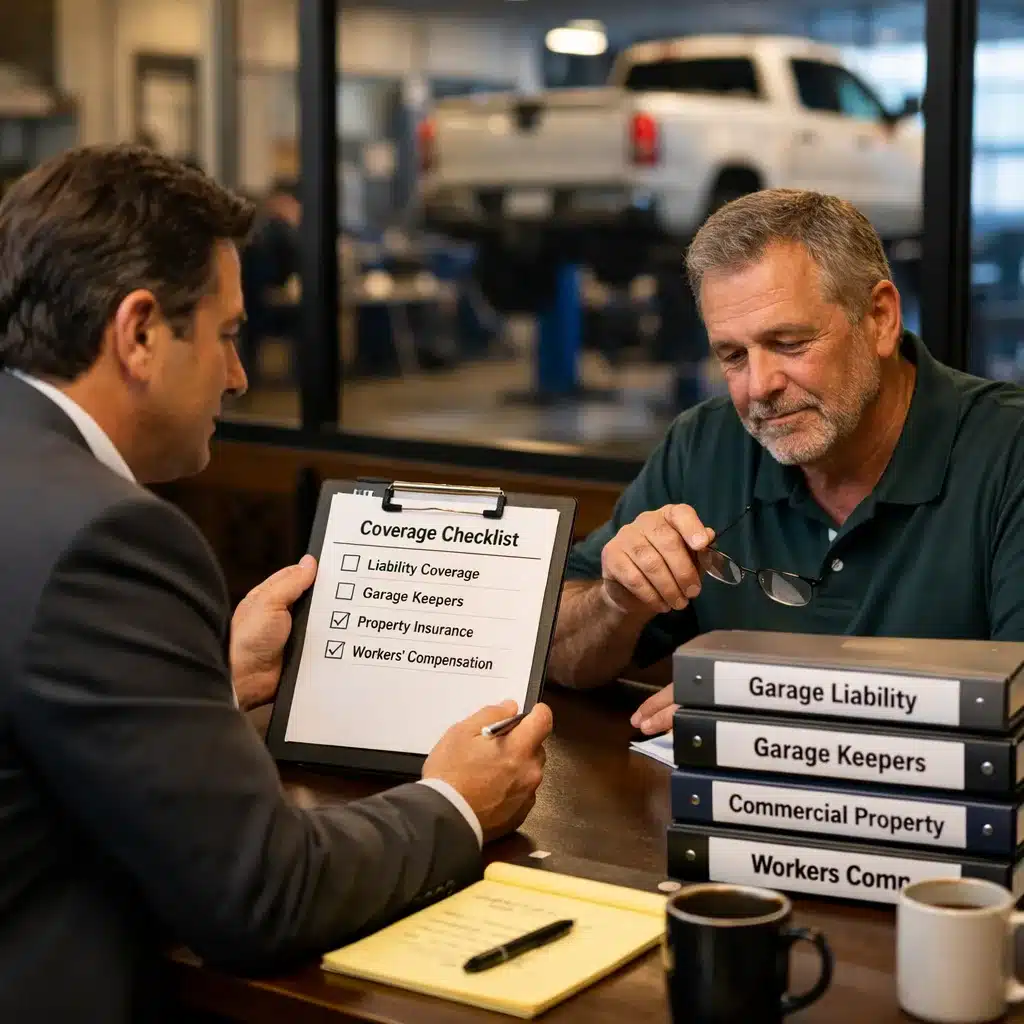
A complete auto repair shop insurance program is not just the garage policy. It requires coordinating several coverages so that no scenario falls through a gap.
For shops looking at auto repair shop insurance cost specifically, our cost guide breaks down what a complete program typically runs by shop size and type. Premiums vary significantly based on payroll, revenue, claims history, and location. A small independent shop might pay $4,000 to $6,000 annually for a complete program. A large multi-bay operation with significant completed operations exposure might pay $10,000 or more.
How Much Does Garage Insurance Cost?
Garage insurance cost is determined primarily by your shop’s payroll and gross receipts, the types of work you perform, your location, and your claims history. The following ranges represent approximate annual premiums for a typical single-location independent auto service shop.
Coverage |
Typical Annual Range |
Key Cost Drivers |
|---|---|---|
|
Garage liability |
$1,300 to $2,500 |
Payroll, revenue, services performed |
|
Garage keepers (direct primary) |
$500 to $1,500 |
Lot capacity, maximum vehicle value in custody |
|
Commercial property |
$800 to $2,000 |
Building value, equipment, inventory |
|
Workers’ compensation |
$1,500 to $4,000 |
Payroll, job classification codes, claims history |
|
Full program (all four) |
$4,000 to $10,000+ |
All factors; claims history most significant driver |
The Insurance Information Institute reports that commercial lines premiums rose an average of 7.1% in 2024 across all business lines. For garage insurance cost in your specific market, working with a specialist broker who places multiple garage programs is the fastest way to benchmark your current rates against market alternatives.
Things to Watch Out For When Buying Garage Insurance
Garage insurance policies are not all equivalent. The policy language determines whether a real claim in your shop will be covered. These are the provisions that produce the most claim disputes.
Why The Coyle Group for Garage Insurance
The Coyle Group has placed garage insurance programs for auto repair shops, body shops, tire dealers, transmission specialists, towing companies, and auto dealers for over 40 years. We know which carriers write the best garage forms, what completed operations language to look for, and how to structure garage keepers limits so they reflect your actual maximum exposure rather than an average that leaves you underinsured on your worst day. If your current program was not reviewed by a specialist in the last 12 months, that review is where we start.
Frequently Asked Questions About Garage Insurance
For more information on the specific insurance coverages that complete a garage insurance program, see our guides to garage insurance versus garage keepers insurance and the complete overview of insurance for mechanics and auto repair shops.
This article was written by Gordon B. Coyle, CPCU, ARM, AMIM, PWCA, CEO of The Coyle Group, who has over 40 years of experience working with business owners of all sizes and industries across the US, solving their insurance challenges.