Quick Answer
Cyber insurance matters because a single breach most small and mid-sized businesses cannot absorb is not covered by your other policies. A cyber policy pays the forensics, legal, notification, ransom, and lost-income costs, and gives you an incident response team the day it happens.
Why Cyber Insurance? The Honest Answer to “Can My Business Survive a Breach Without It?”
TL;DR
The real question behind “why cyber insurance” is not whether cyber risk exists. It is whether your business could write a check for the full cost of a breach tomorrow without borrowing or laying people off. If the answer is no, you have a financial transfer problem, not an IT problem. Cyber insurance moves that cost off your balance sheet and brings a crisis team with it. Your general liability, umbrella, and property policies will not.
For 40 years I have sat across the table from business owners who buy property insurance for a fire they have never had and liability insurance for a lawsuit that never came, then hesitate on cyber. If you have outgrown one-size-fits-all coverage and you are trying to decide whether this line is worth the premium, this page is for you.
Most owners I talk to are not asking me to define cyber risk. They already know attacks happen. What they are quietly weighing is a money question: can I afford to self-insure a breach, or would one incident wipe me out? That is the honest version of “why cyber insurance,” and it deserves an honest answer with real numbers.
The Coyle Group approach
You tell me what a bad day would actually cost your business, and I will tell you whether transferring that risk is worth roughly 3% of your insurance budget. No fear tactics, no jargon. If you want that number for your business, book a call and I will get you a premium indication from three basic questions.
Do you actually need cyber insurance?
Yes, if your business stores customer data, sends or receives payments, or runs on email, you need cyber insurance, and here is the part owners get wrong: size does not make you safe, it makes you a target. In my experience the smallest firms are the most exposed, because attackers know they carry the least defense. That belief that you are too small to bother with is the exposure.
The data backs this up. Roughly 64% of small businesses believe their operation is too small to be an attractive target, while two thirds of attacks now focus on the small and mid-sized market. Hackers chase the “small fish” on purpose, because those firms rarely have the staff or tools to fight an intrusion the way a large enterprise can.
So the question is not whether cyber criminals want your business. It is whether you have decided who pays when they get in.
A few quick tests tell me whether an owner genuinely needs coverage:
If you checked even one box, cyber belongs in your program. You can learn how we structure it on our cyber insurance page.
How much exposure you carry, though, depends on your business model:
There is an honest flip side. If you hold no customer data, take no digital payments, and could comfortably absorb a total loss from cash reserves, cyber may be optional for you, and I will tell you that rather than sell you a policy you do not need.
What a cyber breach really costs a business your size
A cyber breach typically costs a small or mid-sized business six figures, and the range runs far higher than most owners guess. The average event lands around $117,000 according to Kaspersky Labs, but that is only the average. What surprises people is not the headline number, it is how the bill splits across costs they never planned for.
Here is what the research shows once you add up the full incident, not just the ransom:
Cost driver |
Typical impact for an SMB |
|---|---|
|
Average cyber event (baseline) |
~$117,000 (Kaspersky Labs) |
|
Average total attack cost |
~$254,445, up to $7M at the high end (Microsoft) |
|
Downtime while you recover |
~$53,000 per hour (industry estimates) |
|
What responds from your other policies |
$0 in most cases |
The federal government makes the same point plainly. As the Federal Trade Commission notes, recovering from a cyber attack can be costly, and cyber insurance is one option that helps protect your business against those losses. The scale is not abstract either. The FBI logged $12.5 billion in reported cybercrime losses in 2023 alone, according to the Insurance Information Institute.
Now put that next to a premium that averages a few thousand dollars. This is the math that ends most debates. Want to see what a claim actually looks like start to finish? Walk through the anatomy of a cyber breach and then ask whether your business could absorb it alone.
A pattern we see in practice
An employee gets an email that looks like it came from a vendor, updates the “new” bank details, and wires a payment. The money is gone before lunch. There is no fire, no lawsuit, no property damage for another policy to respond to. The cyber policy covers the funds transfer fraud, the forensics to confirm how it happened, and the legal notice if data moved too. That is the difference between a bad week and a solvency event.
If you want that exposure quantified for your own numbers, request a coverage-gap review and we will size it with you.
Doesn’t my general liability or BOP already cover this?
No, in almost every case your general liability, umbrella, and property policies will not pay a cyber claim, and this is the single most expensive misunderstanding I see. Owners assume they are covered, skip the dedicated policy, and only learn the truth after a breach when the denial letter arrives. I blame the industry for explaining this poorly, so let me be direct about why those policies stay silent.
General liability responds to bodily injury and property damage. A data breach is neither. Property policies cover physical loss to physical things, and data is not a physical thing under most forms. Umbrella coverage only extends what sits beneath it, so it cannot reach a risk the underlying policy never covered in the first place.
There is one exception worth knowing. Some small business owners policies can be endorsed to add limited cyber coverage. It sounds efficient, but it is usually a trap.
Here is what a bolt-on endorsement typically leaves out:
I have written before about why you should not simply endorse cyber onto a BOP. It also helps to understand where cyber ends and other coverage begins, which is why the distinction between cyber insurance versus crime insurance matters when someone wires money out the door. A standalone policy is the only reliable answer.
What cyber insurance actually covers (and what it won’t)
Cyber insurance covers the two sides of a breach: the costs your business absorbs directly, and the costs you owe to others. Owners want to know if the premium buys a check after the fact or real help during the crisis, and the honest answer is both, if the policy is structured right. The catch is that coverage varies wildly between forms, so knowing the parts is what protects you.
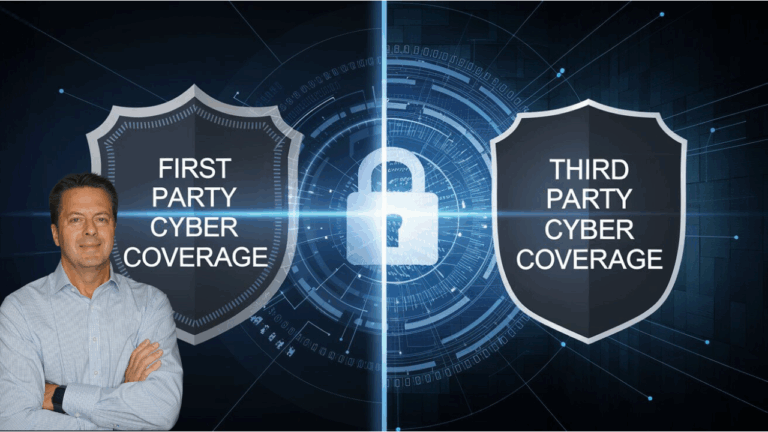
Cyber coverage splits into first-party and third-party protection. First-party pays for your own losses. Third-party pays for claims others bring against you.
The clean breakdown looks like this:
Coverage side |
What it pays for |
|---|---|
|
First-party |
Forensics, data restoration, business interruption, ransom payment, notification costs, credit monitoring, PR |
|
Third-party |
Lawsuits from affected customers, regulatory fines and defense, liability from a breach of others’ data |
For a deeper split of who gets paid and when, the difference between first-party and third-party cyber coverage is worth ten minutes of your time before you buy.
Just as important is what cyber will not do. It is a backstop, not a security program. Common gaps and exclusions include:
Cyber pays for the damage. It does not replace doing the basics well. Book a call if you want your current form read line by line.
How much does cyber insurance cost?
Cyber insurance usually costs a small or mid-sized business between about $1,000 and $7,500 a year for a $1 million limit, and for most of my clients it lands near the low end of that range. What tends to shock owners is not the price, it is how small the price is next to the exposure it removes. This is where the “it is too expensive” objection usually falls apart.
In our own book, the cyber policies we quoted in this market segment averaged around $4,000, which came to less than 3% of the client’s total insurance spend. I call that the 3% reframe: for roughly three cents on every insurance dollar, you move your single most ruinous risk off your balance sheet.
Here is how pricing generally shapes up:
Business profile |
Typical annual premium ($1M limit) |
|---|---|
|
Micro business, low data volume |
~$400 to $1,600 |
|
Small to mid-sized, moderate risk |
~$1,000 to $7,500 |
|
Data-heavy or higher-risk operations |
Priced individually |
What drives your premium up or down comes down to a short list:
This is the point where the answer to why cyber insurance is worth it becomes plain: the premium is a rounding error next to the loss. Two things are pushing rates in 2026, so waiting rarely saves money. S&P projects a 15% to 20% rise in cyber premiums after a 126% jump in ransomware incidents. The market is hardening, not softening. My honest read is the same one I have given for years: the cheapest this coverage will be is today. If you want a real indication for your business, contact us and answer three basic questions.
Why claims get denied, and how to make sure yours pays
Cyber claims get denied most often because the business did not maintain a security control it attested to on the application, and this is exactly the fear I hear owners voice out loud. One told me it plainly: they worry the policy will be invalid because there is some control claimed in it they do not actually have, so the insurer will not pay. That fear is valid, and it is also fixable.
Industry reporting puts the cyber claim denial rate above 40% in some segments, and the pattern behind those denials is consistent. Insurers now gate coverage behind real controls, then check whether you kept your word.
The usual culprits:
The application itself has become brutal. One owner described today’s process as filling out what used to be a one-page form and now feels like applying for a top-secret government clearance. Fourteen-page questionnaires are common, and answering them wrong is how good businesses end up uninsured when it counts.
This is where a broker earns the fee. In practice, we prep clients before they ever answer the questionnaire, so the controls you attest to are controls you actually have. That is the difference between a policy that pays and a policy that argues. Book a call and we will pressure-test your application before an underwriter does.
Are you required to carry cyber insurance?
Cyber insurance is rarely mandated by law the way workers compensation or auto liability is, but “not legally required” is not the same as “optional.” More and more, owners come to me because someone is effectively forcing the issue, and that someone is usually a customer, a regulator, or a lender. The requirement is real even when the statute is not.
Here is where the pressure typically comes from:
Most forms of insurance we buy are mandated somewhere, by government or by contract. Cyber is often the exception, and owners read that gap as permission to skip it. That is the wrong read. The absence of a mandate does not make the risk smaller, it just means no one is forcing you to protect against the one exposure most likely to end your business. If a client is already asking for proof of coverage, contact us and we will get you compliant fast.
The four reasons owners skip cyber insurance, and the honest answer to each
Owners skip cyber insurance for four predictable reasons, and every one of them dissolves under a close look. In the national research, roughly 59% of businesses still carry no cyber coverage, and industry surveys keep finding the same top reasons: owners think their risk profile does not warrant it, premiums cost too much, or they handle the risk internally. Those are the same four objections I have answered for years, so here they are with the honest reply.
“Business owners buy property and liability insurance when they’ve not had a fire or experienced a lawsuit, why is there such reluctance to purchase cyber insurance?”
That is the question I keep coming back to. Insurance becomes the backstop to financial ruin the moment an employee unwittingly clicks a link that wreaks havoc on your systems. If you have watched the CrowdStrike outage or seen how fast a small business gets hit, you already know the risk is not theoretical.
The Absorb-It Test: one question that settles the decision
If you take one thing from this page, take this. I call it the Absorb-It Test, and it is the fastest way to know whether you need to transfer cyber risk:
Could your business write a check tomorrow for the full cost of a breach, six figures or more, without borrowing, without missing payroll, and without laying anyone off?
If the answer is yes, you can self-insure with your eyes open. If the answer is no, and for most businesses it is no, then you do not have an IT question, you have a financing question, and cyber insurance is the answer. That is the whole case for why cyber insurance, in one sentence.
Ready to run the numbers for your business? Book a call and we will get you a premium indication and a straight recommendation.
What to look for in a cyber insurance policy
Look first for real breach response services, not just a limit, because the answer to why cyber insurance earns its keep is the crisis team it brings, not the check it eventually cuts. Most owners compare price and stop there. In my experience the cheapest policy is usually the one that fights you hardest at claim time, so read the structure before the premium.
When we place coverage, we hold every quote up to the same checklist:
Get those parts right and the policy does its job. Miss them and you own a certificate, not protection. That is why cyber insurance should be structured by someone who reads the form, not sold by a checkout button. If you want a second set of eyes, request a second opinion on your current coverage.
Quick answers and buying considerations
Here is the whole decision in one scannable block, so you can act without rereading the page. Cyber insurance comes down to one thing: whether your business could survive a breach it cannot pay for out of pocket. If it could not, you transfer the risk, and everything below follows from that single call.
If you want this turned into a straight recommendation for your business, book a call.
Frequently asked questions
Author’s Expertise
This article was written by the CEO of The Coyle Group, Gordon B. Coyle, CPCU, ARM, AMIM, PWCA, who has over 40 years of experience working with business owners of all sizes and industries across the US, solving their insurance challenges.