
Why Would I Need International Insurance Coverage?
Your standard US business insurance stops at the border. For the 40-50% of small businesses operating internationally, that gap is a direct financial exposure, one injury abroad, one foreign lawsuit, and your domestic coverage pays nothing.
TL;DR
Your standard US business insurance policy, general liability, workers compensation, commercial auto, and property, stops at the border. For the 40-50% of small to mid-size US businesses that operate internationally, that gap is a direct financial exposure. One employee injury abroad, one foreign liability suit, one vehicle accident in a rented car overseas, and your domestic coverage pays nothing. International business insurance closes those gaps through endorsements, master policies, and specialty coverages that most business owners never think about until after a loss.
Why Your US Business Policy Stops at the Border
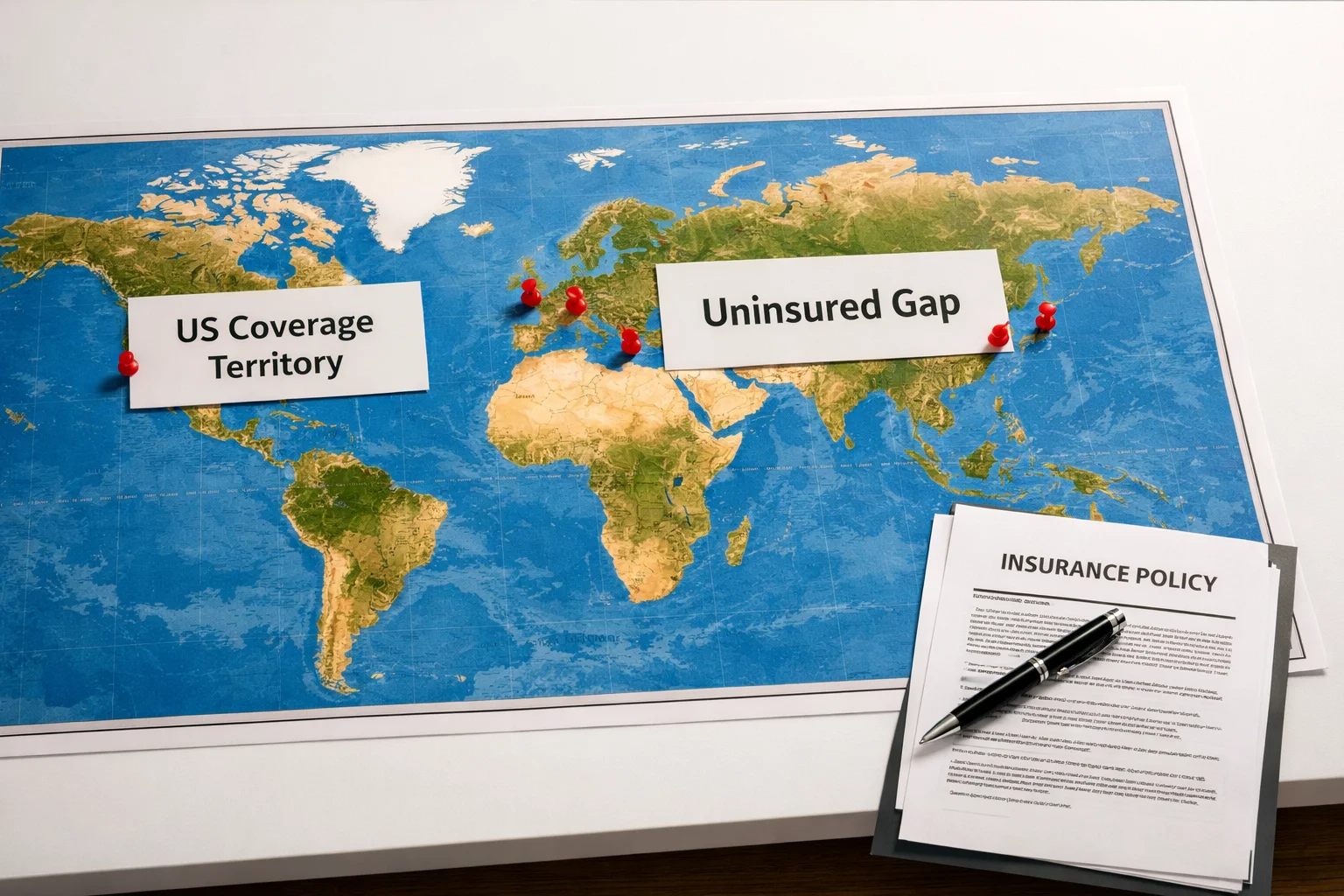
Most commercial insurance policies define their coverage territory as the United States, its territories and possessions, and Canada. Everything outside that boundary is explicitly excluded, not overlooked, not ambiguous, but contractually excluded. This applies across your entire program.
Foreign legal systems compound the exposure. Even if a policy could theoretically respond to a foreign claim, local courts in most countries will not apply US insurance law. Many countries require admitted local policies from a licensed local insurer to be enforceable in their jurisdiction.

The 4 Coverage Gaps That Hit Hardest
When businesses operate internationally without the right coverage, these four scenarios produce the largest uninsured losses. Each one represents a gap that is contractually baked into your domestic policy, not a gray area, but an explicit exclusion.
Gap 1: Employee Injury Abroad
US workers’ compensation provides no coverage for injuries that occur outside the United States. If an employee is injured during a business trip, a factory visit overseas, or a consulting engagement abroad, your workers’ comp carrier will deny the claim. Air ambulance evacuation alone can cost $100,000 to $300,000 per incident, fully out of pocket without coverage.
Gap 2: Foreign Liability Suits
Your US general liability policy covers suits brought in US or Canadian courts only. A product liability claim filed in the EU, a professional liability suit in the UK, or a bodily injury claim filed in Japan falls outside your policy’s coverage territory. Any business that sells products internationally or provides services to foreign clients faces this exposure every time they conduct business abroad.
Gap 3: Auto Liability Abroad
Your US commercial auto policy covers vehicles you own, lease, or rent within the coverage territory. A rental vehicle in Germany, a company car in South Korea, or a hired vehicle in Mexico operates outside that territory and is uninsured. A single serious accident abroad, particularly one involving pedestrian injuries, can produce liability far exceeding what any local rental insurance covers.
Gap 4: Kidnap, Ransom and Extortion
Executives and employees traveling to certain regions face kidnap and extortion exposure that no standard business insurance policy covers. Incidents occur regularly in Latin America, parts of Southeast Asia, and conflict-adjacent regions where US companies conduct business. Without KR&E coverage, the company bears both the financial and logistical burden of a hostage situation alone.
Industries with the Highest International Exposure
Not all businesses operate at the same level of international risk. These four sectors have the most direct and frequent exposure to the coverage gaps described above, and the most to lose when a domestic-only policy meets a foreign claim.
Manufacturing and Supply Chain
US manufacturers sourcing from overseas factories make regular quality control visits, conduct supplier audits, and ship goods internationally. Workers comp exposure from overseas travel, cargo exposure, and product liability in foreign markets are the three primary gaps requiring international coverage.
Professional Services and Consulting
Accountants, management consultants, IT firms, and legal service providers who serve foreign clients face professional liability exposure that their E&O policy does not cover if the suit is brought in a foreign court. A contract executed abroad under foreign law is outside domestic coverage.
Technology and Software
SaaS companies and technology firms with international clients, overseas development teams, or cross-border data operations face liability exposure in multiple foreign jurisdictions simultaneously. GDPR liability in the EU is one example; a claim under foreign data protection law is outside standard US professional liability coverage.
Exporters and Distributors
Any business that ships products into foreign markets faces product liability exposure in those markets. A product recall or injury claim filed in a foreign court requires a policy that covers defense costs and indemnification in that jurisdiction, something a standard US GL policy cannot provide.
What International Business Insurance Actually Covers
A properly structured international insurance program for a small to mid-size US business typically includes five components. Together, they extend your domestic coverage framework to the countries where your people and products operate.
International Liability
Extends general liability coverage to claims brought in foreign courts. Covers bodily injury, property damage, and personal injury arising from operations, products, or employees abroad. May include locally admitted policies in specific countries where required by law.
Foreign Voluntary Workers Comp
Provides workers’ compensation-equivalent benefits for US employees injured abroad. Includes emergency medical evacuation, repatriation of remains, and crisis response services, often the most expensive out-of-pocket costs when a serious incident occurs internationally.
Foreign Auto Liability
Extends auto liability coverage to vehicles rented or hired abroad. Covers third-party bodily injury and property damage arising from vehicle use in foreign countries, the gap your US commercial auto policy leaves when employees rent cars internationally.
Corporate Travel Accident
Provides accidental death, dismemberment, and disability benefits for employees traveling internationally. Often includes travel assistance services: emergency medical assistance, travel document replacement, legal referrals, and security alerts for high-risk destinations.
Kidnap, Ransom and Extortion
Covers ransom payments, negotiation costs, crisis management consulting, legal fees, and business income loss from kidnap or extortion events. Includes 24/7 access to professional crisis negotiators. Available as a standalone policy or as part of a broader international program.
Master Policy vs. Local Admitted Policy
International insurance programs are generally structured in one of two ways. Knowing the difference matters for compliance in specific countries, and for understanding what coverage you actually have when a claim is filed abroad.
Two Structures for International Programs
A master policy is issued in the US and provides worldwide coverage; it follows the insured’s employees and operations globally. This is the foundation for most small to mid-size businesses with moderate international exposure.
A locally admitted policy is issued by an insurer licensed in a specific foreign country, under that country’s regulatory requirements. Some jurisdictions require a locally admitted policy as a condition of doing business; Germany, Brazil, Saudi Arabia, and the UAE are examples.
For most small and mid-size businesses, a master policy is the starting point. As international revenue or headcount in specific countries grows, locally admitted policies in those jurisdictions become necessary. An equipment breakdown endorsement may also be relevant for businesses with equipment deployed in international operations, which similarly requires explicit extension beyond standard policy territory.
The Cost of International Business Insurance
For small to mid-size US businesses, annual premiums for a basic international program typically range from $5,000 to $50,000, roughly 1-3% of international revenue, depending on countries of operation, number of traveling employees, and coverage scope. For businesses with limited international activity, a targeted travel accident policy is far less expensive and addresses the most acute exposures first.
What Drives the Premium
Understanding business travel accident insurance and international coverage
Operating across borders? Your domestic policy likely has gaps you don’t know about.
International Insurance Coverage FAQ
The Bottom Line
Your domestic insurance program was built for domestic operations. The moment your business, or your employees, crosses outside the US, coverage territory definitions transform your protection into a patchwork of gaps.
International business insurance is not a complex or expensive add-on for large multinationals only. It is a practical necessity for any small or mid-size business that operates outside the US, ships products internationally, or sends employees abroad. For most businesses, the cost is modest. The alternative, a single uncovered claim abroad, is not.
The Coyle Group works exclusively with commercial clients. We review your international exposure, identify the gaps in your current program, and structure coverage that actually works in the countries where you operate.
This article was written by Gordon B. Coyle, CPCU, ARM, AMIM, PWCA, CEO of The Coyle Group, who has over 40 years of experience working with business owners of all sizes and industries across the US, solving their insurance challenges.


