
Cyber Insurance Waiting Period
When Coverage Actually Starts (And Why It Matters)
Cyber Insurance Waiting Period Explained: This Clause Could Cost You $30K
Index

Gordon B. Coyle
CEO, The Coyle Group
845-474-2924
How to get started
Executive Summary
Here’s a question most business owners never ask until it’s too late: “If my systems go down today, how long before my cyber insurance starts paying?”
Every cyber policy includes a waiting period, a built-in delay between when a cyber incident occurs and when coverage kicks in. Most business owners don’t realize this until they’re in the middle of a ransomware attack or network outage and discover they’re on the hook for all costs during that gap.
In this guide, we’ll break down exactly what cyber insurance waiting periods are, why they exist, and how they can impact your recovery after a cyberattack.
The Bottom Line (TLDR)
Cyber insurance waiting periods: the gap that catches businesses off guard
Investment range
Can be negotiated from 6-24+ hours depending on security posture and premium
What Is Business Interruption Coverage in Cyber Insurance?
To understand why waiting periods matter, you first need to know what they’re delaying: Business Interruption (BI) coverage.
Business Interruption is the part of your cyber insurance policy that replaces lost income when a cyber incident shuts down or significantly degrades your operations. When ransomware locks your systems, a data breach forces you offline, or a cyberattack stops your ability to do business, BI coverage pays for the revenue you’re losing during that downtime.
This coverage typically includes:
Without Cyber Business Interruption Coverage, your business wouldn’t have a means to recover the income lost during a cyber event shutdown, which is a direct hit to your bottom line. For many businesses, an extended downtime without this protection could be a financial disaster.
Now here’s where waiting periods create the gap.
What Is a Cyber Insurance Waiting Period?
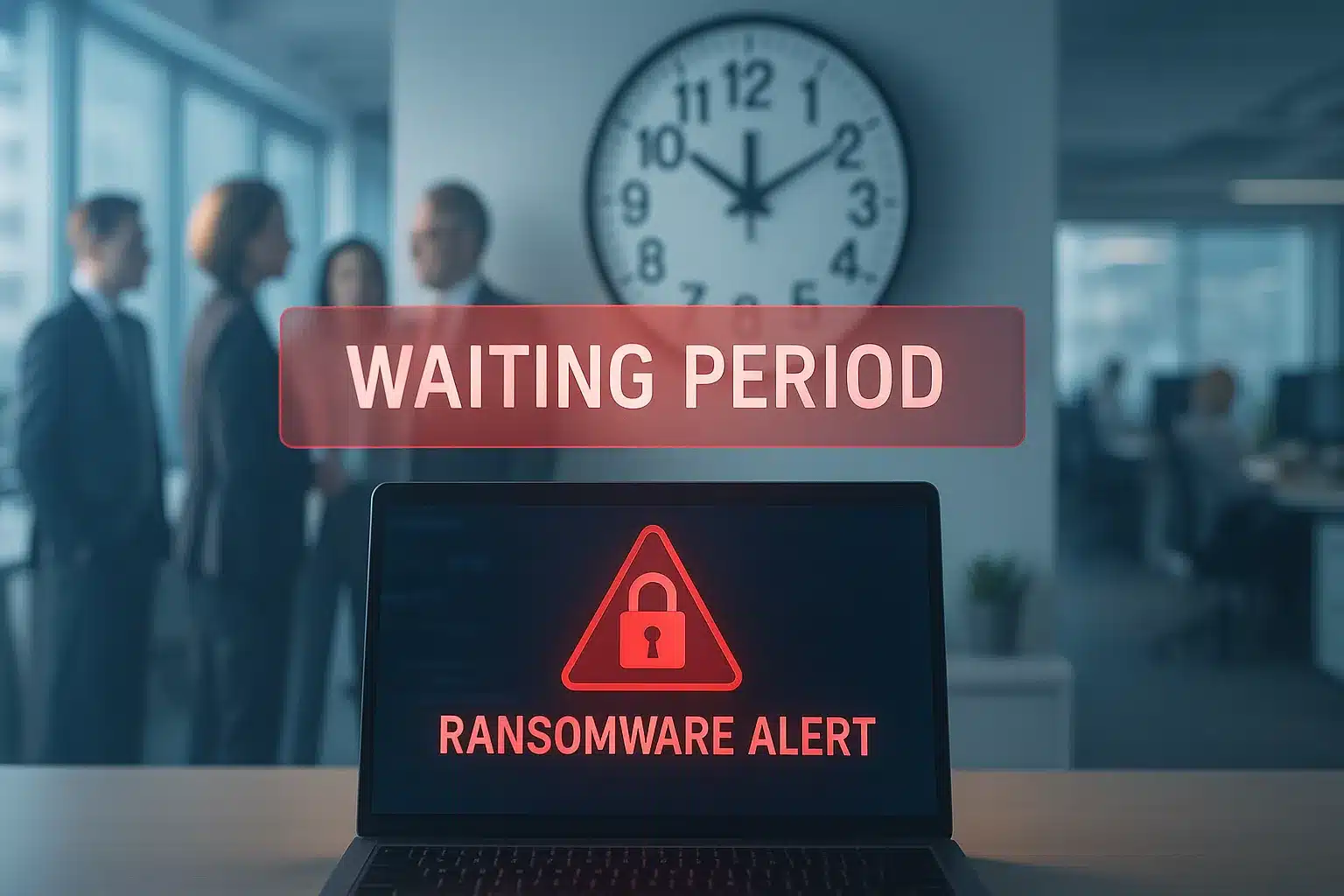
A waiting period is a time-based threshold in your cyber insurance policy that determines when business interruption coverage begins.
Think of it as a time deductible. Instead of paying a dollar amount before coverage starts, you’re waiting out a number of hours.
Standard Waiting Period Ranges
According to industry data, the market standard has stabilized at 12 hours after trending higher during the hard market conditions of 2021 when some carriers pushed for 24+ hour periods.
Example: The 12-Hour Gap
Your network goes down at 9 AM on Monday due to ransomware. With a 12-hour waiting period: Hours 1-12, you pay everything; Hour 13+ coverage may begin. If systems restore in 10 hours, some policies won’t pay anything.
What 40+ Years Taught Me About This Risk
In four decades of insuring businesses against cyber threats, I’ve seen how a poorly understood waiting period can devastate an otherwise well-protected company. Successful business owners understand that cyber insurance isn’t just buying a policy-it’s aligning coverage triggers with your actual downtime tolerance and recovery capabilities.
Why Insurers Include Waiting Periods
Waiting periods aren’t arbitrary. They serve specific purposes in cyber insurance design.
Three Primary Functions
1
Reduce small claims volume
Not every IT hiccup or malware alert should trigger a claim. Minor disruptions that resolve within hours don’t create real financial damage for most businesses.
2
Encourage better risk management
Insurers want policyholders to have incident response plans that kick in quickly. Companies with strong response capabilities can often contain issues within the waiting period.
3
Stabilize premium pricing
Fewer small claims help keep premiums reasonable across the market. According to NAIC market share data, property and casualty insurance direct premiums written reached $974.9 billion in 2024-and waiting periods help maintain market stability.
A waiting period isn’t a sign your insurer is cutting corners. It’s a tool to keep the system functional and affordable. But if that period is too long for your business, you could face serious uncovered losses.
How Waiting Periods Affect Business Interruption Coverage
Most waiting periods apply specifically to Business Interruption (BI) coverage-the part of your policy that replaces lost income when your systems go down.
Two Methods Carriers Use
Common Risks in Gray-Zone Incidents
Many cyber incidents fall into a dangerous middle ground where losses are real but don’t qualify for coverage.
High-Risk Business Types
According to industry research, over 90% of mid-sized enterprises report that a single hour of downtime costs upwards of $300,000. For many businesses, even a 6-hour waiting period represents potentially devastating uncovered losses.

How to Negotiate Shorter Waiting Periods
You’re not stuck with whatever waiting period your insurer sets by default.
Strategies to Reduce Your Waiting Period
Demonstrate strong IT response capability
Work with specialized brokers
Brokers with deep cyber expertise can access carriers offering more favorable terms. Some specialty markets offer 6-hour or even 1-hour waiting periods for DDoS attacks when approved mitigation services are used.
Calculate your downtime tolerance
If your business can’t afford to be down for more than 6 hours, your coverage should reflect that reality. Work with your insurance broker to align waiting periods with Business Impact Analysis results.
Bundle with higher security standards
Carriers reward strong security postures. Implementing MFA, endpoint detection and response, and comprehensive employee training can unlock better waiting period options.
Negotiation Leverage Points
Once you’ve negotiated favorable terms, another critical detail demands attention.
Understanding How the Clock Starts
One of the most misunderstood aspects of waiting periods: when does the clock actually begin?
Coverage Triggers Vary by Carrier
Common trigger definitions:
The difference matters significantly. If your network was compromised on Monday but you didn’t discover it until Wednesday, some policies might start the waiting period on Monday (favorable) while others start on Wednesday (unfavorable).
Critical Distinction: Waiting Period vs Response Time
These are completely separate. Your waiting period clock ticks regardless of how quickly you respond. Some businesses mistakenly believe fast response shortens the waiting period-it doesn’t.
With the mechanics clear, the strategic question emerges: what waiting period actually makes sense for your business?
Matching Waiting Periods to Your Business
There’s no one-size-fits-all answer. The right waiting period depends on your operational resilience.
Critical Questions to Ask
How long can we operate manually before losing income?
What’s our average recovery time from past outages?
Historical data reveals realistic recovery timelines. If you’ve never restored systems in under 16 hours, a 12-hour waiting period offers limited value.
What does our Business Impact Analysis show?
A proper BIA measures financial impact over time. If your analysis shows critical losses begin at hour 6, accepting a 12-hour waiting period leaves you dangerously exposed.
Industry Benchmarks
According to Statista research on ransomware recovery, the average downtime after a ransomware attack ranges from 20-24 days. However, the first hours and days are often the most financially damaging.
Manufacturing companies might handle 12 hours of downtime without catastrophic loss. A financial services firm or e-commerce company could start bleeding money within two hours.
Armed with this knowledge, you’re ready to have the right conversation with your broker.
Questions to Ask Your Broker Before Binding Coverage
Essential Pre-Binding Questions
What is my exact waiting period for network interruption?
Get the specific number of hours in writing. Don’t accept vague answers.
Does the waiting period differ for different incident types?
Some policies apply different waiting periods for:
Which method does my policy use-qualifying period or time retention?
This determines whether losses during the waiting period are ever covered.
How does the policy define when the clock starts?
When interruption occurs? When discovered? When reported? Get clarity.
Can my waiting period be reduced for an additional premium?
Understand the cost-benefit tradeoff for shorter waiting periods.
Are there any exceptions or special provisions?
Some carriers offer reduced waiting periods for specific attack types (like DDoS) when approved mitigation services are used.
If your broker can’t answer these questions clearly, that’s a red flag. You deserve to understand exactly how your cyber insurance coverage works.
The CrowdStrike Event: A Real-World Waiting Period Test
The July 2024 CrowdStrike outage offers crucial insights into how waiting periods function during widespread incidents.
Several factors determined whether businesses received coverage:
The 12-hour standard became critical
Most cyber policies required a 12-hour waiting period to be met. Organizations that restored systems within that window received no business interruption payments.
Method matters significantly
Carriers using the “greater of” method (waiting period loss OR deductible-whichever is greater) created additional complexity in claims.
Systems failure vs security failure
Some policies treated the CrowdStrike event as systems failure rather than security failure, potentially triggering sublimits or exclusions.
Fast recovery limited claims
Many organizations restored systems within hours thanks to incident response investments. While this minimized business impact, it also meant waiting periods weren’t met for coverage.

The event demonstrated why understanding your specific policy language matters. Learn more about how the CrowdStrike incident affected cyber insurance.
Beyond high-profile events, everyday misconceptions create problems at claim time.
Common Misunderstandings About Waiting Periods
Let’s clear up the myths that create problems at claim time.
Coverage starts when the attack happens
The clock starts when the business interruption begins, and coverage only applies after the waiting period ends.
It’s the same as incident response time
Waiting period determines when coverage applies; response time measures how quickly you take action. They’re independent.
All policies have the same waiting period
Waiting periods vary dramatically-from 6 hours to 24+ hours. Some carriers use qualifying periods; others use time retention.
My IT team’s speed affects the waiting period
Fast response is valuable for minimizing loss, but it doesn’t shorten your contractual waiting period.
The waiting period only applies to total shutdowns
Some policies trigger on “substantial degradation” rather than complete outages. Partial interruptions may qualify.
Understanding these distinctions prevents unpleasant surprises when filing claims. Many businesses discover coverage gaps too late because they operated on faulty assumptions. Getting these details right requires expertise most business owners don’t have time to develop.
How The Coyle Group Approaches Waiting Periods
We don’t just sell policies-we audit how waiting periods align with your business operations.
Our Strategic Process
1. Business Impact Analysis Review
We analyze when financial losses become critical for your specific operations. If you can’t afford 12 hours of downtime, your policy shouldn’t assume you can.
2. Recovery Capability Assessment
How quickly can your IT team actually restore systems? Historical data reveals realistic recovery timelines that should inform coverage design.
3. Carrier Comparison
Access to 20+ cyber carriers means we can find markets offering:
4. Security Posture Documentation
We help document your cybersecurity controls to unlock better underwriting terms, including reduced waiting periods.
5. Scenario Planning
We stress-test your coverage against realistic incident scenarios to identify gaps before you need the policy.
This approach helps businesses avoid the $1M mistake of accepting default waiting periods that don’t match operational reality. Understanding the difference between cyber insurance and crime insurance also helps ensure comprehensive protection.
95+
Years of Family Legacy in Insurance
40+
Years Personal Experience
95%
Client Retention Rate
600+
Educational Videos
Questions about Cyber Insurance Waiting Period?
Taking Control of Your Cyber Insurance Waiting Period
We get it. Cyber insurance policies are dense, technical documents filled with terms most business owners have never heard of. Waiting periods, qualifying triggers, time retention methods, it’s not exactly light reading.
And here’s the frustrating part: these technical details matter enormously. The difference between a 12-hour and 24-hour waiting period isn’t just paperwork; it’s the difference between your claim being paid in full or denied entirely.
In 40+ years of helping businesses navigate cyber insurance, we’ve seen every version of this story. We’ve helped companies avoid these gaps before incidents happen. We know which carriers offer better waiting period terms. We know how to negotiate reductions. We understand which policy language protects you and which leaves you exposed.
Here’s what we bring to the table:
The right waiting period isn’t about buying the cheapest policy or accepting whatever your current carrier offers. It’s about understanding your actual downtime tolerance and making sure your coverage reflects that reality.

This article was written by the CEO of The Coyle Group, Gordon B. Coyle, CPCU, ARM, AMIM, PWCA, who has over 40 years of experience working with business owners of all sizes and industries across the US, solving their insurance challenges. Cyber insurance, as well as other management and professional insurance lines of coverage, are his specialty.
Here’s how to take the next step
Schedule Your Insurance Confidence Assessment
In our 30-minute call, you’ll discover:
Not ready for a call?
Get Free Access to Our Gated Video:
“How to Finally Feel Confident in Your Coverage. “
And discover the exact system we use to help business owners eliminate hidden coverage gaps, stop overpaying, and finally feel confident in their protection.
What Peace of Mind Looks Like
Trusted by business owners across the U.S.
The Coyle Group is 1st class! Gordon and his team are knowledgeable, responsive, and attentive to detail. Gordon is that rare breed of professional who genuinely cares for his clients and works hard to exceed their expectations. I highly recommend them.

The insurance brokerage service was truly tailored to my needs, nothing like those big brokers who steer you toward random policies that don’t fit your profile. Thank you to the team for your help.

I was working with another broker and having difficulty acquiring General Liability coverage. A colleague recommended The Coyle Group. They were able to get coverage bound in just a couple of business days and a policy issued in ten days, and with a solid carrier at a competitive premium. Truly impressive results, plus it was a pleasure working with them. I highly recommend the Coyle Group!

If any business is looking to work with an insurance brokerage firm that is not only excellent at what the firm does, but one that deeply values the needs of the clients, then The Coyle Group is the firm for you. Give them a call and see for yourself. I can assure that you will quickly agree.

Want to know more?
See related blogs

The Crowdstrike Debacle and Cyber Insurance
Tech E&O vs. Cyber Insurance: What You Need to Know

First Party vs Third Party Cyber Insurance: What’s Covered, What’s Missing, and What You Actually Need
