SaaS Insurance for Software Companies

Get Contract-Ready for Tech Risks

Home » Insurance By Industry » Technology Firm Insurance » Essential SaaS Insurance: Get Contract-Ready for Tech Risks

SaaS Insurance Explained in 5 Minutes

Gordon B. Coyle

CEO, The Coyle Group
845-474-2924

How to get started

  • Book a free 30-minute call with our insurance expert.
  • Get your tailored SaaS Insurance quote.
  • We handle the transition and ensure zero coverage gaps.

Executive Summary

Close deals faster and sleep better, get limits that satisfy MSAs and investors.
SaaS insurance isn’t a single policy; it’s a coordinated program designed to respond when software failures, data incidents, or board decisions create financial loss.
If a software bug, outage, or breach hits today, would your policy actually respond? Get a contract-ready SaaS insurance program built around your risks.

The Bottom Line – TL;DR

  • What you need: Tech E&O for client losses from software failures, Cyber for breach/ransomware/downtime, D&O for board/investor protection. General Liability won’t cover your actual risks.
  • Typical limits: $1M–$2M for early-stage, $2M–$5M for growth-stage, $5M+ for enterprise SaaS
  • Ballpark costs: $100–$400/month bundled for startups with strong controls; 30–50% more without MFA/backups
  • Time to bind: 3–5 business days when documentation is ready
  • What you get: Certificate of Insurance today, policy forms, endorsements mapped to your MSA, and renewal roadmap

What do SaaS companies need?

A well-structured SaaS insurance program coordinates multiple policies, so coverage responds correctly when software, data, or contracts create financial loss.
Unlike general business insurance, SaaS risk lives in your code, your contracts, and your uptime obligations, not your physical premises. Each policy in the stack covers a different failure mode, and gaps between them are where most claims disputes start.

Coverage

What It Actually Covers

Why You Need It

Tech E&O (Errors & Omissions)

Client financial loss from software bugs, outages, missed SLAs, data loss, failed integrations

Your contracts push liability back on you. GL won’t respond to “your work” failures.

Cyber Insurance

Breach response, ransomware payments, business downtime, privacy lawsuits, regulatory defense

According to IBM’s 2024 Cost of a Data Breach Report, the average cost of a data breach hit $4.88 million globally. However, IBM notes that smaller organizations typically experience lower, but still material, losses ranging from $120K to $1.24M. Ransomware accounts for 41% of cyber insurance claims (Munich Re).

D&O (Directors & Officers)

Protects founders/board from lawsuits over fundraising, security oversight, employment decisions

VCs require it before funding. Industry data suggests experienced founders often purchase D&O at formation, having learned its importance through prior ventures.

General Liability

Bodily injury, physical property damage at your office

Still needed for office leases, but doesn’t touch code/data/cyber risks.

Crime Insurance

Wire fraud, social engineering theft, employee dishonesty

Business email compromise caused over $3 billion in losses from 2021-2023 (FBI IC3). Separate from cyber.

The Coverage Stack

Real Scenarios Which Policy Responds

What Happens
Tech E&O
Cyber
D&O
GL

Your API fails, client loses $200K in sales

✅ Covers

Ransomware locks your systems for 48 hours

✅ Covers

Data breach exposes 50K user records

✅ Covers

Board sued over “inadequate security”

✅ Covers

Visitor trips on cable in your office

✅ Covers

CFO wires $100K to fake vendor email

Crime policy (social engineering)

The gap

According to the National Association of Insurance Commissioners (NAIC), General Liability covers physical risks, injuries, and property damage. It specifically excludes professional services, data breaches, and software failures. That’s 100% of your actual exposure as a SaaS company.

SaaS Insurance Pricing: What Drives Your Cost

SaaS insurance pricing reflects your revenue, data sensitivity, security controls, and SLA commitments, not just your company size. Two SaaS companies at the same ARR can see 2x to 3x premium differences based on controls and contract language alone. The four factors below explain what underwriters actually weigh.

The Big Four Cost Factors

1. Revenue & Data Sensitivity

  • Under $1M ARR: $1,200–$3,600/year bundled
  • $1M–$10M ARR: $3,600–$12,000/year
  • $10M+ ARR: $12,000–$60,000/year
  • Healthcare/financial data adds 20–40% vs. generic business data

2. Security Controls (Biggest Lever You Control)

Control
Premium Impact
Why It Matters

Multi-Factor Authentication (MFA) everywhere

Often results in 20–30% lower premiums

Microsoft research shows MFA blocks over 99.9% of automated account attacks

Endpoint protection + monitoring

Can reduce premiums 15–25%

Stops ransomware before it spreads

Offline backups tested quarterly

Required for coverage

No backup = no ransomware recovery

Documented incident response plan

Typically saves 10–15%

Insurers want proof you’ve practiced

Employee security training

Often reduces premiums 10–15%

Humans are the #1 attack vector

Vendor risk assessments

Can lower costs 5–10%

Industry studies consistently show a meaningful share of cyber claims involve third-party vendors

3. Service Level Agreements

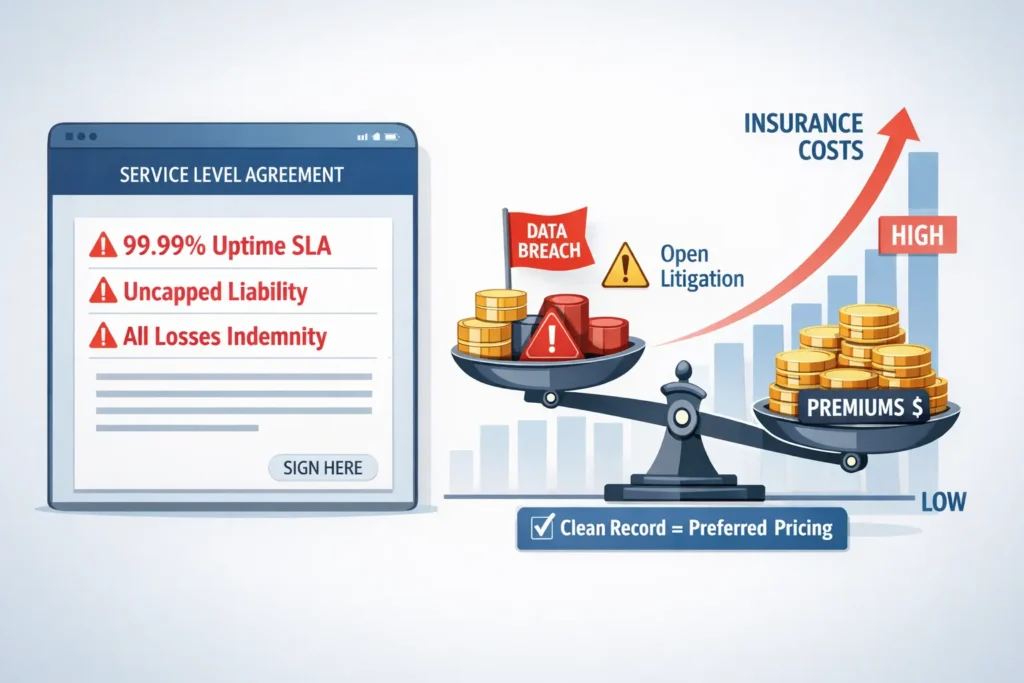
  • Strict uptime promises (99.99%) with financial penalties = higher E&O premiums
  • Uncapped liability clauses = red flag for underwriters
  • “All losses” indemnity language = often uninsurable

4. Claims History

  • Clean record for 5+ years = preferred pricing
  • One breach 2 years ago = typically 30–50% surcharge even after fixes
  • Active litigation = some carriers won’t quote
Illustration showing how strict SLAs and negative claims history raise SaaS Insurance premiums, with flagged contract clauses and rising cost indicators visualized on a digital dashboard.

Typical Monthly Bundles

Stage

Revenue

Coverage

Monthly Cost

Assumes

Starter

Pre-revenue to $1M

$1M limits across E&O/Cyber/D&O

$200 – $400

MFA + backups in place

Growth

$1M–$10M

$2M limits, expanded BI coverage

$500–$1,000

Full security checklist

Scale

$10M–$50M

$5M limits, vendor dependency coverage

$1,200 – $5,500

SOC 2 or equivalent

Enterprise

$50M+

$10M+ limits, global coverage

$6,000–$10,000+

Mature security program

The gap without controls:

If you lack MFA, tested backups, or endpoint detection/response (EDR), we regularly see premium surcharges of 50–100% or outright coverage denial.

Real-World Example: When API Dependencies Fail

The Incident

A cloud HR platform integrated with a payroll processing API. During a critical pay period, the API went down for 14 hours. Their clients couldn’t process payroll.

Client Losses:
  • 25 mid-sized clients missed payroll deadlines
  • Clients paid late fees and faced employee complaints
  • Combined client losses: $380,000
Business Impact:
  • Platform degraded during outage
  • 1,200+ support tickets
  • 48 hours of executive crisis management
  • Lost subscription revenue: $65,000

How Insurance Responded

  • Tech E&O: Covered $280,000 in client settlements + legal defense (company paid $25K retention)
  • Cyber Business Interruption: Covered $65,000 in lost revenue and crisis costs under a dependent business interruption endorsement triggered by the third-party API failure (12-hour waiting period applied; outage was 14 hours)
  • Total insurance payout: $345,000
  • What 40+ Years Taught Me About This Risk: Don’t underwrite to your best-case scenario. This company survived because they’d modeled a vendor failure and bought dependent business interruption coverage, a $200/year endorsement that saved them $345K. Most SaaS founders skip this until it’s too late.

Why SaaS Insurance Is a Decision, Not a Form

SaaS Insurance as a strategic decision—founder reviewing coverage aligned with contracts, vendors, and business operations

Most SaaS founders assume insurance is about checking boxes:
MFA? Yes. Backups? Yes. Policy in place? Done.

But insurance doesn’t fail because a form was filled out incorrectly.
It fails because the coverage wasn’t designed to match how the business actually operates.

Underwriters don’t just look at controls. They look at:

  • What you promise clients in your MSAs
  • How revenue is affected when systems go down
  • Which vendors your platform depend on
  • How losses would realistically unfold during an outage or breach

That’s why two SaaS companies with identical security controls can get very different coverage outcomes.

What 40+ Years Taught Me. The best SaaS insurance programs aren’t the ones with the longest checklists. They’re the ones where coverage, contracts, and operations tell the same story.

That’s what prevents disputes when a claim happens.

How SaaS Insurance Breaks and How We Prevent It

Most SaaS companies don’t get hurt because they skipped insurance.
They get hurt because their coverage wasn’t built for how SaaS risk actually works. Policies that weren’t designed for your revenue model, your vendor dependencies, or your contract language create gaps that only surface at claim time, when it’s too late to fix them.

Here’s where things usually break:

  • The wrong policy is expected to respond when an outage, breach, or claim hits
  • Vendor outages aren’t covered unless the right endorsements are in place
  • Contracts promise more than insurance can pay, creating uninsurable exposure
  • Retro dates and exclusions quietly gut E&O coverage

By the time founders discover these gaps, the damage is already done.

What we do differently:

We design coordinated SaaS insurance programs, Tech E&O, Cyber, D&O, and Crime, that align with your revenue model, your contracts, and your dependencies. No gray areas. No finger-pointing between carriers. Just coverage that works when it matters.

What 40+ Years Taught Me About This Risk. Price doesn’t take down SaaS companies, coverage gaps do.
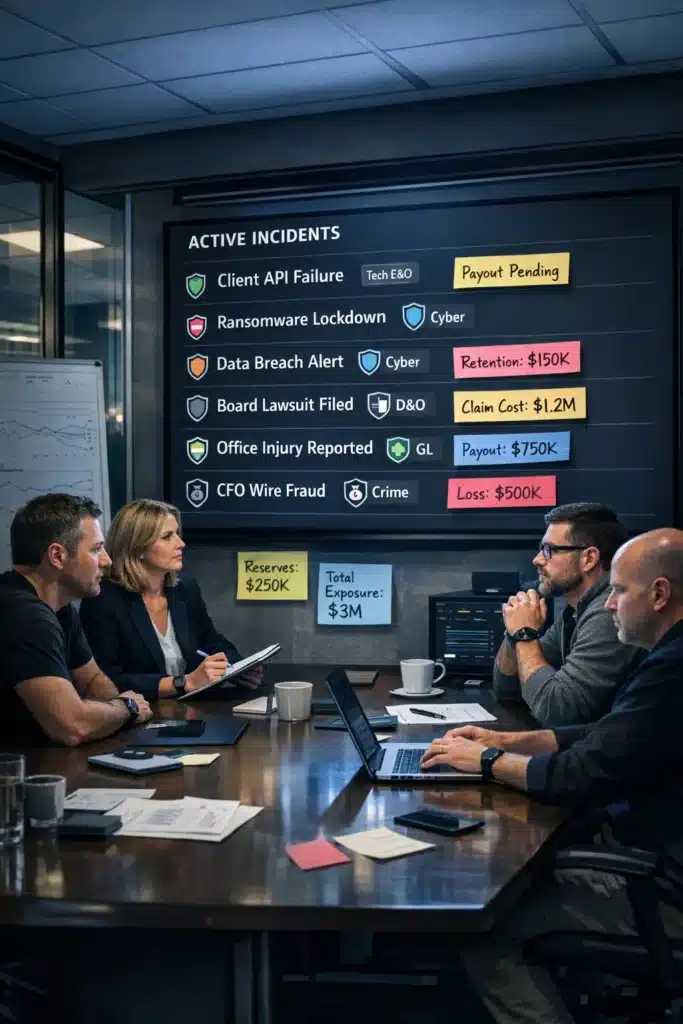
SaaS Insurance response meeting scene with company leaders managing multiple risk incidents and tracking which policies—Tech E&O, Cyber, D&O, GL, Crime—cover each scenario.

95+

Years of Family Legacy in Insurance

40+

Years Personal Experience

95%

Client Retention Rate

600+

Educational Videos

Questions about SaaS Insurance?

Yes. GL covers physical injuries and property damage at your office, slips, trips, and broken equipment. It explicitly excludes professional services, software failures, and “your work” causing financial harm. When a client sues over downtime or data loss, GL doesn’t respond. Tech E&O fills that gap by covering negligence in your software/services.

If you have security documentation ready (MFA proof, backup logs, incident plan), we can bind Tech E&O and Cyber in 2–4 business days. D&O takes slightly longer (3–5 days) due to deeper due diligence. For truly urgent deals, some carriers offer same-day binding if the application is clean.

SMB clients typically require $1M–$2M across Tech E&O and Cyber. Mid-market clients ($10M–$100M revenue) ask for $2M–$5M. Enterprise clients (Fortune 500) often mandate $5M–$10M. We see pressure increasing annually; limits that worked in 2023 don’t satisfy 2025 contracts.

Yes. Placing Tech E&O, Cyber, and D&O with the same carrier typically generates 10–15% package discounts. We also negotiate multi-year agreements for another 5–10% savings if your risk profile is stable. The bigger win: coordinated coverage with no disputes over which policy responds.

SaaS insurance is a coordinated program of business insurance coverages built for software-as-a-service companies. It typically includes Tech E&O (for software failures), Cyber (for breaches and ransomware), D&O (for board and investor exposure), and Crime (for fraud). Standard general liability policies don’t cover code, data, or professional services, which is why SaaS companies need a purpose-built stack.

You’ll likely be declined coverage or face premium surcharges of 50–100%. Some markets offer “conditional coverage” where you have 30–60 days to implement required controls. We help prioritize fixes based on what underwriters weigh most heavily. MFA deployment takes 1–2 weeks; backup testing takes 2–4 weeks.

Absolutely. VCs conduct insurance due diligence during term sheet negotiations. They verify you can meet enterprise client requirements (affects revenue potential) and that you carry D&O protecting their board seat. Some require minimum cyber limits ($2M–$5M) before closing rounds. Missing coverage delays funding.

Strong alignment. Both frameworks require many of the same controls insurers mandate (MFA, encryption, incident response, vendor management). If you’re pursuing SOC 2, your audit evidence becomes underwriting evidence, streamlining insurance applications. Some carriers offer 10–20% discounts for certified companies.

Only if you explicitly add dependent business interruption coverage to your cyber policy. Most base policies exclude third-party service failures. This endorsement covers lost revenue and extra costs when a vendor you rely on goes down. It typically costs $200–$500/year and is essential for SaaS platforms.

Most SaaS companies need four core coverages: Tech E&O to cover client financial losses from software failures or outages, Cyber Insurance for breach response and ransomware, D&O to protect founders and board members from investor or regulatory claims, and Crime Insurance for wire fraud and social engineering. General Liability is usually required for leases, but won’t respond to your actual SaaS risks.

Get the Right Coverage for Your SaaS Company

Most SaaS insurance programs fail because they’re built like small-business policies, not technology risk strategies. When claims involve downtime, data, or board decisions, that difference matters.

We work exclusively with SaaS and technology companies, from pre-revenue startups to publicly traded software firms, structuring insurance programs that hold up under client scrutiny, investor diligence, and real claims.

If you want clarity on whether your current coverage actually protects your revenue and contracts, the next step is simple.

On a 15-minute call, you’ll get:

  • A straight comparison of your coverage vs. your real SaaS exposures
  • A gap check against your MSAs and client requirements
  • Endorsements you’re missing (and which ones you don’t need)
  • Security improvements that often reduce premiums by 20–40%
  • Same-day preliminary pricing ranges when available
Schedule your strategy call

This article was written by Gordon B. Coyle, CPCU, ARM, AMIM, PWCA, CEO of The Coyle Group, who has over 40 years of experience working with business owners of all sizes and industries across the US, solving their insurance challenges. Gordon specializes in helping SaaS and technology companies develop comprehensive insurance programs that protect their operations, satisfy investor and client requirements, and support their growth objectives.

Here’s how to take the next step

Schedule Your Insurance Confidence Assessment

In our 30-minute call, you’ll discover:

  • Whether your current coverage matches your actual risks
  • If you’re getting fair value for what you’re paying
  • How your service experience compares to what’s possible
  • What questions you should be asking but probably aren’t

Not ready for a call?

Get Free Access to Our Gated Video:
How to Finally Feel Confident in Your Coverage.

And discover the exact system we use to help business owners eliminate hidden coverage gaps, stop overpaying, and finally feel confident in their protection.


What Peace of Mind Looks Like

Trusted by business owners across the U.S.

  • The Coyle Group is 1st class! Gordon and his team are knowledgeable, responsive, and attentive to detail. Gordon is that rare breed of professional who genuinely cares for his clients and works hard to exceed their expectations. I highly recommend them.
    Jeff Carton
    Partner, Denlea & Carton, LLP
  • The insurance brokerage service was truly tailored to my needs, nothing like those big brokers who steer you toward random policies that don’t fit your profile. Thank you to the team for your help.

    Yohann Josselin
    Founder & Director, RankForge
  • I was working with another broker and having difficulty acquiring General Liability coverage. A colleague recommended The Coyle Group. They were able to get coverage bound in just a couple of business days and a policy issued in ten days, and with a solid carrier at a competitive premium. Truly impressive results, plus it was a pleasure working with them. I highly recommend the Coyle Group!

    Tim McCarthy
    Director of Operations, Dalmatian Company LLC
  • If any business is looking to work with an insurance brokerage firm that is not only excellent at what the firm does, but one that deeply values the needs of the clients, then The Coyle Group is the firm for you. Give them a call and see for yourself. I can assure that you will quickly agree.
    Dahiema Grant
    Accountant, DSG Advisory CPA

Want to know more?

See related blogs