
Cosmetic Product Liability Insurance
What the Coverage Actually Includes, Who Needs It, and How Much It Costs
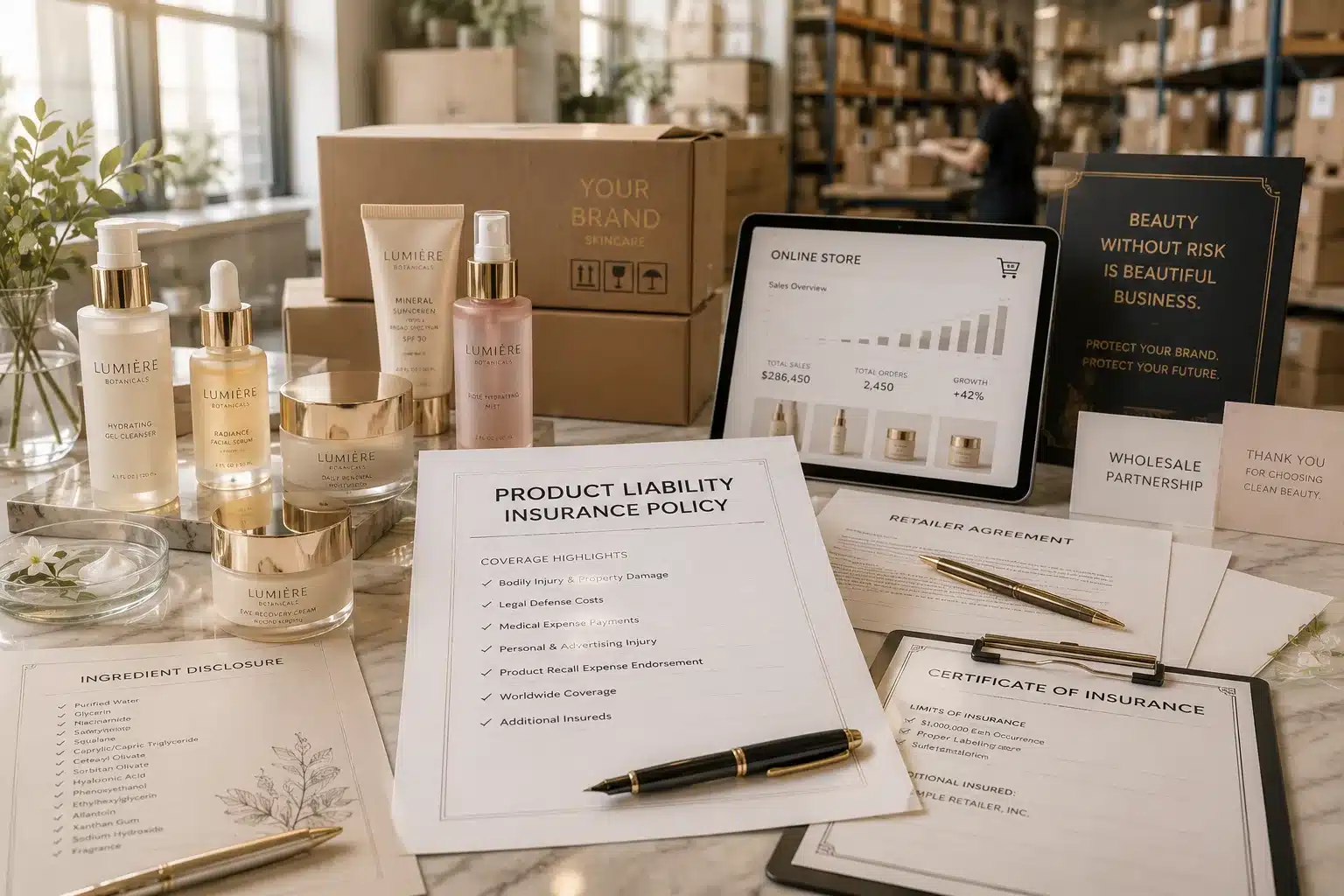

The Coyle Group structures cosmetic product liability coverage for complex, high-value brands that standard carriers and online platforms routinely misplace. We work with indie skincare founders, contract-manufactured labels, Amazon sellers, and established wholesale brands.
One customer reaction can change everything. The time to get covered is before a claim happens, not after.
Your skincare line is growing. Orders are coming in, retailers are calling, and you just landed your first wholesale account.
The time to get cosmetic product liability insurance is before a claim happens, not after.
What Is Cosmetic Product Liability Insurance and What Does It Actually Cover?
Cosmetic product liability insurance pays for legal defense costs, medical expenses, settlements, and court judgments when a customer or third party claims your product caused them harm. Most policies cover allergic reactions, skin irritations, chemical burns, contamination, mislabeling, and failure-to-warn claims.
Here is what a standard cosmetic product liability insurance policy covers:
What makes cosmetic product liability insurance different from a standard general liability policy is specificity. This coverage is built around products you make, import, or sell, not just the premises where you operate.
Who Needs Cosmetic Product Liability Insurance?
Any business whose name appears on a beauty or personal care product needs cosmetic product liability insurance, whether you formulate it in-house, private-label it, or import it, and whether you sell direct-to-consumer, through wholesale, or across major marketplaces.
Businesses that need this coverage include:
One of the most common misconceptions is the belief that working with a contract manufacturer transfers liability entirely to them. It does not. If your name is on the bottle, you are in the lawsuit.
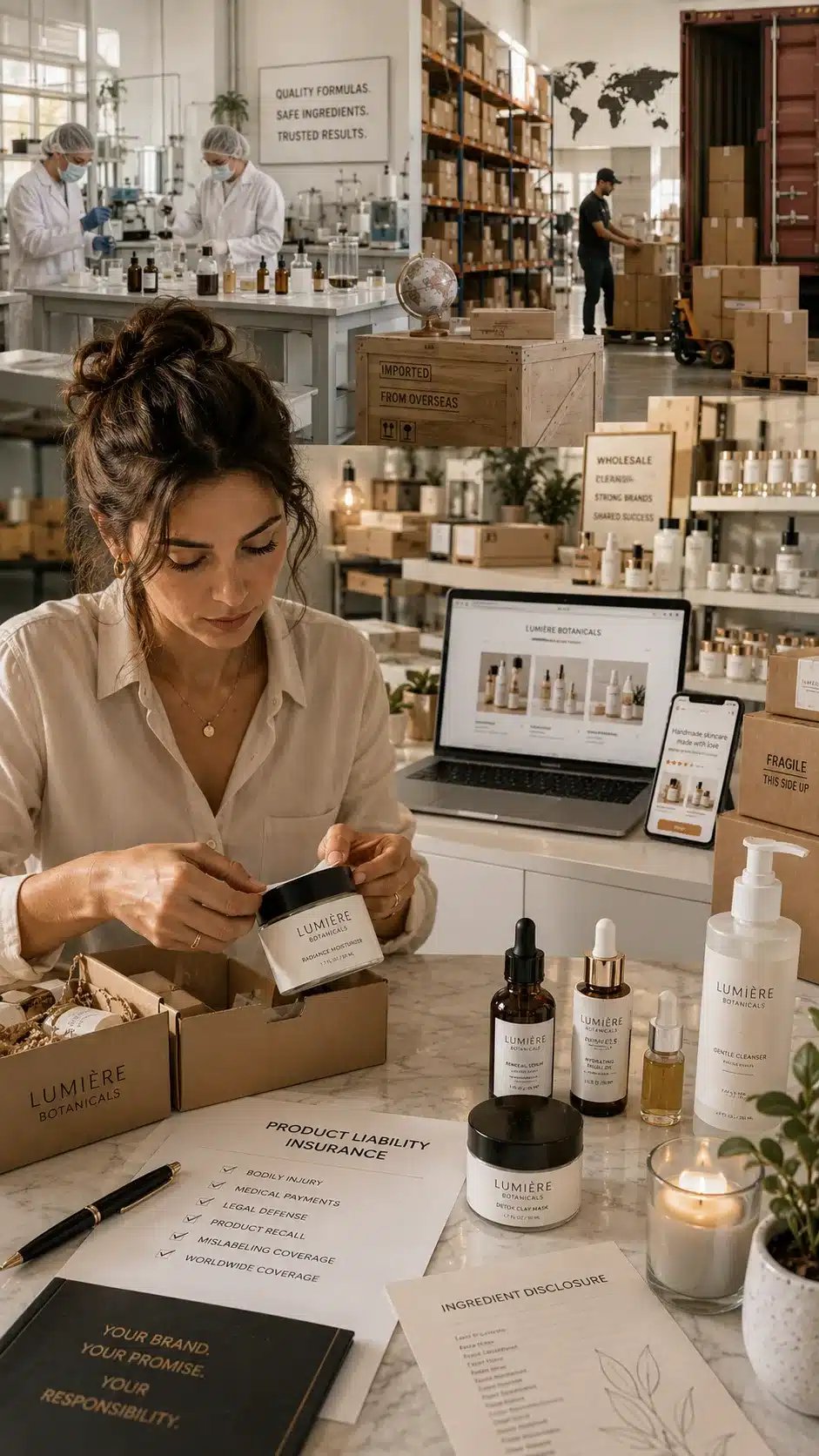
Where we fit best:
The Coyle Group is built for established beauty brands generating roughly $100,000 or more in annual sales, brands past the pre-launch and pre-revenue stage that are moving into wholesale, retail, and higher-volume direct-to-consumer, where a single vendor agreement or a single claim can put real money at risk. If you are still in the formulation or pre-revenue phase, a marketplace or online platform policy will usually carry you until your program is large enough to need a broker who structures it properly, and we are happy to point you in that direction.
Contact us if you are unsure whether your current policy actually covers the products you sell. We review policies at no cost.
What Coverage Limits Does a Cosmetic Product Liability Policy Actually Need?
Standard cosmetic product liability policies start at $1M per occurrence and $2M aggregate, which satisfies Amazon’s minimum and most small retail accounts. The gap most brands discover too late is that national retail chains and major wholesale buyers require $2M to $5M aggregate limits with the retailer named as an additional insured before they will put you on shelf, and if your current policy is not structured to accommodate that, you are renegotiating your coverage mid-deal.
Standard policy limits we structure cosmetic programs around:
Coverage |
Typical Starting Limit |
|---|---|
|
Each Occurrence |
$1,000,000 |
|
General Aggregate |
$2,000,000 |
|
Products and Completed Operations Aggregate |
$2,000,000 |
|
Personal and Advertising Injury |
$1,000,000 |
|
Medical Expense (per person) |
$5,000 |
|
Additional Insured Endorsements |
Included or available on request |
Why the starting limits matter:
Amazon requires a minimum of $1M per occurrence and insists you name “Amazon.com Services LLC and its affiliates and assignees” as an additional insured on the policy. Failure to comply results in listing suspension. The $1M/$2M structure satisfies that requirement from day one.
What retail and wholesale accounts typically require:
Distribution Channel |
Minimum Limit We Recommend |
|---|---|
|
Direct-to-consumer, Etsy, and online DTC |
$1M per occurrence / $2M aggregate |
|
Amazon |
$1M per occurrence (Amazon requirement) |
|
Regional retail (1-3 states, boutique or specialty) |
$1M per occurrence / $2M aggregate |
|
Regional grocery or pharmacy chain |
$2M per occurrence / $4M aggregate |
|
National retail (Sephora, Ulta, Target, Walmart) |
$2M-$5M per occurrence / $5M-$10M aggregate |
|
Wholesale and distribution agreements |
$2M-$5M; check contract language for exact requirement |
|
Private-label supply agreements |
$5M+ in some contracts; verify before signing |
Most retail distribution agreements require the retailer to be named as an additional insured and set a minimum liability limit as a condition of the agreement. If your policy cannot accommodate a high-limit additional insured endorsement without a complete rebuild, you will lose time on that deal.
The practical question is not what limits you can afford today. It is what limits your next retail account will require. Structuring at $2M/$4M from the start costs meaningfully less than rebuilding a policy under the pressure of a pending distribution agreement.
Contact us before you sign a retail or wholesale agreement. We confirm whether your current limits meet the contractual requirement, and fix it if they do not.
What Types of Cosmetic Products Can We Cover?
If your product is applied to the body externally, we can typically structure coverage for it. That includes skincare, color cosmetics, hair care, nail products, fragrances, baby care, and sun care. The nuance that determines which market you land in is ingredient-level: certain formulations require specialty or E&S placement rather than a standard admitted carrier, and knowing the difference before you apply saves significant time.
Product types we place include:
Skincare
Note on high-potency retinol: Carriers do not use a standardized retinol threshold. Formulations above 0.3% retinol often require a specialty market placement, and some carriers exclude high-potency actives entirely. Disclose your retinol concentration at application to avoid a post-claim exclusion dispute.
Color Cosmetics
Hair Care
Hair Color and Chemical Treatments
Note on chemical straighteners and relaxers: This class carries elevated claim frequency. Many standard admitted carriers decline it entirely. We place these through specialty and E&S markets where underwriters understand the risk class and price it accordingly. Do not attempt to place a chemical treatment line through a standard commercial carrier.
Nail Care
Fragrances and Body Products
Baby Skincare
Note on baby products: This class typically requires clean claims history and complete ingredient disclosure. Underwriters review formulations carefully. If you make claims about gentleness or hypoallergenic properties, those claims are part of the underwriting review.
Sun Care
Note on OTC sun care: Sunscreens classified as OTC drugs rather than cosmetics (SPF 15+ in many jurisdictions) require a different product liability form. Standard cosmetic product liability policies may not respond to an OTC drug claim. If your SPF product crosses the OTC threshold, confirm with your broker which policy form applies before you bind.
Candles and Wax Products with Skin Contact Claims
Private-Label and Contract-Manufactured Lines
Important: Private-label and contract-manufactured products are fully coverable, but your policy must list you as the manufacturer of record if your name is on the label. A certificate of insurance from your contract manufacturer does not protect your brand if a buyer sues the label, not the lab.
CBD Formulations
Note on CBD: Many standard admitted carriers exclude CBD products entirely. Specialty and E&S markets write topical CBD where THC content is verified at or below 0.3% and a third-party lab Certificate of Analysis (COA) is available. Above 0.3% THC, the product moves outside cosmetic product liability markets entirely.
Imported Cosmetics with a U.S. Domicile Address
Not sure whether your specific product qualifies? We review your product line on the call at no charge and tell you exactly which market applies before you fill out an application.
What Can Go Wrong Without It? The Real Cost of a Single Claim
In our experience reviewing cosmetic brand policies, a single product liability lawsuit, even one that settles early, commonly runs $75,000 to $250,000 in legal defense fees before a dollar of settlement money changes hands.
The claims that actually happen are not always dramatic. They are often mundane, and still financially devastating:
What Does Cosmetic Product Liability Insurance NOT Cover?
This is where most cosmetic product liability insurance policies get business owners into trouble. The exclusions are specific, and underwriters enforce them. Know what is typically off the table before you buy.
Ingredient-based exclusions:
Product-type exclusions:
Business-type exclusions:
Conduct-based exclusions:
How Much Does Cosmetic Product Liability Insurance Cost?
Premiums for cosmetic product liability insurance typically range from about $1,200 to more than $9,000 per year, depending on annual revenue, product type, distribution, risk tier, and claims history. Very small or pre-revenue sellers can often find standardized online programs below that range; brokered, structured placements for growing brands sit inside it.
Risk Tier |
Typical Products |
Annual Premium Range |
|---|---|---|
|
Entry |
Established DTC brands, simple formulations, single-channel distribution |
$1,200 to $2,000 |
|
Moderate |
Indie skincare with actives, trade show sellers |
$2,010 to $4,994 |
|
High |
Large-volume operations, excess coverage needed |
$5,200 and above |
An established skincare brand doing around $150,000 in annual sales, selling primarily online with no active pharmaceutical-grade ingredients, might pay roughly $1,400 to $2,000 annually. A mid-size brand selling through wholesale accounts with $2M in annual revenue, carrying retinol and AHA products, will pay considerably more and should expect it.
Why Placement Matters as Much as Coverage
Most standard admitted carriers and online insurance platforms apply broad, imprecise underwriting criteria to cosmetic brands. The result is a policy that looks complete but excludes your actual product line, the channels you sell through, or the specific ingredients you use.
Getting placed correctly requires a broker with access to specialty markets that actually write cosmetic risk: carriers who understand that retinol thresholds vary by carrier and are not standardized, who can structure a CBD formulation under the right market rather than declining it outright, and who know how to build additional insured requirements before a retail buyer asks for them.
A generalist broker who places your cosmetic line the same way they write a contractor’s general liability policy will typically get the exclusions wrong, not the coverage type, but the policy form details that determine whether a claim gets paid. That is where the gap lives, and that is what a structural policy review catches before it becomes a problem.
Frequently Asked Questions About Cosmetic Product Liability Insurance
Ready to Structure Your Coverage Correctly?
If you have been running your cosmetic brand without the right coverage, or if you are unsure whether your current policy actually covers the products you sell, the next step is a conversation, not a commitment.
Your job is to know your products and your distribution. Our job is to build the right policy around both.
We review existing policies at no cost. And we work with brands at every stage, from Etsy startups to multi-channel wholesale operations.

This article was written by the CEO of The Coyle Group, Gordon B. Coyle, CPCU, ARM, AMIM, PWCA, who has over 40 years of experience working with business owners of all sizes and industries across the US, solving their insurance challenges.
Here’s how to take the next step
Schedule Your Insurance Confidence Assessment
In our 30-minute call, you’ll discover:
Not ready for a call?
Get Free Access to Our Gated Video:
“How to Finally Feel Confident in Your Coverage. “
And discover the exact system we use to help business owners eliminate hidden coverage gaps, stop overpaying, and finally feel confident in their protection.
What Peace of Mind Looks Like
Trusted by business owners across the U.S.
The Coyle Group is 1st class! Gordon and his team are knowledgeable, responsive, and attentive to detail. Gordon is that rare breed of professional who genuinely cares for his clients and works hard to exceed their expectations. I highly recommend them.


The insurance brokerage service was truly tailored to my needs, nothing like those big brokers who steer you toward random policies that don’t fit your profile. Thank you to the team for your help.

I was working with another broker and having difficulty acquiring General Liability coverage. A colleague recommended The Coyle Group. They were able to get coverage bound in just a couple of business days and a policy issued in ten days, and with a solid carrier at a competitive premium. Truly impressive results, plus it was a pleasure working with them. I highly recommend the Coyle Group!

If any business is looking to work with an insurance brokerage firm that is not only excellent at what the firm does, but one that deeply values the needs of the clients, then The Coyle Group is the firm for you. Give them a call and see for yourself. I can assure that you will quickly agree.

Want to know more?
See related blogs

Product Liability Insurance for Importers: What You Need to Know (Video)

How to Protect Your Business From a Product Recall
The Boar’s Head Product Recall – What’s Insured?
