How to Protect Your Business From a Product Recall

How to Protect Your Business from a Product Recall

A defective or contaminated product can burn cash and brand equity fast. Protection starts before a recall ever happens, continues with a tested response plan, and finishes with the right financial backstop.

Build Prevention into Design and Production

  • Map hazards and controls at each step of production. Use structured methods like HACCP or FMEA scaled to your operation.
  • Lock in supplier quality. Require specs, certificates of analysis, and corrective action timelines in purchasing terms.
  • Standardize incoming inspections and first-article checks for critical components.
  • Document sanitation, changeovers, and maintenance with sign-offs and time stamps.
  • For manufacturers, keep a living risk register. A simple template is outlined in our strategic risk process.

Make Traceability Instant

  • Encode lots, lines, and shifts on every unit, case, and pallet.
  • Keep consignee and retailer lists exportable within minutes.
  • Run quarterly mock traces to prove you can isolate 24 hours or less of output.
  • Food producers can use the step-by-step checklist in product recall for food manufacturers.

Tighten Labeling and Regulatory Controls

  • Treat allergens, dosage, age-grading, and warnings as critical control points.
  • Build dual review into label changes and reprints.
  • Keep current with agency guidance for your category and record how you comply.
  • When a deviation occurs, use a structured investigation. Practical steps are in our guide to root cause analysis.

Create a Recall-Ready Playbook

  • Define roles across QA, legal, operations, customer service, PR, your broker, and the carrier.
  • Prewrite customer notices, press statements, and retailer instructions.
  • Pre-approve disposal vendors and freight partners and capture destruction certificates.
  • Store the playbook with off-site access privileges and version control.

Train and Test the Team

  • Run tabletop exercises twice a year with a rotating scenario.
  • Measure time to isolate lots, notify consignees, and stand up a call center.
  • After each drill, fix bottlenecks and update the playbook.

Protect the Balance Sheet with the Right Insurance
  • Product recall insurance funds the recall process. It pays for notifications, reverse logistics, disposal, crisis communications, and often business interruption during the event. Details and common triggers are outlined in product recall insurance.
  • Product liability insurance funds defense and indemnity when there are injury or property damage claims arising from a product. Budgeting guidance is in product liability insurance cost 2025.
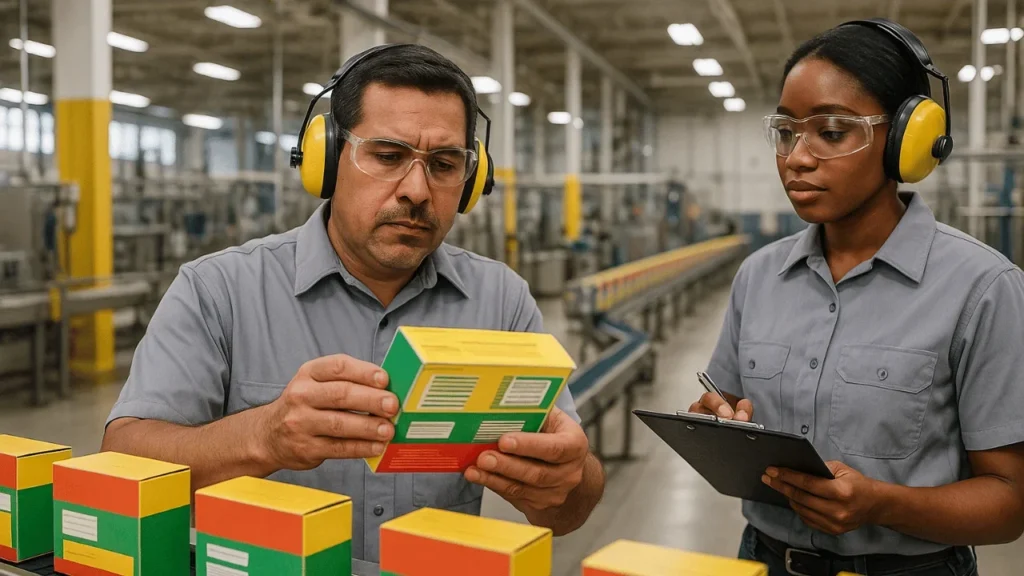
Quality control workers inspecting packaged goods on a production line, illustrating how product recall insurance helps manufacturers respond to defects quickly.

Product Recall vs. Product Liability at a Glance

Coverage area

Product Liability

Product Recall

Injury or property damage lawsuits

Yes

No

Defense, settlements, judgments

Yes

No

Regulatory compliant notifications

No

Yes

Reverse logistics and disposal

No

Yes

Consumer and retailer call centers

No

Yes

Crisis communications and brand repair

No

Often yes

Business interruption during recall

No

Often yes

Government ordered recall costs

No

Often yes

Real-World Example

A regional ready-to-eat foods company discovered a labeling error that omitted a major allergen. The company voluntarily recalled multiple lots, notified retailers and consumers, paid for returns and disposal, and ran a two-week PR and call-center campaign. No injuries and no lawsuits occurred, yet the event created a seven-figure spend on logistics and brand protection. This is exactly where recall insurance complements a solid prevention and traceability program.

Quick Protection Checklist

  • Hazard analysis covers ingredients, components, labeling, and packaging.
  • Supplier quality agreements include test protocols and corrective actions.
  • Lot coding links to lines, shifts, and dates on every level of packaging.
  • Consignee and retailer lists export in minutes and are tested quarterly.
  • Draft notices and press statements are pre-approved and stored with the playbook.
  • Contracts in place for freight, warehousing, and certified destruction.
  • Limits coordinated across product recall insurance and product liability.

Questions about How to Protect Your Business From a Product Recall

How do I reduce the chance of a recall?

Strengthen supplier controls, labeling reviews, and sanitation, then prove traceability with mock drills. Use a structured investigation process like the one in our root cause analysis guide to prevent repeat issues.

What should be in a recall plan?

Names and roles, decision trees, message templates, consignee lists, freight and disposal partners, and a documentation trail. Manufacturers can start with the framework in product recall for food manufacturers.

Do I still need insurance if my quality is strong?

Yes. Even well-run firms face supplier errors, mislabels, and malicious tampering. Use product recall insurance for the operational costs and pair it with liability limits for potential injury claims.

Author’s Experience

This article was written by the CEO of The Coyle Group, Gordon B. Coyle, CPCU, ARM, AMIM, PWCA, who has over 40 years of experience working with business owners of all sizes and industries across the US, solving their insurance challenges.

Check Out Our Blogs