
How Much D&O Insurance Does Your Nonprofit Need?
Right-Sizing Coverage for Nonprofit Boards


Most nonprofit boards set their D&O limit once, accept the number a broker suggested, and have not revisited it since. The organization added employees. Took on government grants. Expanded into new programs. The limit stayed the same.
D&O insurance pays the legal defense and settlement costs when nonprofit board members or executives are personally sued for decisions made in their governance role.
Most board members consider it non-negotiable before they agree to serve.
That gap between “we have D&O” and “we have the right amount” is where the exposure lives.
Getting the limit right requires knowing your organization’s actual risk profile, not a peer’s coverage decision or a grant requirement minimum.
The Coyle Group is a commercial insurance agency that handles the complex, high-value risks other agencies don’t know how to structure, where the details in the policy are the difference between a paid claim and a denied one.
Executive Summary
Most nonprofits need between $1 million and $5 million in D&O coverage.
The right limit depends on:
Small organizations with under $1 million in revenue and no employees often start at $1 million in coverage.
Those with paid staff, government grants, or multi-site operations should target $2 million to $5 million.
Large nonprofits with over $50 million in revenue or significant governance complexity frequently require $10 million or more.
The sections below walk through how to determine the right number for your specific organization.
Is your nonprofit carrying the right D&O limit?
Most boards don’t find out they were underinsured until a claim is already in progress. A generalist broker typically defaults to $1 million because it’s the easiest quote to run, without evaluating your employment headcount, grant exposure, or whether your aggregate is high enough to survive two claims in the same year. At The Coyle Group, we analyze your full risk profile to recommend a limit tied to your actual exposure.
What Happens When a Nonprofit Board Runs Out of D&O Coverage?
Most nonprofit boards assume their D&O policy will cover any claim that arises. The reality is more complicated, and the consequences of running short show up at exactly the worst moment: when a claim is active, defense costs are accumulating, and the board needs protection most.
According to Nonprofits Insurance Alliance claims data, about 63% of nonprofits have faced at least one D&O claim in the past decade, roughly twice the rate for-profit companies experience. Employment practices drive 94% of nonprofit D&O claim dollars, with wrongful termination, discrimination, and harassment representing the majority of filed claims. The average nonprofit D&O claim settles around $35,000, but 10% of claims exceed $100,000 in total costs, and over 1,500 nonprofit D&O claims are filed annually across the United States.
The Wasting Limit Problem Most Boards Miss
The organizations most exposed are not always the largest. Small and mid-sized nonprofits face identical claim types as large institutions, but frequently carry limits set years ago that have not kept pace with organizational growth.
That constraint, combined with a stale limit, leaves individual board members personally exposed.
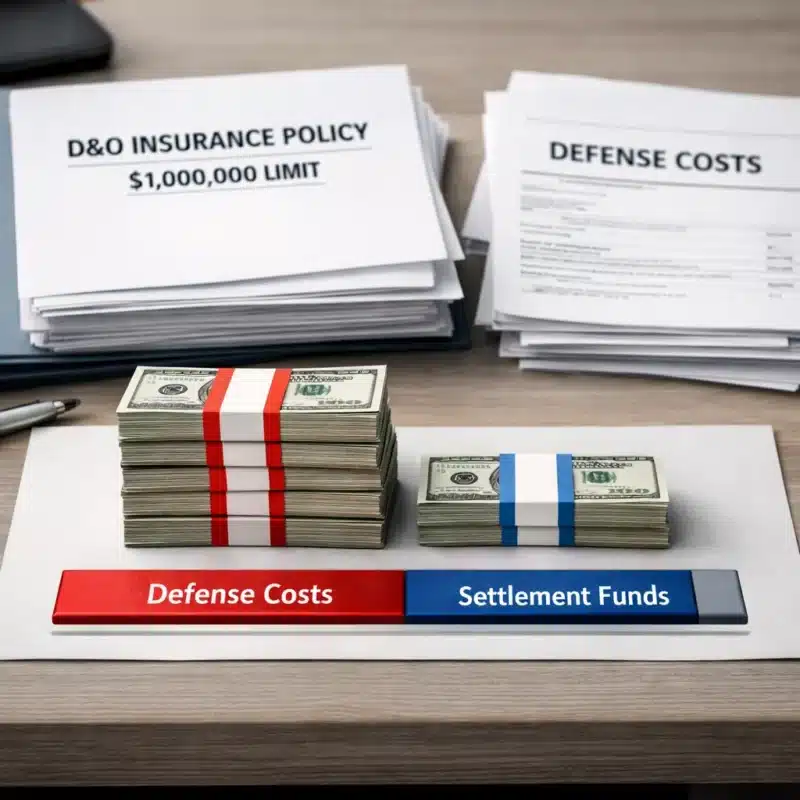
Nonprofit D&O claims differ from for-profit D&O claims in a few important ways
Funders and grantors pay attention to litigation involving a nonprofit they support, which means claim resolution can affect future funding relationships, not just the legal outcome.
When coverage runs out, there are two scenarios
For a deeper look at what nonprofit D&O insurance covers and how it is structured, reviewing that foundation matters before deciding how much to buy.
How Much D&O insurance Does a Nonprofit Actually Need?
Most nonprofits need between $1 million and $5 million in D&O coverage, with the right number tied to annual revenue, employee headcount, program complexity, and geographic reach. Smaller organizations can often start at $1 million, but that baseline needs revisiting each renewal as your budget, staff, and program footprint grow.
The most reliable framework in the industry uses annual revenue as the primary sizing input, then adjusts upward based on risk factors that underwriters consistently flag as claim-driving variables. Here is how coverage benchmarks break down across nonprofit revenue tiers.
The question of how much D&O insurance a nonprofit needs does not have a single answer, but it does have a structured framework, and that is what this chart displays.
Nonprofit D&O Coverage Limits by Revenue Size
Annual Revenue |
Recommended D&O Limit |
Notes |
|---|---|---|
|
Under $500K |
$1M per occurrence / $1M aggregate |
Baseline for volunteer-run orgs with no employees |
|
$500K to $1M |
$1M per occurrence / $2M aggregate |
Aggregate increase needed once any paid staff are on payroll |
|
$1M to $5M |
$1M to $2M per occurrence / $2M to $3M aggregate |
Add EPLI; employment risk rises sharply with staff count |
|
$5M to $20M |
$2M to $5M per occurrence / $5M aggregate |
Multi-location, government grants, or regulatory exposure pushes limits up |
|
$20M to $50M |
$5M to $10M |
Complex governance, investment accounts, or housing programs require higher aggregate |
|
Over $50M |
$10M or more |
Class action exposure, major donor disputes, regulatory enforcement actions |
Two things this table does not capture on its own
What Nonprofit D&O Covers and What It Does Not
Before setting a limit, it helps to know what the policy is actually paying for.
D&O covers
D&O does not cover
The directors and officers liability hub covers the full policy structure, including Side A, Side B, and Side C coverage, for boards that need to understand what is being insured before setting how much to buy.
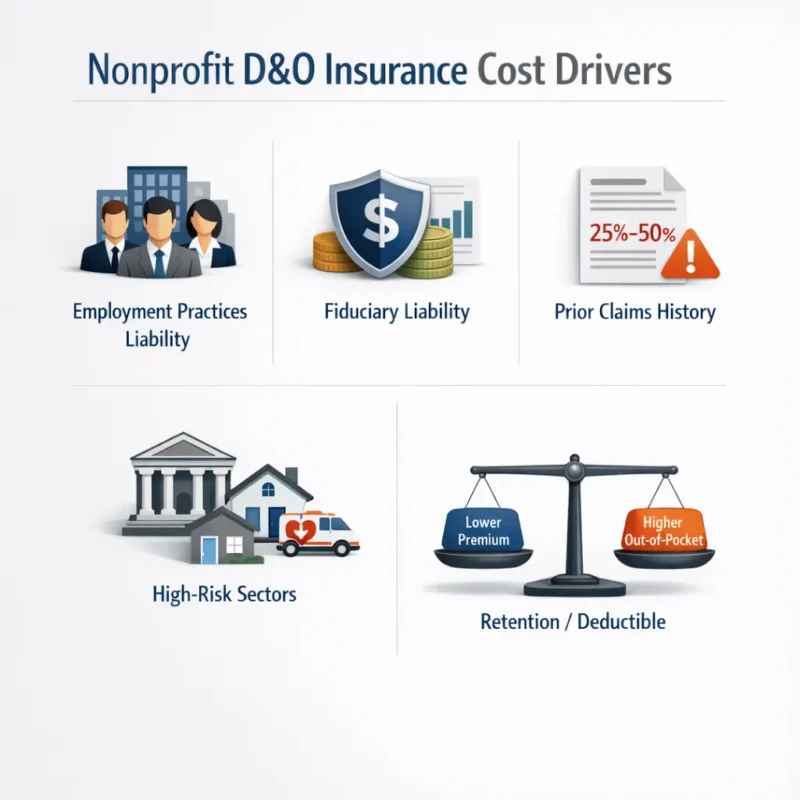
What Factors Push Your Nonprofit’s D&O Limits Higher?
Revenue is the starting input for sizing nonprofit D&O coverage, but underwriters look at a range of organizational characteristics before finalizing a quote or approving a limit increase. Several factors consistently require limits above the baseline revenue-tier recommendation.
The factors that most commonly drive nonprofit D&O limits higher include:
Employee headcount
Organizations with 25 or more employees carry significantly higher employment practices exposure. Every additional employee represents a potential plaintiff in a wrongful termination, discrimination, or harassment claim. Adding Employment Practices Liability alongside D&O is standard practice once payroll reaches this threshold.
Grant funding and government contracts
Nonprofits that receive government grants face regulatory scrutiny over fund usage and grant compliance. A single grant compliance dispute can trigger a formal government enforcement action, with defense costs that run well into six figures even before any finding of wrongdoing.
Public access programs
Organizations operating food banks, shelters, youth services, or community health programs interact with high volumes of individuals. The frequency of those interactions increases employment and governance claim exposure in ways that peer organizations in arts or environmental sectors do not face.
Investment accounts and endowments
Boards managing significant investment portfolios face fiduciary liability claims if investment decisions underperform or are challenged by donors. Fiduciary liability coverage is typically added alongside D&O for nonprofits managing endowments or retirement plan assets.
Multi-location operations
Each additional site adds employees, program complexity, and independent governance decisions. Underwriters treat multi-location nonprofits similarly to larger revenue-tier organizations because aggregate exposure multiplies with each operational footprint.
Prior claims history
A prior D&O claim, even one that resolved favorably, signals elevated risk to underwriters. Organizations with prior claims often face stricter limit approval and higher premiums per dollar of coverage. In some cases, carriers decline to increase limits until a clean claims period is established.
Board size and composition
Larger boards with more individual decision makers mean more insured persons under the policy and more potential for insured-versus-insured disputes, particularly during governance transitions or leadership conflicts.
Sectors with regulatory oversight
Nonprofits in healthcare, housing, education, substance abuse treatment, and social services face more frequent regulatory enforcement actions than nonprofits in lower-scrutiny sectors. Government audits and enforcement actions involving program delivery or billing can generate defense costs that rival large employment claims.
The National Council of Nonprofits provides sector-level governance resources that can help boards identify which of these risk factors apply to their organization before discussing limit adjustments with a broker.
How Much Does Nonprofit D&O Insurance Cost Per Coverage Level?
D&O coverage for nonprofits is significantly more affordable than most executive directors expect, particularly at the $1 million level. Cost increases as limits rise, but the jump from $1 million to $2 million in coverage is usually modest compared to the additional protection it provides.
Here is a realistic premium range based on current market conditions, for organizations without major claims history or high-risk endorsements.
Nonprofit D&O Premium Ranges by Coverage Limit
Coverage Limit |
Estimated Annual Premium Range |
Notes |
|---|---|---|
|
$1M (no paid employees) |
$600 to $900/year |
Baseline for small, volunteer-run organizations |
|
$1M (with employees) |
$750 to $1,700/year |
Market median approximately $855 |
|
$1M bundled with EPLI |
$1,200 to $1,800/year |
Industry median approximately $1,508 |
|
$2M aggregate |
Add $200 to $500 above base premium |
Depends on claims history, sector, and employee count |
|
$2M to $3M policy limit |
$1,500 to $3,500/year |
Mid-tier nonprofits with employment exposure |
|
$5M |
$3,000 to $6,000/year |
Larger organizations with staff of 25 or more |
|
$10M or more |
$5,000 to $15,000/year |
Large nonprofits, endowment holders, government contractors |
Premiums scale at approximately 0.03% to 2% of the selected limit, depending on claims history and sector risk.
For most nonprofits, that premium difference is smaller than the cost of a single attorney consultation hour, and it doubles the available coverage capacity.
What changes costs more significantly than limit alone:
The question of how much D&O insurance is enough covers the limit decision framework in more depth for organizations also evaluating private company or for-profit D&O alongside nonprofit governance needs.
How to Evaluate Whether Your Current D&O Limits Are Still Right
Most nonprofits set their D&O limits during the first broker engagement and do not revisit them unless a claim occurs or a grantor specifically requires a higher limit. Revenue grows, staff are added, programs expand, and the original limit stays fixed.
That is how organizations end up materially underinsured without anyone on the board noticing.
The Nonprofit Risk Management Center recommends nonprofits review D&O coverage annually alongside any significant organizational change.
Switching carriers without confirming the new carrier matches your existing retroactive date can create a gap that exposes the board to uncovered claims from past decisions.
Here is a practical review framework for that conversation with your broker.
Signs your current limits may need to increase:
What to bring to a limit review:
Running this review each renewal year positions your organization to make an informed decision rather than accepting an automatic renewal at a limit that may no longer reflect your actual risk.
“We’re a Small Nonprofit. Do We Really Need More Than $1 Million in D&O Coverage?”
This is the most common objection executive directors raise when discussing D&O limits, and it deserves a direct answer. For many small nonprofits, $1 million in coverage is an appropriate starting point.
But “small” and “low-risk” are not the same thing, and the distinction matters more than most boards realize.
Real-World Example
This is a scenario we see play out. A nonprofit with $800,000 in annual revenue and eight employees was sued by a former program director for wrongful termination and age discrimination. Defense costs over 14 months totaled $210,000 before the case settled for $175,000.
Total cost to the policy: $385,000 against a $500,000 aggregate limit. The board members were not personally liable in the end, but the organization exhausted nearly all of its available coverage on a single claim, leaving zero protection for the remainder of the policy year.
The math case for carrying at least $1 million in aggregate D&O coverage is difficult to argue against at almost any nonprofit size.
The real debate for most organizations is not whether to carry $1 million, but whether the step up to $2 million or $3 million aggregate is warranted, given their specific employee count, program complexity, and sector.
For the smallest organizations, D&O premiums can feel disproportionate relative to budget. That frustration is real, but the answer is not to carry less coverage than the risk warrants.
For organizations in a leadership transition or merger, understanding D&O tail policy options matters alongside the limit decision. Tail coverage should match or exceed the in-force D&O limit to preserve continuity of protection for departing directors after the policy ends.
Questions: Nonprofit D&O Insurance Limits
Right-Size Your Nonprofit’s D&O Coverage
Gordon B. Coyle has over 40 years of experience helping nonprofit boards, executive directors, and governance teams navigate commercial insurance. He has reviewed hundreds of D&O programs and consistently found limits set years ago that no longer reflect the organization’s actual exposure.
The Coyle Group builds nonprofit D&O programs tied to your revenue tier, employee count, program type, and sector risk. We audit what you currently carry, identify limit gaps before a claim forces the question, and coordinate D&O with EPLI and fiduciary coverage so nothing falls through.
If you are not certain your current D&O limit is adequate for where your organization is today, the right move is to get it reviewed before renewal. Reach out, and we will give you a clear recommendation based on your actual risk profile.

This article was written by the CEO of The Coyle Group, Gordon B. Coyle, CPCU, ARM, AMIM, PWCA, who has over 40 years of experience working with business owners of all sizes and industries across the US, solving their insurance challenges.
Here’s how to take the next step
Schedule Your Insurance Confidence Assessment
In our 30-minute call, you’ll discover:
Not ready for a call?
Get Free Access to Our Gated Video:
“How to Finally Feel Confident in Your Coverage. “
And discover the exact system we use to help business owners eliminate hidden coverage gaps, stop overpaying, and finally feel confident in their protection.
What Peace of Mind Looks Like
Trusted by business owners across the U.S.
The Coyle Group is 1st class! Gordon and his team are knowledgeable, responsive, and attentive to detail. Gordon is that rare breed of professional who genuinely cares for his clients and works hard to exceed their expectations. I highly recommend them.


The insurance brokerage service was truly tailored to my needs, nothing like those big brokers who steer you toward random policies that don’t fit your profile. Thank you to the team for your help.

I was working with another broker and having difficulty acquiring General Liability coverage. A colleague recommended The Coyle Group. They were able to get coverage bound in just a couple of business days and a policy issued in ten days, and with a solid carrier at a competitive premium. Truly impressive results, plus it was a pleasure working with them. I highly recommend the Coyle Group!

If any business is looking to work with an insurance brokerage firm that is not only excellent at what the firm does, but one that deeply values the needs of the clients, then The Coyle Group is the firm for you. Give them a call and see for yourself. I can assure that you will quickly agree.

Want to know more?
See related blogs
Protecting Non-Profit Board Members with D&O Insurance

Rippling PEO Review: EPLI Coverage Risks Explained
The Ultimate Guide to D&O Insurance: Everything You Need to Know in 2025