
Cheap Business Insurance – 6 Things to Consider
75% of US small businesses are underinsured. The cheapest policy isn’t a bargain; it’s a coverage gap waiting to become a claim denial. Here’s how to get adequate protection at the most competitive price.
TLDR
Searching for “cheap business insurance” is understandable, but the lowest-priced policy is rarely the right one. 75% of US small businesses are underinsured. 25-33% that suffer a major uninsured loss never reopen. The price difference between an adequate policy and an inadequate one is often smaller than business owners expect. The coverage gap, however, can be the difference between surviving a claim and closing permanently.
Why “Cheap Business Insurance” Is the Wrong Search
A cheaper policy is not a cheaper version of the same thing. It is a different product, one with narrower definitions, lower limits, and exclusions written specifically to reduce what the insurer pays when you file a claim. Most business owners don’t discover this until after a loss has occurred and the claim has been denied or underpaid.
Most business owners approach insurance the same way they approach buying a commodity: find the lowest price, move on. That works for paper clips. It does not work for commercial insurance.
Here is what the search for cheap business insurance actually produces:
The right search is not “cheapest business insurance.” The right search is “adequate business insurance at the most competitive price.” Those are not the same thing, and the difference matters when a claim is filed.

What Cheap Policies Actually Cut
When an insurer or direct-write platform offers a policy at a significantly lower price than competitors, the savings come from somewhere. These are the four most common places, and the ones most likely to produce a claim denial when you need coverage.
Lower Limits
A $1M general liability limit sounds substantial until a customer sustains a serious injury at your premises, and the lawsuit, including defense costs, medical expenses, and damages, exceeds that number. Umbrella coverage fills that gap, but only if you have it. Cheap policies rarely bundle it.
Sub-Limits on Key Perils
Many low-cost commercial property policies apply sub-limits to specific causes of loss, water backup, equipment breakdown, or business interruption. A $500,000 property policy with a $25,000 water backup sub-limit means a burst pipe in your HVAC system is mostly your problem.
Industry-Specific Exclusions
A catering company without product liability. A gym without assault and battery coverage. A tech firm without professional liability. These are not edge cases, they are exactly the exclusions that low-cost policies use to price themselves down.
No Business Interruption Coverage
51% of small businesses lack adequate property coverage. A fire that takes your building offline for four months costs you the repair bill plus four months of revenue, payroll, and rent. Business interruption insurance covers the revenue gap. Cheap policies frequently exclude it or cap it at amounts that don’t reflect actual revenue.
The 5 Coverage Types Small Businesses Skip Most Often
These are the coverages most frequently cut from low-cost policies, and the ones most likely to produce a catastrophic gap when a claim is filed. Each one addresses a distinct exposure that standard general liability and property policies do not cover.
1. Cyber Liability
35% of small businesses carry no cyber insurance. The average cost of a data breach ranges from $120,000 to $1.24 million. A ransomware attack is not covered under a standard GL or property policy. Cyber coverage is a separate policy, and the most commonly skipped.
2. Employment Practices Liability
Wrongful termination and harassment claims hit small businesses at the same rate as large corporations. A single employee lawsuit costs $75,000 to $125,000 in legal fees alone, regardless of outcome. Standard commercial policies do not cover this.
3. Business Interruption
A fire, flood, or utility failure can close your doors for weeks. Without business interruption insurance, that revenue is simply lost. Most small businesses still do not carry adequate coverage, or any coverage, for income loss during a forced shutdown.
4. Umbrella / Excess Liability
Only 32-42% of small businesses carry umbrella coverage. Umbrella policies extend your GL and commercial auto limits for a relatively low additional premium, typically a few hundred dollars per year for $1M in additional coverage. It is among the most cost-effective policies available, and among the most frequently skipped.
5. Professional Liability (E&O)
If your business provides advice, design, or consulting, you need errors and omissions coverage. Standard general liability does not cover professional mistakes. For service businesses, this is one of the most consequential gaps in a cheap policy.
How Business Insurance Is Actually Priced
Understanding what drives your premium makes it easier to find real savings, without cutting coverage. Insurance carriers price commercial policies based on industry classification (your SIC code), revenue and payroll, claims history, limits and deductibles, location, and coverage scope. The levers that save you real money are claims history, deductibles, and carrier selection, not limit reductions.
What Actually Drives Your Rate
A commercial property insurance review that compares actual coverage terms, not just premium totals, often surfaces savings that cutting limits never would.
What to Look for Instead of Price
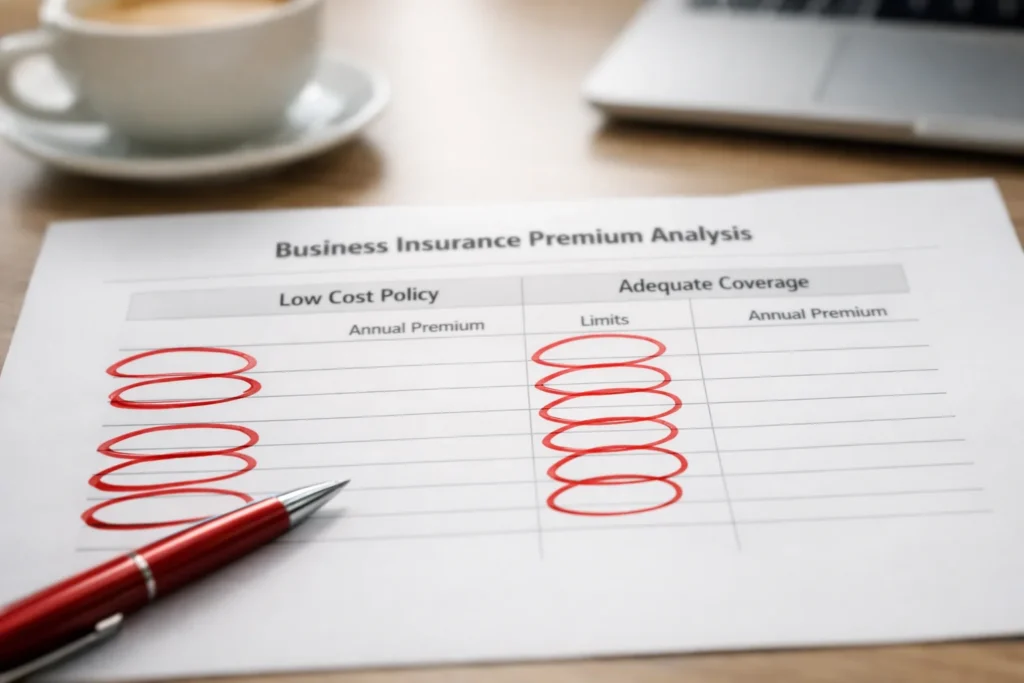
If you want adequate coverage at the most competitive rate, evaluate policies on these criteria instead of the premium alone. A policy that is $400 cheaper per year but excludes the peril most likely to hit your business is not a savings; it is a deferred loss.
Coverage Evaluation Checklist
What Claims Analysis Tells Us
Root cause analysis of commercial claims consistently shows that coverage gaps, not coverage denials, are the primary driver of uninsured losses. The gap was built into the policy at inception.
The most common finding: the insured purchased a policy that met the price target, confirmed it was “business insurance,” and never reviewed the exclusions that determined what it actually covered.
By the time a claim is filed, those exclusions are no longer an abstract policy detail. They are the reason the check isn’t coming.
How an Independent Broker Gets You More for Less
The common assumption is that going direct, buying online without a broker, saves money by cutting out the middleman. That assumption is incorrect. Independent brokers do not add cost to your policy. Their commission is built into the premium regardless of which channel you use. What changes is what you get for that premium.
Broker vs. Direct: What You Actually Get
Is it cheaper to buy business insurance online or through an agent?
Industries That Get Hit Hardest by Underinsurance
These sectors have the highest rate of underinsurance claims and the largest gaps between what was covered and what was owed. If your business falls into one of these categories, a cheap policy is especially likely to fail at the moment you need it most.
Restaurants and Food Service
Kitchen fires, slip-and-fall claims, foodborne illness liability, and liquor liability combine to create layered exposure that low-cost BOPs routinely exclude. A restaurant that carries basic GL without liquor liability, product liability, or a properly maintained equipment breakdown endorsement is materially underinsured.
Professional Services
Accountants, consultants, architects, and IT firms face professional liability exposure that standard GL does not cover. The cheapest policy for a professional services firm is frequently one that covers almost nothing when a client dispute turns into a lawsuit.
Retail and E-Commerce
Product liability, cyber exposure from payment systems, and cargo coverage during shipping are all commonly excluded from entry-level retail policies. An e-commerce business that suffers a data breach affecting customer payment information has no coverage under a standard BOP without a cyber endorsement.
Construction and Contractors
Completed operations coverage, equipment coverage, and subcontractor liability are critical for contractors, and routinely missing from the cheapest builder’s risk and GL packages available online. A claim from work completed two years ago, on a policy that lapsed, can destroy a contracting business.
Want to know what your current policy actually covers, and what it doesn’t?
Cheap Business Insurance FAQ
The Bottom Line
Cheap business insurance is a real product. It just is not the product most business owners think they are buying.
75% of small businesses in the US are underinsured. 25-33% of those that experience a major uninsured loss never reopen. The gap between what they paid for and what they needed was built into the policy at the beginning, in the exclusions, the sub-limits, and the coverage types they chose not to include.
The right goal is not the cheapest policy. It is the most economically priced policy that actually covers what your business faces. Those are not the same thing.
The Coyle Group works exclusively with commercial clients. We review your current coverage, identify gaps, and shop the market to find the best terms at the most competitive price.
This article was written by Gordon B. Coyle, CPCU, ARM, AMIM, PWCA, CEO of The Coyle Group, who has over 40 years of experience working with business owners of all sizes and industries across the US, solving their insurance challenges.


