
If you’re a business owner confused about the difference between E&O and D&O insurance, you’re not alone. I’ve been helping businesses navigate these insurance decisions for over 40 years, and this is one of the most common questions I hear. While these policies may sound similar, they serve completely different purposes and protect against distinct risks.
Here’s the truth: choosing the wrong coverage or missing essential protection could leave your business exposed to devastating financial losses that could have been easily prevented.
Key Takeaways
Quick Answer
E&O (Errors & Omissions) insurance protects your business when clients claim you made a professional mistake that cost them money. D&O (Directors & Officers) insurance protects your company’s leaders personally when someone sues them over a management decision. E&O covers professional service failures; D&O covers leadership liability. Most businesses with both client-facing services and a formal leadership structure need both policies.
What Is D&O Insurance (Directors and Officers Liability)?
Let me start with D&O insurance, since this one tends to confuse business owners the most. D&O insurance protects your company’s leadership, directors, officers, and executives from personal liability when someone sues them for management decisions.
Think of it this way: if you’re running a company and a shareholder, employee, or regulator claims you made a bad management decision that cost them money, they can sue you personally. Without D&O insurance, your personal assets, your house, savings, and investments could be at risk.
In my experience, D&O insurance serves three critical functions that most business owners don’t realize:
Here’s what surprises most business owners: D&O claims don’t just come from unhappy customers. They typically come from employees, but I’ve also seen claims from regulators, competitors, shareholders, and creditors.
What Is E&O Insurance (Errors and Omissions Liability)?
Now, E&O insurance is completely different, and honestly, much easier to understand. E&O insurance protects your business when clients claim you made professional mistakes that cost them money.
If you provide any kind of professional service, consulting, accounting, legal advice, engineering, IT services, even marketing, and a client says you screwed up and they lost money because of it, that’s when E&O insurance kicks in.
The key thing to remember about E&O insurance is that it’s all about your relationship with clients. When clients feel you’ve failed to deliver what you promised, or made an error that hurt them financially, they can sue you. E&O insurance covers your defense costs, settlements, and judgments.
The bottom line? If you’re getting paid to use your professional expertise to help others, you probably need E&O insurance.
What Is the Difference Between E&O and D&O Insurance?
Here’s where I see business owners get confused the most.
The primary difference between E&O and D&O insurance comes down to this simple question: Who’s getting sued and why?
Let me break this down in the simplest way possible:
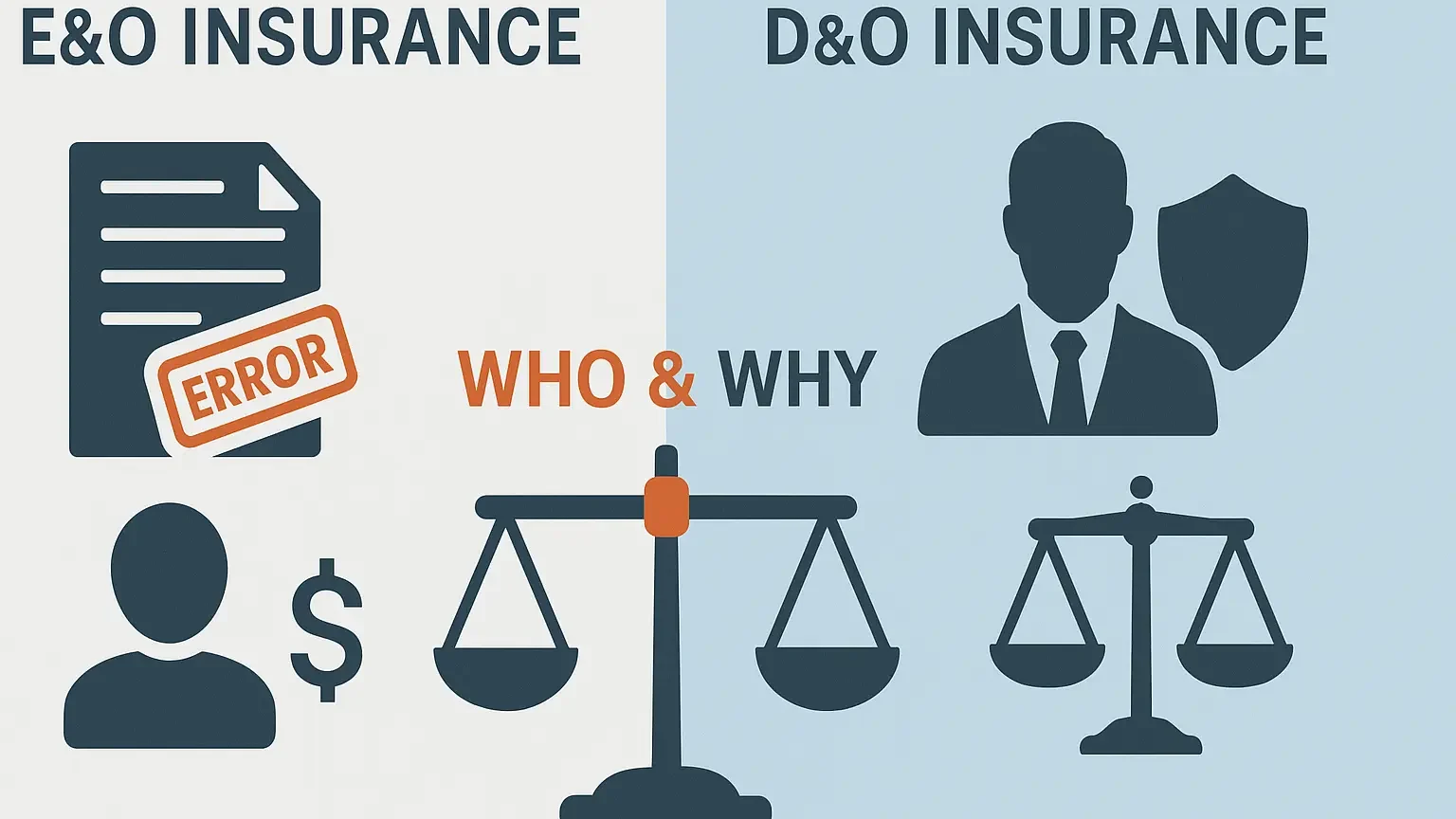
Who Gets Coverage Protection
Types of Wrongful Acts Covered
Key Differences Between E&O and D&O Insurance
After 40+ years in this business, I’ve found the easiest way to understand the difference between E&O and D&O insurance is to look at three key areas:
1. Who Gets Protected
2. Who’s Likely to Sue You
3. What Triggers Coverage
The biggest mistake I see business owners make is thinking these policies overlap. They don’t. They’re designed to protect against completely different risks.
Difference Between E&O and D&O Insurance: Real-World Claim Examples
Sometimes the best way to understand the difference between E&O and D&O insurance is to see how each one works in a real claim scenario.
D&O Claim Example: Board Sued Over Failed Acquisition
A mid-sized manufacturing company’s board approved a $12 million acquisition that ultimately failed, resulting in significant financial losses. Minority shareholders filed a lawsuit claiming the directors failed to perform adequate due diligence and breached their fiduciary duty. The company’s D&O policy covered over $800,000 in legal defense costs and the eventual settlement. Without D&O insurance, the directors would have been personally liable for those costs, putting their homes, savings, and personal investments at risk.
E&O Claim Example: Consultant’s Bad Advice Costs Client $200K
An IT consulting firm recommended a software platform to a client, assuring them it would integrate with their existing systems. After implementation, the software failed to work as promised, causing $200,000 in lost productivity and forcing the client to start over with a different vendor. The client sued the consulting firm for professional negligence. The firm’s E&O policy covered the legal defense and a negotiated $150,000 settlement, costs that would have been devastating to a small firm paying out of pocket.
Notice the pattern? The D&O claim came from shareholders suing leadership over a management decision. The E&O claim came from a client suing the business over a professional service failure. Different risks, different policies, different protection.
Not sure which coverage your business needs?
Do You Need Both Types of Coverage?
Most businesses with both a leadership team and client-facing services need both E&O and D&O insurance. That’s the short answer. The longer answer depends on how your business is structured, but in 40+ years of advising companies, I’ve found that the businesses that think they only need one policy are usually the ones most exposed.
You Definitely Need D&O Insurance If Your Business Has:
Here’s what most small business owners don’t realize: you don’t need to be a Fortune 500 company to get sued by employees or shareholders. Our comprehensive guide to D&O insurance coverage shows exactly when this protection becomes essential.
You Definitely Need E&O Insurance If Your Business:
For more detailed information about what is professional liability insurance and who needs it, I break down exactly which business types benefit most from E&O protection.
Industries That Often Need Both Coverages
In the financial services world, such as hedge funds, private equity, venture capital, and investment advisors, these two policy types are often combined into one policy form. Additionally, technology companies, healthcare organizations, and professional service firms frequently require both D&O and E&O protection.

What About EPLI? How It Fits with D&O and E&O Insurance
There’s a third policy that often comes up in this conversation, and it’s one I think every business owner should understand: Employment Practices Liability Insurance (EPLI).
EPLI covers your company when employees sue over employment-related issues, wrongful termination, discrimination, harassment, or retaliation claims. While D&O insurance can cover directors and officers personally for some employment-related lawsuits, it typically does not cover claims made against the company itself. That’s where EPLI fills the gap.
Here’s how all three work together:
|
|
D&O |
E&O |
EPLI |
|---|---|---|---|
|
Protects |
Directors & officers personally |
The business and its employees |
The company as employer |
|
Claims from |
Shareholders, regulators, employees |
Clients and customers |
Current/former employees |
|
Covers |
Management decisions |
Professional service errors |
Employment actions |
|
Common trigger |
Bad strategic decision |
Client loses money from your mistake |
Wrongful termination or harassment claim |
Many insurers bundle D&O and EPLI into a single management liability policy, which can be more cost-effective than buying them separately. If you’re already looking at D&O coverage, ask your broker about adding EPLI, it’s often just a modest increase in premium for significantly broader protection.
Need D&O, E&O, and EPLI coverage? We design bundled management liability programs that save you money.
What You Can Expect to Pay: Cost Difference Between E&O and D&O Insurance
Let’s talk money, because I know that’s what you’re wondering about. Costs vary dramatically based on the difference between E&O and D&O insurance coverage types, your industry, and your specific risk profile.
According to professional liability insurance cost analysis, most small businesses pay around $82 monthly ($984 annually) for professional liability coverage.
D&O insurance typically costs more than E&O coverage. According to industry data on thousands of small business policies, the median D&O premium is approximately $138 per month ($1,653 annually), with about 41% of small businesses paying less than $100 per month. However, costs vary dramatically by industry; technology companies may pay over $500 per month, while nonprofits often pay as little as $67 per month. Private companies with revenue under $50 million should expect to invest $5,000 to $10,000 per $1 million of D&O coverage.
Then ADD this comparison table immediately after that paragraph:
|
|
E&O Insurance |
D&O Insurance |
|---|---|---|
|
Small Business Average |
~$82/month ($984/year) |
~$138/month ($1,653/year) |
|
Nonprofits |
$500–$1,500/year |
$67/month (~$800/year) |
|
Tech Companies |
$1,500–$5,000/year |
$500+/month ($6,000+/year) |
|
Financial Services |
$2,000–$7,500/year |
$5,000–$10,000+ /year |
Your actual premium will depend on revenue, claims history, industry risk, and coverage limits.
But here’s the thing, your actual cost could be much higher or lower depending on these factors:
What Drives Your Insurance Costs:
My advice?
Don’t shop on price alone. I’ve seen too many business owners buy cheap coverage only to discover it doesn’t protect them when they actually need it.
Want an exact quote for your business? Get a custom D&O and E&O insurance proposal in 24 hours.
Which Business Types Need D&O Insurance?
Any organization with formal leadership structures should consider D&O insurance. This includes:
Public and Private Companies
Public companies are frequently targeted by shareholder lawsuits and regulatory scrutiny. Private companies also face increasing litigation from employees and stakeholders.
Small Business with Directors or Officers
Even small businesses benefit from D&O protection. Small, publicly held companies can face lawsuits from employees, shareholders, or other stakeholders for alleged mismanagement, wrongful termination, or other decisions made by directors or officers.
Learn more about choosing the best D&O insurance providers to ensure adequate protection for your company’s leadership team.
Nonprofit Organizations
Nonprofits need D&O coverage to protect board members making crucial decisions about organizational direction and resource allocation.
Which Business Types Need E&O Insurance?
Professional service providers across industries require E&O insurance protection. Key examples include:
Traditional Professional Services
Technology and Creative Services
For technology firms specifically, understanding tech E&O insurance requirements helps determine appropriate coverage levels for software and IT service providers.
Why Professional Guidance Matters for D&O vs E&O Insurance
These specialized coverages require expert navigation to ensure adequate protection. Policy language, exclusions, and coverage triggers can significantly impact your protection when claims arise.
Additionally, many businesses benefit from integrated coverage approaches that combine D&O and E&O protections efficiently. An experienced specialist can design coverage programs that address your specific risks while managing costs effectively.
Questions about the Difference Between E&O and D&O Insurance
Protect Your Business with Expert Insurance Guidance
Understanding D&O vs E&O insurance differences helps you make informed coverage decisions. However, determining the right protection for your specific situation requires professional expertise.