
Product Recall Insurance for Dropshipping Businesses
Who Pays When You Never Touch the Product

Index

Gordon B. Coyle
CEO, The Coyle Group
845-474-2924
How to get started
TL;DR. Executive Summary
Yes, a dropshipping business can carry recall coverage, but only a seller with supplier records and a recall plan will get a policy that actually pays.
You never see the product. Your supplier ships it straight to your customer, but your name is on the order. Then a batch gets recalled, and the bill finds you.
Sellers tell me the same things again and again.
You don’t hold inventory, but regulators, marketplaces and your own customers still treat you as the seller when a product has to come off the market. We manage the market for you: we read your liability policy and any recall coverage side by side, check what your suppliers can document, and bring back options from insurers that will actually look at a seller like you. 95% of our clients stay with us.
Book a 15-minute call before your next product launch, not an application.
The Coyle Group is a commercial insurance agency that handles the complex, high-value risks other agencies don’t know how to structure, where the details in the policy are the difference between a paid claim and a denied one.
Recall coverage for goods you never possess is exactly that kind of detail.
This page covers what changes when you sell the product but never ship it.
If You Never Touch the Product, Who Pays When It’s Recalled?
You do. If you take the order and the payment, the recall cost lands on your business, even though your supplier made and shipped the item. The part most sellers miss is how fast those costs arrive, often before anyone files a claim. Here is why the rules point at you, and what it costs.
The Federal Trade Commission (FTC) is direct about online sellers. Under its mail and internet order rule, the seller, not the drop shipper, is liable for violations the drop shipper causes. Product safety rules point at you too.
The Consumer Product Safety Commission (CPSC) Resellers Guide notes that the agency recalls 300 to 500 products a year, and selling a recalled product is against federal law.
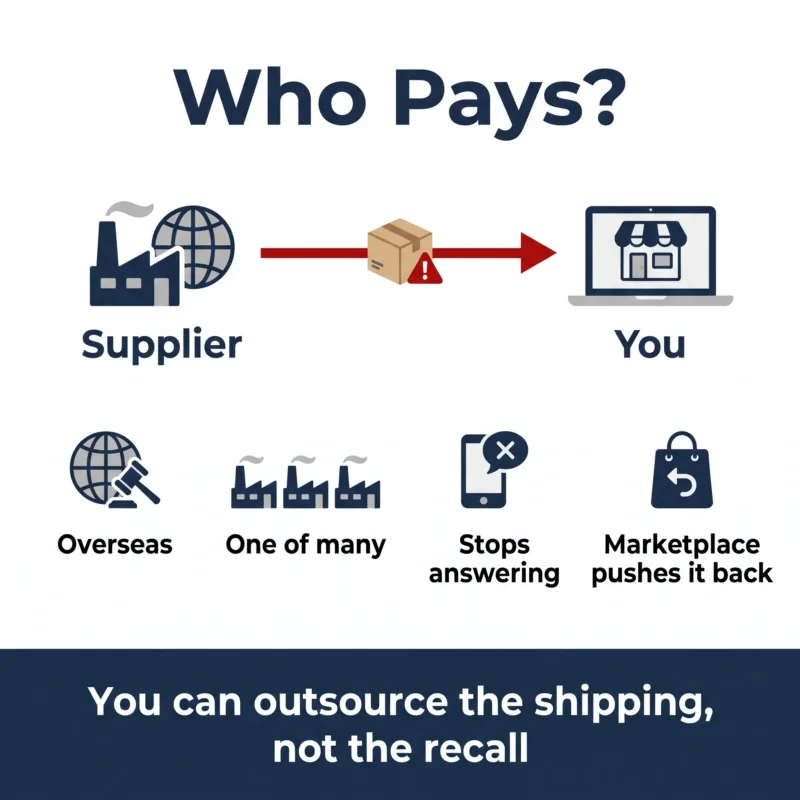
From what I’ve seen, the supplier is rarely the one who pays:
I sum it up for sellers in one line: you can outsource the shipping, not the recall.
What a Recall Costs a Dropshipper
Refunds lead the bill.
In fiscal year 2024 alone, the agency negotiated 333 recalls covering 153 million consumer product units.
For a dropshipper, a recall usually means:
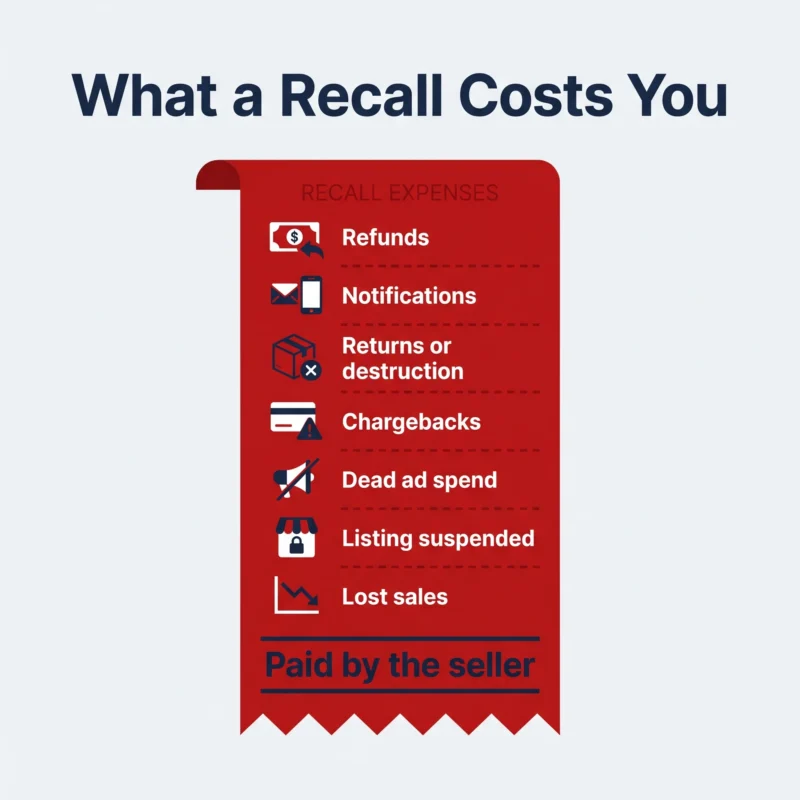
Your total will be smaller, but so is your cushion.
The full picture of what a product recall costs goes well beyond refunds.
Not sure what a recall on your biggest product would cost you? Contact us and we’ll walk through it with you.
Does Product Liability Insurance Cover a Recall?
No. Product liability pays people who are hurt, or whose property is damaged, by something you sold. It does not pay to pull the product, notify buyers or refund them. That gap surprises sellers most when they already carry the policy a marketplace requires. Here is how each option actually compares.
Frankly, most business owners assume they’re basically the same thing with different labels. They’re not.
Resellers carry real product liability exposure for injuries, and that coverage matters. It just answers a different question.
The policy Amazon requires is liability coverage too.
Our e-commerce recall guide explains how that plays out across marketplaces.
Here is the short version for a dropshipper:
Option |
Pays the injured customer |
Pays refunds and notification |
Pays to retrieve or destroy units |
Pays lost income |
Responds when the supplier caused it |
|---|---|---|---|---|---|
|
Product recall insurance |
No |
Yes |
Yes |
Often, as an option |
Yes, if the wording fits |
|
Product liability (including marketplace-required GL) |
Yes |
No |
No |
No |
Yes, for injury claims |
|
Your supplier’s insurance |
Protects the supplier |
Rarely for you |
Rarely |
No |
Only for the supplier |
|
Business interruption on a property policy |
No |
No |
No |
No, a recall isn’t a covered cause |
No |
|
Covering refunds yourself |
No |
You pay |
You pay |
You absorb it |
You absorb it |
What Product Recall Costs Are Covered for a Dropshipper?
Recall insurance covers your own costs to get an unsafe or defective product back from customers: notification, refunds, return shipping, destruction and, with the right option, lost profit. The twist for a dropshipper is that most of those costs look different when you never held the stock. Here is the translation.
Policy cost category |
What it looks like for a dropshipper |
|---|---|
|
Notification |
Emails, texts, site banners, marketplace notices and regulator filings |
|
Customer reimbursement |
Refunds or store credit for affected orders |
|
Retrieval |
Prepaid return labels, or a proof-of-destruction process |
|
Destruction and disposal |
Disposal fees and marketplace removal fees |
|
Replacement |
Shipping a safe replacement where you offer one |
|
Crisis and public relations (PR) |
A consultant and messaging for buyers and platforms |
|
Lost gross profit |
Sales lost while the product is down, usually an optional add-on |
How Product Recall Insurance Works for Dropshippers:
Already carry a policy? Book a 15-minute call and we’ll read the recall wording with you.
Can a Dropshipping Business Get Recall Insurance Without Holding Inventory?
Yes, but not every dropshipper. Insurers write recall coverage for sellers who can show where a product came from, who made it and how they’d pull it back. A store rotating through catalog suppliers with no records usually can’t get there yet. Here is what underwriters look at first, and what to have ready.
Factor |
Why underwriters care |
What to have ready |
|---|---|---|
|
Product category and hazard |
Children’s products, batteries, cosmetics and anything ingested draw the closest review |
A product list with materials, intended users and age grading |
|
Supplier identity and documents |
The insurer needs to know who made it and whether it can recover from them |
Named suppliers, test reports and certificates of compliance |
|
Traceability |
Records that tie orders to a batch keep a recall small |
Order-to-batch records for every product you sell |
|
Written recall plan |
A fast, organized response costs less |
A one-page plan built on the CPSC’s guide on how to conduct a recall |
|
Revenue, channels and loss history |
These size the exposure and set the price |
Sales by channel and three to five years of loss history |
They’re built for sellers past the testing stage.
We are the right fit for established stores doing $100,000 or more a year in sales of physical goods, often under their own brand or with an exclusive supplier.
If you bring goods in under your own name, you’re also the importer of record, and importer insurance covers the rest of that role.
The Coyle Dropship Recall Readiness Checklist
Before we take a dropshipper to market, I want to see these eight things.
Every one you have makes the submission stronger:
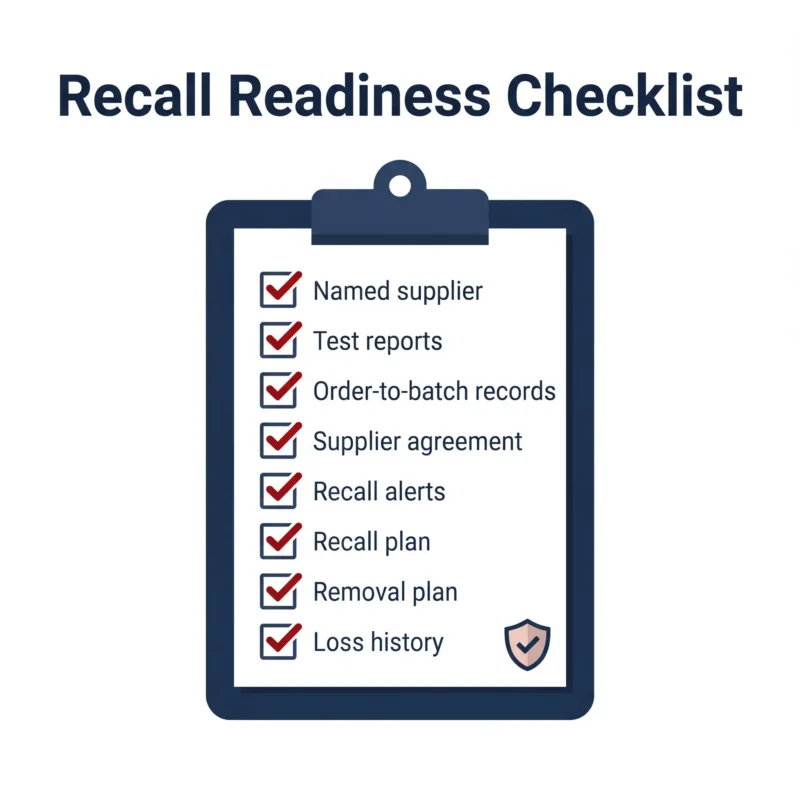
Every time you add a new product line or switch suppliers, run the checklist again.
What Exclusions and Policy Wording Matter Most for Dropshippers?
The possession clause matters most. Some recall forms only cover products that left your care, custody or control, which assumes you once held them. For a seller who never touches the goods, that one definition can decide the whole claim. Four more clauses deserve the same attention, and here is what I check.
For a dropshipper, the recall wording is where I look first:
Many dropshippers buy business insurance online, and those packaged policies usually don’t include recall at all.
Want someone to check those clauses on your current policy? Contact us and we’ll go through them line by line.
What Won’t Recall Insurance Cover?
Recall insurance won’t pay injury claims, defects you knew about before buying the policy, or a pull you make for business reasons rather than safety. Those limits trip up sellers more than the price does. The bigger surprise is how a lack of due diligence on your supplier can sink a claim. Here is the full list.
Usually covered |
Usually excluded |
|---|---|
|
Notification, refunds and return shipping |
Injury and property damage claims (that’s product liability) |
|
Destruction, disposal and replacement |
Defects you knew about before the policy started |
|
Crisis and PR costs |
Pulling a product for business reasons, like a redesign |
|
Lost gross profit, if added |
Deliberate or fraudulent acts by you |
|
Voluntary and regulator-ordered recalls |
Costs you assumed only under a contract, unless added back |
Due diligence is where dropshippers get hurt. What I hear from sellers is that even good insurance won’t help if you can’t show you checked that a product met the rules before you sold it.
That’s why the readiness checklist comes before the quote.
Red Flags in a Dropshipper’s Insurance
If any of these sound familiar, your program needs a look:
Is Product Recall Insurance Worth It for a Dropshipping Business?
It’s worth it when one recall would cost more than your business can absorb, which usually means you sell physical goods with a safety risk at real volume. A store still testing products may be better served by tighter supplier controls for now.
Here is how to tell which side you’re on.
Your situation |
Typical underwriting scrutiny |
What usually makes sense |
|---|---|---|
|
Electronics, batteries and chargers |
High |
Recall coverage alongside product liability |
|
High |
Recall coverage alongside product liability |
|
|
Cosmetics, supplements and anything ingested or applied |
High |
Recall coverage, with documents ready for a closer review |
|
Kitchen, home and pet goods |
Moderate |
Recall coverage once volume is meaningful |
|
Apparel, accessories and low-hazard goods |
Lower |
Product liability plus supplier controls; recall optional |
|
Still testing products at low volume |
Varies |
Supplier vetting, a recall plan and alerts first |
Whichever row you’re in, a few controls help either way: vetted suppliers, a written indemnity, recall alerts for your categories and a one-page plan.
Recall coverage sits on top of those, alongside the rest of your e-commerce business insurance program.
How it plays out
An online store sells a portable phone charger shipped direct from an overseas supplier, about 4,000 units over a year. Reports of overheating come in, and the store announces a voluntary recall. The supplier stops replying. The store refunds every buyer, pays for notification and a proof-of-destruction process, loses its listing for weeks and keeps paying for ads it can’t use. Its liability policy handles one burn claim but pays nothing toward the recall. A recall policy that defined insured products to include goods shipped on the store’s behalf would have paid the refunds, notification, disposal and lost profit, then pursued the supplier under the written agreement the store had on file.
Thinking through which row fits your store? Book a 15-minute call and we’ll place you honestly.
What Drives the Cost of Recall Coverage?
Your product’s hazard, your sales volume and your records drive the price more than anything else. There’s no sticker price, and anyone quoting one without seeing your suppliers is guessing. What surprises sellers is how many of those factors they can actually change. Here is the breakdown.
Cost driver (as of October 2026) |
What pushes the price up |
What brings it down |
|---|---|---|
|
Product type |
Ingestibles, batteries, children’s goods |
Low-hazard goods |
|
Sales and units in market |
More units across more channels |
Fewer channels, smaller batches |
|
Loss and recall history |
Prior recalls or defect claims |
A clean history |
|
Limits and retention |
High limits with a low retention |
Limits sized to your real exposure |
|
Lost profit option |
Adding it |
Leaving it off, if you can absorb it |
|
Controls and documents |
No records, no recall plan |
Traceability, test reports and a written plan |
Pricing depends on underwriting, so a real number for product recall insurance for dropshipping businesses takes a real submission.
The last row is the one you control most.
When we’ve helped sellers organize their supplier records before going to market, the conversation with insurers changes.
How We Review a Dropshipper’s Coverage Before Anything Goes to Market
We start with a confidential review, not a quote. We read what you already carry, check what your suppliers can document, and only then approach insurers that fit. That order matters more for dropshippers than almost anyone, because a weak first submission can get you declined. Here is how it works.
Our Confidential Review follows two paths:
Either way, our process for product recall insurance for dropshipping businesses is the same:
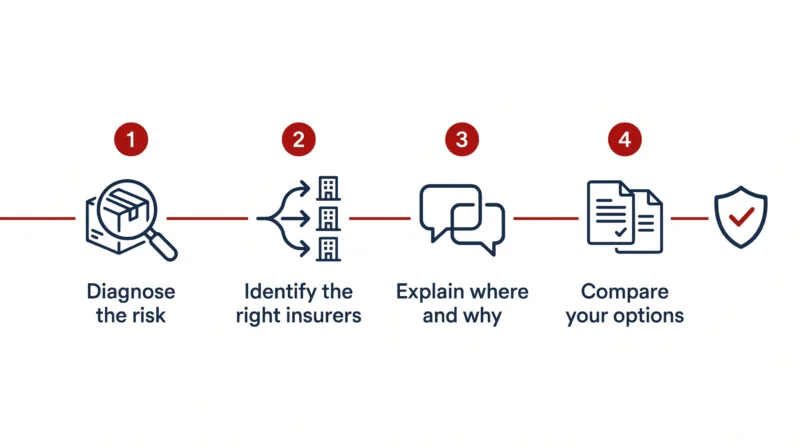
For you, that means fewer applications, no duplicate requests and one point of contact.
We return calls and emails within one business day.
What About Getting Quotes From Several Brokers?
Comparing options is smart. The trouble is how it usually happens.
When several brokers send the same account out, the same few recall insurers see duplicate submissions, and a generalist can misclassify a dropshipper as a simple online retailer. You answer the same questions three times and still end up with a price-only comparison.
Who This Isn’t Right For
If you’re still testing your first products, supplier controls and a basic liability policy may serve you better for now, and I’ll say so. And if the plan is to put three brokers in a race, we’re not the right fit.
Questions about Product Recall Insurance For Dropshipping Businesses?
Build Recall Coverage for the Products You Never Touch
When a supplier ships your product, your insurance has to be built around that fact: the supplier, the records and the store with your name on it. That’s the difference between being covered and being adequately covered. It shows up when a batch fails, when a marketplace pulls your listing, and when your supplier stops answering.
Our family has been in the insurance business since 1929, and we only do business insurance. We’re independent, not captive to any carrier. We review contracts before you sign, start renewals 90 to 120 days out and re-underwrite your business every year, which matters every time you add a product or a supplier. You don’t need five brokers shopping your insurance. You need one capable broker making sure the right insurers compete for your business.
The first step costs nothing and doesn’t disrupt your current broker. We put your liability policy, your recall coverage and your supplier records side by side, then tell you what’s working, what’s missing and what I’d change.
Book a 15-minute call. If your program is solid, I’ll tell you that too.

This article was written by the CEO of The Coyle Group, Gordon B. Coyle, CPCU, ARM, AMIM, PWCA, who has over 40 years of experience working with business owners of all sizes and industries across the US, solving their insurance challenges.
Here’s how to take the next step
Schedule Your Insurance Confidence Assessment
In our 30-minute call, you’ll discover:
Not ready for a call?
Get Free Access to Our Gated Video:
“How to Finally Feel Confident in Your Coverage. “
And discover the exact system we use to help business owners eliminate hidden coverage gaps, stop overpaying, and finally feel confident in their protection.
What Peace of Mind Looks Like
Trusted by business owners across the U.S.
The Coyle Group is 1st class! Gordon and his team are knowledgeable, responsive, and attentive to detail. Gordon is that rare breed of professional who genuinely cares for his clients and works hard to exceed their expectations. I highly recommend them.


The insurance brokerage service was truly tailored to my needs, nothing like those big brokers who steer you toward random policies that don’t fit your profile. Thank you to the team for your help.

I was working with another broker and having difficulty acquiring General Liability coverage. A colleague recommended The Coyle Group. They were able to get coverage bound in just a couple of business days and a policy issued in ten days, and with a solid carrier at a competitive premium. Truly impressive results, plus it was a pleasure working with them. I highly recommend the Coyle Group!

If any business is looking to work with an insurance brokerage firm that is not only excellent at what the firm does, but one that deeply values the needs of the clients, then The Coyle Group is the firm for you. Give them a call and see for yourself. I can assure that you will quickly agree.

Want to know more?
See related blogs

Product Liability Insurance for Importers: What You Need to Know (Video)
How to Protect Your Business From a Product Recall
The Boar’s Head Product Recall – What’s Insured?
